|
Culture and Art
Reference:
Budkin , P.V., Borevich, E.V., Voronova , A.V., Yanchus, V.E. (2026). The study of visual appeal of animation frame by oculography methods. Culture and Art, 2, 139–151. https://doi.org/10.7256/2454-0625.2026.2.73819
The study of visual appeal of animation frame by oculography methods
Budkin Pavel Vladimirovich
ORCID: 0009-0000-1579-8455
Student; Civil Engineering Institute; Peter the Great St. Petersburg Polytechnic University
195251, Russia, St. Petersburg, Kalininsky district, Politechnicheskaya str., 29 letter B

|
pavelbudkin@gmail.com
|
|
 |
Other publications by this author
|
|
Borevich Ekaterina Vladislavovna
ORCID: 0000-0001-6263-3901
Senior Lecturer; Department of Higher School of Design and Architecture; Peter the Great St. Petersburg Polytechnic University
195251, Russia, Saint Petersburg region, Saint Petersburg, Politechnicheskaya str., 29
|
|
plasma5210@mail.ru
|
|
 |
Other publications by this author
|
|
Voronova Anastasiya Viktorovna
ORCID: 0009-0007-7709-3259
Associate Professor; Department of Computer Graphics and Design; St. Petersburg State Institute of Cinema and Television
191119, Russia, St. Petersburg, Central district, Pravdy St., 13
|
|
a-voron5@mail.ru
|
|
 |
|
Yanchus Viktor Edmundasovich
ORCID: 0000-0001-7220-0819
PhD in Technical Science
Associate Professor; Institute of Civil Engineering; Peter the Great St. Petersburg Polytechnic University
195251, Russia, St. Petersburg, Kalininsky district, Politechnicheskaya str., 29 letter B
|
|
victorimop@mail.ru
|
|
 |
|
DOI: 10.7256/2454-0625.2026.2.73819
EDN:
NZOSHL
Received:
03/24/2025
Published:
03/03/2026
Abstract: The study aimed at formalizing the animated elements and identifying perception dependencies on the frame elements. The properties of an animated frame is systematized. The influence of three factors is considered: composition, color scheme and stylization. The goal of the work is to establish how the animated frame elements effect of the information perception by the viewer. The object of the study is an animation frame. The subject of the study is graphic means of creating an animation frame. The author determined the most effective solutions for interaction with the viewer who watching a cartoon. The methodology for conducting the experiment using the eye tracking technology of differences in visual perception of animated frames with different properties is described. To conduct the experiment, appropriate stimulus material was developed. The task was formulated for the observers, which they solved during the experiment. When processing the data obtained during the experiment, statistical multivariate analysis of variance (ANOVA) was used. The 40 observers took part in the experiment. Based on the obtained data, graphs of the dependence of viewing parameters on the properties of frame elements were constructed, which are presented in the article. The results of experiment showed that composition affects the speed of information perception and the length of the gaze path depends on the color scheme, composition, and stylization. The results can be used in the development of animated frames. The novelty of the work lies in the complex analysis of the elements of the animation frame and identifying the influence of the elements of the frame on its visual appeal. Similar studies of the animated frame have not been conducted to date. This is actual for creating an expressive animation frames and immersing the viewer in the atmosphere of the cartoon.
Keywords:
Artistic space, animation space, expressiveness of an animation frame, oculography methods, experimental research, eye-tracking technology, animation, color scheme, composition, stylization
This article is automatically translated.
Introduction The state of modern culture, which is defined by many researchers as a "visual turn", actualizes any research in the field of humanitarian knowledge that is related to all visual, i.e. visible aspects. In their works, A. Brudny and Y. Lotman note that linguistic discourses give way to visual media, which means, as O.V.Gorbatova points out, "... the dominance of the gaze sets a special vector for understanding cultural texts" [1]. In the context of the shift of emphasis on visuality in modern culture, one of the most important competencies of a modern person is the ability to "see". Accordingly, researchers face a set of tasks related to the technology of visual perception awareness. The screen arts and visual culture samples that exist within this framework provide ample opportunities for various kinds of research and experimentation. It should be noted that animation studios have been updated in the last decade. This is primarily due to the growth of the animation industry in our country, which is developing quite successfully in commercial and authorial areas. Various issues and problems of animation from the perspective of cultural studies and art criticism are revealed in the research of N.Krivuli, G.Ermilova, G.Gwon E.A., N.A. Moshkov, V.M.Monetov, T.P. Rylskaya, A.Ya.Zaitsev and others. In the context of the conducted research and experiment, the publications of Volkova, N.P. Kolyadenko, and I.N. Lisakovsky are of interest, which define the synthesis of arts characteristic of animation as "a combination of artistic means of various types of art in creating an integral work, with a single system of artistic imagery, united by a common idea, style, and execution." In addition, it is important to study the artistic and figurative means used in animation and the features of creating an artistic space, which are reflected in their works by I.P. Ivanov-Vano, Yu.B. Norstein, A.Y. Khrzhanovsky, F.S. Khitruk, S.Asenin. Thus, taking into account the development of visual culture and the growing interest in any issues related to animation theory, any research in this field can be considered relevant. The scientific novelty of the study is that it examines the influence of the conditional coordinates of the animation space on the expressiveness of the frame through experimental research. To date, no research has been conducted on the influence of artistic means on the viewer's perception of an animated frame. And the studies indirectly devoted to a similar problem relate exclusively to theoretical aspects: types and techniques of space modeling in animation [2] or the influence of technological advances on the evolution of artistic imagery in an animated film [3]. The theoretical part Yu. Lotman proposed the concept of art space as an integral universe in which the language of art space is not a hollow vessel, but one of the components of the common language spoken by the artwork [4]. A. G. Spirkin says that space "is a form of coordination of existing objects, states of matter. It consists in the fact that objects are located outside of each other and are in certain quantitative relationships. The order of the coexistence of these objects and their states forms the structure of space" [5]. In turn, Voronova A.V. identifies animation space as an entity that has its own distinctive features, among others, in terms of information saturation [6]. The active introduction of computer technology into animation has influenced the development of expressive means and the emergence of new techniques for modeling animation space [7]. The expressiveness of an animation frame is the result of the work of an animator and is a cumulative property of the frame elements (Fig. 1). The frame created by the artist is a "visualization" of the designed animation space. Therefore, the conditional coordinates of the animation space are correlated with the elements of the animation frame. To study the influence of animation frame elements on its perception by the viewer, it is advisable to use oculography methods and eytracing technology, which have shown their validity in studying the influence of the color scheme of a movie frame on its perception by the viewer [8]. To conduct the experiment, we will determine the research factors that correspond to the conditional coordinates of the animation space (Fig.1)

Fig. 1. Diagram of the animation frame structure
The object of the study is an animation frame. The subject of the research is graphic means of creating an animation frame. The purpose of the work is to identify the influence of the conditional coordinates of the animation space on the expressiveness of the frame.
Setting up an experiment The purpose of this experiment is to study the influence of animation frame elements (composition, style, color scheme) on the viewer's perception of it. The experimental methodology includes the development of appropriate stimulus material, setting tasks for the subjects during the experiment, and statistical processing of parametric data obtained during the experiment. The experiment was carried out using oculography methods using oculomotor activity fixation equipment – the SMI RED 250 eytracing software and hardware complex [9, 10].
To conduct the experiment, the research factors were identified, which are identified with the conditional coordinates of the animation space.: - the composition factor; - the stylization factor; - the color scheme factor. These factors in the experiment take the following values:: - the color scheme is based on two color schemes – complementary contrast and triple contrast [11]; - compositional solutions are distinguished according to three basic principles – an object on the background, two equivalent objects, the main object and an explicit subject; - stylization of the frame – minimalism and highly detailed image. In accordance with certain factors, the incentive material was developed. For the stimulus materials, frames from existing hand-drawn animated films satisfying the experimental conditions were used. The frames with suitable compositional solutions were selected. The color schemes in the frames have been edited in accordance with the task. The stimuli were also divided into two groups according to the stylization – with high detail and in a minimalistic style. All images have been cropped to 16:9 format (1920:1080 pixels). A total of 36 incentives have been prepared. Examples of stimuli with a change in the composition factor are shown in Figure 2: one object – Figure 2 (a), two objects – Figure 2(b), object-subject – Figure 2(c).
a  b b  c c Fig.2. Examples of stimuli with a change in the composition factor: a) one object - the film "The Whisper of the Heart" dir. Yoshifumi Kondo (1995) b) two objects - the film "Ponyo Fish on the Cliff" (2008) dir. Hayao Miyazaki, c) object-subject - the film "Mukha Tsokotukha" dir. Boris Stepantsev (1976)
Examples of stimuli with a change in the color scheme factor are shown in Figure 3: complementary color scheme – Figure 3 (a), triadic color scheme – Figure 3(b).
a 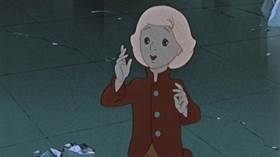 b b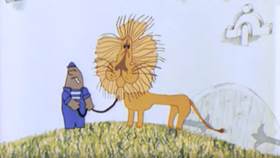 Fig.3. Examples of stimuli with a change in the color scheme factor: a) complementary color scheme - the film "The Snow Queen" dir. Lev Atamanov (1959); b) triadic color scheme - frame film "Film, Film, Film" dir. Fyodor Khitruk (1968)
Examples of stimuli with a change in the stylization factor are shown in Figure 4. The stimuli were selected according to their style – with high detail (Fig. 4 (a)) and in a minimalistic style (Fig. 4(b)). High-detail stimuli imply highly detailed backgrounds and contrasting characters. Minimalistic ones consist of non-detailed backgrounds, sometimes monochrome textured fills with stylized characters.
a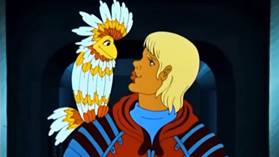 b b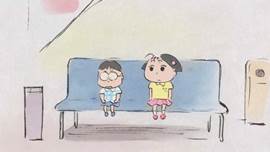 Fig. 4. Examples of incentives with a change in the stylization factor: a) high degree of detail - a frame from the cartoon "The Secret of the Third Planet" dir. Roman Kachanov (1981), b) minimalism - a shot from the animated film "Our neighbors Yamada" dir. Isao Takahata (1999)
The methodology of the experiment
Before starting the experiment, a conversation was held with the subject, during which his actions during the experiment were explained in detail to him. The task for the subject was to memorize and recognize images (stimuli of the experiment). The computer chair was adjusted individually for each subject. In the room where the experiment was conducted, the number of distractions was minimized: no extraneous sounds, neutral lighting design of the laboratory. The experiment consisted of two stages. At the first stage of the experiment, the respondent was shown 12 stimuli on a monitor, with a combination of the corresponding factors (Fig.2,3,4). The subject had a task: to memorize the demonstrated images. The subject determined the time to solve the problem independently: the respondent looked at the images displayed by the program in random order, independently switching to the next stimulus as the task was completed. At the end of the first stage of the experiment, a time interval of 30 minutes was set for each respondent before proceeding to the second part of the experiment. In the second stage, 24 more stimuli were added to the stimulus material, created according to the same principles as the stimuli in the first stage. The stimulus material was reproduced on the screen of the laboratory setup in a random order. The respondent had to solve the problem: did he or she see this stimulus at the first stage of the experiment and answer "yes" or "no". When demonstrating a stimulus, the subject solved the problem of the experiment, after which he independently moved on to the next stimulus. The experiment involved 40 subjects between the ages of 18 and 25 from among students studying at Peter the Great St. Petersburg Polytechnic University. A total of 8,460 fixations and 7862 saccades were collected.
Analysis of the experimental results The obtained parametric data of the template for viewing the stimulus material were processed using ANOVA analysis of variance [12] in a specialized software package "Statistics". The significance level of the p-value parameter was set at 0.05. Variables on graphs, composition (Com): - sinO – one object – background; - duoO – two equivalent objects; - subO – object and subject. Color scheme (color): - color dual – complementary contrast; - color trio – a triad (contrast of three colors). Stylization (Style): - kon – high detail; - min – minimalism. When analyzing the sample of data obtained at the second stage of the experiment, a statistically significant influence of the composition factor on the viewing time of the frame by the viewer (Time, ms) was revealed. It also revealed a statistically significant influence of the factors of color scheme, composition and stylization on the parameter of the length of the path traveled by the viewer's gaze when viewing the frame (Scanpath Length [px]). The results of the ANOVA program procedure with calculated p-value values for the user's time and path parameters are shown in Table 1.
Table 1. The p-value values obtained as a result of executing the ANOVA program procedure for the viewing time parameter (Time) and the user path parameter (Scanpath Length). | The factor | the p-value of the Time parameter | the p-value of the Scanpath Length parameter |
| Color scheme (Color) | 0,755 | ≤ 0,001 | | Composition (Comp) | 0,008 | 0,007 | | Stylization (Style) | 0,720 | ≤ 0,001 |
The hypothesis acceptance coefficient is 0.05, which means that if the p-value is less than 0.05, then there is a statistically significant influence of the factor on the parameter, and if it is more than 0.05, then no influence was detected in this experiment. As we can see in Table 1, for the factors of color and stylization, the p-value for the frame viewing time parameter is greater than 0.05, which means that no influence was detected. However, for the composition factor, as mentioned above, the influence on the time parameter is statistically significant, as well as the influence of all three factors on the parameter of the length of the viewer's gaze path. Frames with a single object–background compositional structure take less time to examine than frames with two objects (Fig.5).
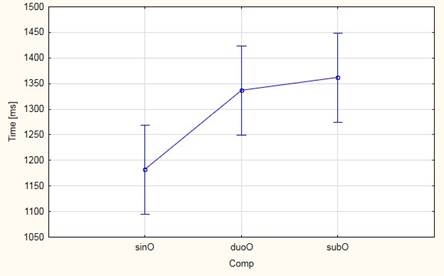
5. The distribution of the values of the time of viewing the stimulus at the second stage of the experiment (the frame recognition stage), depending on the composition.
The effect of the color scheme and stylization of the frame on the viewing time parameter of the animation frame was not revealed. The length of the gaze path depends on the color scheme, composition, and stylization. With the complementary color scheme (dual), the length of the gaze path is shorter than with the triad (trio) (Fig.6).
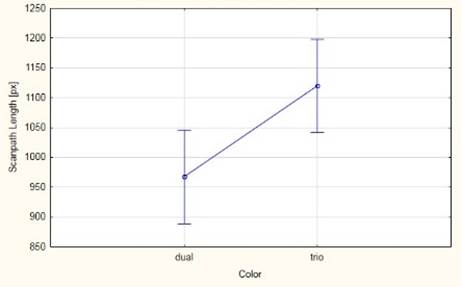
6. The distribution of the values of the length of the path traveled by the viewer's gaze when viewing the frame at the second stage of the experiment (the frame recognition stage), depending on the color scheme.
In frames where two equivalent objects (duoO) are arranged, the user's gaze path is longer than in frames with one object (sinO) and than in frames with an object-subject composition (subO) (Fig. 7).
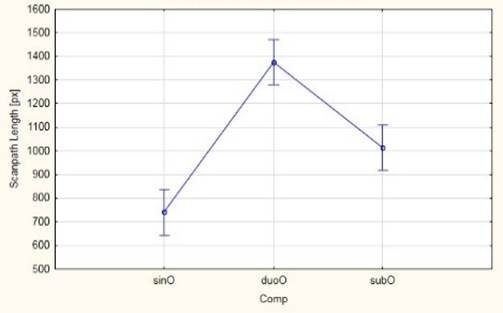
7. The distribution of the values of the length of the path traveled by the viewer's gaze when viewing the frame at the second stage of the experiment (the frame recognition stage), depending on the composition.
The minimalistic stylization in the frame (min) corresponds to a longer user path than the detailed stylization (kon) (Fig.8). 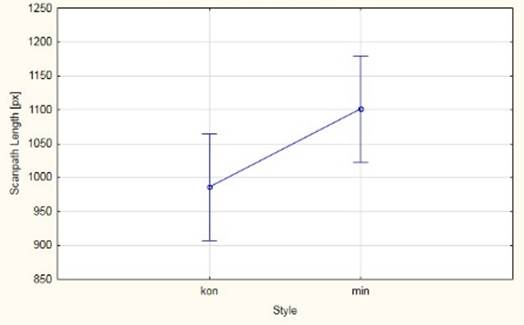
Figure 8. Distribution of the values of the length of the path traveled by the viewer's gaze when viewing a frame at the second stage of the experiment (the frame recognition stage), depending on the stylization.
The graph of the time values for viewing the stimulus at the second stage (the frame recognition stage), depending on the composition and color scheme, is shown in Figure 9.
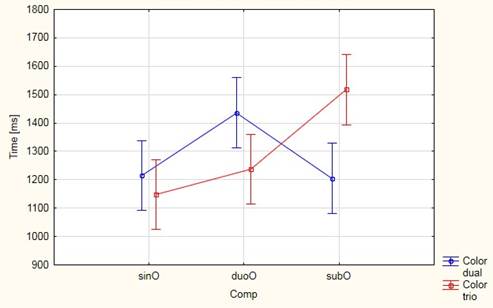
9. The distribution of the values of the time of viewing the stimulus at the second stage of the experiment (the frame recognition stage), depending on the composition and color scheme.
In this graph, one can observe a statistically significant influence of the composition factor in the stimulus in combination with the color solution factor. The difference in the speed of frame interpretation in the object-subject (subO) composition with triadic color contrast is highlighted.
Conclusions The developed methodology for conducting an experimental study of the influence of animation frame elements by the viewer has shown its relevance and allowed us to obtain some results. The novelty of the work lies in a comprehensive analysis of the elements of the animation frame and their effect on the expressiveness of the animation frame. The systematization of animation frame elements is proposed. The method of conducting an experiment using eytracing technology for an objective assessment of differences in visual perception of frames with different properties is described. The appropriate incentive material has been developed. The task that they solved during the experiment is formulated for the subjects. Statistical multifactorial analysis of variance (ANOVA) was used in data processing. An experiment was conducted. During the experiment, the influence of three factors was considered: composition, color scheme and stylization. The results showed that the composition of the animation frame has a statistically significant effect on the viewer's perception of the frame. The simplest composition is an image of an object on a simple background. A more complex composition is "two equivalent objects" and "object-subject". Such frames require more detailed study and have a greater potential for expressing the author's idea. In animated frames with a triadic color scheme, the length of the viewer's gaze is longer than in a complementary one. As for viewing time, in the "object-subject" shots, the triadic color scheme attracts the viewer's attention longer than a complementary one with a similar composition. In frames made in the minimalist style, the length of the viewer's gaze is longer than in highly detailed frames. The results obtained can be used in the development of animation frames. The application of the research results will allow the artist to control the duration of the frame when designing it. The results of the study show that the choice of composition and frame affects the speed of perception of the frame by the viewer, as well as the color scheme, composition and stylization affect the length of the viewer's gaze, which is important for creating an expressive animation frame and immersing the viewer in the atmosphere of the cartoon.
The article is published in the version approved by the reviewers (after receiving a positive review recommending the manuscript for publication) with corrections made by the author (after receiving the editor’s comments, if any).
Read all reviews on this article
References
1. Gorbatova, O. V. (2017). Dialogue in the space of visual culture (based on animation and cinematography): Abstract of the dissertation for the degree of candidate of cultural studies: specialty 24.00.01 [Defense location: Mordovian State University named after N.P. Ogaryov].
2. Trapeznikova, E. V. (2015). Evolution of the image of artistic space in Russian animation: 1985–2014: Abstract of the dissertation for the degree of candidate of art studies: 17.00.03 [Defense location: All-Russian State University of Cinematography named after S.A. Gerasimov].
3. Popov, E. A. (2011). Animated work: typology and evolution of figurative means: Abstract of the dissertation for the degree of candidate of art studies: 17.00.09 [Defense location: St. Petersburg State University of Economics and Finance].
4. Lotman, Y. M. (1992). Articles on semiotics and typology of culture. In Selected articles in 3 volumes (Vol. 1).
5. Spirkin, A. G. (2008). Philosophy (2nd ed.).
6. Voronova, A. V. (2008). Information saturation of the animation space. In Animation in the Era of Innovative Transformations: Materials of the IV International Scientific and Practical Conference "Animation as a Phenomenon of Culture" (pp. 211-216).
7. Trapeznikova, E. V. (2013). Features of conceptual flash animation. Bulletin of VGIK, 15, 30-41.
8. Yanchus, V. E., & Borevich, E. V. (2016). Study of the significance of color solutions in the process of harmonizing the film frame. Scientific and Technical Bulletin of St. Petersburg State Polytechnic University. Computer Science. Telecommunications. Management, 4, 53-68. https://doi.org/10.5862/JCSTCS.252.5
9. Orlov, P. A., Laptev, V. V., & Ivanov, V. M. (2014). On the application of eye-tracking systems. Informatics, Telecommunications and Management, 5, 82-92.
10. New Style. (n.d.). RED 250 / RED 500 remote eye tracking system. Retrieved March 21, 2024, from https://newstyle-y.ru/high-school/group_2164/group_2166/item_11065/
11. Itten, J. (2007). The art of color.
12. Sheffe, G. (1980). Analysis of variance.
Peer Review
Peer reviewers' evaluations remain confidential and are not disclosed to the public. Only external reviews, authorized for publication by the article's author(s), are made public. Typically, these final reviews are conducted after the manuscript's revision. Adhering to our double-blind review policy, the reviewer's identity is kept confidential.
The list of publisher reviewers can be found here.
The reviewed text "The study of the expressiveness of an animated frame by oculography methods" is a competent interdisciplinary study on a topical topic; the author tries to identify the peculiarities of the viewer's perception of the subject of visual culture by analyzing the influence of conditional coordinates of the animation space on the expressiveness of the frame. The research material is data obtained experimentally. Thus, the author addresses several issues: the cultural problem of the specifics of the visual art space, the consideration of the technical components of animated cinema, the potential of eytracing (oculography) in the study of the degree of perception of visual objects, the possibilities of computer technology in solving artistic problems in the field of visual arts and, to a certain extent, to identify the specifics of the visual space of specific animated works, selected by the author for the experiment. The research is thus initially focused on the practical field of application. The theoretical basis of the author's research is a set of publications on visual culture, specific features of animated films, the concept of "artistic space", etc. Based on the theoretical foundation, the author defines the animation frame as the object of research, and the purpose of the work is to identify the influence of the conditional coordinates of the animation space on the expressiveness of the frame. The goal is solved by analyzing the data obtained during a fairly large-scale (40 participants in the experiment and more than 8000 visual fixations) and well-thought-out experiment. The author explains in detail the criteria for selecting visual material for the experiment, its methodology, conduct and processing of the data obtained. As visual stimuli for the participants of the experiment, frames from classical Soviet and Japanese animation were selected, they are divided into three categories according to the number of objects in the frame, according to the characteristics of the color scheme, and according to general style characteristics. The results of data processing are clearly presented in the form of tables and graphs. The work as a whole is characterized by a well-thought-out structure, consistency and logic in the presentation of the material, visual accompaniment corresponding to the sections of the work, etc. The experimental results allow the author to assert that "the composition of an animation frame has a statistically significant effect on the viewer's perception of the frame.... A triadic color scheme takes longer to attract the viewer's attention than a complementary one with a similar composition," etc. The results obtained have not only theoretical significance (the mechanism of perception of a visual object), but also practical (recommendations for animation artists when creating animated works), the author's method of using oculography (eytracing) also deserves attention. The shortcomings of the work include the lack of explanations of some technical terms used by the author when describing the experiment and analyzing the data obtained during the experiment. In general, the work is carried out at a high scientific and methodological level, has practical significance and is recommended for publication.
|





 © 1998 – 2026 Nota Bene. Publishing Technologies. NB-Media Ltd.


