|
DOI: 10.7256/2454-0749.2025.11.76583
EDN:
JMGQHV
Received:
11/01/2025
Published:
12/04/2025
Abstract: The subject of the study is the dynamic evolution of Chinese mythology, viewed through the prism of Bakhtin's theory. The authors of the article explore the mythology of China from the forms of primitive beliefs to modern film and television adaptations, revealing its cultural essence as "scenes of eternal dialogue." The key historical stages of the development of Chinese mythology are analyzed: the polyphonic narratives of the axial epoch, in which figures such as Dayu were reinterpreted by various philosophical schools.; dialogue and mutual construction of religious and secular discourses, as exemplified by the figure of Guan Yu, from the Wei, Jin, Tang and Song dynasties; ongoing dialogue between officials and people, sacred and secular, historical and modern, embodied in the literature of the Ming and Qing times about the "Dedication of the Gods"; visual narrative construction of the "chronotope", embodied in the modern digital game "Black Myth: Wukong". This study provides methodological support for the creative transformation of modern mythology, answers the question of national cultural identity in the context of globalization, and provides an important theoretical framework for exploring the possibility of multicultural identity. The research methodology is based on Bakhtin's "theory of dialogism", rethinks the evolutionary logic of Chinese mythology, and argues that this process is essentially a continuous negotiation between a variety of discourses: official narratives, folk interpretations, philosophical borrowings, and intercultural exchanges. The research expands the scope of carnival poetics and the concept of "chronotope" from literary criticism to mythological research. The scientific novelty of the research lies in the application of Bakhtin's key concepts to the process of the evolution of Chinese mythology as a cultural phenomenon rather than a literary text. This research approach translates the trajectory of literary analysis into the field of cross-cultural research and mythology. The authors of the article offer a new perspective on the study of Chinese mythology as a process of continuous discourse (historical and philosophical, folk and official, secular and religious, modern and traditional). The conclusion reached by the authors of the study is as follows: the essence of Chinese mythology lies in the transformational dynamics throughout the historical stage: cultural mythological archetypes continue to be transmitted through new forms of communication, including digital ones, responding to the global challenges of modernity and trends towards interdisciplinarity.
Keywords:
China, Bakhtin, mythology, transformation, dialogue, image, adaptation, reconstruction, interpretation, communication
This article is automatically translated.
Introduction In the late 1950s, E. M. Kozhinov systematized the unpublished scientific manuscripts and notes of Bakhtin and for the first time revealed the basic principles of his linguistic and aesthetic research, noting the completeness of Bakhtin's ideological system [4]. In the 1960s, Julia Kristeva, a French semiotic specialist, published a book called Semiotics: Studies in the Field of Sign Analysis, in which she first introduced Bakhtin's theory of dialogism and carnival poetics to the French academic community and included it in the discussion between structuralism and poststructuralism [5]. This event contributed to the popularization and integration of Bakhtin's approach into Western theories; his concepts were used in various studies in the field of literary theory, philosophical anthropology and cultural studies, which eventually consolidated his academic status as an important thinker and literary theorist of the 20th century. The philosophical cornerstone of Bakhtin's system of thought, “dialogism”, is the main logic of his linguistic, poetic and philosophical research [12, pp. 151-155]. He defines “dialogism" as the ontological characteristics of human consciousness and the existence of language, emphasizing that meaning is generated in the eternal interaction of various subjects, various discourses and various cultural forms. In this study, the theory of “dialogism” acts as a conceptual tool for studying Chinese mythological narratives that transcend disciplinary boundaries: Chinese mythology has evolved over thousands of years, from the primitive symbols of the “Classics of Mountains and Seas” to the visual reconstruction of modern cinema and television. Chinese mythology has always been at the center of attention and acted as a synergy of many discourses: a dialogue between primitive totems and historical rationality, a game between official narratives and folk legends, intertextuality between local traditions and world culture. The modern research approach to the study of Chinese mythology is based on such key concepts as “incompleteness”, “external perspective” and “carnival activity”, actualizing the historical dimension of mythological research, providing a reliable theoretical basis for the modern transformation of traditional narrative texts and demonstrating the flexibility of interpretation and the viability of classical ideas in diverse cultural contexts. 1. The study of the mythological text and Bakhtin's theory 1.1 Dialogicity: individuality and consistency of mythological images In Dostoevsky's Problems of Poetics, Bakhtin elevated dialogism to the level of ontology and proposed "existence as dialogism", emphasizing multilevel dialogical relationships within the text, including the interaction of various subjects of discourse and the coordination of historical and current meanings [1]. In the Chinese mythological system, mythological images do not exist in isolation, but establish their meanings through intertextual connections between various mythological texts. The image of Nuwa with a “human head and the body of a snake” (Classics of mountains and seas, classics of the Great Wild West) forms the “duality of creation” with Fuxi in primitive beliefs [2, pp. 191-201]. His narrative function - “the restoration of heaven” and “the creation of humans" - is essentially a holistic explanation of the natural order of things and the origin of humanity from its ancestors. At the same time, subsequent generations realized the dialogue between mythological prototype texts through reconstruction. 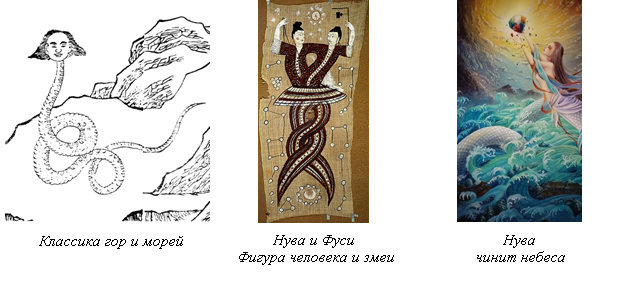
Figure 1. Nuva's Image The Han dynasty of Huainanzi included Nuwa in the cosmology of ”Yin-Yang and the five elements“, making her the guardian of order, who "purified the five-colored stones to repair the heavens", forming a historical unification of myths through the discourse of power (Fig. 1). The semantic boundaries of Chinese mythological images were constantly expanding when discourses collided in different eras. 1.2 Polyphonic narration: the meaning of myth and polyphony Bakhtin argued that the essence of polyphonic novels lies in “a multitude of independent and non-integrated voices and consciousnesses, in true polyphony consisting of full-fledged different voices [1]. The polyphonic character of Chinese mythology is reflected in the coexistence of different interpretations of Confucianism, Buddhism and Taoism. The story of how Mulian saved his mother was first described in the Ullambana Sutra of the Buddha, which was brought to China from India during the early Han Dynasty. Later, in the process of localization in China, the Indian Buddhist concept of reincarnation was integrated into the Taoist concept of hell and the Confucian ethics of filial piety [3, pp. 42-51]. 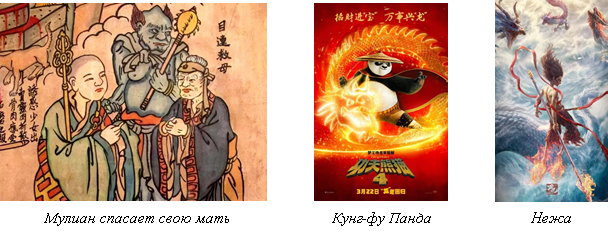
Figure 2. Transformation of images
The Kung Fu Panda film series transformed Chinese symbols such as “dragon" and “phoenix" into symbols of Western personal heroism, while "Nezha: The Devil's Child Comes to this World“ became a response to Hollywood narratives with the local discourse "my fate is determined by myself, not God.” [9, pp. 73-76]. Such an intercultural dialogue is not a confrontation, but what Bakhtin calls “heteroglossia”, the achievement of a temporary consensus on the universal theme of various cultural voices, demonstrating the polyphonic potential of myth as a “cultural environment” (Fig. 2). 1.3 Carnivalization: the restoration of order and the destruction of the sacred Carnival theory interprets carnival as a symbolic phenomenon of resistance to power. Through verbal play, role exchange, and other forms, he uses the “crowned-debunked” ritual to undermine hierarchical order and reconstruct the discourse of equality [11]. Carnival expression in Chinese mythology is concentrated in the dissolution of the sacred in folk narratives. In Journey to the West, Sun Wukong steals peaches, forges the book of Life and death, calls the Jade Emperor the “old emperor,” and riots in the Heavenly Palace, which is a “carnival-style utopia,” using verbal abuse and physical violence to “overthrow” the authority over the heavenly world. More symbolically, Sun Wukong, the “Great Sage Equal to Heaven,“ asks the Jade Emperor to "allow me, the Great Sage Equal to Heaven, to live in this Heavenly Palace" (chapter 4) [15, pp. 171-185].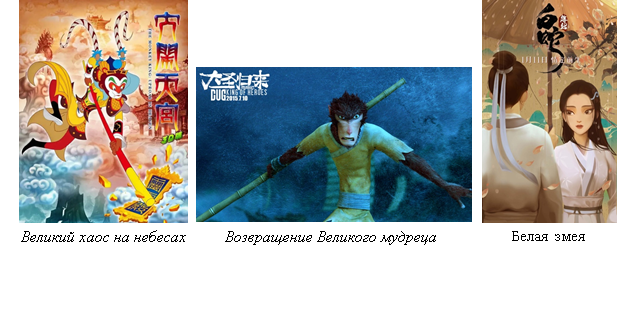 Figure 3. Modern film and television adaptations of mythology This “crown” behavior, in fact, consists in opposing oneself to the supreme power and creating a carnival space of “equality of all beings.” Modern film and television adaptations of mythology emphasize “desacralization.” In “The Return of the Great Sage”, the Monkey King loses his “Great Sage” aura and becomes a “disappointed hero” infected with the spirit of the market; “White Snake: Origin” transforms the White Snake from a “demon under the Leifeng Pagoda” into an ordinary woman striving for true love [8, pp. 62-68]. The carnival strategy of “falling and rising” eliminates the transcendent attributes of mythology and allows it to enter the secular emotional space (Fig. 3). 1.4 Time and space: reconciliation of historical and modern values In 1937, Bakhtin first proposed the concept of the “chronotope” in his work “The temporal form and the Spatiotemporal form of the Novel,” suggesting that “as a cognitive whole, temporal and spatial relations are organically integrated into the literary text.” The time sign should be displayed in space, and space is understood and measured through time [7, pp. 30-33]. From ancient Greek epics to realistic novels, the chronotope has undergone a transformation from the abstract to the concrete, from public to private space, and reflects the influence of social culture in different periods on the concept of time and space. In “The Records of the Great Historian: the Main Chronicles of the Five Emperors” Sima Qian included mythological figures such as Huangdi, Yao, and Shun in linear time frames such as “Huangdi died and was buried in Qiaoshan” and "Yao was in power for 70 years and defeated Shun." In cosmology, he constructed a geographical coordinate system according to which “Huangdi lived on Xuanyuan Hill and married Xiling's daughter" [3, pp. 42-51]. By comparing mythological events with the change of dynasties and specific geographical spaces, he created a unified ideology and transformed mythological characters from transcendent gods into historical monarchs who can be confirmed. 2. Primitive faith: the creation of sacred images in a chaotic space and time. Bakhtin noted that true artistic texts are “unfinished”, and their meaning is always open, awaiting the constant intervention of later interpretations [1]. The Taotie pattern on bronze products of the Shang Dynasty symbolized “divine power” in the Shang Dynasty, but gradually turned into a moral symbol of the warning to “avoid greed” in the Zhou Dynasty [10, pp. 83-92]. The meaning of the totem's divinity is not fixed in a single text, but is constantly being rebuilt by tribes in the process of migration, wars and integration. The change in the meaning of the totemic cult confirms the nature of the “incomplete bearer”, which is always in conflict between sacredness and secularism. This incompleteness is also reflected in the polyphonic structure of totemic functions.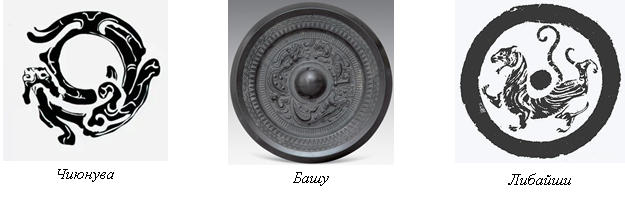 Figure 4. A polyphonic narrative about a totem animal The same totem animal (for example, a tiger) can play several roles in different tribes, such as the god of war (the Chiyou tribe) [16, pp. 103-107], the god of reproduction (the Bashu totem) [14, pp. 87-91] and the guardian of nature (the Libaishi cult) [6], forming “a polyphonic narrative” about primitive beliefs (Fig. 4).
Primitive sacrificial rituals are a prehistoric practical field of carnivalization theory. The idea is to create an “equal space” for communication between humans and gods through irrational bodily actions (such as wearing masks, imitating mythical animals, and having drunken fun), as well as to strengthen collective beliefs in the process of undermining the daily order. The Yuji ritual, recorded in the inscriptions on the bones of the Yinsu oracles (offering wine to the gods accompanied by dance), is a carnival scene that follows Bakhtin's dialectical logic of "coronation-undramatization.” The magician falls into a “state of ecstasy” due to intoxication, and his speech turns from everyday communication into an “oracle". Human individuals in everyday life are not “dramatized” in the ritual and become participants in a chaotic state, but are “crowned” as bearers of sacred power in fusion with the image of the gods. It is worth noting that the carnivalization of primitive sacrifices is not just a violation of public order. The basic logic is to bring order by periodically overthrowing the “crowned-debunked" principle. For example, the carnival imitation of the god of agriculture at the wax festival ultimately indicates the confirmation of the harvest order; the dance designed to drive away the god Nuo in the opera Nuo is designed to strengthen the collective desire for cleanliness (order) by imitating chaos (evil spirits). This confirms Bakhtin's main idea: behind the overthrow of carnival there is a hidden maintenance of a deep cultural order - a primitive mythological image acquires a realistic existence in the carnival ritual, and its sacredness is confirmed in the process of the “destruction-reconstruction” dialogue[1]. 3. The Axial Age: the emergence of polyphonic storytelling (before the Qin Han) The most striking manifestation of Bakhtin's “dialogical” theory in the Axial Epoch was the cross-discursive dialogue of “mythological metatext-philosophical interpretations" formed by various philosophical schools in the spring-autumn period and the period of the warring states, which built their ideological systems by rewriting mythological images [17, pp. 106-116]. This kind of interpretation is not a one-dimensional appropriation of meaning, but a two-way interaction between different schools and mythological archetypes, as well as between different schools through mythological archetypes. This polyphonic narrative not only laid the ideological foundation for the unification of the Qin and Han dynasties, but also laid the tradition of dialogue “harmony in diversity" in Chinese civilization. Daiyu is a key figure in ancient Chinese myths and historical legends. His main deeds are “fighting floods to save people” and “establishing the borders of nine states.” According to the “Classics of Mountains and Seas, in the era of Yao and Shun, when Daiyu lived, floods were in full swing. Daiyu's father was held accountable for failing to deal with the floods, and he took over his father's control. Unlike his father's “blocking” method, Daiyu employed a “dredging” strategy, forcing people to dig rivers and extract silt. After thirteen years of hard work, he finally successfully dealt with the floods and allowed people to live in peace. The image of Daiyu combines mythological and historical elements: on the one hand, his story has a mythological connotation, for example, the legend that he used the help of mythical animals such as turtle and Yinglong; on the other hand, later generations viewed him as a real historical figure and even considered the main character, the founder of the first The dynasties of China, the "Xia Dynasty" [2, pp. 191-201]. This characteristic feature of the "half god, half man" image made Daiya an important cultural symbol for later thinkers, explaining the different views. Confucianism turned Daiyu's flood control actions into a carrier of moral discipline, turning them into an ideal model of “self-improvement - family structure - country management - pacification of the world”: personality development (self-control) manifests itself in restoring public order (country management) through flood control practice (country management), and, finally, is achieved An idealized political vision: “the earth is flat, the sky is flawless, and six ministries and three ministries of internal affairs are properly managed" (world peace) [17, pp. 106-116]. Taoism interprets Daiyu's flood control actions as a philosophical metaphor of “Daiyu follows nature” (following the laws of nature), and through Daiyu's flood control strategy of “going with the flow” explains the Taoist practical wisdom of “following the inherent laws of things.” In Taoist discourse, Daiyu's success lies not in conquering man, but in agreeing with the “path of nature”, which is a mythological example for the Taoist philosophical system of “harmony between man and nature" [17, pp. 106-116]. The Mohists believed that Daiyu was a model of utilitarianism who "worked hard for the good of peace" (all wounds were from the crown to the heels, which characterized physical labor for the good of peace), and emphasized his spirit of "universal love" -fighting floods was not for him the way to "establish peace and eliminate its harm."”, turning the mythical hero into a utilitarian embodiment of “promoting the good of all people” [17, pp. 106-116]. The image of Daiyu is like a “container of meaning”, which continues to undergo “semantic splitting" in the moral discourse of Confucianism, the philosophical discourse of Taoism and the utilitarian discourse of Mohism, which fully confirms Bakhtin's theory of “diversity” [1]. The essence of his original myth has been weakened to one degree or another, but the main narrative of “flood control and saving people” is always present, becoming the semantic core of the dialogue between the three schools. 4. From the Wei and Jin Dynasties to the Tang and Song Dynasties: integration and mutual exclusion of religion and secularism
During the cultural transition from the Wei and Jin dynasties to the Tang and Song dynasties, the image of Guan Yu underwent a dual transformation - from a “historical warlord" to a “Confucian moral god“ and a ”folk god.” This process is not a one-sided rendering of meaning, but a continuous dialogue between official ideology and popular culture through the image of Guan Yu [3, pp. 42-51]. Guan Yu was a famous general during the late Eastern Han Dynasty. He followed Liu Bei, the founding emperor of the Shuhang Dynasty during the Three Kingdoms period, and was known for his loyalty and bravery. Although his life did not have a clear mythological coloring, in subsequent generations it was jointly constructed by officials and the people and became a cultural symbol with great symbolic significance. In the 19th year of Kaiyuan (731), the emperor of the Tang dynasty, Xuanzong, issued a decree on the creation of the “Temple of War”, which abolished the status of Guan Yu as a local deity and turned him into a national symbol of “protection of the country and the people", as well as basic Confucian values such as “loyalty". The words “righteousness“ and ”martial arts" were clearly included in the title. Later texts selectively emphasized Guan Yu's loyalty to the emperor and his honesty, gradually eliminating the human weakness of “rigidity and self-conceit.” Guan Yu in the “Three Kingdoms“, turning him into a morally perfect man with ”great righteousness", becoming the military embodiment of the "Three Kingdoms". The Confucian ideal of the vassal king, which serves to promote the values of ”loyalty to the emperor and patriotism" by the centralized regimes of the Tang and Song dynasties [3, pp. 42-51]. During the Wei and Jin dynasties, folk lore began to endow Guan Yu with divine qualities after his death. During the Tang Dynasty, folk legends were further developed. The Yuquan zi zhenlu says that Guan Yu appeared as the Buddhist guardian deity "Bodhisattva Galan" on Mount Yuquan in Dangyang, making a key leap from man to God [3, pp. 42-51]. Folk legends intentionally preserve and enhance the mortal qualities of Guan Yu. He is different from the abstract gods who are high above us. Although he is the “god of war,” his duties also include attracting wealth and exorcising evil spirits (Fig. 5). This narrative strategy turns him into a secular advocate who is “empathetic, he can be helped” and is widely loved in the secular world. 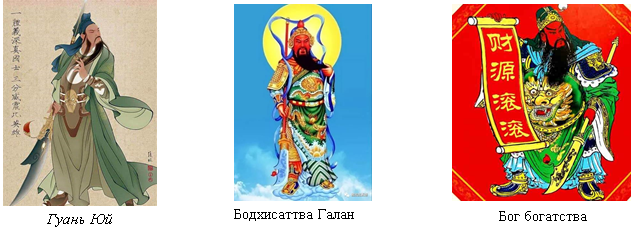 Figure 5. Folk legends Figure 5. Folk legends
The official and private sectors conduct inter-class dialogues based on the common principles of “loyalty and righteousness”, creating a cultural consensus with mutual integration and expanding the boundaries of understanding with mutual exclusion. The official “moral discourse” (Confucian loyalty and righteousness) and the private “utilitarian discourse” (protection of the people and the pursuit of wealth) do not replace each other, but form a “polyphonic" structure. At the same time, the interpretation of each epoch is a response to the previous text and goes beyond it. During the Tang Dynasty, officials gave Guan Yu the meaning of “loyalty,” the private sector during the Song Dynasty added the function of “protecting the people,” and the Ming and Qing dynasties further transformed him into the “god of wealth.” It is precisely in this “incompleteness” that the vitality of the text lies, emphasized by Bakhtin [1]. It is constantly being split by the interaction of different discourses. Its original historical attributes (the generals of the three kingdoms) gradually receded, while the symbolic attributes of cultural construction (the symbol of loyalty and righteousness, the secular patron saint) continued to expand. 5. The Ming and Qing Dynasties: the peak of the dialogue between divinity and humanity The evolution of mythology during the Ming and Qing dynasties demonstrated a clear dual trajectory of politicization and secularization. Against the background of the strengthening of authoritarian imperial power, the government turned traditional mythology into a narrative tool for legitimizing the regime through institutional incorporation and ideological discipline. Folk religion broke through official prohibitions thanks to the theoretical reconstruction of “Three religions in one.” This integration gave rise to the narrative basis of the confrontation between “Changjiao and Jiejiao” in the Novel of the Gods, forming a unique system of political allegories [2, pp. 191-201]. Reconstructing ancient legends, the Ming Dynasty literati turned historical events such as the Shang and Zhou revolutions and the conquest of the Zhou king into a means of criticizing real politics, and the Shang and Zhou revolutions into a symbolic system to strengthen the legitimacy of the regime, comprehend the bureaucratic system and fight corruption. The dilemma of individual values during the Ming and Qing dynasties becomes a typical text for interpreting the political metaphors of ancient Chinese mythology. At first glance, the "Endowment of the Gods" depicts the ancient legend of the "conquest of King Wu by King Zhou", but in fact it contains metaphorical reflections on the reconstruction of the political order during the transition from the Ming Dynasty to the Qing Dynasty [2, pp. 191-201]. After the fall of the Yuan Dynasty, the Ming Dynasty regime needed to prove its legitimacy with a “Mandate from Heaven.” During the late Ming Dynasty and early Qing Dynasty, people also used the “Shang Zhou Revolution” as a metaphor for the complex mentality of the Qing Dynasty, forming a dialogue between official ideology and popular historical views. The three-element immortal system “Changjiao-Jiejiao-Humanity”, built on the Dedication of the gods, is in fact a mythological deformation of the bureaucracy of the Ming Dynasty. Changjiao represents the “orthodox elite”, Jiejiao symbolizes the “heretical forces”, and the power struggle between them around the “Dedication to the gods” refers to the party struggle in the late dynasty Mines and internal contradictions of the bureaucracy [2, pp. 191-201].
The gods in the Dedication of the Gods completely repeat the bureaucratic division of labor of the six ministries and nine ministers during the Ming Dynasty. Here, the "crowned and uncrowned" in Bakhtin's theory of "carnivalization" is revealed: the gods, "uncrowned" in the war between Shang and Zhou, become personalities involved in the human battle, and finally "crowned" as institutionalized bureaucratic gods, implying a hidden criticism of the bureaucratic system, which includes the "supernatural." "individuals" and "institutional mechanisms"[1]. The trajectories of characters such as Nezha, Yang Jian, and Yin Jiao in this story represent a space of tension between “divine demands” and “human struggle,” which is a metaphor for the value dilemma of individuals under the autocratic system during the Ming and Qing dynasties [2, pp. 191-201]. "Initiation into the Gods" uses the Shang and Zhou revolutions as the foundation, and the policies of the Ming and Qing as the foundation. With the help of mythological plots, it completes a triple metaphorical reflection on the legitimacy of the regime, the bureaucratic system and the fate of individuals. His depth lies in the fact that he transforms abstract political philosophy into concrete stories about gods and monsters. This is not a monotonous ideological mouthpiece, but a field of continuous dialogue between officials and the people, sacred and secular, history and reality. 6. Modern approach: visual reconstruction and dialogism in time and space Being a kind of code of national culture, mythology in its construction of time and space follows the binary logic of “sacred time” and “central space". After the Ming and Qing dynasties, popular literature began to show signs of deconstruction of this narrative. “Journey to the West” destroys sanctity due to the difference in time and space: “one day in heaven, one year on earth" [15, pp. 171-185]. The modern industry of cinema, television and games uses digital technologies to free mythological symbols from linear history and create a virtual space-time intertwined with the "past-present-future". Nowadays, mythological time and space have transformed from “inviolable sacred zones” into “visual landscapes that can be viewed and reconstructed.” It is no longer a carrier of a single ideology, but a field for many discursive games. At a time when the film and television industries, as well as the gaming industry, are closely integrated, “Black Myth: Wukong” transforms traditional mythological narratives into modern philosophical fables. While retaining the theme of “searching for the holy scriptures,” he completed a devastating reconstruction of the mythological logic of time and space [13, pp. 130-137]. Unlike the one-way communication of traditional cinema and television, the interactive narrative mechanism implements the embodiment of time and space through the “presence of players.” "Black Myth: Wukong” uses digital twin technology to scan and simulate 36 ancient monuments such as the Shanxi Foguang Temple and the rock carvings of Chongqing Dazu, allowing Tang Dynasty hanging sculptures, Ming Dynasty murals and cyberpunk aesthetics to coexist, creating an overlap of time and space “history-fantasy-future", as well as creating a unique Architecture is a digital Tower of Babel that allows for a dialogue between tradition and modernity, sacredness and secularism, individuals and institutions [13, pp. 130-137]. In the mythological text of the Journey to the West, the time of searching for the Holy Scriptures, there is a one-dimensional embodiment of the spiritual time of “cultivating the mind and becoming a saint” in the physical time of “fourteen years." "The Black Myth: Wukong" transforms Bakhtin's theory of space-time into a vivid visual narrative using digital technologies and uses "space-time folds" to complete the dialogue between an agricultural civilization striving for order and eternity and a digital civilization that adheres to deconstruction and diversity [13, pp. 130-137]. When the player controls Wukong, who destroys the dome of Leyin Temple, and watches the sun illuminate the remains of the Buddha lying on the ground, this scene is not only a visual spectacle, but also a symbolic destruction of the traditional mythological order by modern people. This deconstruction is not a denial, but thanks to the reconstruction of space-time, myths acquire the ability to dialogue with modern people. Conclusion: Myth as a place of constant dialogue 1. The essence of dialogic evolution: “metamorphoses" of cultural genes From primitive totems to images in movies and on television, the main cultural genes of Chinese mythology (such as “the relationship between heaven and man” and “the spirit of resistance”) are always present, but they are transmitted through constant “transformation” (for example, Nuwa turns from a creator god into a symbol of feminism) [2, c. 191-201]. This confirms Bakhtin's point of view that true cultural traditions are not copies, but the continuous generation of new meanings in a dialogue with time [1]. 2. The eternal game between carnival and discipline The reinterpretation of each epoch includes a carnival-style overthrow (for example, the destruction of the “patriarchal order” by modern cinema and television) and the introduction of basic values (for example, the final acceptance of the Highest social responsibility), forming a spiral of “overthrow-reconstruction” [9, pp. 73-76]. The essence of this game lies in the mechanism of self-renewal of human culture, just as Bakhtin's “carnival scene” is always a battlefield of many forces [11]. 3. The modern value of incompleteness
The rejection of a fixed essence and the acceptance of multiple interpretations is the source of the myth's vitality in the modern era. When Yang Jian explores gender equality in the film "splitting a mountain to save his mother" [2, pp. 191-201], and "Deep Sea" reconstructs the "Myth of Shan" using modern visual effects [8, pp. 62-68], we see not a departure from the "original myth", but a modern practice Bakhtin's theories about the “unfinished text" — the meaning of myth is always present in the following dialogue [1]. From the inscriptions on oracle bones to the light and shadow on the screen, the evolution of Chinese mythological images represents the history of a civilization in which people engage in dialogue with themselves through ancient narratives. In the period of primitive beliefs, it was a mysterious dialogue between man and nature; in the axial age, it was an intellectual dialogue between sacredness and rationality [17, pp. 106-116]; at the stage of secular literature, it was a carnival dialogue between the government and the people [15, pp. 171-185]; in the context of modern cinema and television, it is an intercultural dialogue between tradition and globalization [13, pp. 130-137]. Bakhtin's theory interprets these dialogues not by disparate historical events, but by the process of generating meaning that shares a single cultural logic [1, 12]. The continuation of all cultures is a deep dialogism between contemporaries and the past in the square of history, and myths are the most ancient and most vital voices in this dialogue.
The article is published in the version approved by the reviewers (after receiving a positive review recommending the manuscript for publication) with corrections made by the author (after receiving the editor’s comments, if any).
Read all reviews on this article
References
1. Bakhtin, M. M. (1988). Problems of Dostoevsky's poetics (Bai, C. & Gu, Y., Trans.). Xian’gan Sanlian Shudian.
2. Chen, S., & Yang, Y. (2024). Re-telling history, imagining myths, and the modern transformation of traditional cultural images: The case of "Elevation to the Rank of Spirit. Part I: Winds and Clouds of Chaoge." Ningxia Social Sciences, 1, 185-193.
3. He, S., & Chen, C. (2007). Myths, legends, and history. Journal of Historiography, 4, 42-51.
4. Bakhtin, M. M. (1996). Conversations with V. D. Duvakin (Kozhinov, V. V., Ed.). Soglasie.
5. Kristeva, J. (1980). Desire in language: A semiotic approach to literature and art (Gora, T., Jardin, A., & Rudiez, L. S., Eds.). Columbia University Press. URL: https://archive.org/details/desireinlanguage0000kris_b8k4
6. Liu, Y. (1993). Study on the origins of Chinese civilization: Taoism and the cosmology of the Tiger I. Yunnan People's Publishing House.
7. Liu, B. (2015). Rereading Todorov: Reflections on the core concepts of Bakhtin’s dialogism. Studies in Foreign Languages, 1(182), 30-33.
8. Liu, C., & Hu, H. (2025). Ethnicity, modernity, and cosmopolitanism in "The White Snake Trilogy" from Chasing Light Animation Studio. Cinema Literature, 6, 62-68.
9. Liu, L. (2020). Myth and reality: A modern adaptation of Chinese animated films: A comparison of "Nezha's Mischief in the Sea" and "Nezha's Downfall in the World." Film Review, 11, 73-76.
10. Peng, C. (2003). Historical essences in the narrative of mythology: A review of mythological theories in anthropology. Ethno-National Studies, 5, 83-92.
11. Todorov, T. (2001). Bakhtin, the theory of dialogue, and beyond (Jiang, C. & Zhang, P., Trans.). Baihua Wenyi.
12. Wang, M. (2010). The nature of the symbol and the theory of dialogue: An exploration of Bakhtin's thought. Journal of Foreign Languages, 6, 151-155.
13. Xu, C., & Yuan, Y. (2024). How digital games tell Chinese stories: An analysis of intercultural communication in "Black Myth: Wukong." Journal of Southwest University for Nationalities (Humanities and Social Sciences), 45(12), 130-137.
14. Yang, C., & Wang, C. (2016). An analysis of the theme of the tiger and life in ancient ornamental portraits: An analysis of the cultures of the pumpkin-tiger and the dragon-tiger. Medicine and Philosophy (A), 37(2), 87-91.
15. Yang, Y. (1995). Journey to the West: A late representative of Chinese mythology and culture. Social Sciences in China, 1, 171-185.
16. Zhang, B. (2019). Chi Yu and the emergence of Chinese theater. Journal of Xinyang Normal University (Philosophy and Social Sciences), 39(3), 103-107.
17. Zhang, K. (2024). Narrative and deconstruction of the axial time in Chinese mythology. Journal of Nanjing University (Philosophy-Humanities-Social Sciences), 61(4), 106-116.
Peer Review
Peer reviewers' evaluations remain confidential and are not disclosed to the public. Only external reviews, authorized for publication by the article's author(s), are made public. Typically, these final reviews are conducted after the manuscript's revision. Adhering to our double-blind review policy, the reviewer's identity is kept confidential.
The list of publisher reviewers can be found here.
The peer-reviewed article "Reconfiguration and Dialogism: the Evolution of Chinese Mythology from Antiquity to Modernity in accordance with Bakhtin's theory" is a large-scale interdisciplinary study in which the philosophical and literary principles of Bakhtin's theory of dialogism are applied to the analysis of Chinese mythology. The subject of the work is to identify the dialogical nature of Chinese mythological discourse, manifested in the multilevel interaction of cultural, philosophical and artistic texts, from ancient sources to modern audiovisual interpretations. The author demonstrates how mythological images and plots acquire new meanings through the constant "mutual reflection" of various discourses — religious, historical, artistic and digital. Methodologically, the research is based on the principles of Bakhtin's philosophy of language and literature: polyphonism, chronotope, carnivalization, incompleteness of the text. The author skillfully combines these categories with an analysis of Chinese cultural realities, revealing systemic parallels between Bakhtin's concept of dialogism and the Chinese idea of "harmony in diversity." The scientific argument is based on a comparison of texts from different eras, from the Classics of Mountains and Seas and the Chronicles of Sima Qian to the novels Journey to the West and Initiation into the Gods, as well as modern films and video games. It is particularly interesting to refer to the category of "incompleteness" in relation to the evolution of mythological images, which allows us to show their continuous reconfiguration in the context of the historical and cultural development of China. The relevance of the article is undeniable. It is determined not only by addressing fundamental issues of cultural memory and identity, but also by an attempt to rethink classical Bakhtin theory from an intercultural perspective. In the context of globalization and the active interaction of the humanitarian traditions of the East and the West, such studies contribute to the formation of a new field of comparative mythopoetics and philosophical anthropology. The author convincingly shows that Bakhtin's idea of dialogism is applicable not only to the literature of European modernism, but also to archaic and modern Chinese narratives, including the phenomena of mass culture. The scientific novelty of the work lies in the original synthesis of Western philosophy of dialogue and Chinese mythological tradition. For the first time, the author offers a holistic model of the "dialogical evolution" of Chinese mythology, where each epoch (from primitive cults to digital reconstructions of the 21st century) is considered as a stage of continuous semiotic interaction. The introduction of the carnival category is particularly productive to explain the phenomenon of desacralization of mythological images in popular culture and media art. This approach allows us to consider myth not as a static system of symbols, but as a dynamic space of meanings, constantly updated in the dialogue between the sacred and profane. The style and structure of the article are consistent with academic standards. The text is distinguished by its logical construction and compositional completeness: after a theoretical introduction, the stages of mythological transformation (from primitive beliefs and the Axial Epoch to the Ming and Qing dynasties and the modern period) are consistently analyzed. Extensive illustrative material (including drawings and descriptions of visual sources) makes the presentation visual and intermodal. The scientific style is consistent, the argumentation is supported by quotations and references to primary sources and modern research. The linguistic purity of the text and the richness of the terminological apparatus, which organically combines philosophical, philological and cultural vocabulary, should be noted separately. In some fragments, there is an excessive citation density, which somewhat reduces the dynamics of perception, but this is compensated by the depth of analysis. The bibliography of the article is balanced and reflects the broad theoretical and cultural context of the research. It combines sources in Russian, Chinese and English, which emphasizes the intercultural nature of the work. It is especially valuable to refer to the original editions of the works of M. M. Bakhtin, Y. Kristeva, and Ts. Todorov, as well as to modern Chinese studies from 2020-2025, which indicates the author's attention to the latest scientific agenda. Nevertheless, to enhance the international resonance of the article, links to relevant English-language publications on comparative mythology and narrative theory could be added. The appeal to the opponents is expressed implicitly, through dialogue with Western and Eastern theories. The author argues with the traditional perception of myth as a closed text and shows that in the context of Bakhtin's concept, myth is a living process of meaning generation. This position opens up space for further discussions about the transformation of the sacred in postmodern culture and the interaction between digital media and archaic structures of consciousness. In conclusion, it can be noted that the article has a high scientific and cultural value. She demonstrates a mature mastery of the philosophical apparatus, a deep knowledge of the Chinese tradition and the ability to think at the intersection of disciplines. The research is of interest to specialists in the field of comparative literature, cultural studies, philosophy of culture and Oriental studies. We believe that the peer-reviewed work can be recommended for publication in a scientific journal without critical comments.
|









 © 1998 – 2026 Nota Bene. Publishing Technologies. NB-Media Ltd.


