|
Agriculture
Reference:
Mukhametova, S.V., Kladovikova, T.S. (2026). The vital condition of the Chavain Boulevard plantings in the part beyond the river in Yoshkar-Ola. Agriculture, 1, 18–28. https://doi.org/10.7256/2453-8809.2026.1.79691
The vital condition of the Chavain Boulevard plantings in the part beyond the river in Yoshkar-Ola
Mukhametova Svetlana Valeryevna
ORCID: 0000-0001-7892-6450
PhD in Agriculture
Associate Professor; Department of Horticultural Engineering, Botany and Dendrology; Volga State University of Technology
424000, Russia, Republic of Mari El, Yoshkar-Ola, Lenin Square, 3, room 245

|
MuhametovaSV@volgatech.net
|
|
 |
Other publications by this author
|
|
|
Kladovikova Tatyana Sergeevna
Graduate student; Department of Horticultural Engineering, Botany and Dendrology; Volga State Technological University
424000, Russia, Rep. Mari El, Yoshkar-Ola, Lenin Square, 3
|
|
Nusha.ki@mail.ru
|
|
 |
|
DOI: 10.7256/2453-8809.2026.1.79691
EDN:
FRTXPT
Received:
05/01/2026
Revised manuscript submitted: 05/02/2026 07:29
Final review received: 05/03/2026 16:37 — recommendation for publication.
The article is published in the version approved by the reviewers (after receiving a positive review recommending the manuscript for publication) with corrections made by the author (after receiving the editor’s comments, if any).
Read all reviews on this article
Published:
05/08/2026
Abstract: Modern large cities are a well-developed network of streets, avenues and boulevards where citizens stay daily, but it is the boulevards that are most often used for short-term rest and walks, therefore their condition, including landscaping, is very relevant. Monitoring the composition of plantings, sanitary conditions, and planting density at landscaping facilities makes it possible to assess their protective and recreational functions. The purpose of the study is to analyze the vital condition of woody plants in the Chavain Boulevard part beyond the river in Yoshkar-Ola (Mari El Republic). The boulevard in the left-bank part of the city appeared in 1980 in a residential area with multi-storey buildings on alluvial soils, stretched in a latitudinal direction, its southern part is partially shaded by adjacent buildings. This study was conducted in September 2025 by taking a complete inventory of the available woody plants. The sanitary condition was assessed according to a 5-point scale given in the Rules of Sanitary Safety in Forests (2020). It has been established that the surveyed plantings are characterized by a weakened state. Among 1,338 copies 2.2% of healthy people were identified, 81.1% of the weakened, 15.5% of the severely weakened, 0.2% of the shrunken, and 1.0% of the dead. The most reduced vital condition among coniferous plants was Thuja occidentalis, among deciduous trees – Sorbus aucuparia, Prunus padus, Malus baccata and Malus domestica, among deciduous shrubs – Lonicera tatarica. In areas shaded by buildings, the vital condition of light-loving tree species is reduced. Compared to the part of the boulevard in the central area of the city, the plantings in the surveyed area are in better condition, due to a younger age, a wider range of plants and a wider width of green stripes.
Keywords:
green spaces, woody plants, landscaping, urban plantings, sanitary condition, diseases and pests, damage, plant viability, stability, trees and shrubs
This article is automatically translated.
Introduction. Public green spaces play an important role in urban landscaping and are a component of their landscape and architectural appearance, perform important functions to optimize the spatial environment, maintain ecological balance and comfort, enhance the aesthetic appearance of the city. Modern large cities are a well-developed network of streets, avenues and boulevards where citizens stay daily, but it is the boulevards that are most often used for short-term rest and walks, therefore the rational organization of their layout and landscaping is relevant. The study of the features of landscaping and the condition of green spaces on boulevards is due to the fact that in conditions of constant anthropogenic pressure, plantings require monitoring their condition in order to preserve and increase sustainability [1]. Woody plants in urban areas need special attention and care. Due to the high anthropogenic load, they weaken and become more susceptible to diseases. Since the use of pesticides in the city is dangerous, the agrotechnical aspect of plant protection is relevant, since a healthy, well-groomed tree is less susceptible to infection [2]. Improving the technology of tree care in an urban environment helps to remove some of the problems. At the same time, the formation of a multilevel framework of vegetation, which can be implemented on boulevards, performs an aesthetic function and an important ecological task, contributes to the optimization of environmental indicators and the ability to self-sustain [3]. Monitoring of the composition of plantings, sanitary condition, and planting density at landscaping facilities makes it possible to identify the influence of various factors on the general condition of plants and their ability to perform protective and recreational functions [4]. At the same time, it is important to constantly and continuously monitor plantings over a long period of time, which will allow comparing data and making timely decisions to ensure the longevity of plantings and the safety of the urban environment [5]. The purpose of this study is to analyze the vital condition of woody plants on Chavain Boulevard in the zarechnaya part of the city of Yoshkar-Ola (Republic of Mari El). Earlier, we presented the species composition of the plantings of this object [6]. The object of the study. Chavain Boulevard continues from Kirova Street to Komsomolskaya Street. Part of the boulevard on the right bank of the Malaya Kokshaga River was designed back in the 30s of the XX century. Since it was decided to "cut through" it along the existing building, the project was not started until 1955. The boulevard received its visible outlines in 1960, and in 1964 it was named after the founder of Mari literature, Sergei Grigorievich Chavain (1888-1937). In 1980, Chavain Boulevard "stepped" across the river. In 1991, a monument to composer I.S. Klyuchnikov–Palantai was erected in the left–bank part of the boulevard, and in 2012, a monument to writer A.S. Krupnyakov [7]. Before the construction began in the mid-1970s, there were swamps in this part of the city, and a residential area of multi-apartment panel houses was built on alluvial soils. Methods. The study was conducted in September 2025 by taking a complete inventory of the available woody plants. The plants growing directly on the boulevard strips are taken into account. Since the boulevard is located in a residential multi-storey building and is elongated in a latitudinal direction, its southern part is partially shaded by adjacent 9-storey buildings. To identify a possible connection between the vital state of plants and growing conditions, the surveyed part is divided into sections (Fig. 2): section 1 is between Voznesensky Prospekt and Petrova Street, with a length of about 500 m, section 2 is between Petrova and Kirov Streets, with a length of about 600 m, A is the northern strip, B is the southern strip.

Figure 1 – Diagram of the sections of Chavain Boulevard in the zarechnaya part of Yoshkar-Ola (Yandex.maps)
The sanitary condition of the plants was assessed on a 5-point scale of the Rules of sanitary safety in forests (2020): 1 – healthy (without signs of weakening), 2 – weakened, 3 – severely weakened, 4 – shrinking, 5 – dead. For each species, the coefficient of its condition was calculated as the arithmetic mean of the plant scores of this taxon. The condition coefficient of the boulevard's plantings as a whole (K o) is calculated as the arithmetic mean of the condition coefficients of individual species. The condition of the plantings was assessed on the scale: K o< 1.5 – healthy plantings, without signs of weakening; 1.51–2.5 – weakened; 2.51–3.5 – severely weakened; 3.51–4.5 – shrinking; >4.5 – dead plantings. The results of the study. The data obtained on the number of plants by category of vital condition are shown in Table 1. A total of 1,338 specimens of woody plants were found.
Table 1 – Number of woody plants by category of living condition on Chavain Boulevard in the zarechnaya part of Yoshkar-Ola (2025) | Name of the type | Quantity, pcs. | Status category | | 1 |
2 | 3 | 4 | 5 | | Coniferous trees | | Prickly spruce (grade) / Picea pungens Engelm. | 94 | 10 | 81 | 3 | – | – | | Siberian larch / Larix sibirica Ledeb. | 33 | – | 29 | 3 | – | 1 | | Juniper Cossack / Juniperus sabina L. | 37 | – | 37 | – | – | – | | Western Thuja / Thuja occidentalis L. |
15 | – | 7 | 1 | – | 7 | | Total conifers | 179 | 10 | 154 | 7 | – | 8 | | Deciduous trees | | Hanging birch / Betula pendula Roth | 23 | – | 22 | 1 | – | – | | Squat elm / Ulmus pumila L. | 16 | – | 16 | – | – |
– | | Holly maple / Acer platanoides L. | 59 | – | 58 | 1 | – | – | | To. ash-leaved / A. negundo L. | 20 | – | 20 | – | – | – | | Common horse chestnut / Aesculus hippocastanum L. | 1 | – | 1 | – | – | – | | Small-leaved linden / Tilia cordata Mill. | 226 | – | 180 | 46 |
– | – | | Mountain ash / Sorbus aucuparia L. | 26 | – | 20 | 4 | – | 2 | | Balsamic poplar / Populus balsamifera L. | 6 | – | 5 | 1 | – | – | | Common bird cherry / Prunus padus L. | 1 | – | – | 1 | – | – | | Apple tree (type, variety) / Malus sp. | 20 | 20 | – |
– | – | – | | I. domashnaya / M. domestica (Suckow) Borkh. | 87 | – | 69 | 14 | 2 | 2 | | Ya. slivolistnaya / M. prunifolia (Willd.) Borkh. | 5 | – | 5 | – | – | – | | Ya. yagodnaya / M. baccata (L.) Borkh. | 16 | – | 10 | 5 | – | 1 | | Total deciduous trees | 506 | 20 |
406 | 73 | 2 | 5 | | Deciduous shrubs | | Common barberry / Berberis vulgaris L. | 5 | – | 5 | – | – | – | | Common cherry / Prunus cerasus L. | 1 | – | 1 | – | – | – | | Tatar honeysuckle / Lonicera tatarica L. | 119 | – | 40 | 79 | – | – | | Caragana arborescens Lam. |
1 | – | 1 | – | – | – | | Brilliant dogwood / Cotoneaster lucidus Schltdl. & Cham. | 139 | – | 139 | – | – | – | | Viburnum bubblegum / Physocarpus opulifolius (L.) Maxim. | 216 | – | 188 | 27 | – | 1 | | Common lilac / Syringa vulgaris L. | 97 | – | 89 | 8 | – | –
| | Red currant / Ribes rubrum L. | 1 | – | 1 | – | – | – | | Snowy white / Symphoricarpos albus (L.) S.F. Blake | 3 | – | 3 | – | – | – | | Forsythia / Forsythia sp. | 2 | – | 2 | – | – | – | | Thorny rosehip / Rosa spinosissima L. | 1 | – | 1 | – | – |
– | | Sh. wrinkled / R. rugosa Thunb. | 68 | – | 55 | 13 | – | – | | Total deciduous shrubs | 653 | – | 525 | 127 | – | 1 | | Total | 1338 | 30 | 1085 | 207 | 2 | 14 |
The majority of plants (81.1%, 1085 specimens) are characterized by a weakened vital condition (category 2). 207 specimens (15.5%) were classified as severely weakened (category 3), and 2 specimens were classified as shrunken (category 4). (0.2 %), 14 dead plants (category 5) were identified. (1,0 %). 30 specimens were evaluated as category 1, i.e. healthy. (2,2 %). The damage was absent for 10 copies. prickly spruce, presumably of the 'Glauca’ variety, and for 20 specimens. apple trees of the Royalty variety planted during the research period. The western thuja has the worst viability, it has the largest number of dead plants (7 specimens). These are young plants that have died as a result of insufficient care, primarily lack of irrigation. This proves the importance of carrying out agrotechnical measures for plantings for several years after planting to ensure their safety. The death of freshly planted plants, especially expensive ones, leads to economic losses and a decrease in the aesthetics and functionality of the landscaped space.
Dead specimens are found in mountain ash and domestic apple trees. The reduced vital condition of these species was also noted at other urban sites [8]. The most common cause of mountain ash drying is cancerous necrotic diseases of trunks and branches (Figure 2).
a 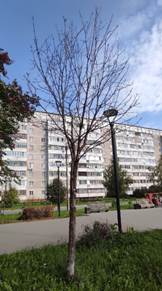 b b 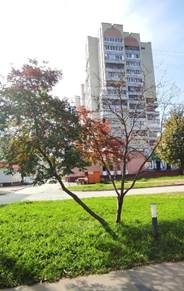 c c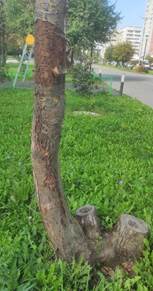 Figure 2 – Examples of damage to mountain ash: a) a dead tree with dead wood, peeling bark, cracks and traces of stem pests, b) a shrinking tree, c) necrosis of bark and stumps from sawn trunks
Of the shrubs, the worst condition was found in Tatar honeysuckle, which is due to heavy pruning to a height of 1-1.2 m, which leads to the removal of almost the entire leafy part of the crown and the exposure of the lower part of the stems. A similar pattern is typical for molded hedges of viburnum bubblegum, which also leads to a deterioration in its vital condition, thinning of the crown and a decrease in decorative effect. At the same time, hedges of similar height from the brilliant dogwood retained their decorative effect and were more dense, so that this species did not show a significant deterioration in its vital condition. A comparison of sites with varying degrees of shade from building showed (Table 2) that in the shaded parts, compared with more illuminated areas, the vital condition of Siberian larch, hanging birch, balsamic poplar, domestic apple, and berry apple trees is reduced. These trees are light-loving, and the lack of light has obviously had an impact on their vital condition. No such difference has been found in shrubs, and we see the reason for this in the greater plasticity of shrubs in relation to environmental factors.
Table 2 – The vital state of woody plants in the areas of Chavain Boulevard in the zarechnaya part of Yoshkar-Ola (2025) | Name of the type | The coefficient of the state of the form | | 1st | 1-B | 2nd | 2-B | Average | | Coniferous trees | | Prickly spruce / Picea pungens Engelm. | 2,0 | 2,0 | 1,8 | 2,0 | 1,9 | | Siberian larch / Larix sibirica Ledeb. |
2,1 | 2,3 | – | 2,0 | 2,2 | | Juniper Cossack / Juniperus sabina L. | 2,0 | 2,0 | – | – | 2,0 | | Western Thuja / Thuja occidentalis L. | 2,0 | 2,3 | 4,6 | 2,0 | 3,5 | | Average for conifers | 2,4 | | Deciduous trees | | Hanging birch / Betula pendula Roth | – | 2,0 | 2,0 | 3,0 | 2,0 | | Squat elm / Ulmus pumila L. | 2,0 |
2,0 | 2,0 | – | 2,0 | | Holly maple / Acer platanoides L. | 2,0 | 2,0 | 2,0 | – | 2,0 | | To. ash-leaved / A. negundo L. | 2,0 | 2,0 | 2,0 | – | 2,0 | | Common horse chestnut / Aesculus hippocastanum L. | – | 2,0 | – | – | 2,0 | | Small-leaved linden / Tilia cordata Mill. | 2,3 | 2,3 | 2,1 | 2,1 |
2,2 | | Mountain ash / Sorbus aucuparia L. | 2,0 | 2,0 | 2,0 | 2,8 | 2,4 | | Balsamic poplar / Populus balsamifera L. | – | 3,0 | 2,0 | – | 2,2 | | Common bird cherry / Prunus padus L. | – | 3,0 | – | – | 3,0 | | Apple tree (type, variety) / Malus sp. | 1,0 | 1,0 | – | – | 1,0 | | I. domashnaya / M. domestica (Suckow) Borkh. | 2,2 |
2,4 | 2,0 | 2,2 | 2,3 | | Ya. slivolistnaya / M. prunifolia (Willd.) Borkh. | 2,0 | 2,0 | 2,0 | – | 2,0 | | Ya. yagodnaya / M. baccata (L.) Borkh. | 2,3 | 2,9 | 2,0 | – | 2,5 | | Average for deciduous trees | 2,1 | | Deciduous shrubs | | Common barberry / Berberis vulgaris L. | – | – | 2,0 | 2,0 | 2,0 | | Common cherry / Prunus cerasus L. | – |
– | 2,0 | – | 2,0 | | Tatar honeysuckle / Lonicera tatarica L. | 2,7 | 2,7 | – | – | 2,7 | | Caragana arborescens Lam. | – | 2,0 | – | – | 2,0 | | Brilliant dogwood / Cotoneaster lucidus Schltdl. & Cham. | 2,0 | 2,0 | – | – | 2,0 | | Viburnum bubblegum / Physocarpus opulifolius (L.) Maxim. | 2,3 | 2,0 | 2,0 | 5,0 |
2,1 | | Common lilac / Syringa vulgaris L. | 2,1 | 2,1 | 2,0 | 2,0 | 2,1 | | Red currant / Ribes rubrum L. | – | 2,0 | – | – | 2,0 | | Snowy white / Symphoricarpos albus (L.) S.F. Blake | – | – | 2,0 | 2,0 | 2,0 | | Forsythia / Forsythia sp. | – | – | 2,0 | 2,0 | 2,0 | | Thorny rosehip / Rosa spinosissima L. | – |
– | 2,0 | – | 2,0 | | Sh. wrinkled / R. rugosa Thunb. | 2,5 | 2,2 | 2,0 | 2,0 | 2,2 | | Average for deciduous shrubs | 2,1 | | Average on the boulevard | 2,15 |
It is worth noting that in section No. 1 (from Voskresenskiy Prospekt to Petrov Street), some species have a worse condition than in section No. 2 (from Petrov Street to Kirov Street) – these are Siberian larch, small-leaved linden, domestic apple, berry apple, common lilac, and wrinkled rosehip. However, the exact reason for this difference is not clear, perhaps it is due to the close proximity of the river to site 1 or the fact that this site was created 7-8 years earlier than site 2. The most common pests of the leaf apparatus of the examined woody plants are leaf-gnawing and sucking insects, mining and skeletonizing insects, mites, as well as leaf black (sooty fungus), rust is noted on the leaves of the balsamic poplar. On the trunks of trees there are hollows, deadwood, closed and open shoots, the main reason for which is mechanical damage, through which pathogens of fungal diseases penetrate. In the future, fruit bodies of fungi appear on them, and stem pests also colonize. This is consistent with the sources [2], where it is noted that the majority of diseases of woody plants in urban environments are caused by fungal organisms. Examples of some of the damages we identified are shown in Figure 3.
a 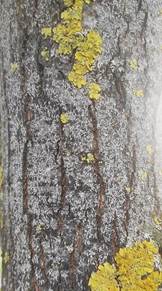 b b 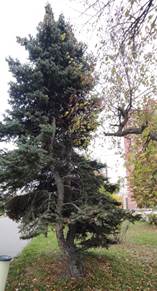 c c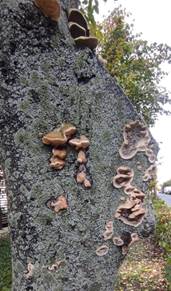 Figure 3 – Examples of damage: a) a comma-shaped shield on a small-leaved linden, b) a curvature of the trunks of a prickly spruce, c) fruit bodies of a mushroom on a bird cherry
The overall condition coefficient of the boulevard's plantings is 2.15, i.e. their vital condition is weakened. Compared to the part of the boulevard in the central part of the city [9], which is assessed as severely weakened (condition coefficient 2.7), the plantings here are in better condition. In many ways, the reason lies in the younger age of the plants: the boulevard was built in 1980 in the zarechnaya part, and in 1960 in the central part. In addition, the zarechnaya part has a wider range of plants (29 species), while in the center it is very limited – only 5 names, of which apple and mountain ash, as shown by earlier studies [8], are the most damaged plants in our city. It is known [10, 11] that a poorer species composition of plantings increases their vulnerability. It is worth noting that the lawn strips in the zarechnaya part of the boulevard are wider than in the center. In addition, in the central part of the city, the plantings are more dense, surrounded by closely located buildings, the width of the boulevard is smaller, and in the river part the boulevard is wider, the space is more open and ventilated, which is generally more favorable for the development of woody plants, despite the low fertility of alluvial soils. Conclusion. Thus, the plantings of the riverine part of Chavain Boulevard in Yoshkar-Ola are characterized by a weakened state. Among 1,338 copies . 2.2% of healthy people were identified, 81.1% of the weakened, 15.5% of the severely weakened, 0.2% of the shrunken, and 1.0% of the dead. The most reduced vital condition among coniferous plants was western thuja, among deciduous trees – mountain ash, wild cherry, berry apple and house apple, among deciduous shrubs – Tatar honeysuckle. In areas shaded by buildings, the vital condition of light-loving tree species is reduced. Compared to the central part of the boulevard, the plantings in the surveyed area are in better condition, due to their younger age, wider assortment and wider green stripes.
The article is published in the version approved by the reviewers (after receiving a positive review recommending the manuscript for publication) with corrections made by the author (after receiving the editor’s comments, if any).
Read all reviews on this article
References
1. Konashova, S.I., & Gulieva, E.A. (2018). Green plantings on the boulevards of Ufa. Interactive Science, 3, 52-54. https://doi.org/10.21661/r-469652. EDN YSWTYX.
2. Savostyanova, L.I. (2023). Pathogenic mycobiota of greened areas in the central district of Moscow: A case study of Novinsky Boulevard. In Botanical Gardens in the Modern World (pp. 163-166). Saint Petersburg State Electrotechnical University "LETI" named after V.I. Ulyanov (Lenin).
3. Nefedov, V.A. (2002). Landscape design and environmental sustainability. Polygraphist.
4. Srodnykh, T.B., Vishnyakova, S.V., Luganskaya, S.N., & Kaiser, N.V. (2024). Dynamics of species composition and condition of green plantings on the boulevards of Yekaterinburg from 2000 to 2023. International Research Journal, 10. https://doi.org/10.60797/IRJ.2024.148.102. EDN HZJQBX.
5. Kupper, K., Nutt, N., & Kaplinski-Sauk, M. (2025). Data from urban tree surveys of the 19th–21st centuries as input for planning the maintenance of historical tree stands: A case study of Kaarli Boulevard in Tallinn, Estonia. Baltic Forestry, 31(1), 793. https://doi.org/10.46490/BF793. URL: https://balticforestryojs.lammc.lt/ojs/index.php/BF/article/view/793. EDN EXCUKC.
6. Mukhametova, S.V., & Kladovikova, T.S. (2026). Species composition of plantings on Chavayna Boulevard in the floodplain part of Yoshkar-Ola. Science Diary, 4. URL: https://dnevniknauki.ru/images/publications/2026/4/biology/Mukhametova_Kladovikova.pdf.
7. History of the streets of Yoshkar-Ola. URL: https://olacity.ru/showthread.php-bid=5&threadid=6552&page=3. Accessed April 18, 2026.
8. Mukhametova, S.V., & Kurnenkova, I.P. (2025). Species composition and living condition of plantings on the streets of Yoshkar-Ola. Bulletin of the Volga State Technological University. Series: Forest. Ecology. Nature Management, 3, 53-69. https://doi.org/10.25686/2306-2827.2025.3.53. EDN UFYNMX.
9. Mukhametova, S.V., & Sedykh, A.G. (2026). Analysis of species composition and living condition of plantings on Chavayna Boulevard in the central part of Yoshkar-Ola. Science Diary, 1. URL: https://dnevniknauki.ru/images/publications/2026/1/biology/Mukhametova_Sedykh.pdf.
10. Anisimova, S. (2023). Analysis of the dendrofloristic composition of urban street tree plantings in Sofia. Scientific Papers. Series B. Horticulture, 67(2), 432-437. URL: https://horticulturejournal.usamv.ro/index.php/scientific-papers/current-issue-id=1443.
11. Alexander, J.F. Martin, & Conway, T.M. (2025). Historical drivers of street tree species selection: A comparative archival study of Canadian Prairie cities. Trees, Forests and People. https://doi.org/10.1016/j.tfp.2025.101044.
Peer Review
Peer reviewers' evaluations remain confidential and are not disclosed to the public. Only external reviews, authorized for publication by the article's author(s), are made public. Typically, these final reviews are conducted after the manuscript's revision. Adhering to our double-blind review policy, the reviewer's identity is kept confidential.
The list of publisher reviewers can be found here.
The subject of the study, according to the author, is the analysis of the vital state of woody plants on Chavain Boulevard in the zarechnaya part of the city of Yoshkar-Ola (Republic of Mari El), where the species composition of the plantings of this object was previously presented. The methodology of the study, the article indicates that the methodological basis of the study is a systematic approach, which involves considering the coastal city as a complex spatial and functional system. The study was conducted in September 2025 by taking a complete inventory of the available woody plants. The plants growing directly on the boulevard strips are taken into account. To identify a possible connection between the vital state of plants and growing conditions, the surveyed part is divided into sections. The sanitary condition of the plants was assessed on a 5-point scale of the Rules of sanitary safety in forests (2020). The condition coefficient of the boulevard as a whole (Ko) is calculated as the arithmetic mean of the coefficients of the condition of individual species. The condition of the plantings was assessed on a scale. The relevance of the topic is indisputable, since public green spaces play an important role in urban landscaping and are a component of their landscape and architectural appearance, perform important functions to optimize the spatial environment, maintain ecological balance and comfort, and enhance the aesthetic appearance of the city. Modern large cities are a well-developed network of streets, avenues and boulevards where citizens stay daily, but it is the boulevards that are most often used for short-term rest and walks, therefore the rational organization of their layout and landscaping is relevant. At the same time, despite the existence of legal prerequisites and the growing investment interest in alluvial projects, there is no unified scientific and methodological framework in Russian practice that ensures the integration of artificial land into the territorial planning system. Ongoing projects are often fragmented and insufficiently consistent with strategic and territorial planning documents, which reduces the effectiveness of using green spaces as a tool for sustainable development of territories. .The scientific novelty lies in the fact that, based on the conducted research, the plantings of the zarechnaya part of Chavain Boulevard in Yoshkar-Ola are characterized by a weakened state. Among 1,338 copies . 2.2% of healthy people were identified, 81.1% of the weakened, 15.5% of the severely weakened, 0.2% of the shrunken, and 1.0% of the dead. The most reduced vital condition among coniferous plants was western thuja, among deciduous trees – mountain ash, wild cherry, berry apple and house apple, among deciduous shrubs – Tatar honeysuckle. In areas shaded by buildings, the vital condition of light-loving tree species is reduced. Compared to the central part of the boulevard, the plantings in the surveyed area are in better condition, due to their younger age, wider assortment and wider green stripes. The results obtained create the prerequisites for the formation of urban planning design and territorial planning at the regional and municipal levels in the support system. Style, structure, content the style of presentation of the results is quite scientific. The article is provided with rich illustrative material reflecting the research. The bibliography is very comprehensive for raising the issue under consideration, but it does not contain references to regulatory legal acts and methodological recommendations. The appeal to the opponents is presented in identifying the problem at the level of the available information obtained by the author as a result of the analysis. Conclusions, the interest of the readership in the conclusions there are generalizations that made it possible to apply the results obtained. The target group of information consumers is not specified in the article.
|





 © 1998 – 2026 Nota Bene. Publishing Technologies. NB-Media Ltd.


