|
Man and Culture
Reference:
Varakina, G.V., Dobrovol'skaya, V.E. (2026). Fairytale images interpreted by product design: the iconographic uniqueness of the capsules «Firebird», «Threads of Time», and «The Secret of Buyan Island» (TD «Culture of the House»). Man and Culture, 2, 148–166. https://doi.org/10.25136/2409-8744.2026.2.79464
Fairytale images interpreted by product design: the iconographic uniqueness of the capsules «Firebird», «Threads of Time», and «The Secret of Buyan Island» (TD «Culture of the House»)
Varakina Galina Vladislavovna
ORCID: 0000-0002-0004-3989
Doctor of Cultural Studies
Head of the Department; Department of General and Slavic Art Studies; A.N. Kosygin Russian State University (Technology. Design. Art)
129337, Russia, Moscow, Yaroslavsky district, Khibinsky passage, 6

|
galina_varakina@mail.ru
|
|
 |
Other publications by this author
|
|
|
Dobrovol'skaya Varvara Evgen'evna
ORCID: 0000-0002-2346-7493
PhD in Philology
Associate Professor; Department of General and Slavic Art Studies; A.N. Kosygin Russian State University (Technology. Design. Art)
115035, Russia, Moscow, Zamoskvorechye district, Sadovnicheskaya str., 33, building 1
|
|
dobrovolska@inbox.ru
|
|
 |
|
DOI: 10.25136/2409-8744.2026.2.79464
EDN:
YOORMW
Received:
04/18/2026
First review received: 04/24/2026 06:17 — manuscript returned for revision
Revised manuscript submitted: 04/24/2026 17:02
Second review received: 04/26/2026 08:54 — manuscript returned for revision
Revised manuscript submitted: 04/27/2026 15:42
Final review received: 04/28/2026 14:36 — recommendation for publication.
The article is published in its final version as approved following the last positive peer review recommending acceptance for publication. It incorporates revisions made by the author in response to prior negative peer review reports that did not recommend publication. All peer review reports, including initial negative reviews, are published in open access alongside the article. All versions of the author’s revisions are archived in the publisher’s repository and may be made available upon reasonable request in accordance with Elsevier’s editorial policies and applicable data availability requirements.
Read all reviews on this article
Published:
04/30/2026
Abstract: This study examines the interpretation of fairytale imagery in product design. The empirical data comes from the capsule collections of the “Culture of the Home” Trading House, a collaboration with the Construction Alliance Holding Company. The study aimed to identify methods for working with folklore and ethnographic material, as well as visual prototypes — murals and fairytale illustrations. This was accomplished through an iconographic analysis of three capsules — “Firebird”, “Threads of Time”, and “The Secret of Buyan Island”. Through this analysis, we determined the rationale for incorporating fairytale themes and their connection to the Trading House's concept. The research methodology is based on an interdisciplinary approach at the intersection of art history, cultural studies, and cultural anthropology. Along with the iconographic method, we used comparative comparison to establish parallels between various cultural phenomena — fairy tales, murals, and designer capsule collections. The novelty of this study lies in its understanding of traditional values in their fairytale-like presentation through the forms of product design. The developed approach to understanding designer products can serve as a methodological basis for expanding existing capsule collections and as a foundation for the development of similar collections. The study's main findings relate to the interpretation of fairytale images in a new cultural space. In this case, fairytale images act as bearers of traditional values, and the fairytale itself serves as a marker of national culture. Through fairytale images, product design conveys traditional values into contemporary culture, implementing a mechanism for national self-identification — the recognition of “one's own” and “other”. Characteristically, the design inherits predominantly positive fairytale images focused on creation, love, overcoming difficulties, justice, and happiness. Moreover, the design utilizes various methods of transmission, both directly illustrating the text and symbolically reproducing it. However, in all cases, stylization is used alongside the creation of a systemic environment.
Keywords:
object design, capsule collection, decorative and applied arts, folk tale, author's tale, traditional values, cultural heritage, iconographic analysis, interpretation, stylization
This article is automatically translated.
Introduction This research is based on a wide range of empirical material, which is very diverse in its linguistic means: textiles, porcelain, book illustration, murals. The main group of analyzed objects were products from capsule collections of the Kultura Dom Trading House (Moscow region, Solnechnogorsk, Lozhki village, ICP Esipovo). The fairy‑tale theme of the capsules "Firebird", "Threads of Time" and "The Secret of Buyan Island", in turn, continued the figurative storyline of the prototypes – the fabulous murals of the industrial parks "Koledino" and "Esipovo" and illustrations to Russian fairy tales by I. Ya. Bilibin. This study is aimed at identifying the features of the interpretation of fairy-tale images in object design, in particular, in the capsule products of the Kultura Dom trade House. The purpose of the study was to determine how designers work with folklore and ethnographic material, as well as with visual prototypes - murals and fairy—tale illustrations. The object of the study is fairy—tale images, the subject of the study is their adaptation and interpretation in modern object design. The research methodology is based on an interdisciplinary approach, which is determined by the thematic field at the intersection of art history, cultural studies and cultural anthropology. Along with the iconographic method, we used the comparative comparison method, which allowed us to establish parallels between different cultural phenomena – fairy tales and fairy-tale illustrations, murals and designer capsule collections. Despite significant artistic practice based on folk culture, traditional forms and techniques [1, 2, 3, 4], The issue of translating the national cultural code through fairy‑tale images familiar to everyone by means of modern decorative and applied art and object design remains open, as does the scientific understanding of the existence of national culture in the modern world. A number of landmark exhibition projects with a fabulous theme can be noted. One of the first was the 2020 exhibition. "A Russian fairy tale. From Vasnetsov to now" (GTG). Among the latter, the most interesting immersive project of the Winery "ONCE UPON a TIME: The Kingdom of a Russian fairy tale" (10/15/2025 – 03/01/2026, Moscow) should be highlighted. In most cases, these are exhibitions of paintings and graphics, often of a retrospective nature, sometimes with access to a modern art space, as well as using current forms of presentation. The art criticism discourse regarding fairy tales in art and design is not so active. One of the aspects of studying fairy–tale themes and its visual potential is the consideration of the latest artistic practices aimed at integrating ethno-cultural heritage as a whole [5, 1, 2]. Fairy-tale images are interpreted as a special case of mythologized consciousness [3, 4], much less often acting as an independent subject of research [6], often in the context of in the context of illustrative material analysis [7]. Moreover, when considering fairy tales and fairy-tale images, the cultural approach prevails in the visual culture of our time. Russian Russian style in general and the influence of Russian national culture on modern art and design are another vector in the study of the visual interpretation of fairy tales [8-10]. Fairy-tale themes and design have many visual intersections, but the research traditions here are very modest. There are separate studies in the field of decorative and applied art [11, 12], monumental and decorative art [6], as well as in the field of design engineering [13]. However, research raises specific issues, such as modern subject analogies of magical curiosities [13], the style of a particular author or factory in a certain time range [14], the image of a fairy—tale hero and costume, often scenic (magical fairy-tale) [15]. This not only does not exhaust the theme of fairy tales in design, but it does not even form the main direction, does not define approaches and strategies in the study of the topic. Fairy tales and fairy-tale images are the subject of study, primarily in folklore and literary studies. Since the end of the twentieth century. The attention of researchers began to attract not only the nature of fairy-tale characters, the origin of plots and interdisciplinary interactions, but also the place of fairy tales in the actualization of folklore heritage [16-18], as well as the formation of national cultural code and characteristics defining the national consciousness and mentality of the Russian people through fairy-tale plots and images [2, 19-21]. The novelty of this research lies in the comprehension of traditional values in their fabulous presentation through the forms of modern object design. The theoretical significance of the research results is due to the identification of the mechanism of adaptation of fairy-tale images in their textual and visual versions to shaping in object design, which can be the basis for the methodology of this kind of research. Our findings also have practical implications for the formation and expansion of capsule collections of fairy-tale themes.
Fairy-tale themes in the concept of TD "Culture of the House" The activity of the House Culture Trading House — artistic, design and marketing — is based on the principle of the connection of generations and historical continuity. The Trading House considers the family to be the starting point, in which the basic life values of a person are formed, fixed in the form of household rituals. The institution of the family is understood by the Russian brand as a model of the universe based on Russian folk traditions. Thus, the imagery of traditional culture, including the artistic and technological practices of our ancestors, is in the area of designers' interest. This dialogue is the basis for a complex process of stylization and shaping aimed at updating our cultural heritage. The slogan "Preserving traditions is a contribution to the future" became a peculiar slogan of the company. It is no coincidence that among the partners of TD Kultura Doma there are large factories — Fedoskino, Rostovskaya Finift, Kadmsky Veniz, Argenta, Orienburg down Shawls, Velikoustyug plant Severnaya Chern, Bakhmetev 1764, Kholuyskaya Strochka, Torzhok Golden Highways.
The idea of referring to national origins, and not by quoting them directly, but by creatively assimilating and recoding them in a new cultural reality, became the basis for creative interaction between the Kultura Dom Trading House and the Construction Alliance Holding. It is not only about the spiritual and moral foundations of Russian culture, but also about a global immersion into its mental nature, including in the form of fabulous images — carriers of cultural values. The result of this interaction was the appearance of three capsule collections of TD "Culture of the House" — "Firebird", "Threads of Time" and "The Secret of Buyan Island", created based on the murals of the industrial parks of the Holding (Moscow region) of the same name. However, cooperation alone cannot explain the appearance of "fabulous" capsules. Fairy tales occupy a special place in the "Culture at Home" program. On the one hand, it is a rich material for replication and stylization; on the other, it is an appeal to our history, authentic folk roots, which fully correlates with the brand concept. There are several reasons for the interest in fairy-tale images on the part of the designers of Culture at Home: These are the imaginativeness and variability of literary texts; the richness and diversity of already existing visual material, including illustrations (in particular, I. Ya. Bilibin), decorative and applied art, the heritage of crafts and artistic crafts. In addition, this is due to a common interest in the roots and origins of Russian national culture in modern Russian society. This interpretation of the fairy tale by a large industrial developer and a Russian design brand correlates with current trends in the field of fairy-tale studies. Thus, in the studies of major Russian folklorists, it is noted that it is through fairy—tale plots and images that one can most clearly show the special soul structure and value orientations inherent in a person of Russian culture - "Russianness", which defines cultural and civilizational identity [19, 22]. Fairy-tale images become a kind of identification marks for people of Russian culture, who do not need to retell the plot of a fairy tale, talk about the functions of a character or describe his appearance. Native speakers of the national code recognize a fairy tale by its individual elements, not verbally, but rather visually [20]. A fairy tale becomes the bearer of a number of symbolic meanings, which makes it possible to actively use fairy-tale images in design. Thus, fairy—tale images can be considered not only as a visual material of modern design - rich and diverse, but also as a carrier of deep content through which the past grows into the present, defining the meanings of the future. The activity of the House Culture trading house, which is based on such a significant concept of strengthening the family and family values, creates objects that are quite functional, combining the principles of usefulness, practicality and, at the same time, aesthetics. It is impossible to rigidly define the consumer audience of this brand, because the range offered is very wide and diverse: from quite budget items to unique products. However, in any thing produced by the "Culture of the House", attention is felt to the quality of the material, production technology, and elegance of details. It can be either a mixed technique with a large proportion of manual execution in Luxury products, or more modest items with individual embroidered motifs or a reinforced edge, available to almost any buyer. Thus, the Trading House implements in practice the principle of diversity of both society and design. Capsule products are also very diverse: napkins and cups, used in most Russian homes every day, and at the same time carpets and luxury bed linen with rich decor, available to a much smaller proportion of buyers. However, the principle of democracy in capsules dominates, at the same time forming stable norms of table setting and household organization based on historically established traditions in Russian society.
Iconography of fabulous capsules The first capsule collection of TD "Culture at Home" was created in the fall of 2025 based on the material of Svetlana Georgievna Perevozchikova's mural "Firebird", located in the Koledino Industrial Park (Moscow region, Podolsk). The capsule, developed under the guidance of Isolde Shangua, brand director of Kultura Dom Trade House, includes home textiles, tableware, and residential interior accessories. The collection not only relies on the imagery and visual material of the mural, it borrows and further develops the symbolic meanings of its main figurative motifs. The capsule collection uses both the complete image of the Firebird and individual motifs of the composition – a golden feather, radiance, a braided ornament, spirals symbolizing the salt cycle. In all objects, color works as a thematic marker: it is either yellow-gold or fiery red (Fig. 1).
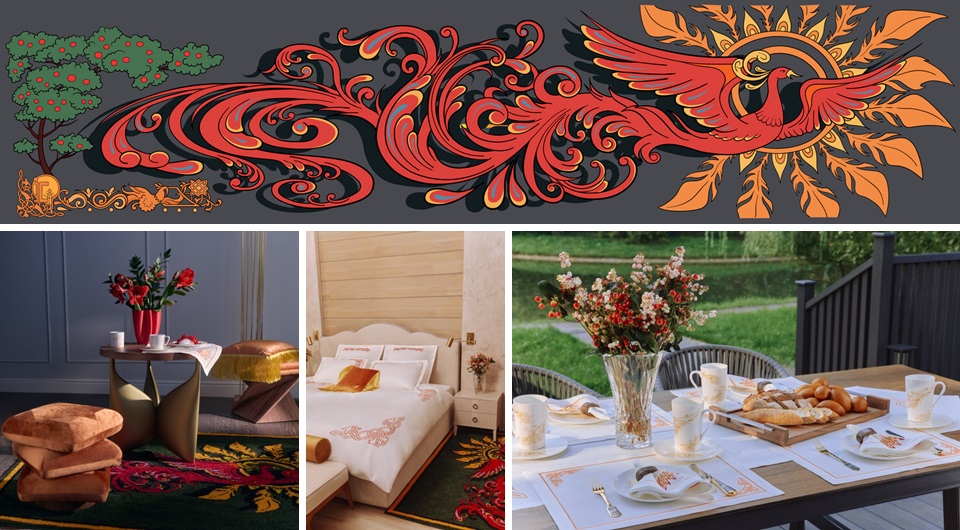
Fig. 1. S. G. Perevozchikova, "Firebird", sketch of the mural, 2025, ICPark "Koledino", developer Holding "Construction Alliance". Capsule collection "Firebird", 2025, TD "Culture of the House" in cooperation with the Holding Company "Stroy Alliance". Photos of the copyright holders of the Construction Alliance Holding and the Culture of the House trading house
Decorative motifs are transferred to household items not mechanically in the form of a print; they are significantly stylized, focusing on a different scale, a specific shape and a specific functional purpose of the product. If the neutral black background is the background of industrial blocks (buildings), and the grandiose scale of the mural allows you to apply the redundancy of decor and a dense mass of color, then in a home where a person rests not only with his body, but also with information and emotion, such activity is inappropriate. And we see how the Firebird's power, preserved on the carpet, an accent element of the interior, weakens against the beige‑gold background of the pillow, losing its fiery red tone. The finely patterned feathers on the paintings of plates, glasses and tea pairings look even more exquisite, like the finest ornament of traditional embroidery. It is no coincidence that designers turn to the technique of gold embroidery when choosing a way to visually present an image. In the exquisite embroidery of home textiles, we see continuity with the mural's companion pattern. However, even here the drawing is verified: it loses its lapidarity and picturesqueness, striving for clarity and clarity in the spirit of the ancient Cyrillic script (Fig. 2).
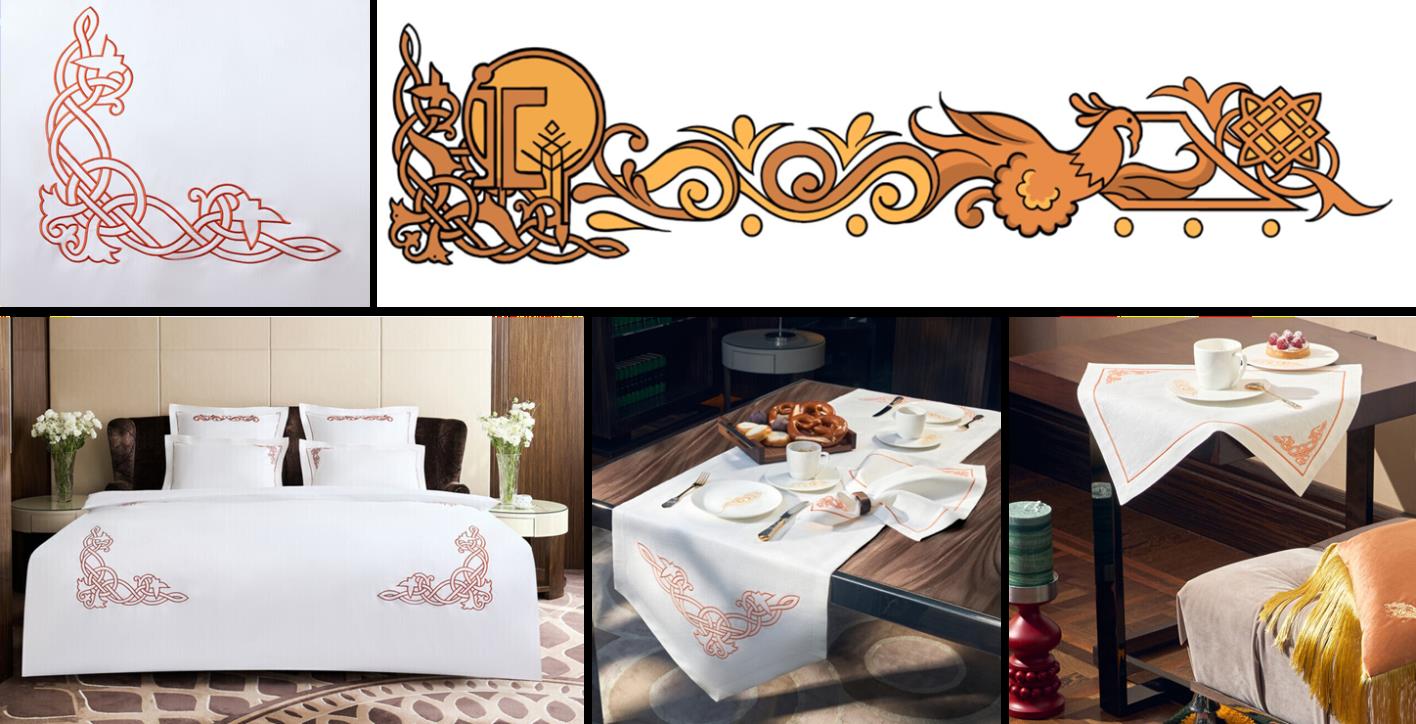
Fig. 2. S. G. Perevozchikova, "Firebird", sketch of the mural, fragment: pattern, 2025, ICPark "Koledino", developer Holding "Construction Alliance". Capsule collection "Zhar-ptitsa", 2025, TD "Culture of the House" together with the Holding Company "Stroy Alliance". Photos of the copyright holders of the Construction Alliance Holding and the Culture of the House trading house
In the same year, 2025, the Kultura Dom Trading House developed two more capsule collections based on the visual material of the fabulous murals "The Secret of Buyan Island" and "Threads of Time" by artist Nina Vladimirovna Ignatova (Esipovo–4, Solnechnogorsk, Lozhki, Moscow Region). They are identical in content and include basic types of products: carpet, decorative pillows, table textiles, linen sets, dishes and accessories. The imagery of the capsules is determined by the picturesque motifs and the color palette of the murals. The capsule "Threads of Time", starting from the mural of the same name, takes as a basis the imagery of folk tales "The Frog Princess", "The Beautiful wife (Go there I do not know where)". However, we have already noted in our study of the iconography of murals that artists "rely not on authentic folklore images, but on the author's interpretation: literary fairy tales, film adaptations, modern stereotypes" [23, p. 8]. This gives great freedom in constructing the composition, enriching the imagery of the mural with a significant number of details: the real world, the world of Ivan Tsarevich, a fantastic landscape with mythical birds and everyday motifs in the staff (Fig. 3).
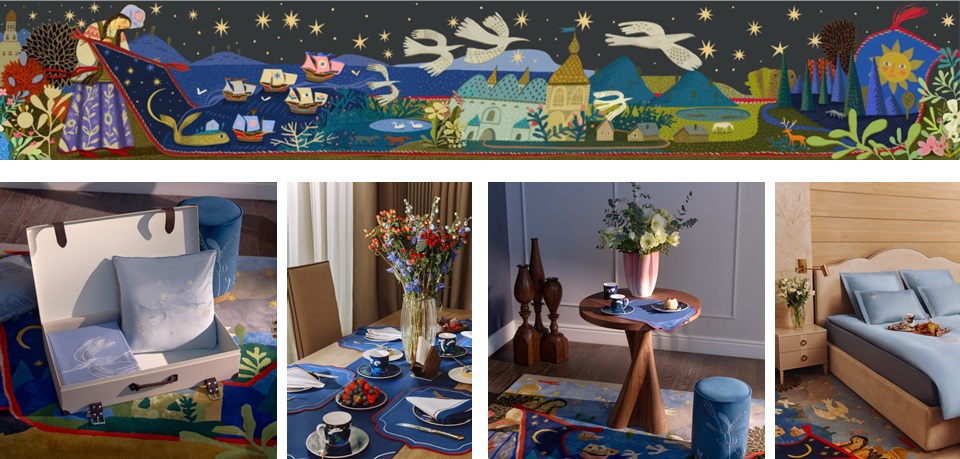
Fig. 3. N. V. Ignatova, "Threads of time", sketch of the mural, 2025, ICPark "Koledino", developer Holding "Construction Alliance. Capsule collection "Threads of time", 2025, TD "Culture of the House" together with the Holding Company "Stroy Alliance". Photos of the copyright holders of the Construction Alliance Holding and the Culture of the House trading house
The designers of "Culture at Home" are moving even further away from the fabulous text. Along with reproducing the mural's compositional core — the image of Vasilisa the Beautiful (Frog Princess) weaving a carpet (carpet, dessert plate, mug) ‑ they explicate individual motifs — a fabulous landscape, flying birds, stars (tea steaming, scented candles, a set of bed linen, decorative pillow). At the same time, these images are well recognizable. They seem to be transferred from the mural to painting and embroidery, adapting to new shapes, sizes, materials and technologies. So, on the plate, the motif of the carpet with the image of Vasilisa the Beautiful weaving it fits in a circle, obeying the shape set by the porcelain. In the circle, the carpet and the landscape are spatially separated; the carpet rather correlates with the sky with stars and fabulous birds. All that remains on the tea pair is a landscape motif with a starry sky and birds, while the carpet transforms into a blue background with a red edge. The image of Vasilisa the Beautiful disappears altogether. Designers symbolically interpret the color palette, understanding it as an active element of the composition. The color becomes a kind of emblem of the capsule, giving rise to a sense of unity, both of its objects and the interior environment as a whole. So, the napkin, the placemat and the path are designed in white, blue and red, reminding either of the night sky when Vasilisa was weaving a magic carpet, or of the carpet itself in their mural version. Thus, everything that falls into the area of table textiles in this collection is interpreted as a miracle city, recalling a similar motif from the play in L. Filatov's poems "About Fedot the Sagittarius, a Dashing Fellow", as well as the animated image from the cartoon "The Frog Princess" (1954, directed by M. Tsekhanovsky) [23]. The color density within the capsule varies from dark blue to sky blue. The dominance of the color spot in porcelain decoration and carpet design is replaced by the dominance of the lineage in textiles. Here, the designers appeal to the traditions of Russian embroidery, in particular, the technique of the smooth surface, the Vladimir top stitch (Fig. 4).
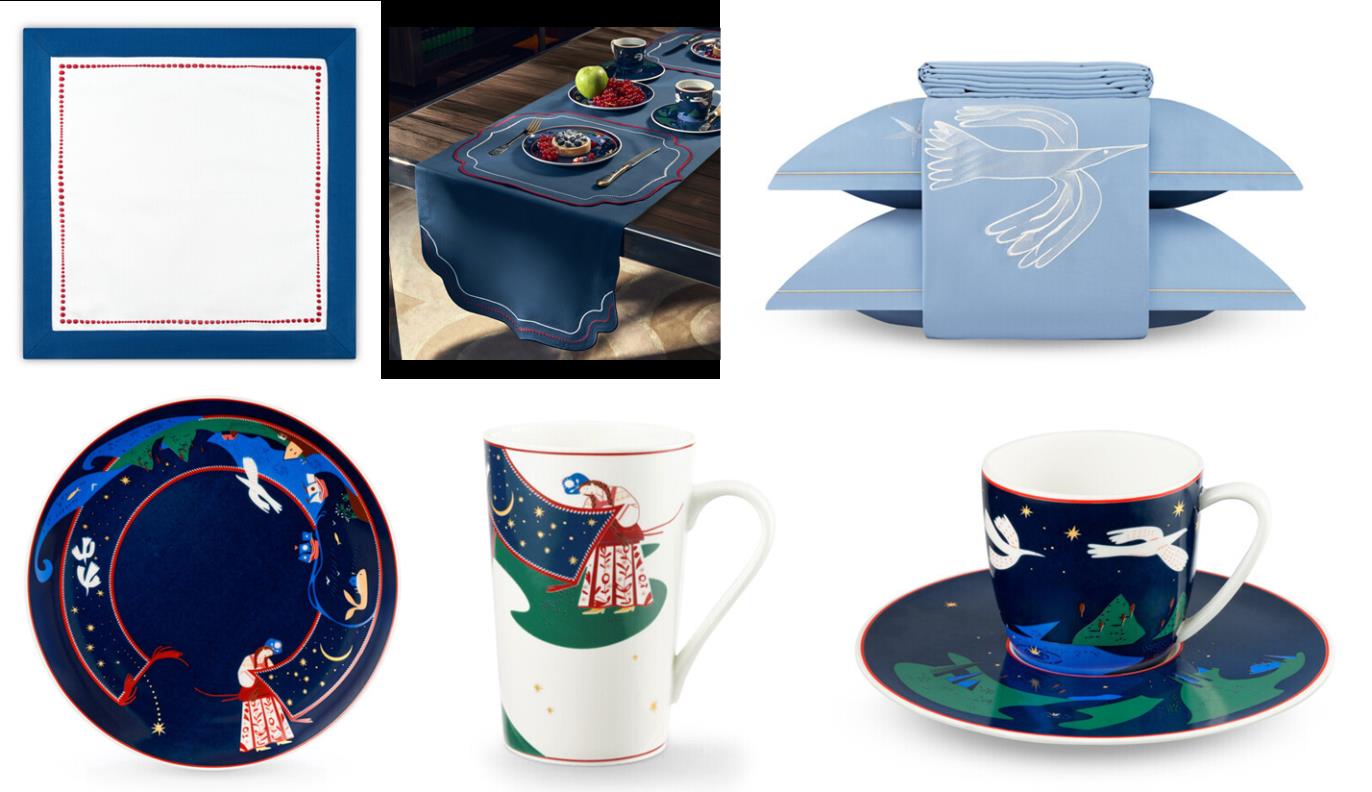
Fig. 4. Capsule collection "Threads of time", 2025, TD "Culture of the house" together with the Holding Company "Stroy Alliance". Photos of the copyright holder of the Kultura Dom trading house
Forming groups in the space of the house, these objects enter into a dialogue, forming a single design environment where the image of Vasilisa, the wonderful carpet and the city kingdom is reflected not only in the decor, but also in the interior as a whole. The interior itself transforms into a wonderful carpet with a living pattern. The capsule "The Secret of Buyan Island", like the mural of the same name, is based on the imagery of Alexander Pushkin's "The Tale of Tsar Saltan", in particular, referring to the images of the Princess.‑Swans, Prince Guidon, Uncle Chernomor and thirty–three heroes, as well as the island city of Buyan itself. There is an effect of action and staginess in the mural, although it cannot be called an illustration of a fairy tale, if only because it does not illustrate a specific moment of action. However, there is space, compositional plans, the interaction of characters and the environment: The Princess‑The swan and Guidon are coming, the ships are sailing up, Chernomor and bogatyrs are coming out of the waters. Thus, the mural moves away from narrative into the realm of the play of symbols, while maintaining a connection with the fairy-tale illustration through the proximity of picturesqueness and text (inscribed lines from the fairy tale of A. S. Pushkin). The designers of "Culture at Home" interpret both the fairy tale and the mural prototype even more symbolically. One can note the careful selection of visual material with an emphasis on the image of a wave, as if echoing A. S. Pushkin: "You, my wave, wave! / You're cheating and you're free." Figurative motifs appear, as in other capsules, extremely rarely: these are images of swans and ships. Moreover, if the image of ships aiming at the Buyan's carcass is in the mural, then the image of the swan bird is absent and is represented only in the anthropomorphic form of the Swan Princess. Designers choose a more elegant ornithomorphic version (Fig. 5).
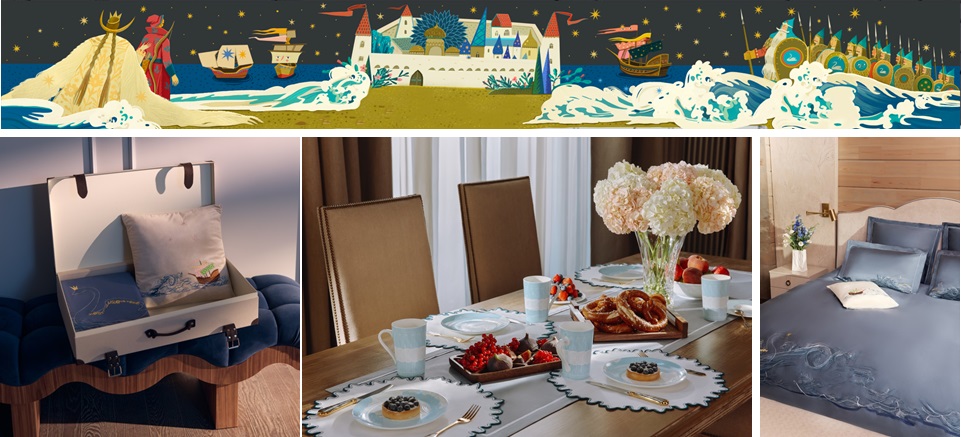
Fig. 5. N. V. Ignatova, "The Mystery of Buyan Island", sketch of the mural, 2025, ICPark "Koledino", developer Holding "Construction Alliance". Capsule collection "The Secret of Buyan Island", 2025, TD "Culture of the House" together with the Holding Company "Stroy Alliance". Photos of the copyright holders of the Construction Alliance Holding and the Culture of the House trading house
The decor of the objects of the "Mystery of Buyan Island" capsule is based on a delicate color – shades of blue—blue - and selected motifs of the visual material of the mural of the same name — waves, clouds, ships, a swan. This allows you to avoid ostentation and illustrativeness in elegant interior items, to give an up-to-date interpretation of retrospective images and forms. Unlike murals, where a dense color is crucial, in capsules the color is maximally lightened by dilution (not blue, but pale blue), transforming into a background. The pasty smear of the mural is replaced by a subtle pattern, which we also observed in the two previous capsules. If the linearity in porcelain painting corresponds to the traditions of decorating dining groups, then in textiles designers find a solution through embroidery, referring to the traditions of the tambour seam (Fig. 6).
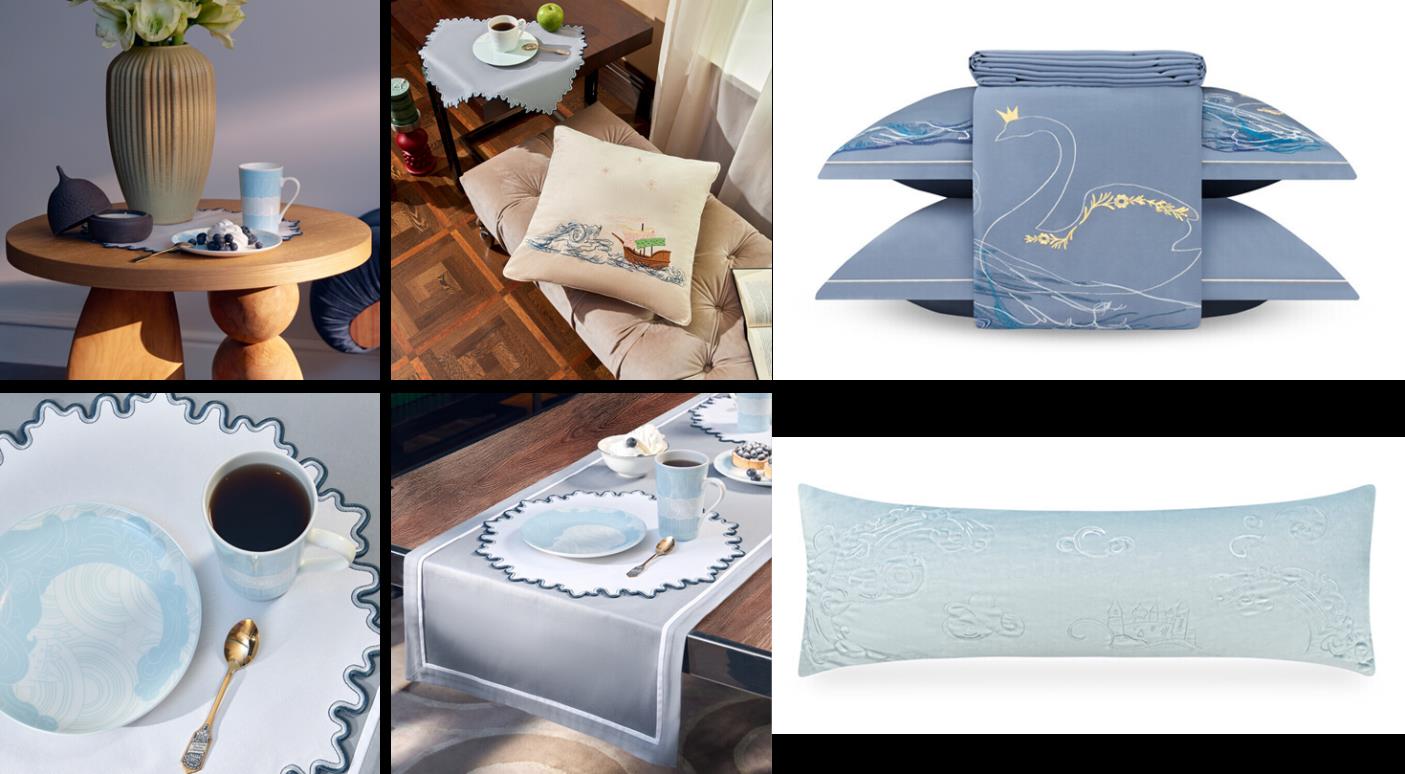
Fig. 6. Capsule collection "The Secret of Buyan Island", 2025, TD "Culture of the House" together with the Holding Company "Stroy Alliance". Photos of the copyright holders of the Construction Alliance Holding and the Culture of the House trading house
This kind of stylization and even schematization in the development of the thematic decoration of capsule objects allows you to form groups of different composition. Moreover, it is recommended to include other non-collectible objects in interior compositions based on the principle of complementarity, without feeling dissonance. The lack of illustrativeness in working with the visual material of murals protects the capsule design from ostentation, retrospection and kitsch, giving a modern interpretation to such familiar fairy-tale plots and images.
Conclusion Thus, by comparing the visual material of the capsule collections of the Kultura Doma trading House and the fabulous murals of the Construction Alliance Holding, we have identified both their thematic kinship and the originality of the design solution. The unity of the visual material of murals and capsules is due to the common position of business partners regarding the idea of connecting times and continuity. If the Construction Alliance Holding considers the issue of industrial progress, understood through history, as its program, then the slogan of the Culture at Home trading house is the idea that "traditions are born in the family." Thus, the partners joined forces in an attempt to build their businesses on Russian traditions, not by reviving them, but by creatively translating them into modern products. However, in the case of capsules, we found great variability in the development of the material — its fragmentation, rearrangement, stylization of forms, schematization and the release of decor into real space by means of including interior items in a single visual series (for example, a placemat — a plate with paintings — gastronomy — table — ...). Moreover, in addition to appealing to the visual material of murals and related texts and illustrations, capsules actively use expressive means of artistic crafts. All this indicates a creative approach to working with visual material, both iconographic and technological in nature. Technologically, capsule collections are an example of the intermediate translation of the picturesque manner of murals and graphic illustrations into the exquisite intimacy of decorative and applied art. In each case, the artists and designers of the "Culture of the House" find a technical equivalent to the element of painting, using an inexhaustible source of traditions of Russian folk art crafts. And if in the case of murals we could talk about their intertextual nature, then in the case of a capsule collection, when referring to other materials and technologies, we can talk about an intermediate approach in product design. It should be noted that this intermediate nature is associated not only with the translation of the motifs and images of the mural from painting to applied art, but also in the search for forms of adaptation of traditional techniques to their machine reproduction. This transfer is not possible directly, given the different nature of art, materials, and technologies. This approach itself is a vivid example of the unity of labor, technology and creativity.
The article is published in its final version as approved following the last positive peer review recommending acceptance for publication. It incorporates revisions made by the author in response to prior negative peer review reports that did not recommend publication. All peer review reports, including initial negative reviews, are published in open access alongside the article. All versions of the author’s revisions are archived in the publisher’s repository and may be made available upon reasonable request in accordance with Elsevier’s editorial policies and applicable data availability requirements.
Read all reviews on this article
References
1. Afanogenen, B. V. (2024). The use of traditional household items in the exhibitions of Udmurtia's ethno-futurist artists. Yearbook of Finno-Ugric Studies, 18(3), 446-459. https://doi.org/10.35634/2224-9443-2024-18-3-446-459
2. Madyukova, S. A., & Popkov, Y. V. (2018). The integration potential of ethnocultural neotraditionalism. Knowledge. Understanding. Skill, (3), 146-156. https://doi.org/10.17805/zpu.2018.3.13
3. Tabunova, N. A. (2025). From antiquity to the present: A neomythological perspective in contemporary art. Art of Eurasia, (1), 178-195. https://doi.org/10.46748/ARTEURAS.2025.01.011
4. Chirkov, V. F., & Galygina, O. M. (2025). Mythological content in the works of "Siberian neoarchaics": A question of studying an artistic direction. Art of Eurasia, (1), 210-239. https://doi.org/10.46748/ARTEURAS.2025.01.013
5. Afanasyevskaia, N. V. (2024). Visual culture as a space for the formation and representation of ethnocultural identity. Yaroslavl Pedagogical Bulletin, (3), 208-213. https://doi.org/10.20323/1813-145X-2024-3-138-208
6. Varakina, G.V., Dobrovol'skaya, V.E. (2026). The Fairy-Tale Character as an Archetype of 'Russianness': In Search of a Cultural Code (Based on the Murals of the Industrial Park 'Yesipovo-4', Moscow Region). Culture and Art, 2, 1–16. https://doi.org/10.7256/2454-0625.2026.2.77776
7. Mishacheva, I. V. (2018). The world of folk tales in book illustration at the turn of the 19th-20th centuries: Heroes and landscape. Herald of Slavic Cultures, 48, 280-290.
8. Sorokina, L.I., Pryamkova, N.A. (2021). Folk art traditions in modern culture. Culture and Art, 3, 23–36. https://doi.org/10.7256/2454-0625.2021.3.33006
9. Vasilenko, E. V., & Mareeva, Y. S. (2019). National culture in the design of Russia. Bulletin of the Institute of World Civilizations, 10(1), 44-49.
10. Flerko, E. D., & Amirzhanova, A. Sh. (2019). "Russian traditions" in contemporary design: An analysis of theoretical research. Costumology, (4). Retrieved from https://kostumologiya.ru/PDF/17IVKL419.pdf
11. Ivanova, E. V. (2019). Fairy-tale images in the interior plastics of Leningrad porcelain artists in the 1950s-1960s. New Art Studies, (2), 56-60. https://doi.org/10.24411/2658-3437-2019-12009
12. Shabalina, N. M. (2011). Main trends in the development of Khaslinsk artistic cast iron foundry in the 20th-early 21st centuries. Bulletin of South Ural State University, (9), 96-101.
13. Vorobieva, T. Yu. (2021). The design project method based on the study of Russian folk fairy tales. In Science and education in the field of technical aesthetics, design, and technology of artistic processing of materials: Proceedings of the XIII International Scientific and Practical Conference of Russian Universities (pp. 135-142). St. Petersburg State University of Industrial Technologies and Design.
14. Kuptsova, I.A., Getmanenko , A.O. (2025). Creative industries as a means of updating Russia's cultural heritage (based on the example of the Tavrida.Art festival of young art). Culture and Art, 10, 171–185. https://doi.org/10.7256/2454-0625.2025.10.76124
15. Vorobieva, T. Yu. (2021). Fairy tale and myth as a way of developing cognitive thinking and the imagination of designers in the learning process in the 21st century. In Art and Design: History and Practice. Proceedings of the VI All-Russian Scientific and Practical Conference (May 29, 2021) (pp. 69-77).
16. Dobrovolskaya, V. E. (2019). The fairy-tale map of Russia: Actualization of folklore heritage or the "creation" of folklore? In Folklore in Everyday Culture: Collection of Articles (pp. 360-373).
17. Dobrovolskaya, V. E., & Chernysheva, Y. S. (2023). Russian fairy-tale heritage as an object of intangible ethnocultural heritage: Problems of actualization and use in the activities of cultural institutions. Traditional Culture, 24(4), 11-21. https://doi.org/10.26158/TK.2023.24.4.001
18. Petrova, N. S. (2013). Kikimora Vyatskaya and Koschey Tverskoy, or the folklore map of Russia. In Folklore of the 21st Century: Heroes of Our Time: Collection of Articles (pp. 30-38).
19. Pus, T. G. (2013). The Russian folk tale as an expression of national mentality. Scientific and Methodological Electronic Journal "Concept", 3, 1441–1445. Retrieved from http://e-koncept.ru/2013/53291.htm
20. Semyonova, L. E., Semyonova, V. E., Sivkova, D. A., & Dementyeva, O. V. (2017). Folk tales as a reflection of the ethnic auto-stereotype of the Russian people. Psychology, Sociology and Pedagogy. Retrieved from https://psychology.snauka.ru/2017/04/8003
21. Ivanova, A. A. (2019). The Firebird in Russian culture: On the problem of the evolution of the artistic image. In The Bird as an Image, Symbol, Concept in Literature, Culture, and Language: Collective Monograph (pp. 18-31).
22. Kharlapova, Y. V. (2024). National character and its reflection in the psychology of Russian folk tales.
23. Varakina, G. V., & Dobrovolskaya, V. E. (2026). Murals in the context of media culture: From self-expression to cultural code (based on the materials of industrial parks in the Moscow region). Herald of Moscow State University of Culture and Arts, (1), 119-133. https://doi.org/10.24412/1997-0803-2026-1129-119-133
First Peer Review
Peer reviewers' evaluations remain confidential and are not disclosed to the public. Only external reviews, authorized for publication by the article's author(s), are made public. Typically, these final reviews are conducted after the manuscript's revision. Adhering to our double-blind review policy, the reviewer's identity is kept confidential.
The list of publisher reviewers can be found here.
The article submitted for review presents the experience of interpreting objects from the capsule design collections of the Kultura Dom trading house, which, on the one hand, have a specific visual prototype – murals of buildings of the Construction Alliance holding, but, on the other hand, demonstrate specific design solutions that allow to adapt solutions of monumental and decorative art in the works of subject design of the circulation character. The topic should be recognized as relevant, as it touches upon the issue of the relationship between art and commercial production, the adaptation of traditional visual images and motifs in the space of a modern city (murals) and houses (capsule collections of household items). In this sense, the analysis of the results of creative and commercial collaboration is of interest and has scientific potential as an experience in understanding the tools of transformation of visual images depending on the requirements of scale, materials, and industrial production method. The article consistently analyzes the key products of the collections "Firebird", "Threads of Time" and "The Secret of Buyan Island", which represent options for rethinking the artistic solutions of their prototypes — murals of the industrial parks "Koledino" and "Esipovo". The author focuses on iconographic analysis, identifies key compositional solutions, and identifies solutions that have made it possible to adapt the scale of monumental images to works of object design (the author calls the main solution an orientation towards the principle of decorating handicrafts that correlate plot images and ornamental motifs with the shapes and materials of objects). In general, the article is a rather interesting way to analyze specific design solutions, but for publication it is necessary to clarify a number of points: The first. The author, listing the research methods, points out that the iconological method made it possible to comprehend fairy-tale characters in the context of modern culture, within the framework of the design concept of the brand "Culture at Home". The iconographic method, also named, is actively used in the article, but the claimed iconological method sounds significantly weaker. It is worthwhile either to exclude it from the list of methods, or to strengthen it in the text, remembering that within the framework of iconological analysis, a work of art is considered as a verbal expression of culture, analyzes its symbolic ideas and connects them with specific social, religious or philosophical ideas of the era. These ideas should be emphasized. Second. It is necessary to revise the text once again and remove unnecessary references to publications and manuscripts, transfer them to the list of references (for example: when considering fairy tales and fairy-tale images in the visual culture of modernity, a culturological approach prevails: Butkova O. V. Transformation of fairy-tale plots in the visual culture of the 1st half of the 20th century: dis. ... cand. Culturology : 24.00.01. Moscow, 2013. 20 p.). The third. The author points out that the novelty of the research lies in the comprehension of traditional values in their fabulous presentation through the forms of modern decorative and applied art and object design. The work deals with monumental and decorative works included in the actual urban landscape (whether this is art is a separate issue) and the interpretation of images in works of mass design. Decorative and applied art is mentioned in the analysis of the range of reference works, and I must say that the fairy-tale plots in the author's porcelain and textiles are quite well studied. It is worth excluding the mention of decorative and applied art from the novelty, given that the very question of the relationship between the author's unique art and the art of circulation is still in the field of active scientific discussions. Fourth, the authors of murals and capsule collections Zhar Ptitsa, Threads of Time, and The Secret of Buyan Island are not named in the work, and this is very important both for understanding the development of authorial manners in murals and collections, and for their use in solving specific commercial tasks. If these shortcomings are eliminated, the article can be published.
Second Peer Review
Peer reviewers' evaluations remain confidential and are not disclosed to the public. Only external reviews, authorized for publication by the article's author(s), are made public. Typically, these final reviews are conducted after the manuscript's revision. Adhering to our double-blind review policy, the reviewer's identity is kept confidential.
The list of publisher reviewers can be found here.
In the journal "Man and Culture", the author presented his article "Fairy-tale images in the interpretation of object design: the iconographic originality of the capsules "Firebird", "Threads of Time" and "The Secret of Buyan Island" (TD "Culture at Home"), in which a study was conducted on the peculiarities of interpretation of fairy-tale images in object design, in particular in particular, in the capsule products of the Kultura Dom Trade House. The author proceeds from the fact that fairy—tale images can be considered not only as a visual material of modern design - rich and diverse, but also as a carrier of deep content through which the past grows into the present, defining the meanings of the future. The idea of turning to national origins through creative assimilation and recoding in a new cultural reality has become the basis for creative interaction between the Kultura Dom Trading House and the Construction Alliance Holding, in which the key importance is not so much an understanding of the spiritual and moral foundations of Russian culture, as a global immersion in its nature, including in the form of fairy—tale images - carriers of cultural values. The relevance of the research determines the need to study, preserve and broadcast unique objects of national cultural heritage. The methodological basis of the research was an integrated approach containing both general scientific methods of description, analysis and synthesis, as well as iconographic and comparative analysis. The theoretical basis of the research is the works of such Russian art historians as Varakina G.V., Dobrovolskaya V.E., Vorobyova T.Yu., Sorokina L.I., Pryamkova N.A. and others. The empirical material included products from the capsule collections of the Kultura Dom Trading House (Solnechnogorsk, Lozhki, ICP Esipovo, Moscow Region), the fabulous themes of the Firebird capsules, Threads of Time and The Mystery of Buyan Island, the fabulous murals of the Koledino and Esipovo industrial parks, and illustrations to Russian fairy tales by I.Ya. Bilibin. The purpose of the study is to determine the ways designers work with folklore and ethnographic material, as well as with visual prototypes — murals and fabulous illustrations. The author defines the capsule collections of TD "Culture of the House" as the object of research, the subject of research is fabulous images as the basis of the design of these collections. However, the object of research presupposes a broader area, phenomenon, process, to which the researcher's attention is directed, and the subject is a specific part or aspect of the object that is analyzed in the work. The work should refine and specify this area. Based on the analysis of the scientific development of the problem, the author concludes that, despite its high artistic and socio-cultural significance, the issue of interpretation and modern application of fairy-tale plots and images remains on the periphery of research. In modern interdisciplinary and art criticism discourse, there are separate studies in the field of decorative and applied, monumental and decorative arts, as well as in the field of design engineering. However, research usually raises private issues. The novelty of this research lies in the comprehension of traditional values in their fabulous presentation through the forms of modern object design. The theoretical significance of the research results is due to the identification of the mechanism of adaptation of fairy-tale images in their textual and visual versions to shaping in object design, which can be the basis for the methodology of this kind of research. The practical application of the research results is possible when developing design projects using traditional fairy-tale themes. To achieve this goal, the author has researched and described in detail the capsule collections of the Kultura Doma trading house — "Firebird", "Threads of Time" and "The Secret of Buyan Island", created based on the murals of the industrial parks of the Construction Alliance Holding (Moscow Region) of the same name. The author pays special attention to the peculiarities of the author's interpretation of the fairy-tale image. According to the author, stylization and even schematization in the development of the thematic decoration of capsule objects makes it possible to form groups of different compositions, to include other non-collectible objects in interior compositions based on the principle of complementarity without feeling dissonance. After conducting the research, the author presents the conclusions on the studied materials. It seems that the author in his material touched upon relevant and interesting issues for modern socio-humanitarian knowledge, choosing a topic for analysis, the consideration of which in scientific research discourse will entail certain changes in the established approaches and directions of analysis of the problem addressed in the presented article. The results obtained allow us to assert that the study of the interpretation and application of traditional fairy-tale plots and images in modern design is of undoubted theoretical and practical cultural interest and can serve as a source of further research. The material presented in the paper has a clear, logically structured structure that contributes to a more complete assimilation of the material. An adequate choice of methodological base also contributes to this. The article is designed in a scientific style, the research theses are supported by illustrative material, but the text of the article needs correction. The bibliographic list of the research consists of 23 sources, which seems sufficient for generalization and analysis of scientific discourse on the studied issues. However, the author needs to make a bibliographic list in accordance with the requirements of GOST and the editorial board. The author fulfilled his goal and obtained certain scientific results that allowed him to summarize the material. It should be noted that the article may be of interest to readers and deserves to be published in a reputable scientific publication after correcting the above shortcomings.
Third Peer Review
Peer reviewers' evaluations remain confidential and are not disclosed to the public. Only external reviews, authorized for publication by the article's author(s), are made public. Typically, these final reviews are conducted after the manuscript's revision. Adhering to our double-blind review policy, the reviewer's identity is kept confidential.
The list of publisher reviewers can be found here.
In the journal "Man and Culture", the author presented his article "Fairy-tale images in the interpretation of object design: the iconographic originality of the capsules "Firebird", "Threads of Time" and "The Secret of Buyan Island" (TD "Culture of the House"), in which a study was conducted on the peculiarities of interpretation of fairy-tale images in object design, in particular in particular, in the capsule products of the Kultura Dom trade House. The author proceeds from the fact that fairy—tale images can be considered not only as a visual material of modern design - rich and diverse, but also as a carrier of deep content through which the past grows into the present, defining the meanings of the future. The idea of turning to national origins through creative assimilation and recoding in a new cultural reality has become the basis for creative interaction between the Kultura Dom Trading House and the Construction Alliance Holding, in which the key importance is not so much an understanding of the spiritual and moral foundations of Russian culture, as a global immersion in its nature, including in the form of fairy—tale images - carriers of cultural values. The relevance of the research determines the need to study, preserve and broadcast unique objects of national cultural heritage. The methodological basis of the research was an integrated approach containing both general scientific methods of description, analysis and synthesis, as well as iconographic and comparative analysis. The theoretical basis of the research is the works of such Russian art historians as Varakina G.V., Dobrovolskaya V.E., Vorobyova T.Yu., Sorokina L.I., Pryamkova N.A. and others. The empirical material included products from the capsule collections of the Kultura Dom Trading House (Solnechnogorsk, Lozhki, ICP Esipovo, Moscow Region), the fabulous themes of the Firebird capsules, Threads of Time and The Mystery of Buyan Island, the fabulous murals of the Koledino and Esipovo industrial parks, and illustrations to Russian fairy tales by I.Ya. Bilibin. The purpose of the study is to determine the ways designers work with folklore and ethnographic material, as well as with visual prototypes — murals and fabulous illustrations. Based on the analysis of the scientific development of the problem, the author concludes that, despite its high artistic and socio-cultural significance, the issue of interpretation and modern application of fairy-tale plots and images remains on the periphery of research. In modern interdisciplinary and art criticism discourse, there are separate studies in the field of decorative and applied, monumental and decorative arts, as well as in the field of design engineering. However, research usually raises private issues. The novelty of this research lies in the comprehension of traditional values in their fabulous presentation through the forms of modern object design. The theoretical significance of the research results is due to the identification of the mechanism of adaptation of fairy-tale images in their textual and visual versions to shaping in object design, which can be the basis for the methodology of this kind of research. The practical application of the research results is possible when developing design projects using traditional fairy-tale themes. To achieve this goal, the author has researched and described in detail the capsule collections of the Kultura Doma trading house — "Firebird", "Threads of Time" and "The Secret of Buyan Island", created based on the murals of the industrial parks of the Construction Alliance Holding (Moscow Region) of the same name. The author pays special attention to the peculiarities of the author's interpretation of the fairy-tale image. According to the author, stylization and even schematization in the development of the thematic decoration of capsule objects makes it possible to form groups of different compositions, to include other non-collectible objects in interior compositions based on the principle of complementarity without feeling dissonance. After conducting the research, the author presents the conclusions on the studied materials. It seems that the author in his material touched upon relevant and interesting issues for modern socio-humanitarian knowledge, choosing a topic for analysis, the consideration of which in scientific research discourse will entail certain changes in the established approaches and directions of analysis of the problem addressed in the presented article. The results obtained allow us to assert that the study of the interpretation and application of traditional fairy-tale plots and images in modern design is of undoubted theoretical and practical cultural interest and can serve as a source of further research. The material presented in the paper has a clear, logically structured structure that contributes to a more complete assimilation of the material. An adequate choice of methodological base also contributes to this. The article is designed in a scientific style, the research theses are supported by illustrative material. The bibliographic list of the research consists of 23 sources, which seems sufficient for generalization and analysis of scientific discourse on the studied issues. In a previous review, it was stated that the author defines the capsule collections of TD "Culture of the House" as the object of research, and fabulous images as the basis of the design of these collections as the subject of research. However, the object of research presupposes a broader area, phenomenon, process, to which the researcher's attention is directed, and the subject is a specific part or aspect of the object that is analyzed in the work. The work should refine and concretize this area: the object should be fairy-tale images, and the subject is their adaptation and interpretation in modern subject design. The author fulfilled his goal and obtained certain scientific results that allowed him to summarize the material. It should be noted that the article may be of interest to readers and deserves to be published in a reputable scientific publication after correcting this flaw.
|





 © 1998 – 2026 Nota Bene. Publishing Technologies. NB-Media Ltd.


