|
Historical informatics
Reference:
Borodkin, L., Vladimirov, V.N., Garskova, I.M. (2026). Digital Transformation of University Historical Education in the Era of Artificial Intelligence: Scientific and Methodological Conference at Lomonosov Moscow State University. Historical informatics, 1, 48–58. https://doi.org/10.7256/2585-7797.2026.1.79070
Digital Transformation of University Historical Education in the Era of Artificial Intelligence: Scientific and Methodological Conference at Lomonosov Moscow State University
Borodkin Leonid
Doctor of History
Corresponding Member of the Russian Academy of Sciences, Professor, Head of the Department for Historical Information Science at Lomonosov Moscow State University (MSU)
119991, Russia, Moskva oblast', g. Moscow, ul. Lomonosovskii Prospekt, 27-4

|
borodkin-izh@mail.ru
|
|
 |
Other publications by this author
|
|
Vladimirov Vladimir Nikolaevich
Doctor of History
Professor, Department of Archival Studies and Historical Computer Science, Altai State University
of. 312, ul. Lenina, 61, g. Barnaul, Altaiskiy krai, Russia, 656049,
|
|
vvladimirov@icloud.com
|
|
 |
Other publications by this author
|
|
|
Garskova Irina Markovna
ORCID: 0000-0001-7877-6034
Doctor of History
Professor; Faculty of History; Department of Historical Information Science, Lomonosov Moscow State University
27-4 Lomonosovsky Ave., Moscow, 119991, Russia
|
|
irina.garskova@gmail.com
|
|
 |
Other publications by this author
|
|
|
DOI: 10.7256/2585-7797.2026.1.79070
EDN:
URJDRR
Received:
03/27/2026
Published:
04/03/2026
Abstract: On January 30, 2026, a nationwide conference on the digital transformation of historical education was held at the Faculty of History of Lomonosov Moscow State University, gathering 122 participants (including 57 candidates and 18 doctoral students) from 27 cities in Russia and 6 CIS countries. The main methods and approaches to transforming educational technologies discussed at the conference included the following areas: digital technologies and artificial intelligence in teaching (the use of large language models – LLM, prompt engineering for source analysis, generative text translation using neural networks, the application of ChatGPT for educational and research purposes); analytical data processing methods (network and spatial analysis, use of the Python programming language), as well as technologies for three-dimensional virtual reconstructions of historical and cultural heritage objects. Original developments in the use of digital technologies and artificial intelligence in education were presented by speakers from MSU, Tomsk, Nizhny Novgorod State Universities, Ural Federal University, and RUT MIIT. Data processing methods using the results of scientific projects were demonstrated in a series of reports from the MSU Department of Historical Informatics: R environment, QGIS, 3D reconstructions, VR/AR. The main results presented at the conference showed a great interest among students in neural networks (primarily for their own research interests, for translation from foreign languages, as well as for recognizing handwritten and old printed texts using programs like Transkribus); successful experience in implementing digital platforms and information systems in education ("Single Window of Resources", archival AIS "Great Descriptions" for part-time students, etc.); a noticeable trend in the use of ChatGPT – from information retrieval to source analysis and idea generation; the emergence of a new system for checking academic texts for plagiarism and using generative AI (report by Yu.V. Chekhovich, IPU RAS). Thus, the conference demonstrated a transition from discussing the potential of artificial intelligence to specific methodologies and measurable educational outcomes.
Keywords:
historical education, historical information science, digital history, digital transformation, artificial intelligence, artificial neural networks, generative artificial intelligence, Large Language Models, Association of scholars in the field of Historical Information Science, History Faculty of Lomonosov Moscow State university
This article is automatically translated.
The Faculty of History of Lomonosov Moscow State University and the Association of Researchers in the Field of Historical Informatics (AIC) held a meeting on January 30, 2026. The All-Russian Scientific and Methodological Conference with international participation "Digital transformation of university historical education and the development of educational programs in historical informatics and related programs". This scientific and methodological conference has traditionally been held at the Faculty of History of Moscow State University since 2009. It discusses the problems and prospects for the development of specialization in historical informatics and related fields, as well as ways to improve the teaching of information technology and digital tools to students of history. The conference was held in a mixed mode – you could participate face-to-face in the classroom at the Faculty of History of Moscow State University or connect online both as a speaker and as a listener. A total of 122 people have registered to participate in the conference, including 42 AIC members. The share of participants with academic degrees has increased significantly: 57 candidates and 18 doctors of sciences. The share of students, postgraduates and young scientists is almost a third. Neighboring countries were represented by 19 participants from four countries. The Russian participants were mainly from Moscow, St. Petersburg, Barnaul, Krasnoyarsk, Yekaterinburg, Perm and Tambov, as well as 27 other cities of the Russian Federation. A special feature of the 2026 conference was the emphasis on the exchange of experience in the application of artificial intelligence (AI) methods and technologies in the educational process. The conference program included the following main areas: - digital technologies in teaching historical subjects and teaching digital technologies to historians; - development of bachelor's and master's degree programs in historical computer science, as well as those close to them in profile; - the role of modern trends in the development of digital technologies (artificial intelligence, machine learning),
According to the results of the expert evaluation of the abstracts, 20 reports were included in the program. Nine reports were presented in the first section "Digital/Information technologies in historical education". S.V. Shpirko spoke about the RSUH's experience in teaching information technology to humanities students and about new trends based on the cooperation of the departments of the Institute of Information Sciences and the Historical and Archival Institute in his report "From the experience of teaching information Technology at RSUH: the present and new trends". The main attention was paid to such disciplines as intelligent information systems and artificial intelligence in the humanitarian field, as well as the intellectual analysis of texts, which use the experience of the Department of Historical Informatics of the Faculty of History of Lomonosov Moscow State University. The speaker also focused on the bachelor's degree program "Intelligent Systems in Document Management", which contains both a block of mathematical disciplines and disciplines related to the use of artificial intelligence technologies. A similar program, including the most important and effective information technologies, is being launched in the near future for historians. The report "Current approaches to digital support of educational programs in history and other humanitarian fields: the case of the Higher School of Economics-Perm", presented by S.I. Kornienko (co–authors - I.D. Ismakayeva and A.V. Senina), focused on digital support of humanitarian programs within the framework of the Data Culture project (digital literacy, Python programming, analysis data) and through specialized digital courses (compulsory courses, elective courses, electives, courses in vocational training programs). The important role of project activities (applied and research projects) in the formation of students' digital competencies, including the use of neural networks, was emphasized. A rather controversial issue was raised about the permissibility (and even desirability) of using AI at the HSE when writing research papers, while relying on the basic ethical principles developed at this university. Report by E.V. Bobrova, (IMTK RUT (MIIT)) "A practice-oriented approach to teaching archival disciplines for correspondence studies: experience working with the Great Inventory AIS" was devoted to the interesting experience of teaching archival disciplines to documentary students studying in absentia, and therefore full-time archival practice is not available to them. MIIT has found an opportunity for part–time students to participate in the work of the first non-profit volunteer archival information system (AIS) "Great Inventories" (the name emphasizes the scale of the task - to make available huge amounts of archival data). The author of the report analyzed the motivation of students when choosing a specific archive, personal thematic interest, educational tasks, the desire to acquire specific professional (digital) competencies, and gain an understanding of the possibilities of artificial intelligence in text recognition. The students' assessments of the advantages and disadvantages of AIS, primarily related to the quality of the source texts, became useful. In general, this practice has become a valuable stage of professional training. The report by O.I. Chekryzhova and A.S. Shchetinina "Digital tools in the implementation of additional professional education programs at Altai State University" describes the system of digital tools used by the university to implement additional professional education programs. In particular, as part of the digitalization programs at AltSU, a "Single window of educational resources" has been created, including a specialized e-learning platform, which hosts more than 800 electronic courses, including within the framework of the federal project "Digital Departments". A personal account system has been developed for applicants and employees, which allows them to submit applications online, upload documents and sign them with a simple electronic signature. To conduct classes in a remote or hybrid format, as well as for monitoring and certification, teachers and tutors (the latter are appointed for students of advanced training programs in the "Digital Department") use LMS MOODLE tools. Access to the courses is also provided through the DPO platform with authorization using a corporate account. Tools such as Reports, Event Logs, and Estimates are used to track digital footprints.
Several reports of the section directly reflected the experience of using AI in historical education. In the report "Possibilities and limitations of the use of artificial intelligence in modern historical education", professor of the Department of Modern and Contemporary History of the Faculty of History of Moscow State University G.Ch. Moiseev considered the specifics of historical education in this context. Further, referring to the results of a large-scale study of 2023-2024 conducted by sociologists from Moscow State University and RUDN University on a sample of about 50,000 students from different faculties, he noted that 2-3-year bachelors used AI to complete educational tasks during the study period, and by the 4th year their interest in AI decreased, since non-educational tasks became the most relevant., and the research topics. The speaker emphasized that the challenges and dangers that are often associated with AI are rather reasonable limitations, and sometimes even new opportunities to expand students' skills. The author of the report considers the loss of competitiveness of our graduates in the labor market to be dangers or threats due to the loss of the ability to work professionally with information, critical source analysis skills and expert knowledge that neural networks do not possess, creating the illusion of competence. G.Ch. did not ignore it. Moiseev and such an unobvious problem as the "conformism" of neural networks, which offer an "average" result of information search, the most popular opinions, often avoiding critical analysis. In the report by A.A. Akasheva "The use of artificial intelligence technologies by students of history at Nizhny Novgorod State University named after N.I. Lobachevsky. Analysis of three-year observations" discussed the results of three surveys conducted by the author in 2023-2025 on the use of ChatGPT by students (158 respondents). The aim was to identify attitudes towards AI, the ways in which ChatGPT is used, preferred services, features of text and graphic models, as well as to find out suggestions for classes on working with AI. There has been a marked increase in interest in the possibilities of AI and a shift in the use of neural networks from information search to writing papers, analyzing sources, and generating ideas. The report "The possibilities of using artificial intelligence in teaching history students a foreign language" was prepared by teachers of two departments of the Faculty of History - Historical Informatics (I.M. Garskova) and Foreign Languages (T.Y. Kestner, M.L. Kusheleva) and is devoted to a topic important for both professional historians and students – the possibilities of AI in working with texts in foreign languages. The authors emphasized that the term "generative translation" is gaining popularity today – a modern concept that uses large language models (LLM) and is not a simple replacement for "machine translation" (Google Translate, Yandex.Translate, DeepL), but its logical development, i.e. not the "mapping" of words from one language to another., and by creative "re-expression" of meaning with maximum accuracy of correspondence, within the context. As illustrations, the report compares the translation of text from English and French using several neural networks with the analysis of typical morphological and syntactic errors; at the same time, rapid progress is noted in improving the quality of translation performed by modern models. Non-standard use of artificial intelligence capabilities in teaching was proposed in the report by A.V. Bocharov (Tomsk State University) "Experience in adapting the capabilities of LLM services to control tasks for extracting and analyzing historical information in the discipline of Historical Informatics". The speaker spoke about the author's experience in adapting algorithms for large language models (LLM) of artificial intelligence, using industrial engineering and pipeline techniques by students to analyze historical or historiographical sources using the example of publicly available LLMs (Mistral, DeepSeek, Qwen, etc.). Examples of bibliographic search, frequency content analysis of bibliography, historiography, and the construction of thematic reviews of scientific texts and thesauri of the subject area. In the report by K.T. Tuenbayeva and S.A. Zhakisheva (Al-Farabi Kazakh National University) "Development of educational programs in the humanities in the context of digital transformation: the role of library and information science and historical informatics", digital transformation was analyzed from the perspective of the formation of research qualifications, and not as a simple set of digital skills. Historical computer science was considered as an example of an infrastructurally and methodologically integrated field, which defines its educational program and culture of working with data. The authors of the report consider the transition from fragmentation to the integration of professional competencies (communicative, technological, source studies, archival, infrastructural, methodological and research) to be the main task of the development of the humanities in the digital age. * * * The second section ("The experience of developing educational programs in historical informatics and digital history") included 11 reports. The first three reports reflected the experience of implementing specialized master's degree programs at three universities. L.I. Borodkin's report "Specialization in historical Informatics: how we see the ratio of the components of the interdisciplinary research profile of a Moscow State University graduate historian" gave a brief description of 20 years of experience in preparing bachelors and masters in the field of Historical Informatics. Approaches to the development of the department's specialized master's degree program are based on the principle of fundamental scientific knowledge and educational programs common to Moscow State University, as well as a focus on training historical analysts capable of effective work in changing conditions, in a new digital environment adapting to the rapidly growing capabilities of AI. The faculty of the department conducts not only numerous courses for those specializing in historical computer science, but also three general faculty courses ("Computer Science and Digital Technologies in History" and "Mathematics and Artificial Intelligence" for all undergraduate students, as well as "Data Science and Artificial Intelligence" for all undergraduates). The Master's degree program in Historical Informatics is an academic master's degree program, i.e. it focuses on scientific research and/or pedagogical professional activity as the main one. This determines the requirement for cathedral master's theses.: They should contain an increment of historical knowledge obtained using various digital tools, information technologies, and mathematical methods. The experience gained during the successful work on the master's thesis provides opportunities for continuing research within the framework of postgraduate studies. At the moment, 12 graduate students are working on their PhD theses at the Department of Historical Informatics.
The second report on the development of specialized master's degree programs "The experience of project-based learning for students of the Digital History program at Ural Federal University (2022-2025)" was presented by S.V. Sokolov and V.S. Ivshin. One of the main components of the program is project-based learning, which is conducted during the first three semesters of the Master's degree program in close collaboration with external partners, mainly museums. In addition, the university itself is the internal customer of the projects. Each stage of project-based learning should end with a specific result. All projects are practice-oriented and applied in nature. The main theme of the projects is historical and cultural, and the main way of presentation is a virtual museum. The success of a project is determined, in particular, by the degree to which the results are integrated into the customer's activities. In the third report, "The experience of implementing the master's program "Artificial Intelligence and Digital History", presented by L.K. Karimova (Kazan Federal University), it was noted that new student learning tools developing in the context of digitalization require the development of new educational approaches and models. This Master's degree program was conceived as a joint project of the Institute of International Relations, History and Oriental Studies and the Institute of Computational Mathematics and Information Technology of Kazan Federal University. It is planned to train Data managers who are able to competently manage digital humanitarian projects. The curriculum consists of three blocks: humanities, information technology, and design. As a result, students must implement their own digital history project in two years of their master's degree. The training is aimed at cooperation with representatives of the real sector of the economy. The first set of undergraduates took place in 2024, so it's too early to sum up the results. Eight reports of the second section of the conference were focused on discussing the experience of teaching training courses within the framework of the master's program "Historical Informatics". Reports on a number of such disciplines of the curriculum were made by teachers of the Department of Historical Informatics of the Faculty of History of Moscow State University (for more information on this specialized educational program, see [1]). Thus, in the report by S.A. Salomatina "Network analysis for historians: the experience of reading special courses", special courses on network analysis were presented, focused primarily on the problems of interdisciplinary tasks of social history related to the methodological experience of sociologists. The necessity of studying the historiography of network analysis, mastering the conceptual framework, techniques and computer programs, including the R software environment, was emphasized. The author pays special attention to the development of educational datasets, which are rich in available software products, as well as to the creation of datasets based on materials from scientific projects and student research papers of the department. The report by T.Y. Valetov "A new atlas of digital maps at the Faculty of History of Moscow State University as a methodological material for teaching GIS" demonstrated how the results of a scientific project can be used in teaching a training course on geographic information systems. The author demonstrated the results of the project – maps of the administrative division of the USSR / The Russian Federation by several time slices for the period 1979-2011, created in the open source geographic information system QGIS. The maps are accompanied by tables of population and area data in Excel format, as well as reference files on changes in the administrative division during the study period. The report describes the opportunities and challenges of using the presented materials and shows three training videos (on the basics of QGIS, creating thematic maps and connecting data from other years). In his report "Modeling the three-dimensional world of cultural heritage: the current stage of the 15-year evolution of the 3D course system at the Moscow State University Department of Historical Informatics," D.I. Zherebyatyev described the development of this issue within the framework of the cathedral curriculum, noted the variety of objects of study, as well as methods and technologies in the tasks of virtual reconstruction of cultural heritage, showed the possibilities and new the results of AI application in these tasks (using virtual and augmented reality (VR/AR)). The problems of 3D modeling and the use of neural networks in the educational process at the department were also touched upon by M.S. Mironenko in his message "From a 3D model to a virtual reality museum." The author emphasized the possibilities of using neural networks based on working with historical sources, which make it possible to avoid hallucinations and create historical reconstructions that integrate realistic and scientific approaches. Students' opinions about the discipline taught by the Department of Historical Informatics for all second-year undergraduate students of the Faculty of History were analyzed by A.V. Dmitrieva in her report "The seminar "Informatics and Digital Technologies in History" at the Faculty of History of Moscow State University: student expectations and work practice." The author of the report processed student questionnaires collected in 2024 and 2025. The most important skills for students were proficiency in basic office applications (text and tabular processors, creating presentations), tools for digitizing documents, as well as specialized competencies such as the use of database technologies and 3D modeling in historical research. The survey results show that students show great interest in methods and approaches to historical sources using information technology. Volodin's report "Building Internet heuristics for historians: a scenario approach in teaching information search today" was devoted to a new model of the Internet heuristics course, which is taught as part of the specialization in the Department of Historical Informatics at Moscow State University. Describing the scenario approach to the search, the speaker noted that we are talking about the preliminary design of a research heuristic route, where a sequence of digital tools, resources and methods of criticism is selected for a specific task. Figuratively speaking, a historian is no longer just a "reader" in an electronic library, but an architect of the search process who knows where the "bearing walls" of data (archives) are laid, where "communications" (aggregators) are laid, and how to use "construction equipment" (analysis tools). The pipeline of the scenario approach is quite simple: goal setting (excessively detailed formulation of information needs) → scenario selection → execution → critical integration of results.
V.A. Ilyashenko's report "Python Programming Language for a Historian: reading experience and course development at the Moscow State University Department of Historical Informatics" presented the results of a special Python course for students specializing in the department starting in 2020. The interest of students of history in mastering basic programming skills is due to the fact that this special course is aimed at humanities students and is more understandable to master compared to inter-faculty courses taught by mathematicians for students of mainly natural sciences faculties. Every year, about 20-30 students from different departments of the Faculty of History enroll in the course, and about 70% of those who enroll successfully pass the exam. In the report by L.I. Borodkin and I.M. Garskova "A new model of a semester course in artificial intelligence for undergraduates of the Moscow State University Faculty of History: through the eyes of students", a mandatory semester course was presented, which since 2021 has been taught by the Department of Historical Informatics - "Data Science and Artificial Intelligence". The course program includes 24 hours of lectures and 8 hours of practical classes in computer labs. In the current academic year, more attention was paid to the sections of the course related to large language models (LLM), generative neural networks, as well as new experience in using neural networks in historical research. The course's practical classes cover methods and programs for recognizing handwritten and old-print texts in Latin and Cyrillic (in particular, the program (Transcribus), as well as the use of generative neural networks for working with historical texts. At the end of the course, a survey of undergraduates was conducted, 98 out of 110 students who took the exam answered the questionnaire. The analysis of the collected questionnaires reflects the priorities of undergraduates in history in various aspects of mastering the capabilities of AI. To the question "Which course topics were most useful to you?" the largest number of responses were on the topics "artificial neural networks, LLM", "generative neural networks, chatbots" and "experience in using neural networks in historical research at the present stage" (47, 53 and 65 responses, respectively). The most difficult topics were related to the statistical foundations of data science: cluster analysis, regression analysis (65 responses), as well as topics of machine learning and deep learning (34 responses). The topic of recognizing handwritten and old-print texts (in Cyrillic and Latin) using specialized Transcribus software aroused the greatest interest in practical classes (it was indicated by more than a quarter of the respondents). The desire of undergraduates to get more hours of practical training in a computer classroom was quite expected (33 responses). The most interesting were the answers to the question about the purposes for which students use artificial intelligence in their master's degree. The undisputed leader was the answer "to satisfy their interests outside of studying at the Faculty of History" (71 questionnaires). The answer "for translating texts from foreign languages" was only slightly less frequent (62 questionnaires). And in third place was the answer "in preparation for classes" (49 questionnaires). The last most common answer was "for writing the text of some sections of the thesis," which indicates the tendency of undergraduates to work independently (in addition, it should be noted that the course is taught to first-year undergraduates who are still far from defending their thesis). After the breakout sessions of the conference, a round table "Artificial Intelligence in university education: transformation or revolution?" was held, the title of which reflected the active penetration of artificial intelligence methods into educational technologies and research tactics, hopes and concerns related to it. An authoritative expert in the field of machine learning and natural language processing, Head of the Department, delivered the main report at the round table. Yu.V. Chekhovich, one of the founders of the Antiplagiat company (2005-2024), works at the Laboratory of Intelligent Data Analysis of the Trapeznikov Institute of Management Problems of the Russian Academy of Sciences (Fig. 1). He spoke about the new developments of the Dumate company he founded, which has been creating systems for detecting signs of generative AI in academic texts since 2025. For more than 20 years, this team has been creating products that ensure transparency of the scientific and educational environment, support academic integrity and contribute to improving the quality of research. The speaker touched upon the reasons for the high popularity of AI services in universities, and the tasks that students often use them to solve. As such tasks, the speaker mentioned the help of AI in explaining a complex topic, the use of neural networks to search for literature on a given topic. Another example is language support. However, there are also unethical practices of using generative LLM models: generating the text of a work from beginning to end, translating a foreign work into one's native language and presenting it as one's own, and other problems (see [2]). The report aroused great interest, many questions and a lively discussion (the article by Yu.V. Chekhovich will be published in one of the next issues of Historical Informatics).
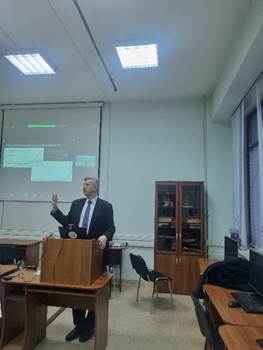
Rice. 1. Yu.V. Chekhovich speaks. In general, the conference reflected the growing interest in the use of AI in the development of university educational programs of a historical profile. The annual January conference, organized by the Faculty of History and AIC, has become the main platform for discussing innovations in this segment of higher education in the country.
The article is published in the version approved by the reviewers (after receiving a positive review recommending the manuscript for publication), with corrections made by the author (submitted after receiving editorial comments, if any).
The review is published in open access directly after the text of the article itself. All versions of the author's corrections are stored in the publisher's repository and may be available upon request by authorized organizations.
Read the review for this article
References
1. Borodkin, L. (2024). Transformation of university history education against the backdrop of the digital era: academic and methodological seminar at Moscow State University. Historical informatics, 1, 1-10. https://doi.org/10.7256/2585-7797.2024.1.70393
2. Chekhovich, Y. V. (n.d.). Use of AI in the preparation of scientific and educational works. Generate correctly. Fundamental Library of BGU: Website. Retrieved March 30, 2026, from https://library.bsu.by/images/sampledata/asimages/pdf/Чехович.pdf
Peer Review
Peer reviewers' evaluations remain confidential and are not disclosed to the public. Only external reviews, authorized for publication by the article's author(s), are made public. Typically, these final reviews are conducted after the manuscript's revision. Adhering to our double-blind review policy, the reviewer's identity is kept confidential.
The list of publisher reviewers can be found here.
The peer-reviewed text "Digital transformation of University historical education in the era of artificial intelligence: a scientific and methodological conference at Moscow State University" is an information and overview text that introduces the reader to the topics of the introductions of participants of the All-Russian Scientific and Methodological Conference with international participation "Digital Transformation of University Historical education and the development of educational programs in historical informatics and related programs" conducted by the Faculty of History of Lomonosov Moscow State University and the Association of Researchers in the Field of Historical Informatics on January 30, 2026. The text contains information that is traditional for describing a scientific conference, such as: the composition of participants, scientific directions (digital technologies in teaching historical disciplines and teaching digital technologies to historians; the development of bachelor's and master's degree programs in historical informatics, as well as those close to them in profile; the role of modern trends in the development of digital technologies), main reports on sections with thesis content performances. There is a significant emphasis on the exchange of experience in the application of artificial intelligence (AI) methods and technologies in the educational process. The text is divided into two parts corresponding to the two sections of the scientific conference: "Digital/information technologies in historical education" and "Experience in the development of educational programs in historical informatics and digital history". The conference reports in various aspects address the use of digital tools (including methods and technologies of artificial intelligence) in teaching and research activities; in total, 20 reports of the conference participants are reflected in the work. The reports of the first section demonstrate to a greater extent the diversity of approaches of Russian and Kazakh universities to the use of digital tools in teaching various disciplines in different formats of education (full-time, distance, part-time, etc.) Among the reports of the second section, presentations with experience in implementing specialized master's programs at three universities (Moscow State University, Ural Federal University, Kazan Federal University university), as well as reports by teachers of the Department of Historical Informatics of the Faculty of History of Moscow State University summarizing the experience of teaching training courses in the framework of the master's program "Historical Informatics". The paper presents the results of a profile survey of students and brief information about the round table "Artificial intelligence in university education: transformation or revolution?". The work is, as already mentioned, informational and overview in nature, the content of the reports is presented in the most general form, therefore it would be logical to accompany the text with a link to the conference proceedings, but this is not observed. In general, the work was carried out at the proper scientific and methodological level, corresponds to both the title and the goals set, and is recommended for publication in the "Chronicle of Scientific Life" section.
|





 © 1998 – 2026 Nota Bene. Publishing Technologies. NB-Media Ltd.


