|
Man and Culture
Reference:
Chuvilkin, V.S. (2026). Fugue and improvisation: on the problem of the dialogue between academic and jazz traditions. Man and Culture, 2, 70–80. https://doi.org/10.25136/2409-8744.2026.2.78919
Fugue and improvisation: on the problem of the dialogue between academic and jazz traditions
Chuvilkin Vsevolod Stanislavovich
PhD in Art History
Senior lecturer; Department of Music Theory and Composition; Rostov State Conservatory named after S. V. Rachmaninov
Lecturer-art critic (musicologist); Rostov State Philharmonic
16 Oborona str., Rostov-on-Don, Rostov region, 344082, Russia

|
chuvilkin_vsevolod@mail.ru
|
|
 |
|
DOI: 10.25136/2409-8744.2026.2.78919
EDN:
GGPBFK
Received:
03/19/2026
Revised manuscript submitted: 03/24/2026 19:09
Final review received: 03/25/2026 21:43 — recommendation for publication.
The article is published in the version approved by the reviewers (after receiving a positive review recommending the manuscript for publication) with corrections made by the author (after receiving the editor’s comments, if any).
Read all reviews on this article
Published:
03/26/2026
Abstract: The subject of the research is the interaction between improvisation and the strict polyphonic form of the fugue in the context of jazz and academic music of the 20th – early 21st centuries. The object of the study is jazz fugues as a phenomenon that emerged at the intersection of academic and jazz traditions. The author examines in detail such aspects of the topic as the historical continuity of jazz fugues from the baroque practice of improvisation, the structural mechanisms of incorporating improvisation into the polyphonic texture, as well as the typology of forms arising from this synthesis. Special attention is given to parallels between the baroque model of the figured bass fugue and jazz improvisation over a harmonic grid. The work analyzes specific compositional techniques: walking bass, comping, transforming interludes into improvisational solos, as well as the influence of jazz stylistic idioms on thematic material and development. The methodological foundation of the research is a comprehensive approach that combines methods of historical-theoretical, structural-functional, and stylistic analysis. The work is based on studies on the theory of the fugue (N. Simakova, A. Milka, V. Frayonov), the history of baroque improvisation (M. Serebrennikov), and the theory of jazz (O. Kovalenko, I. Presnyakov). The scientific novelty lies in the systematic analysis of the impact of improvisational elements on the structure of jazz fugue. For the first time, a typology of its structural principles is substantiated: res facta, oriented towards the Bach model, and standard-fugue – a form suggesting an unlimited number of improvisations. In the standard-fugue, the exposition serves the function of the theme of a jazz standard. A significant contribution of the author is the identification of the mechanisms for incorporating improvisation into counterpoint (walking bass and comping) and interludes (transforming them into written or unwritten improvisations). The main conclusions of the research are as follows: the jazz fugue is not a compromise between rigor and freedom, but rather a logical development of the European tradition of "instant composition," adapted to the rhythmic and harmonic language of jazz. The baroque model of the figured bass fugue reveals a deep kinship with jazz practice, allowing us to view the jazz fugue as an actualization of the historical principle of improvisational polyphonic thinking.
Keywords:
improvisation, fugue, jazz fugue, jazzing-fugue, jazz, Oleg Gorchakov, John Lewis, baroque improvisation, jazz polyphony, Bill Evans
This article is automatically translated.
At first glance, the spontaneity of improvisation and the strict structurality of the fugue are perceived as absolute opposites. It would seem that the highest of all polyphonic forms, the fugue, which requires rational calculation, should exclude any element of chance. However, an appeal to the history of the fugue shows that this opposition is by no means absolute. If the practice of improvising fugues existed earlier in academic music, then in the twentieth century, with the advent of jazz, this tradition received an unexpected continuation and reinterpretation. How does jazz improvisation based on other rhythmic and harmonic principles interact with a strict polyphonic form? How can the spontaneity of jazz and the structurality of the Baroque model be combined? These issues have not yet received systematic coverage in the musicological literature, which determines the relevance of this article. The practice of improvising fugues has deep roots in the European tradition. Even in the Baroque era, when an organist was required to be able to improvise a prelude at certain points in a church service, the fugue, contrary to popular belief, was also not thought of as an exclusively "written" form. As M. Serebrennikov convincingly shows based on the study of German sources of the XVIII century, the ability to improvise a fugue on a proposed topic was a mandatory skill for a professional musician of that time [7, p. 5-6]. It is worth considering that the practice of improvisation is based not on "pure" spontaneity, but on the use of pre-prepared blocks, as M. Saponov explicitly writes: "An improviser does not create matter, but composes it from ready-made blocks" [6, p. 57]. N. Simakova, the author of one of the recent textbooks on polyphony, notes that in terms of fixing the musical text, fugues can be "... with missing musical text, that is, improvisable" [8, p. 155]. The intermediate link between fixed and unfixed samples is occupied by the fugue-partimento, a type of fugue with a digital bass"... which was written in a partial, abbreviated, or rather encrypted form, focusing only on the topic and its further developments" [ibid., p. 275]. Most of the improvised Baroque fugues were general bass fugues in which the polyphonic fabric was recorded as a digital bass, leaving room for improvisational realization of voices [7, p. 8]. Structurally, such fugues were strophic compositions in which each stanza included a group of theme passages, sequential development in interludes and cadence. The latter were not very diverse and represented universal formulas. This structural principle reveals a deep affinity with jazz practice. In jazz improvisation, the digital bass is replaced by its historical successor, the harmonic grid. Jazz stylistic idioms are used as "blanks", which, according to O. Kovalenko's work, represent "... melodic-rhythmic, harmonic and textured cells of a jazz improviser..." [2, p. 67]. However, jazz not only reproduces, but also transforms the Baroque principle. Certain features of jazz improvisation penetrate not only into the components of the fugue, but also in some cases transform the form of the whole. Jazz improvisation and fugue. The relationship between improvisation and fugue in the twentieth century acquired new qualities in connection with the emergence of jazz. By the early 20s, as I. writes. Presnyakova, the first samples of jazzing the classics appear [5, p. 78]. By now, a significant amount of jazz transcriptions of classical fugues has been accumulated (J. S. Bach's fugues are particularly popular with jazzmen). Examples include jazzing versions of the first volume of J. S. Bach's "Well-Tempered Clavier" recorded by J. Lewis or C. Corea. By their structure, such interpretations approach the principles of jazz standard performance: presentation of the theme – a series of improvisations – the return of the theme. A fragment of a fugue (mainly from its exposition) can serve as the theme of a jazz standard here. However, jazzing versions, for all their popularity, represent an area of performance interpretation. We are interested in another phenomenon – the jazz fugue. In this work, it is understood as a modern author's composition, the thematic material of which is based on the use of certain jazz idioms (swing, blues-lad, drive, etc.) while preserving the fundamental structural principles of fugue. In such works, jazz idioms are embedded in the very fabric of the composition, rather than incorporated into the finished text. On the impact of improvisation on the jazz fugue. There are some parallels between the fugue as a form[1] and the tradition of jazz music making. The idea of the fugue is the development, proof through refutation and further affirmation of an initially given thesis[2]. A jazz theme for improvisation may be in a similar context. We are talking about those cases when jazz improvisation unfolds as a new melody, born of a variant development of the core: there is a given thesis, from which various variants grow in the future. In other cases, improvisation has the appearance of a figurative line, which the authors provide with a characteristic background accompaniment. The sound of such a texture in a jazz context will be perceived, if not as a manifestation of improvisationism, then at least quasi-improvisationism[3] – a composer's imitation of spontaneity. Let's consider the impact of jazz improvisationism on different components. In the practice of jazz performance, movement in uniform durations in a low register is used as a counterbalance to a syncopated melody, a striking example of which is the contrabass walking bass. It is this rhythmic contrast that has made this technique a very common solution for counter-combinations in jazz fugues. The walking bass is a technique that still bears the imprint of improvisation, since in most recordings it reveals an element of spontaneity: the performer can freely choose between three principles of movement: diatonic, chromatic or chord tones.
Another way to introduce improvisational principles into counter–constructions is the comping technique (comping, short for "accompaniment"). In jazz art, this technique refers to chords, rhythms, and countermelodies that support a solo melody. In the practice of arrangement and accompaniment, comping is often not fixed, but improvised by performers based on a given chord sequence of a harmonic grid. In jazz fugues, this technique is manifested by introducing quasi-improvised chord sequences into the texture. The introduction of quasi-homophonic chord sequences is not new for fugue, if we recall the works of 19th–century composers, such as the piano fugues of F. Mendelssohn, F. Liszt, and others. Nevertheless, jazz specifics (primarily its harmonic and rhythmic aspects) make their own adjustments. This inevitably creates rhythmic polyphony between a quasi-improvised line (often a theme) and chords accompanied by it. A vivid example of the introduction of comping into the texture of a jazz fugue is a fragment from E. Markovich's "Jazz Fugue in F Major". Here, a syncopated, quasi-improvisational chord sequence is used as a counter-compound to the theme. Example No. 1 by E. Markovich. Jazz fugue in F major The theme of the fugue 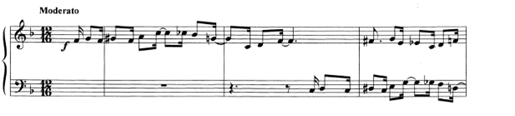
Stretch chain (tt. 52-58)
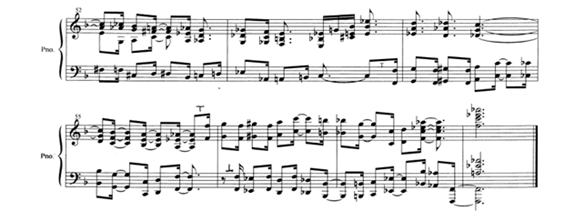
In this example, there is another typical jazz technique – a sequence of dissonant chords descending in semitones. Improvisation instead of an interlude. The interlude sections of the fugue turned out to be the most suitable for the inclusion of jazz improvisation in its purest form. This is explained by the lack of strict regulations "... regarding both the place ... of appearance, and intonation material, structure and size" [3, p. 67]. This, in turn, makes the interludes the most free areas, which does not exclude the element of spontaneity. It was probably this feature of the interludes that became a prerequisite for the organic synthesis of jazz idiomatics with the logical laws of fugue, up to the introduction of jazz improvisation into fugue. There are two main types of improvisational interludes: written out and unwritten. The first type is compositional improvisations, prescribed by the composers and occupying the space between the passages of the theme. Usually, such sections reveal a clearly defined solo melody of a figurative nature, which is contrasted with a less developed, often quasi-chordal background. Example No. 2 M. Nordahl Jazz fugue II 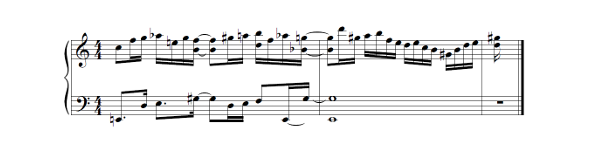
Another example is the final interlude from N. Kapustin's C–sharp minor fugue (from the cycle "24 Preludes and Fugues"). Here, the texture approaches improvisation on a continuously repeated blues riff. It is likely to assume that such interludes are born as a result of free improvisation, and only then are recorded by the composer in the musical text. The second type is the interlude fragments of a jazz fugue composition that the author has not written, giving the performer complete freedom. In most cases, this refers to "unscripted fugues" from jazz practice. As an exception, a harmonic grid may be fixed in the sheet music edition. Consider B. Evans' composition "Fudgesicle built for four". Example No. 3 by B. Evans. «Fudgesicle built for four» Topic 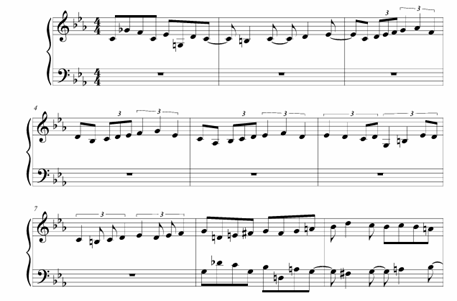
Intermedia-improvisation 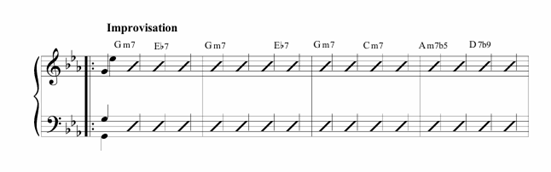
This example is a pure fusion of a fugue structure and a jazz standard. The four-voice exposition with two held counter-compounds is strictly structured. However, instead of a developing section, an irregular number of solo improvisations is assumed for a given harmonic grid. Here, like a jazzing fugue, it is the exposition that acts as the standard that completes the performance. All of these properties make the fugue form mobile and with an unlimited number of possible structural variants of execution, and therefore the content (depending on the composition and stylistic preferences of the performers). Another striking example is the fugues of J. R.R. Tolkien. Lewis, written especially for the ensemble "Modern Jazz Quartet". Fugues such as "Vendome" or "Versailles" contain completely improvisational sections. The form of the whole is thus constructed like a concert rondo, where the function of the refrain is performed by fugated refrains, and the role of episodes is played by unwritten interludes-improvisations.
In modern practice, it is not uncommon to perform a jazz fugue created by another author, with the inclusion of his own improvisation, although the composer did not mean this. For example, A. Templeton's "Bach goes to town" (the first jazz fugue written for a big band) does not contain improvisational sections in the musical text. However, in the recording by the Hosey Osterwold ensemble, the trumpeter's improvisation sounds before the final section. Such interpretations already have something in common with jazzing fugue. Another specific feature of the interludes in the jazz fugue stems from the orientation of the authors to specific jazz styles. In O. Gorchakov's "Bi-bop Fugue", the first interlude, as we believe, is an imitation of the instrumental composition of the combo in its most typical version: piano, double bass and solo instrument (most often saxophone). The accompaniment is presented here in the form of "stingy" piano comping in the spirit of "random" accented harmonies combined with a low-register walking bass. Example No. 4 O. Gorchakov "Bi-bop fugue" 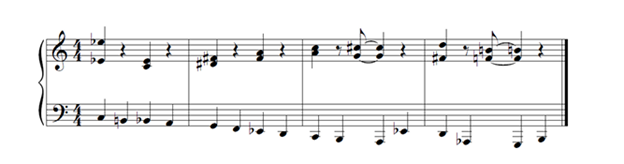
The second interlude of this piece contains an extended quasi-improvisational melodic line, significantly chromatized and outlined by the eighth. Example 5 O. Gorchakov "Bi-bop fugue" 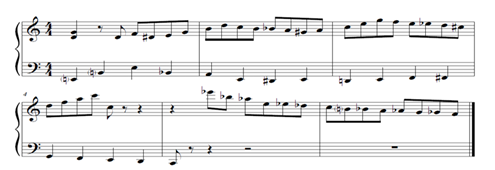
It is worth recalling that many be-bop improvisations were similar extended rows of eighths at a fast pace. In addition, the field of chords in be-bop also shows a clear tendency towards increasing dissonance due to sharp "additions" to the tones of melody and chords. Thus, interludes not only have an improvisational function, but also reveal the stylistic component of the entire composition. It can be argued that jazz improvisation naturally transforms the interlude, shifting the focus to textural principles unusual for academic fugue: for example, the presence of a solo line of a figurative nature with a syncopated chord accompaniment. Due to the possibility of integrating jazz improvisation, the compositional significance of the interlude in such fugues increases markedly, which fully corresponds to jazz practice. It is in improvisations that the author's personality of a jazzman is most revealed: for example, O. Peterson and T. Monk's performances of the same standard – "Round midnight" – are completely different. And such cases are the stylistic norm of jazz art. So, the collision of the traditional fugue structure with the improvisational art of jazz could not but affect the shape of the whole. The authors of the jazz fugues probably realized the risk of excessive canonicity, almost mathematical precision of all the elements and aspects of the musical construction, which would be extremely contrary to the very nature of jazz art. Therefore, relying on the existing traditions of polyphony and jazz, the authors found a way to introduce the fundamental property of jazz – improvisation – to different levels and sides of the fugue. As a result, new unusual compositional forms have emerged, suggesting that the exposition section should be treated as a jazz standard, that is, as a topic for further improvisations. However, further improvisations are not predetermined by the material of the exposition. Thus, a new principle of organizing the form of the whole appears, although rarely found: the jazz standard fugue, in which contrapuntal sections (primarily the theme) alternate with improvisational interludes. We propose to define the samples written based on traditional models as jazz fugues res facta. In fact, it is a special stylistic form of fugue res facta. Tinctoris introduced the concept of res facta, which is important for understanding the essence of a musical composition. "a made, manufactured thing"), that is, "... a polyphonic composition recorded before being performed; the same is the counterpoint in the recording (contrapunctus scripto), the canthus is composite" [4, p. 648]. Res facta is naturally opposed to the practice of cantus supra librum (lit. "singing over a book"), when "the singer improvises a counterpoint to a given tenor" [ibid., p. 647]. Summarizing, it can be argued that the interaction of improvisation and fugue in jazz music is not paradoxical, but, on the contrary, has deep historical roots. The practice of improvising fugues in the Baroque era was based on the model of the general bass fugue with a characteristic combination of ready-made formulas. The jazz practice of the twentieth century transforms this baroque principle. Now the features of improvisation are deeply integrated into the theme, counter-composition, interlude, and also affect the overall shape of the whole. Thus, jazz practice revives the art of improvised fugue, albeit in an updated non-academic style. [1] In this article, we rely on the definition of V. Fraenov, set out in the Great Musical Encyclopedia: "Fugue is a form of polyphonic music based on an imitative presentation of an individualized theme with further passages in different voices, with imitative and (or) contrapuntal processing, as well as (usually) tonal–harmonic development and completion" [9, p. 975]. [2]The idea that V. Dolzhansky outlined in the article "Concerning the fugue" [1, p. 153]. [3]In this study, "quasi-improvisationality" is understood as a property of musical material that brings it closer in outline to examples of jazz improvisation.
The article is published in the version approved by the reviewers (after receiving a positive review recommending the manuscript for publication) with corrections made by the author (after receiving the editor’s comments, if any).
Read all reviews on this article
References
1. Dolzhansky, A. N. (1973). On the fugue. In Selected articles (pp. 151-162). Music.
2. Kovalenko, O. N. (1997). Theoretical problems of style in jazz music: Dissertation for the degree of candidate of art studies: 17.00.02.
3. Milka, A. P. (2016). Polyphony. Part II. Composer.
4. Pospelova, R. L. (2009). Treatises on music by Ioann Tinktorius with the full Russian translation of them. Moscow State Conservatory named after P. I. Tchaikovsky.
5. Presnyakova, I. A. (2022). Jazzing of the swing era: pro et contra. Problems of music science, 4, 76-86.
6. Saponov, M. A. (1982). The art of improvisation: Improvisational types of creativity in Western European music of the Middle Ages and the Renaissance. Music.
7. Serebrennikov, M. A. (2011). On the improvisation of the fugue in the Baroque era (based on German sources). Opera musicologica, 2(8), 4-34.
8. Simakova, N. A. (2007). Counterpoint of strict style and fugue. Book two. Fugue-its logic and poetics. Composer.
9. Frayonov, V. P. (1981). Fugue. In Musical encyclopedia (Vol. 5, pp. 975-994). Soviet Encyclopedia.
Peer Review
Peer reviewers' evaluations remain confidential and are not disclosed to the public. Only external reviews, authorized for publication by the article's author(s), are made public. Typically, these final reviews are conducted after the manuscript's revision. Adhering to our double-blind review policy, the reviewer's identity is kept confidential.
The list of publisher reviewers can be found here.
The subject of the article "Fugue and Improvisation: towards a dialogue between academic and jazz traditions" is the interaction of two multidirectional musical phenomena: the strict polyphonic form of the fugue and the spontaneous nature of jazz improvisation. The author focuses on identifying historical parallels between the practice of improvising fugue in the Baroque era and its transformation in jazz music of the 20th century. The focus is on the analysis of specific forms of synthesis, such as jazz fugue, as well as ways to integrate improvisational elements (walking bass, comping, intermedia improvisations) into the structure of academic form. The research is based on an integrated approach combining methods of historical musicology, structural, functional and stylistic analysis. The author turns to the comparative historical method, drawing parallels between the Baroque principles of improvisation (general bass fugue, the use of ready-made blocks) and jazz practice (harmonic grid, stylistic idioms). The work uses the method of source analysis, as well as formal and textural analysis of musical examples. The theoretical basis was the works on both academic polyphony and jazz theory. The relevance of the article is due to the fact that the issue of systemic understanding of the synthesis of academic polyphonic form and jazz improvisationism remains insufficiently studied in modern musicology. The introduction of the concept of "jazz fugue" into scientific use and the analysis of the mechanisms of interaction between the two traditions meet the urgent need to understand the musical processes of the XX–XXI centuries, where the boundaries between "academic" and "pop" are increasingly blurred. The article timely raises questions about the forms of preservation of classical heritage in modern improvisational practice. The scientific novelty of the work lies in overcoming the well-established stereotype of the fundamental incompatibility of the rational form of fugue and spontaneous jazz improvisation. The author introduces and substantiates important classification concepts: jazzing fugue (a performing interpretation of classical fugues in the style of jazz standard); jazz fugue (an original composition where jazz idiomatics are initially embedded in the structure of the form); jazz standard fugue - a hybrid form in which the exposition works as a theme for subsequent improvisations; intermedia-improvisation (written out and not written out) as a key synthesis area. In addition, it is new to draw a typological parallel between the Baroque principle of generalbass-Fuge and the jazz practice of playing on a harmonic grid, which allows us to talk about continuity not at the level of style, but at the level of compositional thinking. The article has a logical structure, built from the general to the particular. The introduction sets the problem field, fixing the apparent antagonism of form and spontaneity. This is followed by an excursion into the history of Baroque improvisation, which creates a solid foundation for the main part. The main section is devoted to the analysis of specific interaction mechanisms: the influence of jazz improvisation on counter-compositions (walking bass, comping) and, most thoroughly and convincingly, on the interlude sections. The content part is full of high-quality musical examples that serve as an evidence base for theoretical conclusions. The style of presentation is academic, while not overloaded with excessive terminology, which makes the text accessible to a wide range of experts in the field of art and cultural studies. Using the term quasi-improvisationality allows us to accurately describe the borderline phenomena between a fixed text and spontaneity. The bibliographic list includes fundamental works on polyphony and highly specialized works on improvisation and jazz. Drawing on the treatises of John Tinctoris (p. Pospelova) testifies to a deep theoretical study of the historical context. The list is adequate to the research objectives, but it could be expanded with more modern foreign studies on jazz theory and analysis of the work of Bill Evans and John Lewis, which would give the work additional breadth. There is clearly a polemical subtext in the text: the author consistently destroys the myth of the "mathematical precision" of the fugue as an exclusively written form, appealing to historical sources. The opponents in this context are those musicologists who consider the fugue exclusively as a "school" form, alien to improvisation. The question to potential opponents (supporters of a strict distinction between academic and jazz cultures) is formulated at the very beginning of the article and consistently resolved in the conclusions. The article is a complete, independent scientific study, characterized by a high theoretical level and scientific novelty. The author has managed to convincingly prove that the dialogue between academic and jazz traditions within the framework of fugue is not an eclectic experiment, but naturally continues and transforms the historical practice of improvisational music making. The work makes a significant contribution to the development of problems of stylistic synthesis in 20th century music and can serve as a basis for further research in the field of jazz polyphony. As a recommendation: The work is dominated by examples of American and Russian schools. It would be interesting to expand the geographical and stylistic range of examples to see references to the European jazz scene (for example, the works of John Surman or modern experiments in the field of third stream), which could enrich the context of the study. The article meets high scientific criteria, has novelty and practical significance. It is recommended for publication in a scientific journal.
|





 © 1998 – 2026 Nota Bene. Publishing Technologies. NB-Media Ltd.


