|
Culture and Art
Reference:
Yang, E. (2026). Memorial objects of traditional culture as dominants of urban symbolism in modern China: the example of Kaifeng and Luoyang. Culture and Art, 2, 92–108. https://doi.org/10.7256/2454-0625.2026.2.78337
Memorial objects of traditional culture as dominants of urban symbolism in modern China: the example of Kaifeng and Luoyang
Yan En'yui
ORCID: 0009-0006-8280-613X
Postgraduate student; Institute of Philosophy; St. Petersburg State University
St. Petersburg, Sredny prospekt Vasilyevsky island, 33, entrance 2

|
whw789456123@gmail.com
|
|
 |
Other publications by this author
|
|
|
DOI: 10.7256/2454-0625.2026.2.78337
EDN:
NJLCZB
Received:
02/21/2026
Published:
03/03/2026
Abstract: The subject of the study is memorial objects of traditional Chinese culture – temple complexes, pagodas, cave monasteries, imperial necropolises, historical axes of planning, and archaeological zones – as structural dominants of the symbolic space of modern Chinese cities. The focus is on their role in shaping urban identity, maintaining cultural memory, and organizing the semiotic structure of the urban landscape in the context of accelerated modernization and globalization. Using the examples of Kaifeng and Luoyang, the analysis investigates how these objects retain their status as meaningful centers amidst changing socio-economic contexts, as well as how their functions transform from religious and political to cultural-representational, touristic, and image-related. Special attention is given to the mechanisms of integrating memorial complexes into contemporary urban planning and commercial strategies, as well as the nature of their interaction with new architectural structures and mass tourism infrastructure. Thus, the study aims to identify patterns of cultural heritage symbolization within the space of modern Chinese cities. The methodological foundation of the research is based on Yuri M. Lotman's cultural semiotics (concepts of the semiosphere, boundaries, and urban text). Methods of semiotic analysis, comparative-historical correlation, and critical discourse analysis of normative and touristic texts are employed. A strategy of triangulation of empirical data is applied, which includes the analysis of urban planning documentation, statistics on tourist flows, and heritage preservation materials. The scientific novelty of this research lies in the innovative intercultural application of Lotman's theory of spatial semiotics to the unique material of ancient historical Chinese cities. For the first time, a comprehensive model for comparative analysis of mechanisms of cultural symbolization is proposed and tested in two contrasting types of urban semiospheres: a strictly centripetal one, characteristic of Kaifeng's space, and a complex duocentric sacred-landscape one, illustrated by Luoyang. The work convincingly shows that historical memorial objects function not merely as a static architectural heritage of the past but act as active, dynamic boundaries and crucial nodes for recoding cultural meanings. Furthermore, significant differences in contemporary methods of commodifying historical memory are detailed, and specific modes of interaction between traditional sacred and modern touristic discourses in the context of current urban development are analyzed.
Keywords:
Semiosphere, urban text, Yuri Lotman, cultural semiotics, urban symbolism, Kaifeng, Luoyang, cultural memory, memorial objects, traditional Chinese culture
This article is automatically translated.
Introduction In the context of accelerated urbanization and globalization, historical Chinese cities are becoming spaces of intense interaction between cultural memory and modern forms of urban development. Of particular importance in this process are memorial objects of traditional culture, which structure the symbolic space of the city and participate in the formation of its identity. The purpose of this article is to study how memorial sites of traditional culture — temple complexes, historical monuments, archaeological sites, sacred landscapes — function as leading, semantic factors in the symbolism of modern Chinese cities. The theoretical basis for such an analysis is the cultural semiotics of Yuri Mikhailovich Lotman. This conceptual system offers the most important theoretical prerequisites for studying culture as a communicative system organized according to the laws of language. The practical significance of the research topic lies in an in-depth study of how memorial sites of traditional culture are involved as dominant factors in the formation and functioning of symbols and networks of meaning production in modern Chinese cities. In this study, monuments are considered not as static "heritage" preserved for museums, but as active actors in the cultural process, constantly involved in modern dialogue. Focusing on two illustrative cases — Kaifeng and Luoyang — the work seeks to reveal how historically saturated cities in the context of globalization and modernization carry out self-representation, self-adaptation and self-renewal through their key cultural symbols. The study examines: the transformation of the semiotic functions of memorial sites in the modern urban environment; the mechanisms of their interaction with various urban discourses; the analytical potential of Lotman's model of the semiosphere as applied to historical Chinese cities. The scientific novelty of the study is the application of Lotman's concept of the semiosphere to the material of historical Chinese cities and the development of a comparative model for the analysis of centripetal and duocentric semiospheres. Memorial objects are considered as active transcoding mechanisms and boundaries of cultural memory, which allows us to identify different modes of symbolization in Kaifeng and Luoyang. The research is based on a data triangulation strategy that combines semiotic analysis with methods of field urbanism and critical discourse analysis. The empirical basis of the study was: 1. Analysis of normative discourse: The "Kaifeng City Master Plan (2011-2020)", which consolidated the strategy for the creation of the "National Demonstration Park of the Song Dynasty Culture", and UNESCO documents on the protection of the Longmen grottoes (Decision 24 COM X.C.1) defining strict semiotic boundaries of buffer zones. 2. Field research and statistics: The analysis of tourist flows and architectural solutions is based on data from the Bureau of Culture and Tourism of Henan Province and technical reports on the reconstruction of Mingtang and Tiantang facilities (2013). This approach makes it possible to overcome the static nature of the structural description and verify Lotman's theoretical models with specific cases of urban fabric transformation. The practical significance of the research lies in the possibility of applying semiotic analysis in the development of strategies for the preservation and actualization of cultural heritage in historical cities of China. Considering memorial sites as structural elements of the urban semiosphere allows us to take into account not only their material preservation, but also their symbolic functions in the modern urban environment. The findings can be used in urban planning, management of tourist flows and the formation of cultural policy, focused on the balance between the preservation of historical identity and economic development. The proposed approach promotes a more meaningful integration of heritage sites into the modern urban fabric and prevents their reduction to simplified tourist images. The theoretical construct of the study is the Semiosphere and the urban text in the concept of Yu.M. Lotman The methodological basis of the research is the concept of the semiosphere by Yu. M. Lotman, who considers culture as an integral semiotic space within which the production, translation and interpretation of meanings is carried out [14]. In this model, the minimum unit of analysis is not a single symbol or text, but a set of interacting languages and codes forming a dynamic, hierarchically organized system [7]. The semiosphere is characterized by polyglotism, internal heterogeneity, and the presence of boundaries that perform the function of translating and filtering meanings. In relation to the urban environment, this concept is specified in the concept of "urban text". The city is understood as a multi-layered structure in which architecture, layout, memorial sites, ritual practices and discursive modes form an interconnected system of signs [8]. Historical axes, sacred complexes, monuments, and toponymy are elements of this structure that define the spatial and semantic organization of urban space. Of particular importance in the semiosphere are memorial objects that function as "texts within a text" — stable nodes of cultural memory that preserve information about previous cultural states [8]. They serve a dual function: on the one hand, they condense historical experience, and on the other, they participate in the modern process of transcoding and interpretation. Through interaction with various urban discourses (religious, tourist, administrative, commercial), such objects become zones of intensive semiotic exchange. The key analytical tool is the concept of boundary. In Lotman's theory, the border is understood not as a periphery, but as an active translation zone that ensures the interaction of various codes within the semiosphere. In an urban environment, memorial complexes often serve as such boundaries, dividing and simultaneously connecting the sacred and profane, historical and modern, local and global dimensions. Thus, the application of Lotman's model allows us to consider Kaifeng and Luoyang as different types of urban semiosphere, in which memorial objects act as structure-forming dominants, organizing the processes of symbolization, memory preservation and dialogue with modernity. Kaifeng is the Semiosphere of the Imperial capital and the modern metropolis
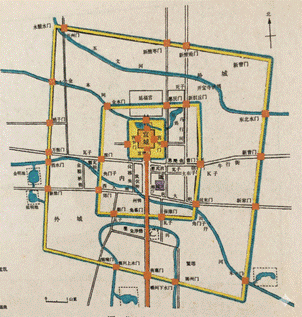
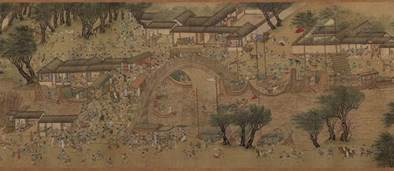
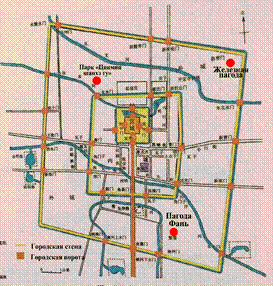
Kaifeng, being the capital of such dynasties as the Late Zhou and Northern Song, is a classic example of an urban text subject to "reconstruction", where layers of different eras overlap and appear through each other [18]. Modern Kaifeng is an important industrial and transport hub, but its symbolic identity is inextricably linked with the image of the North Song "eastern capital", depicted on the Qingming Shanhe Tu scroll [22]. The historical layout forms a semiotic framework. The foundation of Kaifeng's urban text lies in its historical axis and defensive system. Although most of the ancient walls and gates have been lost, their remains, reconstructed fragments, such as the Zhuxianzhen Gate, as well as the results of archaeological excavations, such as the ruins of the Song Palace complex, continue to exist as powerful symbolic markers. They form an invisible but clearly recognizable structure on which modern meanings are "built up". This planning matrix, similar to the recoding mentioned by Lotman, organizes the perception of urban space.
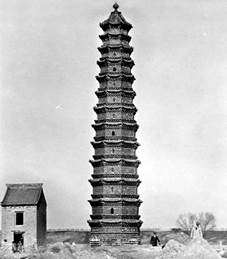
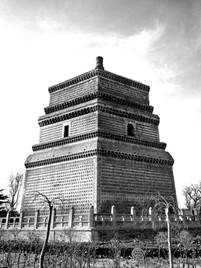
Fig. 1. Historical urban axis of Kaifeng. Complexes of memorial sites function as memory nodes. The key dominants activating the Sun formation in the semiosphere of Kaifeng are, l Xiangguo-si Temple is an active Buddhist monastery with a thousand—year history. In Lotman's terminology, this is a text within a text — an integral semiotic world with its own internal hierarchy, rituals and language. It performs several functions for the urban semiosphere. Firstly, it serves as a symbol of continuity, since its existence, despite periods of destruction, marks the connection of time. Secondly, it is a center of sacred dialogue, a place where the languages of religion, art (architecture, sculpture), history and tourism intersect. Thirdly, it functions as a border — the monastery walls separate the spiritual universe of Buddhism from the hustle and bustle of the surrounding city, but pilgrims and tourists constantly cross this border, carrying out the act of translation. l The Iron Pagoda and the Po Pagoda — these structures serve as visual dominants of Kaifeng, acting as its iconic symbols. Their austere silhouettes against the sky represent a concentrated statement about the cultural and technological achievements of that era. They do not so much "tell" a story as "mean" it, acting as a Lotman symbol [9] capable of evoking an associative series associated with stability, antiquity, and spiritual quest.
2. The Iron Pagoda of Kaibao Temple (1049, Kaifeng) Fig. 3. Fan Pagoda (974, Kaifeng)
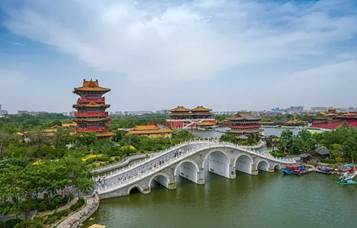
- Qingming Shanghe Tu Park, which is a large-scale reconstruction of the scroll of the same name, is a unique example of intersemiotic translation: it transposes a planar text of fine art into a three-dimensional architectural and topographic text [13]. This process of "unfolding" a static image into a dynamic space has a pronounced economic dimension. According to the Kaifeng Bureau of Culture and Tourism, the annual flow of visitors exceeding 3 million people (2019) and the high share of income from performative practices (up to 40% of revenue, in particular from the show "The Dream of the Great Song") verify the thesis of the commodification of memory. Functioning as a highly efficient "semiosis machine", the park translates the historical code into the language of the impression economy [24], where authenticity is replaced by entertainment.
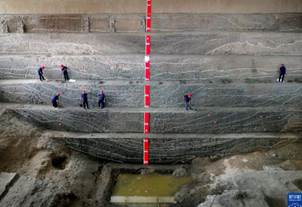
Rice. 4. The Qingming Shanghe Tu Scroll (Northern Song Era, Bianjing). Fig. 5. Kaifeng. Qingming Shanghe Tu Park. - The semiotic specificity of Kaifeng's urban text is thus determined by vertical opposition: the original text of history (the ruins of the Northern Song) lies at a depth of 3-12 meters (the phenomenon of "cities above cities"), remaining invisible, while a hyperreal simulacrum is constructed on the surface. For the mass consciousness, this visible construct paradoxically becomes "more real" than the archaeological prototype hidden underground, which creates a semiotic gap between history as a fact and history as an object of consumption [21].
Fig. 6. Ruins of the Zhouxiao Bridge in Kaifeng city (Northern Song Era). 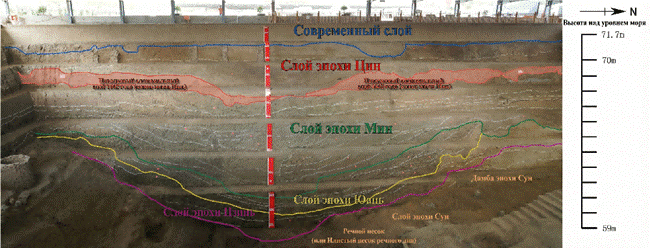
7. Section of the western wall of the Bianhe riverbed (Northern Song Epoch). - Dialogue and tension. The semiosphere of Kaifeng is by no means harmonious. There is a semiotic tension between the memorial zones and the surrounding modern buildings — residential high—rise buildings, industrial areas. An ancient pagoda stands next to a multi—lane highway - this is a visual metaphor for this dialogue-conflict [17]. Historical objects, while maintaining their dominant status, are constantly forced to assert their importance in a new context, competing for symbolic space with the more powerful language of economics — the language of commercial advertising and utilitarian architecture. The state policy aimed at protecting heritage and developing cultural tourism acts here as a meta-text trying to regulate this dialogue and set priorities in reading the urban text [23]. Luoyang Semiosphere of Sacred landscape and Imperial Necropolises Luoyang, one of the oldest capitals of China, has a different type of semiotic organization. If Kaifeng is the text of the imperial capital, focused on the ideas of center and power, then Luoyang is the text of the sacred landscape and eternity, a system of meanings that transcends linear time and indicates immortality and the absolute. Its symbolism is more closely related to Buddhist cosmology (Longmen caves) and imperial ideas about the afterlife (tombs). The Longmen grottoes, as an explicit text, represent the symbolism of the highest sacred authority, demonstrating absolute truths and designed to transform consciousness, and not just an artistic exhibition. At its core, the Longmen is a giant symbolism that carries and transmits Buddhist ideological teachings. The Longmen Grottoes are an integral architectural and sculptural complex formed in accordance with Buddhist cosmology and the religious hierarchy of images. Their spatial organization and iconographic program are subordinated to a single concept, in which each cave performs a specific symbolic function, and the totality of ensembles forms a systematic visual narrative of Buddhist teaching. In the context of the urban semiosphere of Luoyang, this complex functions as a sacred dominant, structuring the idea of the city as a space of spiritual and historical continuity. Within the framework of the semiosphere of the city of Luoyang, the Longmen grottoes perform the following functions, - An absolute sacred dominant. This is the place where the boundary between the profane world and the sacred world is most permeable. For a pilgrim or tourist, visiting Longmen is crossing a semiotic boundary, entering a space fully encoded in the language of Buddhist iconography and cosmology. - A symbol of cultural apogee. The colossal statue of Buddha Vairochana in Fengxian Temple is perceived not only as a religious image, but also as a sign of the highest achievement of the Tang civilization in China. It functions as a symbol in the Lotmanian sense, producing meanings related to art, state power, and spiritual synthesis [5; 10]. - The bifurcation point in the modern semiosphere. Today, Longmen is a UNESCO World Heritage Site surrounded by mass tourism infrastructure. There is an inevitable recoding — the sacred text becomes the object of aesthetic consumption, scientific research and economic exploitation [1]. This creates a semiotic tension between the silence of contemplation and the noise of the crowd, between prayer and photographing. The management of this place is an attempt to find a balance between these different modes of interpretation [15]. The Temple of the White Horse, as a source text, is a special type of symbol or place with a fundamental, constituent meaning. It serves as an "archetype", a "reference response" and a "starting point" for all subsequent development. As the primary marker of the penetration of Buddhism into China, its cultural significance lies in establishing an authoritative historical reference point and value standard [3]. Traditionally revered as the first Buddhist monastery in China, it semiotically signifies the establishment of a sacred origin for the entire Chinese Buddhist tradition. This is not just an ancient monument, but a fundamental reference system to which all subsequent monasteries, art, and thought of Chinese Buddhism can be built or correlated in one way or another. For the cultural identity of the city of Luoyang, the existence of the White Horse Temple radically confirms the priority position of this area in the historical sequence and provides material evidence proving the exceptional depth and primordial purity of the local cultural continuity. Imperial tombs, such as those of the Eastern Han Dynasty, form another powerful layer of urban semiotics — the text of death and eternal power. They reveal how, through a complex system of spatial, ritual, and symbolic codes, the abstract concepts of "death" and "power" are reduced to a single semiotic system with timeless meaning that can be read, observed, and reverently accepted by posterity. Their cultural encoding of death and spatial narrativization define, organize, and transcend death by cultural means, using its finite nature to affirm and enhance the eternity of power. Located, as a rule, outside the old city, imperial tombs form a special zone on the periphery of the semiosphere, reserved for the memory of bygone dynasties. These architectural complexes, which are usually less visited than Longmen, are similar to "voiceless" texts, whose language is the language of spatial organization, subordinated to Confucian and Taoist ideas about the afterlife and ancestors (Funeral Alley/ Sacred Alley: Symbolizes the sacred path leading from the world of the living ("Yang world") into the world of the dead (the "Yin world"). Kurgan: Imitates mountain peaks, symbolizing eternity and immortality, being a monumental embodiment of death). They are important markers of cultural memory, recalling the cyclical nature of imperial history.
The planning axis and the modern center. Like Kaifeng, the historical axis of old Luoyang (which connected the city gates) continues to influence the semiotic structure of the space [2]. However, the modern commercial and administrative center has shifted relative to the historical core [19]. This creates the effect of semiotic duocentricity — the city has two centers of importance, one is associated with ancient sacredness and imperial memory (Longmen, the old city zone) [18], and the other is associated with modern economic and administrative life. The dialogue between them also determines the nature of the urban text. Architectural reconstruction: The most significant example of modern "reconstruction of meaning" is the Mingtang and Tiantang complex (2013). This is the creation of an "architectural prosthesis": the Tiantang Tower, about 80 meters high, is a steel cover structure above an archaeological excavation. In contrast to the strict protection of the buffer zone of the Longmen grottoes (with an area of 1,042 hectares), the city center is undergoing aggressive architectural rewriting. Behavioral text: The static "monument text" in Luoyang is giving way to a dynamic "text-behavior". According to the Bureau of Culture and Tourism (2024), there are more than 1,200 Hanfu costume rental salons in the city center. The tourist's physical body, dressed in a costume, becomes the bearer of a symbol that "completes" the urban text and fills in the gaps of the lost architecture with live action, turning the city into an immersive scene. Comparative analysis of symbolization mechanisms in two urban texts Based on Lotman's theory and the semiotic analysis of Kaifeng and Luoyang carried out in the article, using the comparative historical method and from the standpoint of cultural semiotics, a systematic comparison of the two ancient capitals reveals clear differences between them [4; 16]. | | Kaifeng | Luoyang | | Key historical and textual position | The text of the imperial capital. The focus is on the urban image of the "center of power — worldly prosperity", where the prototype symbol is the Qingming Shanhe Tu scroll. | The text of the sacred landscape and eternity. The focus is on the image of a sacred place of "sacred — eternal — spiritual overcoming", where cave grottoes and tombs act as prototype symbols. | | The dominant character type | 1. Vertical symbolism (Iron Pagoda, Po Pagoda) 2. Axial order (Imperial Road, city gate) [18] 3. Representation of urban life (Qingming Shanghe Tu Park) | 1. Sacred mountain image (statue of Buddha Vairochana in the caves of Longmen) 2. The Original Temple (Temple of the White Horse) 3. Tomb complexes (tombs of the Eastern Han Emperors) | | Spatial structure of the semiosphere | Centripetal-consolidating [16]. Historical symbols (walls, axes) are deeply woven into the fabric of the modern city, forming a dense field of dialogue where ancient and modern are layered. | Diffuse-sacral [16]. The key symbols (Longmen, tombs) are located on the outskirts of the city or in the natural environment, creating a clear distinction between sacred and profane spaces. | |
The mechanism of polyglot interaction | 1. Intensive dialogue of commerce and history (theme park reconstructions) 2. Intrusive merging with everyday life (modern life around monuments) 3. Intense visual competition (the neighborhood of ancient pagodas and skyscrapers) | 1. The tense coexistence of religion and tourism (pilgrimage and sightseeing conflict) 2. Metaphorical connection between nature and the sacred (landscape integrity of the Ihe River and cave caves) 3. The play of boundaries between reverent silence and modernity | | The method of recoding memory | Representation, immersion. Activation of historical memory through scenic, experimental reconstructions (for example, Qingming Shanhe Tu Park), emphasis on the "accessible past". | Contemplation, normality, ritual. The emphasis is on "uplifted eternity" through the preservation of authentic space, ritual and normative practices. | | Characteristic of the boundary function | A permeable border. Historical zones and city streets are intertwined, and the border serves as a transit channel for commerce, tourism, and everyday life. | Threshold limit. The zones of cave caves and tombs have clear physical and psychological limits, the border is a ritual transitional space between the sacred and profane, life and death. | | Modern reproduction of meaning | Consumer, entertainment transcription. Historical symbols are integrated into the chain of cultural and tourist consumption, generating new texts such as "a night walk in Qingming Park" or "an ancient-style fair" [20; 24]. | Legacy, academic transcription. Symbols are consolidated in the status of World Heritage Sites and research sites, giving rise to new texts such as the "archaeological park" or the "international academic forum." | | A model of dialogue with modernity | A confrontational merger. Elements of modernity (commerce, transport) directly surround and permeate historical symbols, creating a strong visual and semantic tension. | Parallel distance [12]. New districts of the modern city and zones of sacred history preserve geographical and functional distance, forming the structure of "two centers" | | The narrative of cultural identity | "The living Sun capital." The emphasis is on the vitality of history, its civic character and continuity. | "The Holy City of Xia." The emphasis is on the primordial nature of civilization, its spirituality and transcendence. |
| Key stress in development | The conflict of conservation and development. How not to destroy the deep structure of a historical text in the process of commercial use. | The contradiction of sacredness and publicity. How to preserve the solemnity and integrity of the spiritual space, opening it to the general public. |
Based on Lotman's theory, it is possible to identify common features and features of the functioning of memorial sites in the semiospheres of Kaifeng and Luoyang.
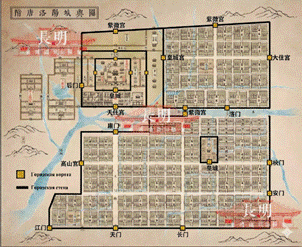
Figure 8. Diagram of the historical urban axis of Luoyang. Fig. 9. Diagram of the historical urban axis of Kaifeng. Common features The core function of memory — In both cities, key complexes of memorial sites (temple ensembles, cave monasteries) serve as condensing cores of cultural memory, around which historical narratives and urban identity are organized. The role of borders — These objects serve as a semiotic boundary separating spaces encoded by history and culture from the space of modern daily life. Their visit is connected with the ritual of transition to a different mode of meaning. Polyglotism and recoding — All objects are subject to multiple interpretations (religious, historical, aesthetic, tourist, commercial). At the present stage, the process of transcoding sacred and historical texts into the language of mass culture and economics is characterized by an intensification [6]. Dialogue with modernity — In both cases, there is a complex, sometimes conflicting dialogue between the memorial dominants and the surrounding modern architectural environment, which creates a semiotic tension and enriches the urban text. Features The dominant type — In Kaifeng, the text of the imperial capital dominates, focusing on the ideas of the center, power and secular urban life (which is reflected in the reconstruction of Qingming Shanghai Tu Park). Luoyang is dominated by the text of the sacred landscape and eternity, focused on spiritual practice (Buddhism) and the cult of the afterlife (tombs). The character of the semiotic space — the semiosphere of Kaifeng is more centripetal — historical objects are woven into the fabric of the modern city [18], coming into direct contact and conflict with it. The semiosphere of Luoyang is more diffuse and duocentric [19] — its key sacred sites (Longmen) are located at some distance [12], forming independent, prominent areas of significance, less integrated into the urban fabric. The mechanism of interaction with the Kaifeng visitor through Qingming Shanghe Tu Park actively uses the strategy of immersive, entertaining exploration of history. Luoyang (especially Longmen) offers a more contemplative, aesthetically religious mode of perception, although it is also being transformed by the pressure of the tourist flow. Discussion: Theatricalization of memory, "living heritage" and cultural identity issues The phenomenon of total theatricalization of historical cities is often interpreted by the Western view as "disneyification" or the creation of simulacra. However, Chinese academic discourse offers a different perspective. Leading researchers (for example, Dai Jinhua) and experts from the Chinese Academy of Tourism consider this process not as a falsification, but as an "activation" and "bodily living" of history. In the Chinese tradition, the emphasis shifts from the material authenticity of the ruins to "shenyun" (神韵, shenyun — transmission of the spirit) [11]. From the point of view of Lotman's semiotics, this "turn to performance" can be interpreted as an "explosion" that breaks through the boundary between the past and the present. Dressing up in Hanfu, a modern urbanite performs a ritual of self-identification, restoring the interrupted connection of time. The city ceases to be a "museum" (where the exhibits are separated by glass) and becomes a "theater" where history is not an object of contemplation, but a space of participation. Conclusions An analysis based on Yuri Lotman's theory of cultural semiotics shows that the memorial sites of traditional culture in modern Kaifeng and Luoyang are not static historical relics, but are active dominant factors in the dynamic semiosphere of the city. They manifest as: - the structure-forming elements of the urban text, defining its semantic axes and centers, - cultural memory capacitors that connect the times and form a unique urban identity, - complex symbols capable of multiple interpretations in the dialogue of various cultural languages (religious, historical, political, commercial),
- zones of semiotic boundaries, where there is an intensive exchange and translation of meanings between traditional and modern, sacred and profane, local and global. The specifics of each city are determined by the nature of these dominants. Kaifeng builds his text around the image of a prosperous imperial capital, embedding the past in the formats of the modern landscape. Luoyang forms its semiosphere around images of sacred revelation and eternal imperial repose, maintaining a great distance between ancient monuments and everyday life. The process of symbolization in these cities is an ongoing and often unpredictable dialogue. Government policy on heritage protection, the market mechanisms of the tourism industry, religious practices of believers and the daily trajectories of citizens — all these forces are involved in the constant re-reading and recoding of ancient texts. While remaining relatively unchanged in material terms, memorial sites are in a state of constant semiotic renewal, which confirms Lotman's idea of dynamics and explosive character as immanent properties of living culture. Their study as key dominants of the urban symbolic system opens the way to a deeper understanding of the mechanisms of self-organization and self-writing of culture in the context of rapid modernization.
The article is published in the version approved by the reviewers (after receiving a positive review recommending the manuscript for publication) with corrections made by the author (after receiving the editor’s comments, if any).
Read all reviews on this article
References
1. Van D. (2010). Internationalization of heritage: UNESCO and the Longmen Grottoes in China. China Information, 24(2), 123-147.
2. Dong, S., & Shen, D. (2023). Research on the laminar overlay of the historical urban landscape of Luoyang based on the translation of historical maps. Land, 12(3), Article 663. https://doi.org/10.3390/land12030663
3. Kan, D., Cheng, C., Yin, C., & Li, H. (2025). What role does the preservation of “great heritage objects” play in shaping sustainable patterns of urban intensity? An empirical study from Luoyang. Sustainability, 17(9), Article 3882. https://doi.org/10.3390/su17093882
4. Leontovich, O.A., & Kotelnikova, N.N. (2022). The semiotic portrait of a large Chinese city. Herald of the Peoples' Friendship University of Russia. Series: Linguistics, 26(3), 701-720. https://doi.org/10.22363/2687-0088-31228
5. Li, M. (2024). From cultural heritage to symbolism of images: Calligraphy of Weibei in the inscriptions of twenty statues of Longmen. Educational Administration: Theory and Practice, 30(5), 531-540.
6. Li, Y., Jiao, L., & Zhou, M. (2024). The impact of digitalization of cultural heritage on tourists' attitudes: The role of constructive authenticity and technology-direction fit. Journal of Travel & Tourism Marketing, 41(2), 221-234. https://doi.org/10.1080/10548408.2024.2311328
7. Lotman, Y.M. (1996). Inside the thinking worlds: Man-Text-Semiosphere-History. Languages of Russian Culture.
8. Lotman, Y.M. (2000). Semiosphere. Art-SPB.
9. Lotman, Y.M. (2002). Symbol in the system of culture. In Articles on the semiotics of culture and art (pp. 211-225). Academic Project.
10. McNair, E. (2007). Donors of Longmen: Faith, politics, and patronage in medieval Chinese Buddhist sculpture. University of Hawaii Press.
11. Nakonechna, E., & Shchepansky, Y. (2024). The authenticity of cultural heritage in relation to reproducibility and intangibility: From the philosophy of conservation to practice. International Journal of Cultural Policy, 30(2), 220-237. https://doi.org/10.1080/10286632.2023.2177642
12. Niu, Y., Zhu, H., Dong, W., & Yan, W. (2025). GIS-oriented framework model for urban resilience balancing heritage preservation and urban development: A case study of the Sui-Tang site in Luoyang. Geocarto International, 40(1), Article 2591775. https://doi.org/10.1080/10106049.2025.2591775
13. On Qingyi, & Jin Ge. (2017). Simulacra and simulation: Double simulation in the North Song dynasty theme park. Tourism Geographies, 19(2), 227-243.
14. Stepanov, Y.S. (2001). Semiotics: Anthology. Academic Project.
15. Xu, H., & Soufield, T. (Eds.). (2018). Heritage tourism and cities in China. Routledge.
16. Fan, C., & Gu, T. (2025). Comparative analysis of spatial patterns and influencing factors on historical districts of four ancient capitals of China. npj Heritage Science, 13, Article 245. https://doi.org/10.1038/s40494-025-01765-0
17. Hartley, J. (2014). Urban semiosis: Creative industries and the collision of systems. International Journal of Cultural Studies, 18(1), 79-101.
18. Qin, C., Cao, C., Storozum, M.D., Liu, H., Wang, S., Wan, C., Ge, C., & Hou, W. (2024). Urban archaeology in Kaifeng, the capital of dynastic China: Progress and conclusions. World Archaeology, 54(5), 680-699.
19. Zhang, S., Ren, Y., Liu, C., Geng, Y., Su, C., & Ma, Z. (2025). Morphological evolution and socio-cultural transformation of historical urban zones: The historical urban landscape approach from Luoyang, China. Buildings, 15(8), Article 1373.
20. Zhang, F. (2010). Diverse models of the "Qingming Shanghe Tu" park dissemination. News Enthusiast, 2, 72.
21. Zhu, Y. (2012). Performative heritage: Reinterpreting authenticity in tourism. Annals of Tourism Research, 39(3), 1495-1513.
22. Cheng, M. (2017). The cultural effect of the "Qingming Shanghe Tu" painting. Guangming Daily. Retrieved from https://epaper.gmw.cn/gmrb/html/2017-09/03/nw.D110000gmrb_20170903_1-08.htm
23. Shang, G., & Yao, S. (2024). Stylization of history and commodification of heritage: The linguistic landscape of reconstructed historic streets in Chinese cities. Language & Communication, 98, 60-73. https://doi.org/10.1016/j.langcom.2024.06.001
24. Yuan, L., & Marzuki, A. (2024). What keeps visitors at historical theme parks: A study based on expectation confirmation theory. Frontiers in Psychology, 15, Article 1293638.
Peer Review
Peer reviewers' evaluations remain confidential and are not disclosed to the public. Only external reviews, authorized for publication by the article's author(s), are made public. Typically, these final reviews are conducted after the manuscript's revision. Adhering to our double-blind review policy, the reviewer's identity is kept confidential.
The list of publisher reviewers can be found here.
The subject of the article is "Memorial objects of traditional culture as the dominant urban symbols of modern China: Using the example of Kaifeng and Luoyang,"memorial sites of traditional culture (temples, pagodas, archaeological zones, imperial tombs) in the cities of Kaifeng and Luoyang are presented. The author considers them not only as a static historical heritage, but also as active, meaning-forming elements (dominants) that form the unique symbolism and identity of modern Chinese cities. The focus is on the mechanisms of functioning of these facilities in the context of globalization, urbanization and the development of the tourism industry. The methodological basis of the work is the cultural semiotics of Yu.M. Lotman, primarily the concepts of the "semiosphere", "urban text" and "borders". The researcher adapts Lotman's theoretical framework to analyze China's specific urban environment. To verify theoretical conclusions and overcome descriptiveness, the author uses the strategy of "data triangulation", combining semiotic analysis with elements of field research, analysis of normative documents (master plans, UNESCO documents) and statistical data on tourist flows. This gives the research an interdisciplinary character and credibility. The relevance of the work is due to the processes of accelerated urbanization in China, which threaten the preservation of the historical identity of ancient cities, as well as the increasing role of cultural tourism as an instrument of economic development, which often leads to a simplification of the historical image. There is also a need for scientifically based approaches to the integration of ancient monuments into the modern urban fabric. The analysis proposed in the article of how memorial sites become a field of dialogue or conflict between tradition and modernity is timely and practically significant for specialists in the field of urbanism, cultural policy and heritage preservation. The scientific novelty of the research lies in the application of Lotman's model of the semiosphere for a comparative analysis of two types of Chinese urban texts. The author illustrates the theory with examples and develops an original classification, contrasting the "centripetal-consolidating" semiosphere of Kaifeng (focused on the image of the imperial capital) and the "diffuse-sacred" semiosphere of Luoyang (focused on Buddhist cosmology and the idea of eternity). It is also new to consider modern phenomena (for example, the Qingming Shanghe Tu reconstruction Park) as mechanisms of "recoding" and forming new meanings. The article is written in an academic but accessible language, characterized by logical and harmonious composition. The structure of the work is fully consistent with the goals and objectives set. The introduction clearly identifies the problem field, goals, novelty, and empirical basis; the theoretical section provides the necessary minimum of information about Lotman's concept, on which further analysis is based; the main sections on Kaifeng and Luoyang are based on a single principle, which facilitates subsequent comparison. Each section is full of specific examples, supported by links to sources and illustrations (descriptions of drawings), which makes the analysis convincing. The comparison table is the strong point of the work. She clearly demonstrates the differences in the mechanisms of symbolization, spatial structure, functions of the border and models of dialogue with modernity, summarizing the results of the study. The conclusion contains reasonable conclusions about the role of memorial sites. The bibliographic list includes key works by Yu.M. Lotman, as well as a wide range of sources in Russian and English (including normative documents, statistical reports, art history and urban studies), as well as modern research on Chinese urban studies (Wang Jian, Chen Zhen, etc.), which indicates a solid theoretical and source base of the work. The author argues with a simplified approach to heritage as a "preserved museum", asserting the view of the monument as a living, developing text. Based on Lotman's work on the dynamics of culture, the researcher shows the limitations of a purely protective approach and critically evaluates the phenomenon of "simulacrum" and "commodification of memory" in the tourism industry, which can be considered as a dialogue with critics of mass culture. Recommendations and observations: 1. Some terminology overload. In some fragments, there is an excessive use of special terms ("intrusive fusion", "intersemiotic translation", "text within text", "bifurcation point"), which may make it difficult for a reader who is not a specialist in semiotics to perceive the material. 2. I would still like to get an answer to the question: Does the Chinese tradition have its own concepts of sign and symbol that correlate or conflict with Lotman's model? 3. Technical notes on the design. The text uses non-standard hyphens and spaces (in the title of the section), which is a consequence of technical formatting and requires proofreading before publication. The article is an original and in-depth scientific study that contributes to the study of the cultural semiotics of the city and modern processes in urbanism in China. The author successfully demonstrates the heuristic potential of Lotman's theory in relation to non-Western material and offers a convincing comparative model for analyzing two ancient capitals. The article deserves to be published in a scientific journal and will be of interest to cultural scientists, semiotics, urbanists, heritage conservationists and anyone interested in modern Chinese culture.
|





 © 1998 – 2026 Nota Bene. Publishing Technologies. NB-Media Ltd.


