Culture and Art
Reference:
Jankovic, O.V. (2026). Two Silences – John Cage and Toru Takemitsu. Culture and Art, 2, 267–286. https://doi.org/10.7256/2454-0625.2026.2.78047


|
Library
|
Your profile |
 This work is licensed under a Creative Commons Attribution-NonCommercial 4.0 International License.
|
Culture and Art
Reference:
Jankovic, O.V. (2026). Two Silences – John Cage and Toru Takemitsu. Culture and Art, 2, 267–286. https://doi.org/10.7256/2454-0625.2026.2.78047
Two Silences – John Cage and Toru Takemitsu
DOI: 10.7256/2454-0625.2026.2.78047EDN: NPHDZGReceived: 02/04/2026Published: 03/03/2026Abstract: This paper conducts a comparative analysis of the concepts of silence in the works of John Cage and Toru Takemitsu. The study aims to explore the philosophical origins of the notion of silence, as well as the ways of interpreting and applying the concepts in the musical language of both composers. The analysis includes the historical and cultural context of the formation of Cage's and Takemitsu's aesthetic views, as well as the individual characteristics of their creative paths. Special attention is given to the question of how silence functions in musical time and space, and how it is perceived by the listener and performer. The aim of the paper is to compare Cage's and Takemitsu's approaches to silence and to determine whether the concepts formulated by them persist throughout their works or only manifest in pieces where silence is prominently featured. To this end, non-programmatic compositions that are not devoted to silence are considered, those being Takemitsu's solo piano piece "For Away" and Cage's sixth solo piano etude from the "Etudes Australes" cycle. The research method includes a step-by-step examination of each composer's concepts of silence while taking into account the historical context, philosophical definitions, and an analysis of the musical text, as well as subsequent comparisons. The scientific novelty of this study lies in the analysis of Cage's and Takemitsu's concepts of silence through the lens of lesser-known piano works, which allows tracking the consistency of their aesthetic and philosophical principles. The results of the research reveal several differences in their approaches and concepts of silence, demonstrating its multifaceted nature: silence is not limited to a conventional understanding, but can manifest in various ways—such as the "boundary of the auditory range" or the "flow of continuous music." The paper draws parallels between musical interpretations of silence and other fields of knowledge, such as quantum physics, Indian philosophy, Japanese cultural heritage, and Zen Buddhism. Takemitsu's silence is defined as "spiritual" and "musical," while Cage's silence is characterized as "practical" and "intellectual." Keywords: concept of silence, treatment of silence, Takemitsu For Away, Cage Etudes Australes, piano solo, silence in music, concept ma, hierarchy, continuous music, silence as musicThis article is automatically translated. Introduction The problem of the functioning of silence in the musical art of the 20th century remains one of the most controversial in modern musicology. Despite the universal character of silence as an integral component of the musical fabric and a necessary condition for the existence of the musical form as a whole, its philosophical status and compositional function are not unambiguous. A fundamental question arises: if silence is present in any music as a structural prerequisite for sound, can we talk about different types of its conceptualization that have aesthetic specifics and reflect the peculiarities of the composer's artistic thinking? In other words, is silence a universal, neutral element of the musical fabric, or is it capable of serving as a carrier of an individual philosophical position? The interpretation and structural role of silence in the works of individual composers varies significantly and requires special analytical understanding. This issue is particularly important in connection with the works of John Cage and Toru Takemitsu, whose artistic systems are associated with rethinking the boundaries of the sounding and the silent. The scientific literature extensively explores the philosophical foundations of Cage's aesthetics and the historical context of the American musical avant-garde. In the most relevant articles, the intellectual orientation of Cage's artistic method is revealed, for example, in the works of Olga Manulkina, while K. M. Kurlenya interprets Cage's "nothing" as an experience of sensual and emotional tension. The present study correlates with the first position and polemically distances itself from the second, considering Cage's silence primarily as a practical, intellectually organized principle. Regarding Takemitsu, the recent writings of Tatiana Tsaregradskaya on "visual stimuli" and Luigi Irlandini, who mentions "Takemitsu temporality" in his work, with which this study, to a certain extent, is in touch, have made a significant contribution to understanding his artistic thinking. The names of the two composers are often mentioned in scientific works in the context of Cage's influence on Takemitsu (Mikiko Sakamoto et al. references to "Cage Shock"), A. A. Samoylenko speaks about the "Asian avant-garde", which again puts the names Takemitsu and Cage in the context of "teacher" and "student", with which this work agrees only partially. However, a comparative analysis of the concepts of silence and their embodiment by Cage and Takemitsu is practically absent in the scientific literature: researchers' attention is focused on the problem of the influence and philosophical premises of their aesthetics, while the difference between the principles of silence functioning and their comparison in musical thinking has not received systematic coverage. The object of the study is the phenomenon of silence in the musical art of the 20th century. The subject is its conceptualization in the piano works of Cage and Takemitsu, which are not among the program compositions directly declaring this principle. The purpose of the work is to identify the philosophical nature of the concept of silence in each composer and to determine the degree of stability of their aesthetic artistic manifestos. The realization of this goal involves an appeal to the historical and cultural context of the formation of their views, an analysis of existing scientific interpretations and a structural examination of the works "For Away" by Takemitsu and the VI etude from the cycle "Etudes Australes" by Cage, followed by a comparison of the identified principles. The methodological basis of the research consists of comparative and historical-cultural approaches, structural analysis of musical text and philosophical and aesthetic interpretation. The relevance of the work is determined by the need to clarify the conceptual status of silence in modern music science and rethink the innovative compositional thinking of the 20th century. The scientific novelty of the study lies in substantiating the different philosophical nature of the concept of silence in Cage and Takemitsu and proving that the revealed differences are manifested not only in programmatic works, but also in works where silence is not recited as an independent artistic manifesto. This demonstrates that the aesthetic attitude of the composer is found at the deepest level of musical thinking and has a structure-forming character. Concepts of silence John Cage: Silence as an intellectual installation The formation of the concept of silence in the aesthetics of John Cage (1912-1992) is usually associated with his visit to the anechoic chamber at Harvard University in 1951. Expecting absolute acoustic emptiness, the composer discovered the impossibility of achieving it: even in conditions of complete isolation, he continued to hear two sounds — high and low, which were later explained by an acoustics specialist as the functioning of the nervous system and blood circulation. For Cage, this experience became an empirical confirmation of a fundamental thesis: absolute silence as a physical condition does not exist. Further theoretical understanding of this conclusion led to the creation of the work 4'33" (1952), in which silence was reinterpreted not as the absence of sound, but as the absence of intentionally organized sound. Thus, the composer radically shifted the focus from acoustic reality to the act of perception: the boundary between "sound" and "silence" is determined not by physical parameters, but by the focus of attention. Everything that is included in the field of listener's consciousness becomes a musical event. It is important to emphasize that silence is not a negative category in this model. It is not "nothing" in the metaphysical sense, but it denotes a situation of abandoning the author's control over the sound. Unlike the traditional understanding of pause as an expressive means of drama, Cage's silence neutralizes the psychological function and is deprived of expressive load. If in the symphonic climax a three-second pause is perceived as a tense expectation, then in Cage's logic such a pause is only the absence of deliberate orchestral sound while maintaining the continuity of the acoustic environment. We don't stop hearing — only the object of attention changes. Thus, silence turns out to be associated with the category of intention. Cage is not so much interested in sound as a physical phenomenon, but rather in the difference between intentional and unintentional sound — and, moreover, the mechanism by which the listener "makes" the sound intentional, including it in the act of perception. In this aspect, a comparison with the observer effect in quantum physics is possible: the very fact of directed attention transforms the status of a phenomenon. Cage's aesthetics are interpreted ambiguously in the scientific literature. Some researchers emphasize the sensory-emotional aspect of his understanding of "nothing." However, in the context of the history of the musical avant-garde of the 20th century, the interpretation that emphasizes the rational nature of his method seems more convincing. Thus, Olga Manulkina considers Cage's aesthetics in the field of intellectual strategies of American modernism, where the constructiveness and conceptuality of an artistic gesture are of fundamental importance. It is also significant that his teacher Arnold Schoenberg called Cage a "brilliant inventor", emphasizing the fundamental nature of his contribution to the musical avant-garde; similar characteristics have been fixed in Russian historiography ("brilliant inventor", "bold inventor" — L. N. Loginov). Even Cage's appeal to Eastern philosophy and Zen Buddhism was primarily conceptual in nature. His interest in the ideas of non-action (wu wei) and the continuity of the existence of sound was transformed primarily into compositional procedures. Eastern thought did not act as a spiritual practice in the traditional sense, but as a methodological resource. The principle of "allowing" is implemented in a system of random operations and aleatory techniques aimed at minimizing subjective control. Thus, the composer seeks to eliminate the expression of personal will, replacing it with a system of rules. It is significant that within the framework of this aesthetic, silence does not deepen subjective experience, but, on the contrary, affects the cognitive level of perception. It does not address a subconscious or sacred experience, but initiates a rethinking of the very concept of a musical event. Silence becomes an intellectual setting that redistributes attention and calls into question the boundaries between art and acoustic reality. In this sense, the Cage concept of silence can be defined as a practical and intellectually organized principle. He does not seek to metaphysically "fill" emptiness, but reveals the impossibility of emptiness as such. Music is thought of as a continuum that stops only at the moment of abandoning listening. Toru Takemitsu: Silence, "ma" and overcoming influences The formation of the artistic consciousness of Toru Takemitsu (1930-1996) took place in conditions of cultural isolation during the war and limited access to Western music. The real acquaintance with the European tradition took place only in his youth and became a turning point for the composer. Initially focused on French modernism, he consciously distanced himself from the national tradition. However, in the 1960s, there was a rethinking of one's own cultural identity, largely in the context of acquaintance with the aesthetics of John Cage, which caused the so-called "Cage shock" in Japan (P. Burt, 1998; M. Sakamoto, 2010). As Takemitsu himself noted: "I learned life from Cage — or, more precisely, I learned how to live, and realized that music is not separate from life. This simple and clear fact has been forgotten." [2, p. 137] Nevertheless, the issue of influence requires careful formulation. The history of music proves that every composer is formed in the field of previous traditions: Cage, for example, was significantly influenced by Arnold Schoenberg, whose radical thinking largely predetermined his own "ingenuity". However, a truly significant artistic statement does not arise as a result of borrowing, but as a result of overcoming the influence and acquiring an autonomous language. In this sense, Takemitsu's aesthetics cannot be reduced to the Cage model, despite the obvious points of contact. If for Cage silence is defined as the absence of intentional sounds, then for Takemitsu it is thought of as a special state of sound space, rooted in the Japanese concept of "ma". The term "ma" is traditionally translated as "interval", "gap", "space", however, in artistic practice it does not mean emptiness in a negative sense, but an active, "charged" pause. "Ma" is not the absence of sound, but the presence of emptiness, which has formative power. In a musical context, "ma" occurs between sounds, but it is not limited to time length. It represents a space-time continuum in which sound and silence mutually define each other. The intensity of the silence here correlates with the quality of the previous sound: the pause makes sense only in connection with it. Thus, silence becomes an equal participant in the compositional process, but not as a result of the neutralization of the author's intention (as in Cage), but as a result of a special ontology of sound. Takemitsu emphasized that even a single sound can contain completeness and completeness of being, an idea close to the concept of ichi-on jōbutsu in the Shakuhachi tradition. Sound here is not an element of linear development, but an independent phenomenon that requires contemplative listening. Hence his statement: "Ma is the mother of all sounds" [3]. Unlike Cage's understanding of silence as a rejection of the hierarchy of the intentional and the unintentional, Takemitsu's silence retains a metaphysical dimension and is associated with the experience of the deep integrity of the world. The similarity with Cage is evident in the recognition of the continuity of sound existence. If "4'33" institutionalizes ambient noise as a musical fact, then Takemitsu introduces the concept of Oto no Kawa — "flow of sound", denoting the constant presence of sound matter in the world. However, unlike the Cage gesture aimed at removing copyright control, for Takemitsu, composition remains an act of giving meaning to this flow. Music is not eliminated, but, on the contrary, is formed as a result of the subtle interaction of sound and "ma". Many studies (for example, M. E. Ordina, 2023) emphasize the connection of Takemitsu aesthetics with the visual images of the Japanese garden. Indeed, the composer's spatial thinking reveals parallels with the principles of landscape organization. However, such comparisons should be considered metaphorical and inspirational rather than defining a compositional methodology. The visual dimension acts as a source of images, but it does not replace the musical and philosophical basis of his concept of silence. Thus, despite the initial impulse associated with "Cage shock", Takemitsu's concept of silence is formed as an independent aesthetic system. If Cage listens to unintentional sound and seeks to eliminate the subjectivity of the composer, then Takemitsu listens to the "music of silence", understanding it as an active, spiritually saturated space. This difference reveals not only the cultural distance between the West and the East, but also fundamentally different philosophical foundations of artistic thinking. Comparative analysis of the concepts of silence in works for solo piano Before delving into the analysis of the works of these two authors, it is necessary to briefly explain the choice of these compositions and the principle by which we will identify the uses of silence in the musical flow. Cage and Takemitsu in their work paid great attention to the philosophical and spiritual definitions of silence, reflections on hierarchy in music, as well as various ideas and concepts that are associated with their opus and certain compositional techniques and methods. However, it is interesting to observe how these concepts of silence were used and preserved precisely in those works in which silence was not in the first place. Through the analysis of two lesser-known works by composers, in which the emphasis is placed on other components of the musical language, we will try to determine whether Cage and Takemitsu really adhered to their concepts of silence in all their works. In order to "level out" the field for comparison, let's take two pieces for solo piano, created at approximately the same time, and after the composers formed their views on silence — Takemitsu after "November Steps" (1967), Cage after 4'33" (1952). The two compositions for comparison are as follows:
Before proceeding to a detailed analysis of these works, it is necessary to keep in mind that although both compositions were created at approximately the same time (which assigns them certain qualities that come from external, social and cultural influences), they occupy different places in the stages of development of the composers, in the context of creative path and life experience. It should also be borne in mind that both authors differ significantly in their musical language and that each of them has gone through their own, largely different artistic path. Nevertheless, it seems that it is through the analysis of these two works for solo piano that the nuances of the author's thinking are most clearly visible, through which they realize (or not) his ideas and philosophical reflections. Let's start the analysis with the sixth etude from the "Etudes Australes" cycle, which John Cage created using his favorite technique that allowed him to "free sound" from his own will and control — aleatorics. The sketches in this cycle are written using the "technique of chance", and are designed as a duet of the right and duet of the left hand, which makes them very difficult to perform. Cage has shown considerable interest in the so-called "chance operations" and "chance music" since the early 1950s. "Random operations" are procedures that generate a random order of events, such as rolling dice. For Cage, who is passionate about Oriental culture and Zen Buddhism, the most important source of inspiration for the use of "chance operations" was the "Book of Changes" ("I Ching"). To get an answer to the question posed in this ancient treatise, it is necessary to toss a coin six times, as a result of which the reader correlates with one of the 64 possible hexagrams. When working on "Etudes Australes", the composer used both "I Ching" and "Atlas Australis" star maps (maps of the southern starry sky, which is where the name of the work comes from). He compared a separate note of a twelve-tone chromatic series to each of the numerous stars and built a score that resembles a star chart in its structure, using a pointillist technique of composition in four musical systems.
Figure 1 — VI sketch from the cycle "Etudes Australes". John Cage.
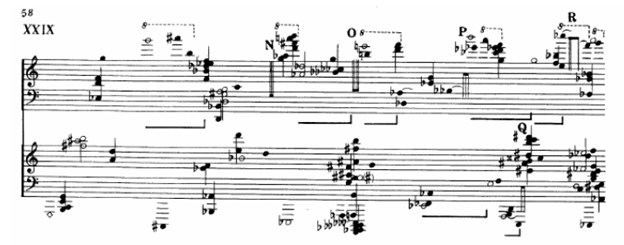
It is noteworthy that the study, considered at this moment in the context of the interpretation of silence, does not contain a single pause. Moreover, it lacks fixed durations, as well as indications of dynamics and articulation. This aleatoric principle gives the performer a significant role as a co-creator of the musical process. As can be seen in Fig. 1, the etude is written by senza misura and does not contain not only the clock features, but also the final clock chetra, which usually, at least visually, separates one etude from another. All 32 studies follow each other without interruption, forming a certain type of progression, as a result of which they become practically impossible (Figure 2).
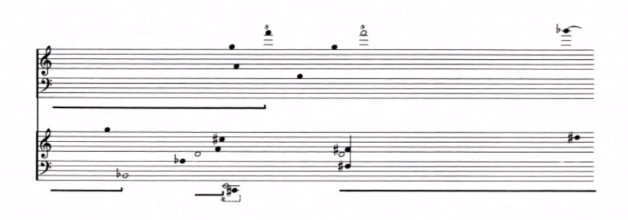
Figure 2 — XXIX sketch from the cycle "Etudes Australes". John Cage. Such freedom of notation is associated with untamed natural phenomena that can only be observed and heard. The desire to connect with the spiritual principle, as well as to approach the idea of "omnipresent" and "continuous" music, is thus clearly manifested in the very text of the composition. We expect that this study, like a force of nature, will be extremely unprovable, that it will "breathe" pauses and permeate silence. At certain points, our expectations are met, and that is very effective, due to the significant "voids" between the notes in the score, which replace the pauses of classical notation (Figure 3).
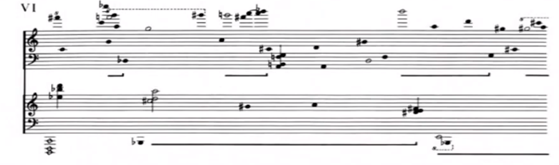
Figure 3 — VI etude from the cycle "Etudes Australes". John Cage. However, a large number of compositional techniques and the success of the implementation of this idea depend crucially on the technical and mental training of the performer. "Etudes Australes" is essentially a Cage collection of unintentional sounds, one of the many attempts to artificially reproduce silence. It can be argued that if we accept his understanding of silence as the absence of intentionally produced sounds, then at a certain level of perception the whole study turns out to be a form of silence.
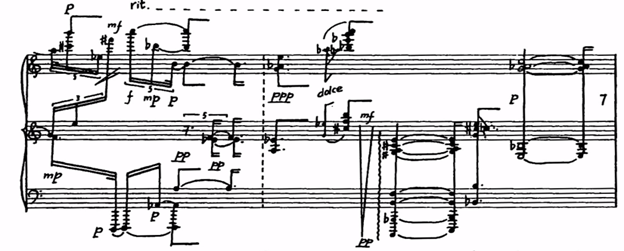
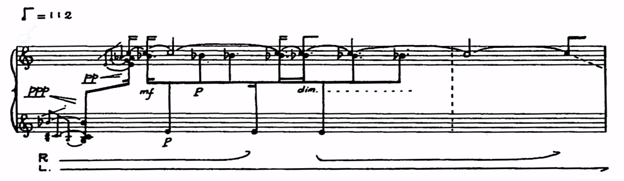
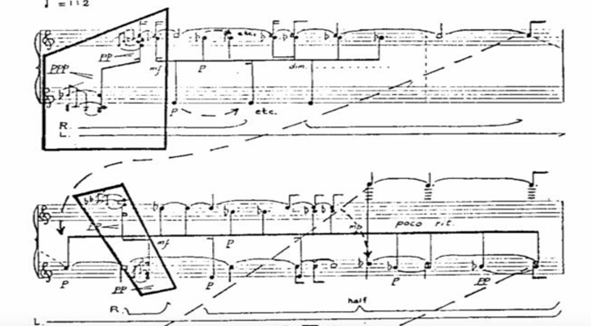
Figure 4 — "For Away". Toru Takemitsu. Unlike Cage, Takemitsu incorporates "concrete" silence into the music itself — into his compositional language, harmony, as well as rhythmic and melodic patterns — without trying to give the music any other, additional function. As for the philosophy of silence and related ideas, certain similarities can be found between the compositions under consideration. So, for example, the pointillist texture that we observed in "Etudes Australes"Cage is also present in some episodes of "For Away" Toru Takemitsu (Figure 4).
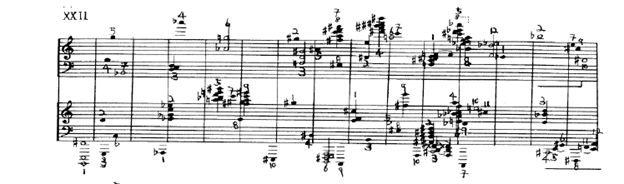
Figure 5 — "For Away". Toru Takemitsu. We see that Takemitsu also uses the opportunity to "liberate" the music and the artist by recording "For Away" in senza misura (Figure 5). However, unlike Cage, he does not resort to aleatorics, maintaining precise indications of durations, detailed dynamics and very explicit recommendations on the use of the pedal. Nevertheless, despite the lack of aleatorics, when listening to this composition, there is a feeling of space for naturally organized fragments of musical thought. It seems that the aleatoric sound here is carefully recorded in the score, thereby ensuring accuracy and freedom of performance. At the same time, Cage's sketch requires performance under conditions of considerable nervous tension due to extremely complex technical requirements. For this reason, pianists, while learning an etude, are forced to resort to various auxiliary means (Figure 6), thereby overloading themselves and achieving the opposite effect to that which Cage originally intended.
Figure 6 — XXII sketch from the cycle "Etudes Australes". John Cage. We have already noted that there are no pauses in Cage's sketch, but there is a certain amount of empty space, which in the classical sense implies the presence of silence, which, in turn, is explained by the alleatoric nature of the composition. It is even more significant that Takemitsu, in his much more conventional (primarily from the point of view of notation) play, uses only about ten pauses, none of which exceeds the duration of the dotted eighth. Each of them serves solely to clarify the rhythmic pattern, rather than performing the function of a "pause" in the true sense of the word. However, this does not mean that there is no silence characteristic of Takemitsu in this work.
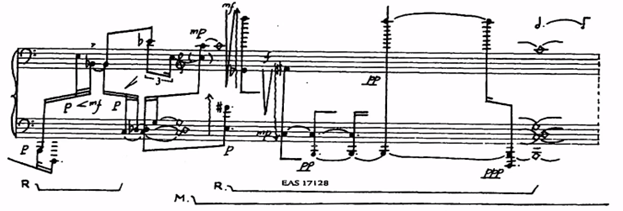
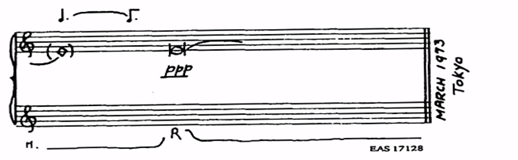
Figure 7 — "For Away". Toru Takemitsu. Silence in "For Away" it manifests itself in a different way, which is very characteristic of the composer. Let's pay attention to the conclusion of Fig. 7, where the dynamic designations pp and ppp are combined with the use of an extremely high piano register, followed by a resonance held by the pedal – an echo of the harmonic basis of the previous material. This is just one of the many examples present in the work (see also Fig. 8), in which the boundaries between sound and silence are blurred. It becomes difficult to determine at what point the sustained sound fades out and where silence begins — a kind of "threshold of audibility" arises. Even the very beginning of "For Away" (Fig. 5) is brought out of silence by the composer (which allows us to draw an interesting parallel with the beginnings of many Bach compositions with a beat), thereby introducing the listener to "music that always exists." [3]
Figure 8 — "For Away". Toru Takemitsu. It is also important to mention the concept of "ma", which is omnipresent in Takemitsu's work. We have already briefly noted that "ma" allows for several interpretations and, consequently, different ways of manifestation. In this composition, we do not encounter the expected "loud silence", which often acts as the main way to implement this concept in music. Instead, "ma" here manifests itself through the distance between the manifestations of similar musical material (Fig. 9). In other words, all that lies between these two appearances is silence, or "ma" in Takemitsu's understanding.
The analysis shows that with the external proximity of a number of compositional solutions — pointillist texture, senza misura recordings, sparseness of sound space — the mechanisms of silence functioning in the considered works are fundamentally different. In both cases, the listener is faced with the intersection of sound and silence, but the ways they are implemented reflect different aesthetic and philosophical attitudes. In the sixth etude from the cycle "Etudes Australes", silence is not represented as a pause or a structural gap. It manifests itself through the aleatorics system and the principle of minimizing copyright control. The absence of fixed durations, dynamics and articulation, the spatial organization of notation and the use of randomness procedures translate the sound stream into the sphere of unintentional events. In this context, silence has an intellectually organized, practical character: it arises as a result of a methodological decision and is primarily associated with the redistribution of the listener's attention. A musical event ceases to be a strictly defined structure and becomes a field of observation. In "For Away", silence acts differently. Despite the relative conventionality of the notation, it permeates the fabric of the work through space-time relations, dynamic extremity, register extremity and pedalized resonance. The concept of "ma" is realized here as an organized interval between sound manifestations, as a tense "between" saturated with inner meaning. Unlike Cage's rejection of control, Takemitsu's silence is structured and metaphysically colored; it does not eliminate the author's presence, but transforms it into a form of contemplative organization of the sound space. The difference is also found in the role of the performer. In the Cage etude, the performer becomes a co-creator of the sound result, since the concretization of the material largely depends on his decisions and capabilities. In Takemitsu's "For Away", the degree of freedom is much less: the sound parameters are carefully fixed, but it is silence and resonance that form the character of perception and create a feeling of inner breathing of the form. In both cases, the effect of "continuous music" occurs, but it is achieved in different ways.: For Cage— it is through observation and cognitive reorientation, for Takemitsu, it is through deep listening to the sound and its gradual dissolution. Thus, the comparative analysis confirms the initial hypothesis of the study: the concepts of silence formulated by the composers at the philosophical level remain valid in works where silence does not act as a central stated theme. Moreover, the difference in the ways of its realization reflects the cultural and philosophical distance between the American and Japanese avant-garde of the second half of the 20th century. The observations obtained substantiate the position formulated in the introduction that silence can function as a carrier of the composer's individual philosophical position, regardless of the degree of its declarativeness. In some cases, it acts as a methodological principle and a means of demarcating author's control, in others — as an aesthetic category regulating breathing, density and temporal organization of musical space. It is in this difference that the deep individuality of the artistic thinking of each of the authors is manifested.
The present study has confirmed that the phenomenon of silence in twentieth-century musical art, considered as a philosophical and compositional category, is manifested in John Cage and Toru Takemitsu through fundamentally different but integral concepts that persist even in works where silence is not the central element. An analysis of the works "For Away" and the sixth etude from the cycle "Etudes Australes" shows that, despite the difference in methods and aesthetic attitudes, both composers create a special "space of silence" where sound and its absence become equal elements of the musical flow. Takemitsu's motifs act like "stones" in a Japanese garden, forming "ma" — an active, creative space between sounds, saturated with inner meaning and metaphysical coloring. Cage, on the other hand, uses silence as a practical and intellectually organized principle: the rejection of author's control and aleatory techniques allow the listener to perceive unintentional sounds as musical events, turning attention into a means of creating music. Both approaches demonstrate the preservation of philosophical concepts of silence in works where it is not stated as a central theme. In Cage's practice, silence is the "absence of presence" of intentional sounds, active observation and redistribution of attention. For Takemitsu, on the contrary, silence is the "presence of absence", "ma", a space in which sound events and pauses mutually define each other and form a holistic perception of musical time and space. The intensity of silence depends on the strength of the sound, as light is perceived brighter against the background of darkness, and emotional involvement in sound enhances the perception of "ma". In both cases, special attention should be paid to the connection of these aesthetics with Zen Buddhism, where the simultaneous presence and absence of all "things" forms the philosophical basis for understanding sound and silence. For Cage, this is the absence of intentional sounds, for Takemitsu, it is the presence of emptiness as an active space. This understanding allows us to consider silence not as a passive pause, but as an active, creative component of the musical fabric that shapes perception and promotes deep contemplative involvement of the listener. In a broader context, the results of the study confirm the original hypothesis of the work: the concepts of silence in Cage and Takemitsu are preserved in the works outside the framework of the program declaration, and the difference in their implementation reflects the cultural and philosophical distance between the Western and eastern traditions of the avant-garde. The scientific novelty of the research lies in the author's interpretation of a previously unexplored aspect of the aesthetics of the two composers, identifying their unique philosophical approaches to sound and silence, and showing how these approaches are implemented at the level of the structure of a musical composition, perception and performance practice. Thus, silence acts for both composers not only as a musical element, but also as a carrier of a philosophical position, demonstrating different ways of understanding the interaction of sound, time and space. Cage shows silence as a practical intellectual category, and Takemitsu as a metaphysically saturated, space-time "ma". This duality reveals the deep individuality of each composer and their contribution to shaping the modern understanding of silence in the musical art of the 20th century.
The article is published in its final version as approved following the last positive peer review recommending acceptance for publication. It incorporates revisions made by the author in response to prior negative peer review reports that did not recommend publication. All peer review reports, including initial negative reviews, are published in open access alongside the article. All versions of the author’s revisions are archived in the publisher’s repository and may be made available upon reasonable request in accordance with Elsevier’s editorial policies and applicable data availability requirements. References
1. Cage, J. (1995). Conversation with William Duckworth.
2. Takemitsu, T. (1995). Confronting Silence: Selected Writings (Y. Kakudo & G. Glasow, Eds.). Gallen Leaf Press. 3. Burt, P. (1998). The Music of Toru Takemitsu. 4. Cage, J. (1961). Silence: Lectures and Writings. Wesleyan University Press. 5. Woo, J.-L. (2019). The Practicality of the Impossible: Studies in 20th and 21st Century Etudes. Faculty of Music, University of Cambridge, Clare College. 6. Chenette, J. (1985). The Concept of Ma and the Music of Takemitsu. Grinnell College. 7. Poletti, I. (2015). Silence, Rocks, Gardens, Dolphins: The Music of Toru Takemitsu. https://issuu.com/igorebulipoletti/docs/toru_esssay_1 8. Solomon, L. J. (1997). John Cage: The Sounds of Silence. 9. Sakamoto, M. (2010). Takemitsu and the Influence of "Cage Shock": Transforming the Japanese Ideology into Music. University of Nebraska-Lincoln. 10. Kang, E. (2010). Late Twentieth-Century Piano Concert Etudes: A Style Study. University of Cincinnati, College-Conservatory of Music: Piano. 11. Zatkalik, M. (2005). Šta još možemo naučiti od lingvistike. Muzička teorija i analiza, 2. Fakultet muzičke umetnosti. 12. Tsaregradskaya, T. (2014). Toru Takemitsu: Between Painting and Music. Scientific Notes of the Gnessin Russian Academy of Music, 3, 35-54. https://nbpublish.com/library_read_article.php-id=66088 13. Sakamoto, Mikiko. (2010). Takemitsu and the Influence of “Cage Shock”: Transforming the Japanese Ideology into Music. Glenn Korff School of Music: Dissertations, Theses, Student Creative Work, and Performances, University of Nebraska-Lincoln. 14. Tsaregradskaya, T. (2014). Toru Takemitsu: Between Painting and Music. Scientific Notes of the Gnessin Russian Academy of Music, 3, 35-54. https://nbpublish.com/library_read_article.php-id=66088 15. Irlandini, L. A. (2022). Musical Time in Tōru Takemitsu's November Steps. Per Musi, 42, e224224. https://doi.org/10.35699/2317-6377.2022.40417 16. Samoylenko, A. A. (2024). Toru Takemitsu: In Search of His Style: Piano Music of the Early Period. Fine Arts Magazine: Science and Education, 1, 1. 17. Poryadina, M. E. (2023). The Image of the Japanese Garden in the Works of Toru Takemitsu. Vestnik Akademii Russkogo baleta im. A. Ya. Vaganovoy, 1, 84. 18. Petruseva, N. A. (2023). Distancing & Collision of the West with the East: P. Boulez, K. Stockhausen, T. Takemitsu. DOI: 10.36945/2658-3852-2023-2-103-117. 19. Loginova, L. N. (2025). John Cage-Inventor of Languages and Meanings. DOI: 10.24412/2658-7858-2025-40-25-31. Music in the Cultural System: Scientific Bulletin of the Ural Conservatory, 40, 25-31. 20. Lipov, A.N. (2022). John Milton Cage. A look at the most famous composer of the American avant-garde of the twentieth century. Culture and Art, 7, 68-81. https://doi.org/10.7256/2454-0625.2022.7.36139 21. Kurlenya, K. M. (2025). Xenakis and Cage: Two Nothingnesses-Two Nonexistences-Two Beginnings of Music. Ideas and ideals, 17(1), 375-399. DOI: 10.17212/2075-0862-2025-17.1.2-375-399. 22. Petrov, V. O. (2015). Musical Silence and the Noisy Music of John Cage: Principles of Integrating Noise into Musical Composition. Culture and Art, 5, 479-490. https://nbpublish.com/library_read_article.php-id=66909 23. Manulkina, O. B. (2013). John Cage and the History of American Music. Scientific Bulletin of the Moscow Conservatory.
First Peer Review
Peer reviewers' evaluations remain confidential and are not disclosed to the public. Only external reviews, authorized for publication by the article's author(s), are made public. Typically, these final reviews are conducted after the manuscript's revision. Adhering to our double-blind review policy, the reviewer's identity is kept confidential.
Second Peer Review
Peer reviewers' evaluations remain confidential and are not disclosed to the public. Only external reviews, authorized for publication by the article's author(s), are made public. Typically, these final reviews are conducted after the manuscript's revision. Adhering to our double-blind review policy, the reviewer's identity is kept confidential.
Third Peer Review
Peer reviewers' evaluations remain confidential and are not disclosed to the public. Only external reviews, authorized for publication by the article's author(s), are made public. Typically, these final reviews are conducted after the manuscript's revision. Adhering to our double-blind review policy, the reviewer's identity is kept confidential.
|
| We use cookies to make your experience of our websites better. By using and further navigating this website you accept this. | Accept and Close |

 © 1998 – 2026 Nota Bene. Publishing Technologies. NB-Media Ltd.