|
Culture and Art
Reference:
Zhu, H., Fedorovskaya, N.A. (2026). Perception of Russian visual art in Heilongjiang Province through the lens of the Feng Shui system in the early 21st century (based on the works of A.N. Cherkasov presented at the RuiYi Gallery). Culture and Art, 2, 17–31. https://doi.org/10.7256/2454-0625.2026.2.77985
Perception of Russian visual art in Heilongjiang Province through the lens of the Feng Shui system in the early 21st century (based on the works of A.N. Cherkasov presented at the RuiYi Gallery)
Chzhu Khe
ORCID: 0009-0004-7416-3053
PhD in Art History
Postgraduate Student; School of Arts and Humanities; Far Eastern Federal University
690922, Russia, Primorsky Krai, Vladivostok, Russian island, village of Ajax, room 7, sq. 225

|
chzhu.khe1@dvfu.ru
|
|
 |
Other publications by this author
|
|
|
Fedorovskaya Natalia Alexandrovna
ORCID: 0000-0002-8789-7994
Doctor of Art History
Professor; Department of Cultural Studies and Art; Far Eastern Federal University
690922, Russia, Primorsky Krai, Vladivostok, Russian island, village of Ajax, 10 K. f
|
|
fedorovskaya.na@dvfu.ru
|
|
 |
Other publications by this author
|
|
|
DOI: 10.7256/2454-0625.2026.2.77985
EDN:
CCUUWP
Received:
01/28/2026
Published:
02/04/2026
Abstract: This study examines the features of how contemporary Russian landscape and narrative painting are perceived within the artistic sphere of Heilongjiang Province, features determined by traditional cultural codes, in particular the system of Feng Shui. It explores how Feng Shui functions as a cognitive framework and system of value judgments in the consciousness of Chinese viewers, shaping their visual preferences and interpretation models. In contrast to the dominant approaches in art history focused on metropolitan institutions and global trends, this work shifts the focus to regional art perception practices, where the well-being-oriented logic of Feng Shui acts as a key factor. The relevance of the research is linked to the need to understand the adaptation of Western art forms within local cultural contexts, especially in border regions with active cultural exchange, such as Heilongjiang. Here, the painting of Russian Far Eastern artists, particularly the works of A.N. Cherkasov, holds a special place, transmitting both the European pictorial canon and a regional cultural code. The work employs a comprehensive interdisciplinary methodological approach, including the study of the philosophical origins of Feng Shui, art historical analysis (formal-stylistic, iconological, semiotic, and hermeneutic), a sociological survey (N=215) of Heilongjiang Province residents with subsequent statistical data processing, and a case study of the commercial "RuiYi Gallery" in the city of Heihe, which exhibits the paintings of A.N. Cherkasov. The scientific novelty of the research lies in the following: firstly, in transferring the category of "Feng Shui" from the sphere of architecture and design into the field of art reception studies; secondly, in developing methods for identifying regional specificities in art perception; thirdly, in obtaining empirical data on art perception in a Chinese border region. The main conclusions of the work indicate that Feng Shui functions as a powerful cultural code, asserting the dominance of a traditionally Chinese, utilitarian and functional-aesthetic approach to artistic perception, where the practical benefit of a work (attracting luck, wealth, harmony) prevails over its formal-aesthetic qualities. This interpretative system interacts with the process of localizing Russian painting, forming hybrid formats of acceptance. Art galleries, acting as active transmitters of Feng Shui discourse, intensify this process, which creates barriers for non-figurative and conceptual art and potentially limits the diversity of the local artistic ecosystem.
Keywords:
Feng Shui, art perception, cultural code, semiotics of art, sociology of art, receptive aesthetics, landscape painting, Russian painting, Cherkasov's works, Heilongjiang galleries
This article is automatically translated.
Introduction When studying contemporary art in China, academic focus has traditionally focused on the processes taking place in central cities with a well-established culture of perception and acceptance of foreign art, such as Beijing, Shanghai, etc. At the same time, there is an equally significant but often ignored cultural force at the regional level, based on the perception of modern art through the prism of traditional ideas, folk beliefs and behavioral models, the core of which is the feng shui system. Established stereotypes often become a problem for the perception of art that does not meet the usual canons, regardless of the artist's skill level and his recognition at the world level. The purpose of this article is to objectively show how feng shui, being a traditional and deep cognitive system of value judgments, forms models of perception and interpretation of the work of recognized masters of Russian painting in the Heilongjiang province of China, using the example of the works of the Far Eastern artist A.N. Cherkasov. The study aims, firstly, to show the feng shui categories (yin-yang, five elements, symbolism) that set the public pragmatic criteria for evaluating works of art, focusing on luck and well-being, and how these criteria manifest themselves in preferences for certain subjects, colors and compositions. Secondly, using the example of the analysis of A.N. Cherkasov's paintings, it is necessary to identify how these representations interact with the process of localization of Russian painting in the specific regional context of cross-border cultural exchange between Russia and China. Thirdly, using the example of the RuiYi Gallery, the largest and most influential gallery in the province, to show how Feng Shui discourse is strategically used to shape the exhibition and educational activities of art institutions. The study uses a comprehensive interdisciplinary methodological approach, including the study of the genesis, historical and cultural context, philosophical, and semiotic iconological and hermeneutic understanding of Feng Shui, which reconstructs its conceptual framework as an interpretive system, which is projected onto the art criticism formal and stylistic analysis of paintings by A.N. Cherkasov. A sociocultural approach, including a sociological survey (questionnaire) followed by statistical analysis, is used to study the perception of fine art in Heilongjiang Province. The main theoretical foundations of Feng Shui in scientific discourse Currently, the feng shui system is being considered by Russian and Chinese researchers from the perspective of Chinese and Western philosophy, historical evolution, and intercultural communication. The researchers focus on the genesis and main positions of feng Shui – the teaching of yin-yang and the five elements, as well as symbolism. For example, Yang Tiancai explains that feng shui refers to the classical Chinese science of kanyu, whose ideological roots go back to Zhou Yi. The ancient thought of Feng Shui focused on the search for a favorable geographical environment, striving for harmony of heaven, earth and man. By the modern period, it has evolved from geographical knowledge into a complex picture of the world, deeply penetrating into everyday life; its goal is the rational adjustment of space to comply with the laws of nature, creating a livable environment [1, p. 1]. Liu Junzu reveals the importance of the doctrine of yin-yang and the five elements as the basis of Feng Shui culture, emphasizing the philosophical idea of the interrelationship and dynamic balance of all things. He quotes the arguments of Confucius from the chapter "Xiqi Zhuan" ("系辞传", in translation). "Narration of linked words") of the famous treatise "Yi Zhuan" ("易传", translated from "The Book of Changes"): "In"And "there is a Great Limit that generates two beginnings, two beginnings generate four symbols, four symbols generate eight trigrams", believing that through the system of trigrams one can deduce positive or negative development trends [2, pp. 88-99]. Peng Hua considers the "yin-yang balance" as the central idea of feng Shui, pointing out that harmony is achieved only when they are balanced [3, p. 1]. As for the doctrine of the five elements, Yan Linlin notes that his ideas are set forth in one of the most important ancient Chinese sources of the Confucian canon, Shang Shu (Shu-ching), summarizing what exists in five properties - metal, wood, water, fire, earth, and revealing the relationship of mutual generation and overcoming between them [4, pp. 26, 76]. The astrological treatise of the Song era "Yuanhai Ziping" ("渊海子子平平平平,,", in translation. "The Wealth of Astrology") uses this teaching as a framework, linking the character and fate of a person with the properties of the five elements and offering methods for regulating their balance through the name and the environment [5, pp. 379-559]. These ideological systems are deeply embedded in the consciousness of the Chinese and continue to shape home life and the perception of works of art to this day. Despite the fact that there is much more Chinese research in this area, we will pay special attention to the position of Russian authors. Thus, M. V. Rubets draws attention to the fact that feng shui, based on the systems of yin-yang, five elements and numbers, harmonizes the artificial environment with the cosmic order, continuing to shape the Chinese perception of space [6]. Russian researchers pay great attention to the issues of intercultural communication and the modern transformation of feng shui, research shows its separation from the original context and integration with pragmatism. For example, M. B. Serdyuk, E. A. Koroleva, L. N. Andreeva, and others note that the popularity of feng shui in the Russian Far East is due to its pragmatic orientation and eclectic mixing with local culture; the original philosophical content is often lost, and it turns into an everyday commercial practice combining utilitarian goals and decorative function [7, 8, 9]. M. V. Nashchokina's research shows that feng Shui principles are attracting growing attention in modern European landscape design, being applied in the planning of garden spaces, reflecting the mutual borrowing of Eastern and Western concepts [10]. In the context of the study of the feng Shui system, integration with modern Western theories of art is of interest. For example, feng shui can be considered as a powerful system of "iconographic interpretation" rooted in Chinese culture. E. Panofsky proposed a three-level interpretation model that can be applied to the Feng Shui system: the first level (subject description) concerns the perception of form, lines and color; the second (iconographic analysis) is associated with the recognition of plots and allegories; the third level is aimed at revealing the "inner meaning" reflecting the worldview of the era, and is based on on a broad cultural background [11, pp. 3-17]. It is at this level that feng Shui provides the viewer with a ready-made vocabulary of symbols and context for generating meanings.
Numerous Chinese and Russian researchers analyze in detail specific images that carry the meanings of feng Shui. For example, Peng Zhi points out that images of mountains and waters correspond in Feng Shui theory to the trigram "gen" (艮), symbolizing stability and patronage, and are often interpreted as a "supporting mountain" [12]. The importance of the symbol of water is emphasized in the Tang treatise "Qing Nan Xu" ("The Secret words of the Green Bag", the preface to the Feng Shui book "Qing nan ao Yu", Chinese, approximate translation "Secret words from the Green Bag") it is written that the state of water affects fate and well-being, directly reflecting her role as a symbol of wealth [13]. The richness of the symbolism of the image of plants is indicated, among other things, by the ancient Chinese treatise of the IV-III centuries BC. "Guan-tzu" ("管子子"), where it is noted that lush vegetation is considered the embodiment of abundance and wealth of the state [14, p. 1132]. In addition, the homophony (the same sound) of the Chinese words "wood" (材) and "wealth" (财) further strengthens this connection in the feng Shui system. In traditional Chinese art, certain plants and fruits are attributed features that symbolize human qualities and properties. Sun Jinjin points out that the meihua plum, orchid, bamboo and chrysanthemum symbolize steadfastness, nobility, honesty and proud independence, receiving the honorary name of the "four noble plants" [15]; Chen Yupu notes that the peony is considered the "king of flowers" and represents wealth and luck [16, p. 44]; Wang Xiang He states that the sunflower in folk culture symbolizes optimism and light [17]; and Wang Chunhua explores the associations of lilac with purity and nobility in Chinese and Russian cultures [18]. In addition, Wang Chenghui mentions that mountain ash in the cultures of China and Russia symbolizes good luck, harvest and happiness [19]; Xiao Dongfa and Li Dandang point out that pomegranate has become a symbol of family prosperity, unity and abundance [20, pp. 110-122]. Animal images also carry complex symbolism. In the chapter "Fu Rui zhi" ("符瑞志", translated from "Records of Good Omens") of the work "Song Shu" ("宋书", translated from "Song History") of the Southern and Northern Dynasties, it is recorded that the appearance of a white deer foreshadows the wisdom and mercy of the ruler, which strengthens his association with well-being, enhanced by the homophony of the words "deer" (鹿) and "welfare" (禄) [21, p. 232]. Wang Feifei analyzes that the combination of fish and lotus in folk art often covertly symbolizes the harmony of yin-yang and fertility, and the homophony of "fish" (鱼) and "excess" (余) makes it a symbol of wealth [22]. Wang Jingyuan explores the plot of "Cat and Butterfly", where the homophones "cat-butterfly" (猫蝶) and "deep old age" (耄耋) embody the wishes of longevity [23]. Wang Juan and Hao Jianguo point out that the pattern "magpie and plum blossoms" corresponds to the phrase "joy on the edges of the eyebrows", meaning the approach of good luck [24, p. 116]. An S.A. argues that the extensive use of benevolent homophone patterns in Chinese art creates a symbolic system similar to the principles of Feng Shui, aimed at harmonizing the energetic atmosphere, and emphasizes that Chinese landscape painting, reflecting the sacralization of nature, has become a form of synthesis of Eastern and Western aesthetics and a carrier of intercultural dialogue [25]. Shi Lu's research reveals the evolution of the perception of Chinese zoomorphic images (dragon, phoenix, qilin/unicorn) in Russian culture of the XVIII–XIX centuries: from sacred symbols with protective functions in Feng Shui through "desacralization" and "aestheticization" to a resource for expressing identity and decorating space [26]. Han Chuanbo and Yang Man describe the influence of the theory of the five elements on the color system of traditional Chinese art: white (metal) – purity, green (wood) – life, black/blue (water) – depth, red/orange (fire) – passion, yellow (earth) – abundance [27].K. Marat and A.A. Dadyrova point out that the key ideas of feng shui ("qi", yin-yang balance) influence the composition, symbolism and emotional expressiveness of works of art [28]. Thus, existing research mainly analyzes the meanings of feng Shui in specific artistic images from the standpoint of iconology, semiotics and hermeneutics, providing a valuable reference point for interpreting works in the artistic environment of Heilongjiang Province. However, from the point of view of the sociology of art and receptive aesthetics, there is relatively little research on how Feng Shui culture influences the perception of art. Only a few works occupy a critical position. For example, Feng Shanshu points out that traditional feng Shui concepts such as "supporting mountain and water in front of the face" have long influenced the psychology of collecting, encouraging galleries and artists to create standardized "feng Shui paintings" or "paintings to attract wealth". Such works, although they may be widely accepted by the public, can lead to unification and vulgarization of creativity [29]. Consequently, deeper empirical and theoretical research is needed in this area at the level of interaction between audience perception and the further development of art. The works of A.N. Cherkasov in the context of the Feng Shui system In December 2024, a combined method of online questionnaires, online surveillance, and in-depth interviews was applied. A total of 215 valid questionnaires were received: 20 respondents with a master's degree or higher (9.30%), 167 with a bachelor's degree (77.67%) and 28 with a bachelor's degree or lower (13.02%). The Heihe art space RuiYi Gallery was chosen as a case study for in-depth study. Founded in 2015, the gallery has an exhibition area of 4,400 m2, specializes in Russian oil painting and has a collection of about 3,000 works, of which more than 1,000 are on permanent display. As a representative art institution of Heilongjiang Province, it demonstrates the features of the artistic ecosystem common to the province. Based on an analysis of the structure of her collection and interviews with curators and management staff, the results were obtained demonstrating the influence of the feng Shui system on the formation of gallery funds and the artistic preferences of art connoisseurs.
| 
| | 1. The functional role and symbolic perception of painting Data source: Survey of 215 respondents (N=215) |
The survey of 215 respondents revealed a close relationship between the motivation to purchase paintings and their practical function: 161 people (74.88%) purchase them mainly for interior decoration, and 5 of them (2.33%) directly indicated a desire to attract good luck, which demonstrates a commitment to tradition and a pragmatic orientation. 23 people (10.7%) buy paintings solely out of artistic interest, the same number (10.7%) – for a gift, and 8 people (3.72%) – for investment purposes. 192 people (89.3%) pay attention to the benevolent meaning of the works, and 130 (60.47%) fully agree that fine art can influence the feng shui of living space [Fig. 1]. These studies show that the horizon of expectations of art connoisseurs associated with Feng Shui culture significantly influences their perception and evaluation of works: preference is given to works corresponding to benevolent subjects with a broad cognitive basis in traditional Chinese art. For example, among 215 respondents, 179 people (83.25%) prefer landscape, animalistic, and still-life oil paintings that carry a benevolent meaning. As an example of the perception of paintings by Chinese viewers from the point of view of feng Shui, consider two works by Alexey Nikolaevich Cherkasov (born 1965, Yuzhno-Sakhalinsk), a popular Far Eastern artist who works closely with RuiYi Gallery [30]. A. N. Cherkasov is represented in RuiYi Gallery by landscapes. His painting "The Glare of the Stream" (2019, RuiYi Gallery of China) from the Sakhalin series can serve as a typical example for the intercultural interpretation of the modern landscape [Fig. 2].
| 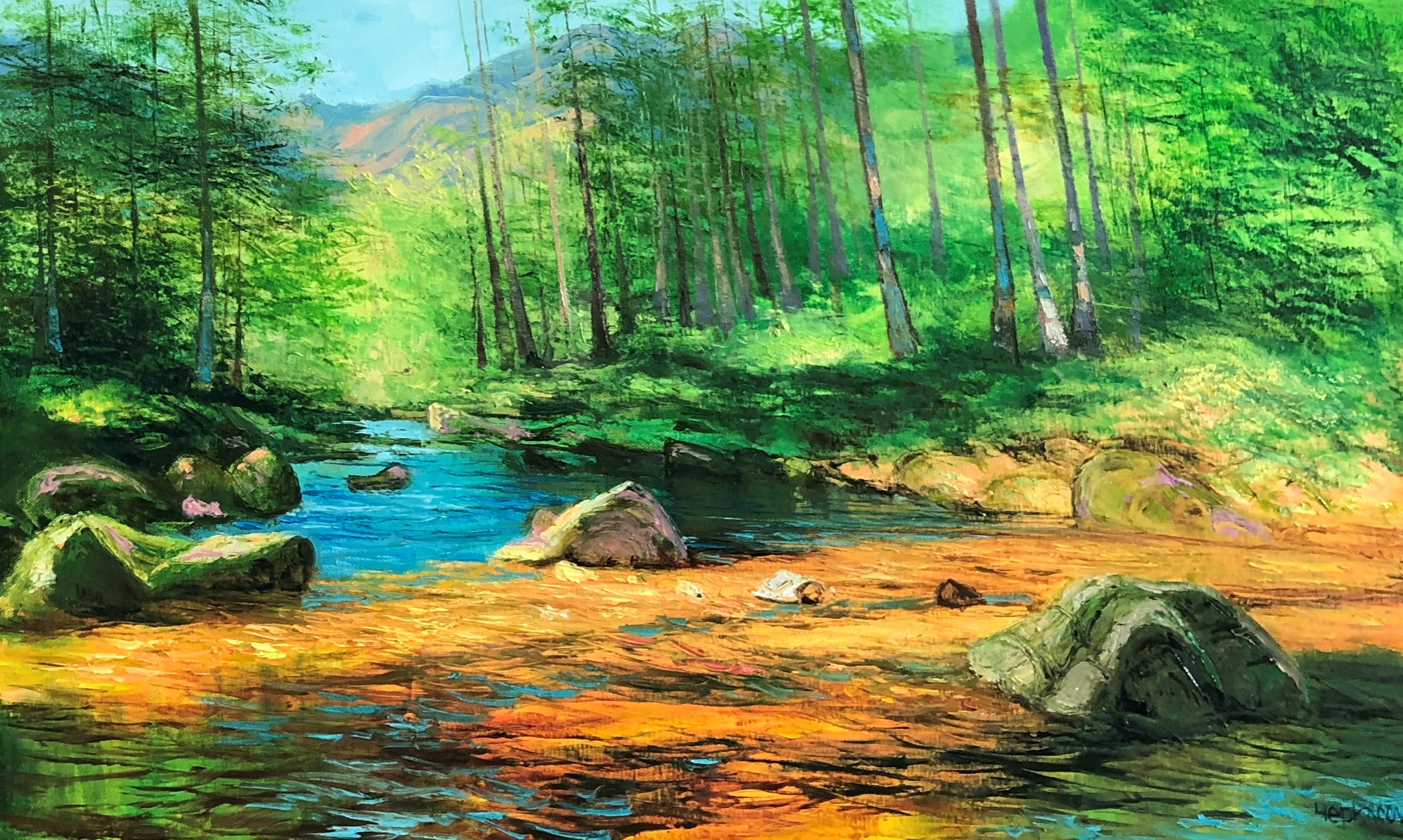
| | 2. Cherkasov A. N., The glare of the stream, oil on canvas. 60×100 cm. 2019 Image courtesy of RuiYi Gallery. |
Formal stylistic and semiotic analysis serve as a key methodological basis for interpreting the Feng Shui meanings of works. At the formal level, G. Welflin's categories can be applied, such as "linear and picturesque", "clarity and obscurity", which provide a universal framework for describing the evolution of visual form [31]. In the context of Feng Shui, "picturesqueness" (merging of brushstrokes, organic unity) and "fuzziness" (soft contours) are often associated with the smooth flow of "qi", while sharp "linear" fractures or excessive "clarity" can be interpreted as a violation of harmony, symbolizing an obstacle. At the semiotic level, according to Charles S. Pierce's trichotomy, the elements of painting are divided into "iconic", "indexical" and "symbolic" signs, which jointly participate in the construction of feng Shui meanings [32]. In the work of A. N. Cherkasov, from a formal point of view, let us pay attention to the pronounced "picturesqueness": the absence of clear contours, the shapes of trees, water and rocks are conveyed by merging brushstrokes and soft color transitions, creating visual integrity. The color naturally gradates from warm orange tones in the foreground to cool blues in the distance, forming an open dynamic. Such "fuzziness" and "openness" visually metaphorize the unhindered flow of energy, creating an aesthetic resonance with the principle of "smooth flow of qi" in feng shui. Within the framework of Charles S. Pierce's semiotic system, the elements of the painting have a multilevel semantic structure.: as "iconic signs", the stream and forest accurately reproduce the landscapes of the Far East; as "index signs", the dynamics of water and the moisture content of moss indicate a living ecosystem; at the level of cultural "symbolic signs" in the context of Feng Shui, a winding river (water) symbolizes financial well–being, a lush forest (tree) - vitality, mountains in the background plan (earth) – career stability, jointly forming a system of favorable symbols of "wind accumulation and qi gathering". According to E. Panofsky's iconological scheme, the meaning of the work is revealed on three levels: on the pre-iconographic level – the basic recognition of the natural landscape; iconographic analysis refers the painting to the genre of landscape, where the artist expresses a sense of love for his native land through the image of natural objects; on the deep iconological level, the composition and the ratio of elements – a winding river, forest, remote mountains – inadvertently conform to the ideal Feng Shui scheme, allowing the work to become a visual embodiment of the universal ideal of "harmonious coexistence." From the hermeneutic position of H. G. Gadamer, the work promotes the "merging of horizons": the horizon of the artist, combining local experience and the desire for harmony, meets the horizon of the viewer, which, depending on the cultural background, causes nostalgia, feng Shui interpretation or aesthetic perception of nature. This allows personalized expression and diverse cultural expectations to enter into a dialogue, explaining the widespread acceptance of the work in different contexts. As a result, the painting transforms the regional landscape into an intercultural visual parable about flow, balance and harmony through the synergy of form, symbols and deep structure.
| 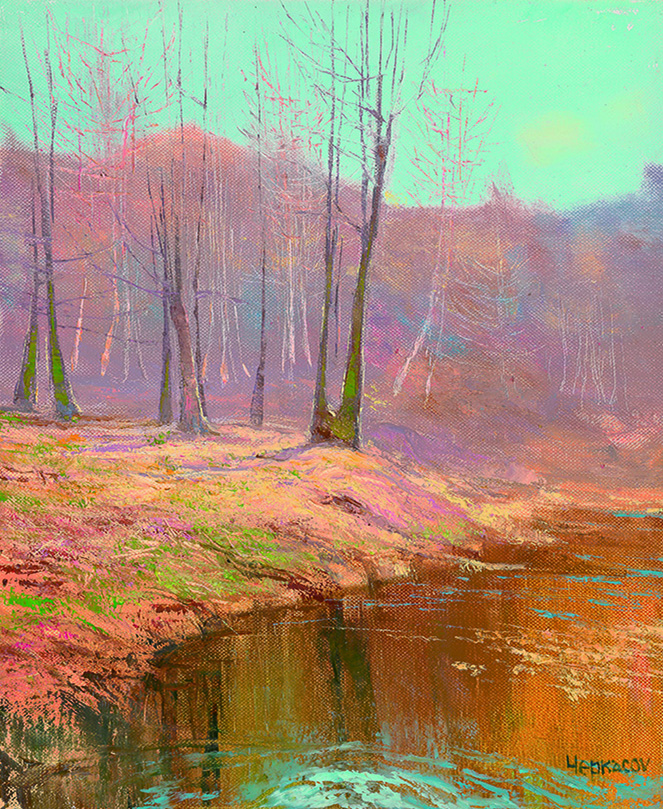
| | 3. Cherkasov A. N., Autumn on Khekhtsir, oil on canvas. 50×60 cm. 2018 Image courtesy of RuiYi Gallery |
Let's consider another interesting landscape by A.N. Cherkasov "Autumn on Khekhtsir" (2018, RuiYi Gallery), which, despite the author's skill, faces an intercultural problem of perception [Fig. 3]. Studying the plot and composition reveals a visual contradiction: in general, the work creates an atmosphere of harmony through soft, merging brushstrokes and colors, whereas the dead tree in the center is outlined with clear, sharp lines. In feng Shui interpretation, the former is associated with harmonious energy, and the latter with destructive power. This formal conflict forms the basis of the rejection of the work in a particular cultural context. The survey shows the following results: 113 out of 215 respondents (52.56%) stated that they would not like to see images of "rotting trees" or "dead wood" in the house, associating them with decay and financial difficulties, which creates a negative attitude towards the image. The analysis of the painting's sign system reveals a semantic conflict: as an iconic sign, the painting reproduces a specific landscape; as an index sign, a dry tree indicates the extinction of life, and a stream indicates a current; at the level of a symbolic sign in Russian culture, a dry tree can be associated with a poetic understanding of the natural cycle, whereas in the Feng Shui system it becomes a negative symbol of "decline"and "stagnation of qi." Warm colors and flowing water play a softening role, but the study confirms that the negative symbolic meaning of dead wood often dominates in the "misunderstandings" of relevant cultural groups. A review of A. N. Cherkasov's work from the standpoint of iconology reveals a cultural discrepancy in interpretation: at the pre-iconographic and iconographic levels, the work can be understood as an artistic expression of the changing seasons; however, in a deep iconological interpretation, the Feng Shui viewer reduces its essential meaning to "suppression of vitality" and "decline", making the work a "counterexample", confirming the dominance of cultural conventions in the perception of art. From the point of view of H. G. Gadamer's theory of "merging horizons", this process can be hermeneutically interpreted by the fact that the artist's creative horizon expresses the dialectic of the life cycle, but when confronted with the viewer's stable misconception that "a dry tree symbolizes extinction", the merger does not lead to resonance, but to a narrowing of meaning and a negative assessment; mitigating The elements lose their power, and the key negative symbol increases. This case shows that when a key visual symbol of a work is closely linked to a deep negative convention of the target culture, a rigid barrier to intercultural interpretation arises: the dialectical content and the intention of harmonization hardly overcome the cognitive barrier erected by cultural misunderstanding. This highlights the need for a thorough study of sensitivity to specific cultural symbolic systems in the process of intercultural artistic communication. The conducted research reveals the rootedness of such ideas: among 215 respondents, 105 people (48.84%) consider rocks and cliffs as a symbol of crisis and obstacles, refusing to use them in decoration; 113 people (52.56%) consider images of thunderstorms, hurricanes or raging waves to be symbols of uncontrolled disaster and avoid them. Regarding tiger patterns, 49 people (22.79%) see them as a symbol of "evil power" (凶煞), which does not promote harmony in the family, while 166 people (77.21%) see them as a symbol of courage and power. This shows that the final assessment depends on the activated symbolic codes within the same culture, which leads to radically different interpretations. Let's add that 193 people (89.77%) would not like to hang portraits of strangers at home, and 163 (75.81%) indicated discomfort from invasion of personal space; 201 people (93.49%) are not interested in abstract painting due to the lack of specific iconic signs and the inapplicability of the "symbolic vocabulary" of Feng Shui. This analysis allows us to understand how visual characteristics are transformed in the minds of art connoisseurs into meanings of luck or taboo, revealing the unique grammar of perception formed by Feng Shui discourse. According to the head of RuiYi Gallery, the focus on feng Shui meanings of paintings is an effective strategy for promoting Russian painting, which usually receives a positive response. This indicates that when choosing art, most consumers subconsciously follow traditional Feng Shui ideas about striving for good luck and avoiding harm, forming an "expectation horizon" and evaluation criteria. Among the approximately 1,000 permanent exhibits of the gallery, up to 85% of the works relate to subjects that are easy for Feng Shui interpretation (landscapes, animals, still lifes), and only about 15% are portrait and abstract works focused on artistic expression. This structure of the exhibition reflects the formative role of Feng Shui culture in the practice of art mediators. Feng Shui culture acts here as an active filter of perception, transforming a work of art from a purely aesthetic object into a cultural medium endowed with a practical function in the world of life. This collective and purposeful nature of the formation of visual preferences correlates with the concept of the "will to art" (Kunstwollen) by the art historian A. Rigl, who understood the "will to art" as an immanent spiritual force that determines the stylistic features of an era and guides its development from within [33]. In the context of the mass artistic ecosystem of Heilongjiang Province, such a "will" can be considered as a universal cultural desire to harmonize and optimize living space according to the principles of Feng Shui, a specific manifestation of which is a sustained interest in the works of a certain iconography. This "will", in fact, sets a set of implicit "rules of the game" for artists and galleries, directing creativity in a direction consistent with collective psychology and cultural expectations. Thus, the gallery in this process acts as an active "interpreter" and an amplifier of cultural symbolic codes. She asserts Feng Shui discourse as an effective language for discussing and evaluating art, forming a self-reinforcing cycle: society's preferences shape the visual foundations of art institutions, which in the long run can lead to the homogenization of the regional visual environment. Conclusion
The study of the activities of the art institutions of Heilongjiang province testifies to the prevailing traditional view of fine art from the standpoint of the Feng Shui system, which provides society with a ready-made and culturally legitimate framework of interpretation and lowers the threshold of perception of oil painting for the general public. Within the framework of this logic, the practical functions of a work (attracting wealth and good fortune, averting evil, etc.) often become the primary criterion for evaluation, ahead of its formal aesthetic merits and conceptual depth. Works by Russian artists are also included in this system. Studying the works of A. N. Cherkasov from the standpoint of feng Shui and modern methods of art studies allows us to demonstrate the formal stylistic, semiotic and hermeneutic features of these works, as well as some of the reasons for the acceptance and non-acceptance of certain subjects and genres of foreign paintings by mass art connoisseurs who make up the main contingent of visitors to art galleries and buyers of paintings in Heilongjiang province. The conducted sociological study of RuiYi Gallery viewers and employees objectively confirms the commitment to traditional representations of the feng Shui system and indicates that art institutions, actively acting as interpreters and popularizers of Feng Shui discourse, enhance the described mechanism of reception. This creates additional barriers to the development of forms of artistic expression using non-figurative forms or critical language, which implicitly affects the creative strategies of artists. In the long run, focusing on aesthetic demands that dominate Feng Shui can reduce the freedom and diversity of creativity, leading to a homogenization of the artistic offer.
The article is published in the version approved by the reviewers (after receiving a positive review recommending the manuscript for publication) with corrections made by the author (after receiving the editor’s comments, if any).
Read all reviews on this article
References
1. Yan, T. (2022). Zhou Yi (Book of Changes) (Zhou, Trans. & Comm.). Zhonghua Shuju.
2. Liu, J. (2015). Xiangjie "Yijing": Sici Zhuan (Detailed Explanation of the Book of Changes: Commentary on Sici). Xinxin.
3. Peng, H. (2024). Yin-Yang. Huaxia.
4. Yan, L. (2019). Shang Shu (Shang Shu) (Yan, Trans.). Jinghua.
5. Xu, S. (2002). Yuanhai Zipin (Yuanhai Zipin) (Li, Comm.). Hainan.
6. Rubets, M. V. (2022). Digit/number in the Chinese tradition and the "naive" worldview of the Chinese. Ideas and Ideals, 14(4-1), 191-214. https://doi.org/10.17212/2075-0862-2022-14.4.1-191-214
7. Serdyuk, M. B., & Koroleva, E. A. (2018). Feng Shui in the modern culture of the Far East of Russia. Society: Philosophy, History, Culture, 8, 191-195. https://doi.org/10.24158/fik.2018.8.37
8. Koroleva, E. A. (2019). The concept of Feng Shui: Research methodology and development practice in the modern culture of the Far East of Russia. Society: Philosophy, History, Culture, 2, 82-85. https://doi.org/10.24158/fik.2019.2.17
9. Andreeva, L. N. (2007). The art of Feng Shui. Notes of the Mining Institute, 173, 211-213.
10. Nashokina, M. V. (2018). The power of motivation: Modern trends in landscape art. Collection of Scientific Works of the State Nikitsky Botanical Garden, 147, 181-184.
11. Panofsky, E. (1962). Studies in Iconology: Humanistic Themes in the Art of the Renaissance. Harper & Row.
12. Peng, Z. (2020). Spatiotemporal consciousness and aesthetic meaning of the trigrams Zhen and Gen in "Zhou Yi"-with a focus on Wang Chuan-shan's interpretation. Zheshue Dongtai, 11, 111-122.
13. Shi, J. (2011). Discussion of the auspiciousness and inauspiciousness of the five elements and water cities. Dongnan Zhiye, 4, 84-85.
14. Gong, X., & Gong, Z. (2020). Shishuo Tonglan 2 (Review of Shishuo 2). Jiangxi People's Publishing House.
15. Sun, J. (2022). A look at the meaning of traditional Chinese culture through the "Four Noble Ones". Hanczi Wenhua, 16, 172-174.
16. Chen, Y. (2021). Chinese painting of seiy: Peony. Guangxi Fine Arts Publishing House.
17. Wang, X. (2011). The brightest of flowers: Decorative sunflower. Huamu Pengjin, 10, 10-11.
18. Wang, C. (2015). Analysis of the differences between Chinese and Russian floral cultures. Fujian Linye, 6, 30, 26.
19. Wang, C. (2011). Cultural features of symbolic meanings of plants in Russian and Chinese languages. Neijiang Shifan Xueyuan Xuebao, 26(5), 49-52.
20. Xiao, D., & Li, D. (2015). Plants and emotions: The glory of plants and cultural symbolism. Xiandai.
21. Li, F. (2000). Research and interpretation of Han reliefs. All-China Association of Literary and Art Workers.
22. Wang, F. (2009). On the humanistic spirit reflected in the image of the fish in "Shijing". Qingnian Kexue, 5, 168-169.
23. Wang, J. (2022). Beauty and metaphors in the paintings "Cat and Butterfly". Shouzan Paimai, 5, 48-53.
24. Wang, J., & Hao, J. (Eds.). (2023). Tushu Wufu Si (Illustrated Explanation of the Five Blessings "Happiness"). Huashan Wenyu Publishing House; Hebei Publishing Group.
25. An, S. A. (2019). The art of China in Eurasian culture. Culture in the Eurasian Space: Traditions and Innovations, 1, 58-61.
26. Shi, L. (2025). Perception of images of Chinese animals in Russia in the 18th-19th centuries. Litera, 7, 45-65.
27. Han, Z., & Yang, M. (2022). Discussion on the origin and evolution of the philosophy of the five elements. Jinggu Wen Chuan, 11, 59-61.
28. Smirnova, E. (2024). The origin and development of ancient art: Feng Shui. Conference Materials, May 20-21, 2024, 283-289.
29. Feng, S. (2016). "Feng Shui Hua" puzzles the market of Chinese landscape painting. Gongguan Shijie, 16, 32-36, 31.
30. Kondratova, L. A., & Zhgulieva, E. V. (2025). Artists of the Khabarovsk Territory. Cultural and Historical Heritage of Russia and the Asia-Pacific Region: Proceedings of the All-Russian Scientific Student Conference, Khabarovsk, February 26, 2025.
31. Popov, D. A. (2018). The concept of Heinrich Wölfflin in the context of the history of the methodology of the humanities. Manuscript, 12-1, 160-163. https://doi.org/10.30853/manuscript.2018-12-1.35
32. Molchanova, G. G. (2015). The synergy of visual and verbal in chromatics (painting) as a semiotic code of communication. Bulletin of Moscow University. Series 19: Linguistics and Intercultural Communication, 2, 7-19.
33. Demenev, D.N. (2021). Unity of the process of creating a fine art painting: ideal and material. Philosophical Thought, 3, 1-41. https://doi.org/10.25136/2409-8728.2021.3.32491
Peer Review
Peer reviewers' evaluations remain confidential and are not disclosed to the public. Only external reviews, authorized for publication by the article's author(s), are made public. Typically, these final reviews are conducted after the manuscript's revision. Adhering to our double-blind review policy, the reviewer's identity is kept confidential.
The list of publisher reviewers can be found here.
The subject of the study of the article "Perception of Russian fine art in Heilongjiang province through the prism of the Feng Shui system at the beginning of the 21st century (using the example of works by A.N. Cherkasov presented at RuiYi Gallery)" is the mechanism of reception of works of Russian fine art (using the example of the artist A.N. Cherkasov) in the specific regional context of the Chinese province of Heilongjiang. The focus of the work has shifted from traditional art criticism to the study of how the traditional Chinese Feng Shui system shapes aesthetic preferences, evaluation criteria, and interpretation strategies among the local public and art galleries. The author applies a comprehensive interdisciplinary approach, which is the main strength of the work. The methodology includes semiotic analysis for decoding visual images in paintings; formal stylistic analysis for connecting performance techniques with Feng Shui concepts; hermeneutic approach for understanding the process of interpretation and "merging horizons" of the artist and the viewer; sociological tools (questionnaires, included observation, interviews – 215 respondents), cultural and philosophical analysis to obtain empirical data about audience preferences and strategies of the gallery and the reconstruction of the conceptual foundations of Feng Shui. This synthesis of methods makes it possible to comprehensively explore the object, providing depth and evidence-based conclusions. The topic of the article is relevant within the framework of modern trends in cultural studies and art studies. She responds to a request to study the role of traditional cultural codes in the perception of modern art; the sociology of art and the mechanisms of art market formation at the regional level, especially in the context of the Russian-Chinese cultural dialogue. The scientific novelty of the study lies in the research perspective – shifting the focus of attention to the provincial artistic context of China; for the first time, the work of a modern Russian Far Eastern artist and the activities of a provincial Chinese gallery were chosen as the object of analysis; in the synthesis of classical Western art theory with the traditional Chinese Feng Shui system as an interpretative framework. The author empirically and theoretically substantiates the thesis that feng shui does not act as a "superstition", but as an active cultural and semiotic system that influences demand, supply and the language of art discussion itself. The article is distinguished by its academic style, logical and clear structure. The introduction clearly states the problem, purpose and objectives. The theoretical part demonstrates the author's good knowledge of both Chinese and Western scientific literature. The analytical part effectively combines theoretical calculations with a specific analysis of works and empirical data. The illustrations and graph (Fig. 1) are appropriately integrated into the text and reinforce the argumentation. The conclusion fully and adequately summarizes the results obtained. The list of literature is extensive and diverse, including classical works on art theory, modern research on Feng Shui, cultural studies and sociology of art by Russian and Chinese researchers, which demonstrates a deep study of the topic. The author indirectly appeals to potential opponents, mentioning the critical position (Feng Shanshu) about the vulgarization of art through "feng Shui paintings." The article, in response to criticism, shows that feng shui is a deeply rooted system of interpretation, and not just a commercial tool. The work demonstrates a multilevel mechanism of interaction between cultural codes and artistic perception. The article is a high-quality, original scientific study that makes a significant contribution to the field of cultural studies, art history and sociology of art. Its strengths are interdisciplinarity, relevance of the topic, scientific novelty and a successful combination of theoretical analysis with empirical data. The work has a high practical significance for curators, art managers and artists working in the field of intercultural exchange. The article is recommended for publication in a scientific journal.
|





 © 1998 – 2026 Nota Bene. Publishing Technologies. NB-Media Ltd.


