|
Culture and Art
Reference:
Li, M. (2026). Technological Transfer and China's "Local Response": The Establishment of the First Machine Wallpaper Production in Shanghai and Tianjin. Culture and Art, 2, 126–138. https://doi.org/10.7256/2454-0625.2026.2.77882
Technological Transfer and China's "Local Response": The Establishment of the First Machine Wallpaper Production in Shanghai and Tianjin
Li Men
ORCID: 0009-0001-7794-5868
PhD in Art History
Postgraduate student; Business Communications Institute; St. Petersburg State University of Industrial Technology and Design
198262, Russia, Saint Petersburg, Kirovsky district, Leni Golikova str., 19

|
925357695@qq.com
|
|
 |
|
DOI: 10.7256/2454-0625.2026.2.77882.2
EDN:
NYMGHI
Received:
01/25/2026
Published:
03/03/2026
Abstract: This study investigates the process of technological transfer in machine-based wallpaper production in China during the late 19th and early 20th centuries, with a specific focus on the concomitant local design responses it engendered. Employing a comparative analysis of Shanghai and Tianjin—two pivotal port cities that served as gateways for Western technologies—the research elucidates the distinct mechanisms through which Western lithography was adopted, adapted, and ultimately hybridized with indigenous aesthetic traditions. The methodological approach is interdisciplinary, synthesizing archival documents, material analysis of historical product samples, and contemporary periodicals to construct a nuanced historical narrative. The analysis reveals two divergent models of local adaptation. In the commercial metropolis of Shanghai, adaptation followed a logic of market-driven hybridization. Factories initially reproduced European patterns but rapidly evolved to create designs that strategically incorporated traditional Chinese symbols—such as peonies, butterflies, and motifs denoting longevity—executed with the new lithographic techniques. This created a visually modern product tailored to local consumer taste. In contrast, industrial enterprises in Tianjin, often linked to state-led "Self-Strengthening" initiatives, pursued a more culturally assertive path. Their designs demonstrated a deeper engagement with the compositional schemes and subject matter of traditional guohua painting and popular nianhua prints, resulting in a style perceived as more authentically "northern" and reserved. Beyond regional comparisons, the work delves into the complex coexistence of old and new technologies. It details how advanced lithography, capable of fine gradients and vibrant imported aniline dyes, did not simply replace traditional woodblock printing. Instead, a market segmentation emerged, and a technical hybridization occurred where lithography might be used for backgrounds while key symbolic elements were added via wooden blocks. This phenomenon underscores the cultural dimensions of technological choice. Theoretically, the research is framed by the theory of technological transfer and visual studies, emphasizing that transfer is a complex sociocultural process of selection, modification, and re-invention, not passive copying. Its scholarly novelty lies in elevating the overlooked wallpaper industry to a significant case study for examining early industrialization, consumer culture, and cultural dynamics in modern China. The findings contribute to modernization debates by demonstrating that global technological flows precipitated creative local negotiations and syntheses. In conclusion, the article posits that wallpaper design served as an active agent and a tangible field for China's "local response." The evolution from imitation to creative synthesis reflects a profound process of cultural reflection and adaptation, which played a crucial role in shaping the unique aesthetic contours of early Chinese modernism during this pivotal transitional era.
Keywords:
wallpaper design, technological transfer, lithography, xylography, Shanghai, Tianjin, wallpaper production, local response, cultural dialogue, hybridization
Scientific article
UDC
DOI:
Technological transfer and China's "local response": the establishment of the first wallpaper machine factories in Shanghai and Tianjin
Lee Meng
St. Petersburg State University of Industrial Technologies and Design
191186, 18 Bolshaya Morskaya str., Saint Petersburg, Russian Federation
925357695@qq.com, ORCID: 0009-0001-7794-5868
Annotation. The article examines the process of adapting Western wallpaper machine production technologies in Shanghai and Tianjin in the late 19th and early 20th centuries through the prism of the evolution of their design. Based on the analysis of archival materials and scientific literature the mechanisms of transformation of the visual language of wallpaper in the context of western and traditional Chinese ornaments, as well as the formation of new aesthetic preferences. It is shown that wallpaper design has become a field for cultural dialogue and market adaptation in China.
Keywords: wallpaper design, technological transfer, lithography, woodcut, Shanghai, Tianjin, wallpaper production, local response, cultural dialogue, hybridization.
Technology transfer and china’s “local response”: the emergence of the first machine-produced wallpaper factories in shanghai and tianjin
Li Meng
Saint Petersburg State University of Industrial Technologies and Design. 18 Bolshaya Morskaya Street, St. Petersburg, 191186, Russian Federation.
925357695@qq.com, ORCID: 0009-0001-7794-5868
Abstract: This article examines the process of adapting Western machine-production technology for wallpaper in Shanghai and Tianjin from the late 19th to the early 20th century through the lens of the evolution of its design. Based on the analysis of archival materials and scholarly literature, it explores the mechanisms of transformation in the visual language of wallpaper within the context of Western and traditional Chinese ornamentation, as well as the formation of new aesthetic preferences. It is shown that wallpaper design became a field for cultural dialogue and China's market adaptation.
Keywords: wallpaper design, technology transfer, lithography, woodblock printing, Shanghai, Tianjin, wallpaper production, local response, cultural dialogue, hybridization
Introduction
Since the middle of the 19th century, following the opening of ports, China has been drawn into the global capitalist system, accompanied by a large-scale influx of Western industrial goods and technologies. Conditions have been created for the penetration of not only Western industrial technologies into China, but also new aesthetic paradigms. Wallpaper, as a decorative material symbolizing the modernist lifestyle and the technology of its mass production, also entered China during this period.
The purpose of this article is to address the research gap regarding the activities of the first wallpaper factories in Shanghai and Tianjin, in the context of the transfer of Western technologies to China at the turn of the nineteenth to twentieth centuries.
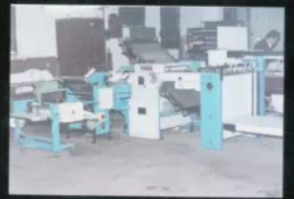
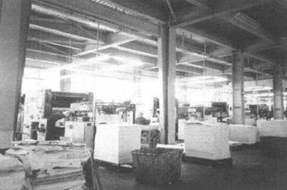
1. Lithographic press at a factory in Shanghai, 1910s[1]
Literary review
There are no publications on the formation of the first machine wallpaper production in China. Russian researchers primarily focus on assessing modernization processes. For example, addressing this topic, Ermachenko describes Chinese researchers' assessments of technological transfer processes in general and the impact of technology on social processes in China [1, pp. 214–223]. Similarly, G. N. Romanova examines China's transition from a traditional society to a modern one. As an exogenous form of modernization and a "forced" discovery by Western powers, he notes that Anglo-American historiography is characterized by praise for the West's civilizing role, whereas Chinese historiography regards foreign expansion as an incentive to slow economic modernization [2, pp. 34–46].
It should be noted that existing research, both Chinese and foreign, mainly focuses on the macroeconomic history or history of printing technologies, while a micro-level empirical analysis of a particular wallpaper industry, especially the process of adapting Western technologies to local conditions and their interaction with traditional practices, remains insufficiently developed. It is important to note that the problem of early industrialization in China was highlighted by S. Cochran [6] and in collective works on urban history [4, 5]. Since existing research on the economic history of port cities and the activities of foreign corporations in China only indirectly addresses design issues, this work focuses on analyzing how technological transfer in wallpaper production has influenced the evolution of their visual design, and he contributed to the formation of hybrid design solutions. Source database: It includes local chronicles, customs reports,[7] periodicals, and corporate archives (for example, records of printing houses owned by the British American Tobacco Company[8]), which enable the construction of a multidimensional historical picture.
Research methods
The methodological basis of the research is the theory of technological transfer [3] and visual research approaches that focus on cultural dialogue and the hybridization of forms. This theory emphasizes that the transfer of technology from one socio-cultural environment to another is not merely a simple copying but a complex social process involving selection, adaptation, modification, and repeated innovative development.
The author chose Shanghai and Tianjin as cases because, as the most important ports, they played similar roles as platforms for the introduction of foreign technologies, yet they could also demonstrate different models of local response due to differences in the economies of their respective regions.
Results and discussions
In the late nineteenth and early twentieth centuries, technological transfer to China occurred unevenly and primarily under external influence, resulting in limited success and the underdevelopment of the domestic base. The main vectors of technology transfer were the import of weapons, the construction of railways and telegraph lines, and the development of the mining industry. Technology transfer to China was carried out through foreign enterprises, government initiatives such as the "Self-Empowerment Movement"[2], and the creation of Chinese-run institutes for the study of Western technologies. Foreign direct investment played a significant role, particularly from the UK, with a concentration in manufacturing and utilities.
Foreign companies were establishing businesses and infrastructure, particularly in coastal areas, and were interested in profit. For example, British investments were largely in production and utilities [10, pp. 181–197]. Efforts have been made to introduce steam-powered technologies in various industries, including silk production. China hired foreign experts to develop and operate new technologies, and some Chinese traveled abroad to acquire technical knowledge.
Shanghai and Tianjin were the two principal centers that initiated the era of mass wallpaper production in China, shaping its aesthetics and market dynamics for decades to come. Considering the specific manifestations of design strategies, it is necessary to highlight the various approaches that have developed in Shanghai and Tianjin.
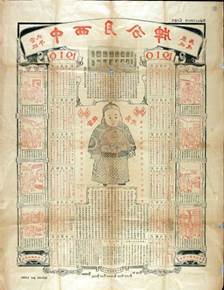
Shanghai, as the main commercial center, has demonstrated a high sensitivity to global trends. Factories founded by foreign capital, such as the Shanghai Color Lithography Company, initially focused on reproducing popular European patterns: neoclassical garlands, stylized flowers, and geometric ornaments in the spirit of Art Nouveau [8]. However, as the advertisements in the newspaper "Shenbao" show [Fig. 4], by the 1910s, the range had become include patterns specifically designed for Chinese consumers. This was expressed through the use of traditional symbols—butterflies, meaning longevity; plum blossoms; and peonies—but executed via a new lithographic technique, which gave them a different, more "modern" look [4, p. 178].
2. Wallpaper samples with a hybrid design: traditional symbols of longevity, made by lithography (Shanghai, 1915).[3]
Unlike Shanghai, Tianjin's design strategy exhibited a more pronounced regional character. Enterprises associated with the policy of "self-enhancement" regarded wallpaper not only as a commodity but also as a tool of cultural affirmation. The Educational plant at the General Directorate of Industry experimented with the creation of ornaments that combined the technical perfection of lithography with compositional schemes borrowed from traditional painting "Guohua" and printing splints "Nianhua" [5, p. 155]. This created a distinctive "northern" style that differed from Shanghai products by being more restrained in color and focusing on classic Chinese subjects.
The transition to lithography has significantly altered the wallpaper's color scheme. Machine printing made it possible to achieve complex gradients and subtle shades that were inaccessible to woodcut, which used a limited number of local colors.
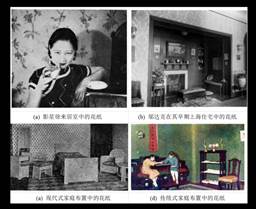 
3. Comparison of printing technologies: woodcut (left) and lithography (right).
The data from customs reports on the import of aniline dyes [7, p. 341] correlate with the appearance of bright, saturated colors in the wallpaper assortment, which have become a marker of modernity and European style. At the same time, the technological superiority of lithography did not lead to the disappearance of traditional motifs, but transformed their embodiment. Traditional woodcut, with its clear lines and conventionality, remained within the segment of inexpensive products for conservative consumers. At the same time, as evidenced by product samples from the Tianjin Museum collection, many factories began producing hybrid products. Lithography was used to create a background (imitating the texture of silk or sky), and key symbolic elements (hieroglyphs, main figures) were then applied using wooden blocks, which added an "aura" of handmade products and cultural authenticity [5, p. 160]. This dialogue of technologies has generated a unique visual language characteristic of early Modern Chinese art.
The key technology in wallpaper machine production was multicolor lithography, which offered high productivity, fine detail, and smooth color transitions. At the initial stage, Chinese factories were heavily dependent on foreign technicians. However, thanks to "reverse engineering" and learning by doing, Chinese technicians quickly mastered the skills of operating, maintaining, and even upgrading equipment. For example, to reduce dependence on expensive imported chemical inks, Shanghai factories have experimented with using local plant and mineral pigments. Although the flowers' durability proved somewhat lower, the cost decreased significantly, thereby expanding market access for the middle- and low-price segments [6, p. 201].
Despite the spread of new technologies, the traditional practice of making wallpaper by woodcut did not immediately disappear. There was a clear market division between them: machine wallpaper (lithography) was aimed at the new urban middle class, offering patterns featuring Western landscapes and geometric ornaments, thereby emphasizing modernity and fashion. Their competitive advantage was price (compared to imports) and efficiency. Traditional woodcut wallpaper held the market in rural areas of China, and parts of the urban population committed to traditional aesthetic views; the patterns included symbols of good luck (happiness, wealth, longevity, flowers, birds, fish, insects), and their value lay in the "craftsmanship" of handmade and cultural authenticity.
This coexistence illustrates the cultural dimension of technological choice. In some cases, the phenomenon of "hybridization" has been observed: for example, the use of wooden stamps to manually refine machine wallpaper or the design of lithographic patterns that mimic the woodcut effect, which is a creative manifestation of a "local response."
Conclusion
The research demonstrates that wallpaper design has become an active field for technological transfer and a site of China's local response. First, it marked the end of the craft era: the emergence of machine factories in Shanghai and Tianjin in the 1920s signaled the transition from artisanal, manual production to mass production. Secondly, machine production has made wallpaper more accessible to the growing urban middle class. In the third factories, Shanghai and Tianjin have become symbols of the early modernization of the Chinese light industry and the formation of a new consumer culture.
Shanghai and Tianjin have developed distinct design strategies that reflect their unique positions within China's economic and cultural geography. The evolution of the pattern from direct copying of Western patterns to the creation of hybrid forms demonstrates how technological innovations have stimulated processes of cultural reflection and adaptation. Design proved not to be a secondary element but a key factor determining the market success and cultural perception of a new industrial product.
list literatures
[1]Ermachenko I. S. Features of modernization in China // Social and humanitarian Sciences. Domestic and foreign literature. Series 9, Oriental and African Studies: An abstract journal. 2004. No. 2. pp. 214-223. URL: https://cyberleninka.ru/article/n/2004-02-061-062-osobennosti-modernizatsii-v-kitae (date of request: 24.10.2025).
[2]Romanova G. N. Economic modernization of China in the 19th-first half of the 20th centuries in the assessment of domestic and foreign historiography // Izvestiya Vostochnogo Instituta. 2016. No. 2 (30). pp. 34-46. URL: https://cyberleninka.ru/article/n/ekonomicheskaya-modernizatsiya-kitaya-xix-pervoy-poloviny-xx-vv-v-otsenke-otechestvennoy-i-zarubezhnoy-istoriografii (date of request: 24.10.2025).
[3]Bauman, Z. (2004). Globalization. Consequences for man and society. M.: The whole world.
[4]Zhang Zhongli (chief editor). (1990). A study of the modern city of Shanghai. Shanghai: Shanghai People's Publishing House. / 张仲礼 (主编). (1990). 《近代上海城市研究》. 上海: 上海人民出版社.
[5]Lo Shuwei (chief editor). (1993). The history of the modern city of Tianjin. Beijing: Publishing House of Social Sciences of China. / 罗澍伟 (主编). (1993). 《近代天津城市史》. 北京: 中国社会科学出版社.
[6]Cochran, S. (2000). Meeting Chinese Networks: Western, Japanese, and Chinese Corporations in China, 1880-1937. Berkeley: University of California Press. / Cochran, S. (2000). Encountering Chinese Networks: Western, Japanese, and Chinese Corporations in China, 1880-1937. Berkeley: University of California Press.
[7]Wang Chuifang (chief editor). (2009). General Chronicles of China Customs. Part 6 (Chronicles of Industry, Trade and Commerce). Beijing: Customs Publishing House China. / 王垂芳 (主编). (2009). 《中国海关通志第六分册(工商贸易志)》. 北京: 中国海关出版社.
[8]"Shenbao" (1872-1949). Shanghai. / 《申报》 (1872-1949). 上海.
[9]Twyman, M. (1998). The British Library Printing Guide: History and Technology. London: British Library. / Twyman, M. (1998). The British Library Guide to Printing: History and Techniques. London: The British Library.
[10]Brown, S. R. The Transfer of Technology to China in the Nineteenth Century: The Role of Direct Foreign Investment. The Journal of Economic History. 1979;39(1):181-197. doi:10.1017/S0022050700096388
[1] Xinhua yinshuachang (formerly Shijie shujiu) – century-old industry leader (5) // Yangpu shihua (official WeChat account). 20.03.2015. URL: https://mp.weixin.qq.com/s/__biz=MzA4NTA0NjUxNQ==&mid=205120551 (date accessed: 24.10.2025).
[2] The " Self-empowerment Movement" (also known as the "self-empowerment policy" or the "self-empowerment movement"). Assimilation of overseas affairs") is a period of Chinese history (1861-1895), during which the Qing Empire tried to modernize the country by borrowing Western technologies.
[3] "Shanghai Design Invitation Exhibition 2021 — "Poster as a Field"" was mainly divided into two parts: "History and Memory" and "Diversity and Dialogue". This poster exhibition was presented in the "History and Memory" section. [Electronic resource] // Official source. Shanghai, 2021. URL: https://so.html5.qq.com/page/real/search_news?docid=70000021_02561c98daa40652 (date of request: 24.10.2025).
The article is published in its final version as approved following the last positive peer review recommending acceptance for publication. It incorporates revisions made by the author in response to prior negative peer review reports that did not recommend publication. All peer review reports, including initial negative reviews, are published in open access alongside the article. All versions of the author’s revisions are archived in the publisher’s repository and may be made available upon reasonable request in accordance with Elsevier’s editorial policies and applicable data availability requirements.
Read all reviews on this article
References
1. Ermachenko, I. S. (2004). Features of modernization in China. Social and Humanitarian Sciences. Domestic and Foreign Literature, Series 9, Oriental Studies and African Studies: Abstract Journal, 2, 214-223. EDN: FPIAEH.
2. Romanova, G. N. (2016). Economic modernization of China in the 19th and the first half of the 20th century in the assessment of domestic and foreign historiography. Proceedings of the Eastern Institute, 2(30), 34-46. EDN: WHTIWL.
3. Zhang, Zhongli (Ed.). (1990). Study of the modern city of Shanghai. Shanghai: Shanghai People's Publishing House.
4. Luo, Shuwei (Ed.). (1993). History of the modern city of Tianjin. Beijing: China Social Sciences Press.
5. Wang, Chui fan (Ed.). (2009). General chronicles of the customs of China. Part 6 (Chronicles of industry, trade, and commerce). Beijing: China Customs Press.
6. Kopytoff, I. (2006). Cultural biography of things: commoditization as a process. Neprikosnovennyi zapas, 46, 53-67.
7. Bourdieu, P. (2001). Practical sense. St. Petersburg: Aleteya. EDN: QOGTMH.
8. Ding, J. (2022). A study of Shanghai wallpaper workshops in home decoration during the Republic of China Era. Furniture and Interior Design, 29(2), 124-129.
9. Cochran, S. (2000). Encountering Chinese networks: Western, Japanese, and Chinese corporations in China, 1880–1937. Berkeley, CA: University of California Press.
10. Brown, S. R. (1979). The transfer of technology to China in the nineteenth century: The role of direct foreign investment. The Journal of Economic History, 39(1), 181-197.
11. Gerth, K. (2003). China made: Consumer culture and the creation of the nation. Cambridge, MA: Harvard University Asia Center.
12. Larmour, J. (2012). Global design history. London: Routledge.
13. Armitage, D., & Guldi, J. (2014). The history manifesto. Cambridge: Cambridge University Press.
14. Sassen, S. (2001). The global city: New York, London, Tokyo (2nd ed.). Princeton: Princeton University Press.
15. Ogle, V. (2015). The global transformation of time: 1870–1950. Cambridge, MA: Harvard University Press.
16. Callon, M., Méadel, C., & Rabeharisoa, V. (2002). The economy of qualities. Economy and Society, 31(2), 194-217.
First Peer Review
Peer reviewers' evaluations remain confidential and are not disclosed to the public. Only external reviews, authorized for publication by the article's author(s), are made public. Typically, these final reviews are conducted after the manuscript's revision. Adhering to our double-blind review policy, the reviewer's identity is kept confidential.
The list of publisher reviewers can be found here.
The article "Technological Transfer and the Local Response" has been sent for review China: the establishment of the first wallpaper machine factories in Shanghai and Tianjin." The relevance of the stated topic, especially in the context of the problems of China's early industrialization, is beyond doubt. According to the author, "the purpose of this article is to fill the existing research gap about the activities of the first wallpaper factories in Shanghai and Tianjin in the context of the transfer of Western technologies to China at the turn of the XIX–XX centuries." It can be noted that this is how the author rather defines the subject of research and identifies an existing problem (lack of research on the activities of the first Chinese wallpaper factories), the development of which seems very promising for achieving new scientific results. The research methods are highlighted by the author in a separate fragment, which does not contain information about what methods the author himself used in the course of his work. The main content of the work demonstrates the author's mastery of the material, context, and passion for the topic under study. The author states the following at the beginning of the main text: "Shanghai and Tianjin were the two main centers from which the era of mass production of wallpaper in China began, defining its aesthetics and market dynamics for decades to come. Considering the specific manifestations of design strategies, it is necessary to identify the different approaches that have developed in Shanghai and Tianjin." However, the main part of the work itself, alas, resembles rather a historical reference and a set of facts, rather than an independent study that led to certain scientific results and conclusions. And in this direction, the author needs to make significant improvements, expanding and redoing the main part of the work according to the objectives of the analytical article. The final conclusion seems weighty, logical, and constructive: "Shanghai and Tianjin have developed various design strategies that reflect their unique position in China's economic and cultural geography. The evolution of the pattern from direct copying of Western patterns to the creation of hybrid forms shows how technological innovations have activated the processes of cultural reflection and adaptation. Design turned out to be not a secondary element, but a key factor that determined the market success and cultural perception of a new industrial product." It is in this vein that the entire work should be written. The bibliographic list consists of only ten publications, of which only one is in English. It is necessary to expand the bibliography, because it is a convincing review of existing works on the stated topic that is the foundation of the research. After some revision, the article, due to its subject matter and the author's unconditional awareness, will be able to arouse great interest among students and practitioners, undergraduates, postgraduates and scientists whose field of interest includes the study of Chinese culture at the turn of the XIX-XX centuries.
Second Peer Review
Peer reviewers' evaluations remain confidential and are not disclosed to the public. Only external reviews, authorized for publication by the article's author(s), are made public. Typically, these final reviews are conducted after the manuscript's revision. Adhering to our double-blind review policy, the reviewer's identity is kept confidential.
The list of publisher reviewers can be found here.
The subject of the research of the article "Technological transfer and China's "local response": the formation of the first machine wallpaper production in Shanghai and Tianjin" is the analysis of the process of technological transfer in the field of machine wallpaper production in China at the turn of the XIX–XX centuries. The main focus is on the adaptation of Western technologies (lithography, woodcut) and the formation of hybrid design solutions in Shanghai and Tianjin, considered as key centers of early industrialization. In the study, the author applies a comprehensive interdisciplinary synthesis – the work combines the approaches of economic history, the history of technology, design and cultural studies, which allows a comprehensive review of the process of adapting machine wallpaper production as a sociotechnical phenomenon. The author successfully combines historical and archival analysis (enterprise documents, customs reports, periodicals), visual analysis and iconography (study of wallpaper samples, advertising materials), comparative historical method (comparison and in-depth study of models of Shanghai and Tianjin), theoretical framework of cultural transfer and sociotechnical analysis. The methodology chosen by the author provides a multi-faceted research: technological, economic and cultural directions. The topic of the article is relevant in the context of interest in the history of design, modernization and dialogue of cultures, and the hybridization of material culture. The study fills a gap in the study of the early Chinese wallpaper industry, which was previously considered only in the context of macroeconomic or polygraphic research. The scientific novelty is determined by the fact that the author introduces the topic of the formation of machine wallpaper production in China as an independent object of research for the first time; the author proposes an original typology of "local responses": "commercial syncretism" in Shanghai and "cultural-affirmative adaptation" in Tianjin; the phenomenon of technological dichotomy (the coexistence of lithography and woodcut) is revealed; the author proves that design has become a key field of cultural translation of technology, rather than just an element of production. The article has a clear structure (introduction, literature review, methodology, results, conclusion), is logically structured and rich in factual material. The style is scientific, but accessible, with the correct use of terms. The visual range (drawings, diagrams, images to illustrate technological and design differences) successfully complements the text. The meaningful work demonstrates a deep understanding of the context, and the comparison of Shanghai and Tianjin is conducted systematically and convincingly. The source base includes archival materials, periodicals, local chronicles, and museum collections. The theoretical framework is based on modern works on the history of design, cultural studies and technological transfer, while Chinese studies are less fully represented. Taking into account possible counterarguments, the author emphasizes that the technological transfer was not linear, but included complex adaptation processes, explains the coexistence of lithography and woodcut not by technological backwardness, but by a conscious socio-cultural choice and responds to potential criticism about the "secondary nature" of Chinese design, showing the creativity of hybridization. The article is an original study that contributes to the history of design, cultural studies, and the study of China's modernization. The author successfully combines the analysis of a specific industry with the processes of technological transfer, demonstrating how global trends were reflected in local contexts. The work has a high scientific value and can become the basis for further research in the field of material culture and design. As a suggestion: in the conclusions section, some theses of the conclusions are duplicated in the sections, which slightly reduces the content of the text. The article is a high-quality scientific study offering a new perspective on technological transfer and cultural adaptation in China. It deserves high praise and is recommended for publication in a specialized scientific journal.
|





 © 1998 – 2026 Nota Bene. Publishing Technologies. NB-Media Ltd.


