|
Culture and Art
Reference:
Khripkova, E.A. (2026). Murals of the church of St. Mary and St. Clement in Schwarzreindorf: on the creation and interpretation of an iconographic program, influences and samples. Culture and Art, 2, 167–194. https://doi.org/10.7256/2454-0625.2026.2.77828
Murals of the church of St. Mary and St. Clement in Schwarzreindorf: on the creation and interpretation of an iconographic program, influences and samples
Khripkova Elena Avenirovna
ORCID: 0000-0002-8101-680X
PhD in Art History
Associate Professor; Department of Theory and History of Art; Russian State University for the Humanities
Office 903, Miusskaya square, 6, room 3, Moscow, 125047

|
samary@inbox.ru
|
|
 |
Other publications by this author
|
|
|
DOI: 10.7256/2454-0625.2026.2.77828
EDN:
OCCVJU
Received:
01/21/2026
Published:
03/03/2026
Abstract: The article is devoted to the study of the fresco ensemble of the Church of St. Mary and St. Clement in Schwarzrheindorf. The object of this study is the Romanesque church in Schwarzrheindorf, built in the mid-12th century by Arnold von Wied, chancellor of king Conrad III and archbishop of Cologne. It has preserved a unique ensemble of Romanesque frescoes, which is the subject of this work. The purpose of this article is to demonstrate the influence of a number of medieval monuments on the concept of the iconographic program and monumental decoration of the double church of Schwarzreindorf, especially its upper chapel. In this work, using formal-stylistic and iconographic analysis, as well as a historical-biographical method, a close connection was demonstrated between the paintings of the upper church of Schwarzrheindorf and the monumental decoration of the churches of Ravenna and the church of St. Andrew and St. Mary of the Premonstratensian Abbey in Knechtsteden. This allowed us to put forward a hypothesis about the influence on this project of Arnold von Wied's childhood friend, Anselm of Havelberg, who became Archbishop of Ravenna in 1155, as well as the curator of the construction of the Knechtsteden Abbey Church, Dean of Cologne Cathedral Albert of Aachen. Comparing the image of the angel in the lower church program with the image of the "operacio" from the abbey of Stablot made it possible to clearly demonstrate the nature of the influence of another close friend of Arnold von Wied ‒ Wibald von Stablo, abbot of the abbeys of Stablo and Corvey ‒ on the creation of the fresco ensemble of the lower church. Demonstrating these connections and stylistic parallels allowed the author to formulate a number of conclusions and arguments that shed light on both the possible influences and models that inspired the pictorial ensemble of this church, as well as on the creation and dating of the decorative program of the upper and lower churches of Schwarzrheindorf.
Keywords:
Schwarzreindorf, monumental decoration, iconographic program, upper chapel, Knechtsteden, frescoes, interpretation, Ravenna, influences, Arnold von Wied
This article is automatically translated.
The double Church of St. Mary and St. St. Clement's in Schwarzreindorf: issues of creation, preservation, dating and historiography The picturesque ensemble of the double churches of St. Mary and St. Clement in Schwarzreindorf is one of the most important extant examples of ensembles of Romanesque frescoes of the Rhine Valley. The time of the consecration of this building is known thanks to an inscription found on the wall of the choir of the lower church, which indicates the date of April 24, 1151. However, as M. Friese points out, "it has now been established that Arnold von Wied began the construction of a double chapel in Schwarzreindorf even before he went on the Second Crusade. From a letter from Abbot Wibald von Stablot dated 1148 to Arnold's sister Hedwig von Wied, it follows that she supported her absent brother in his affairs between 1147 and 1149" [1, p. 86]. In this case, Hedwig had to oversee the construction of the temple until its return [2, p. IX; 3, p. 23]. This temple, which has become the object of this study, was originally designed as a church of the ancestral castle, but it could well become a palace chapel designed to receive royalty. However, in 1156, just five years after the completion of the temple, it became the tomb of its founder. The plan of the original building, in which the two chapels are connected by a through octagonal opening, is shown in Fig.1.
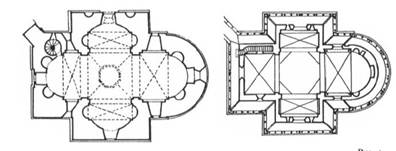
Fig. 1. Plans of the original building of Arnold von Wied in Schwarzreindorf (lower and upper churches – from left to right). Reconstruction of 1151-1156 Image source: [1, s. 305, Taf. 2]
After the death of the founder, the church was rebuilt and extended to the west to accommodate the building for the residents of the new convent, which was established on this territory to constantly offer prayers for the deceased. As P. Klemen points out [4, p. 274], the only triple arcade in this temple appeared in the conch of the western wall during this period. This arcade, similar to the arcades of the palace chapel in Aachen and the Church of San Vitale in Ravenna, was embedded in an already existing scenic layer (Fig. 2).
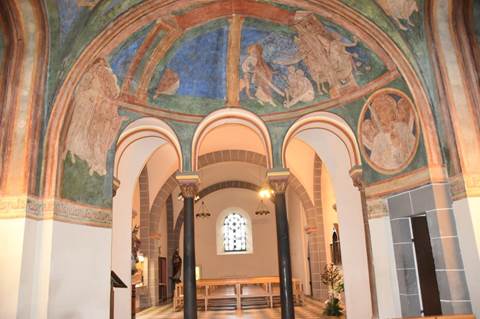
2. The triple arcade in the western wall of the lower church of St. Mary and St. Clement, built by Arnold von Vid in Schwarzreindorf.
The subject of this study is the picturesque decoration of the double church of Schwarzreindorf, which was preserved in the lower and upper churches, where it was discovered in 1846 by A. Simons, who studied the history of architecture in Schwarzreindorf on the initiative of Gottfried Kinkel, professor of art history at the University of Bonn [5, p. 117]. A. Simons became the author of the first scientific monograph dedicated to this monument [6]. The publication of his results, as S. Gershner notes, "is an exemplary example of the methodology of early research in the field of art history" [5, p. 117]. In 1854, the frescoes were uncovered and their restoration began, which led to the loss of the paint layer and some distortions during the release of the frescoes from the multilayer whitewash [3, p. 42]. During this disclosure, the restorer (Christian Hohe) documented in detail everything he saw, but some errors were made in the monument's program, since the artist had no idea what text it was based on [3, p. 43]. The frescoes in the upper church were discovered in 1868 by Ernst aus'm Weerth, who then renovated them in 1875 [4, p. 275]. In his work "Wall paintings of the Christian Middle Ages in the Rhineland," Werth examines their iconography and composition [7, pp. 9-16]. Further restoration and conservation work was carried out by A. Bardenhever in 1910-1911 and 1935. At the same time, the damage was repaired, and the incorrect additions of the first restoration were partially corrected [8]. S. Gershner's work has been devoted to the preservation of frescoes and the study of the results of restoration interventions in the painting of the lower church since the restoration campaign of 1854 [5]. P. Kern notes that during the last works on the conservation of paintings in 1994-1995 and 1998-1999, on behalf of the Rhenish Office for the Preservation of Monuments under the leadership of J. Hochman, the issue of whether the existing murals of Schwarzreindorf are sufficiently reliable in relation to the original state of the 12th century. "despite losses, misinterpretations, renewals and corrections" [8]. The research of V. Hansmann and Y. Hochmann revealed "an abundance of authentic 12th-century material" in the medieval wall painting of the church [9, pp.26-29]. In the end, after intensive research on this issue, it was shown for most parts of the painting program that "anyone who wants to understand the meaning of the image program can be guided by what is now visible, since, if necessary, he refers to the analysis of the condition carried out and documented by the Bureau of Monuments, reports of previous restorers and discussions of the authenticity of the monument"[8]. Modern ideas about the state of preservation of the monument allow us to conclude that after the restoration work of the 20th century, the monument's program is quite accessible for interpretation and even stylistic analysis.
Despite the fact that the Schwarzreindorf Church has been studied for the second century, many questions remain in the study of this monument regarding the dating of the picturesque ensemble, the interpretation of its iconographic program, its stylistic features, possible patterns and sources of inspiration. In addition, there are also a number of issues related not only to the interpretation of the programs of the lower and upper churches, but also to understanding how they represent a single purpose. Were the programs of both chapels conceived immediately during the life of the founder by himself as a single whole and worked out in all details, or was the program of the upper church finalized later, after the death of Arnold von Wied? In the latter case, who influenced or could have influenced the creation of each of these programs and to what extent? The purpose of this work is to use formal stylistic and iconographic analysis, as well as the historical and biographical method to demonstrate the influence of a number of medieval monuments on the idea of the iconographic program and decorative decoration of the double church of Schwarzreindorf, especially its upper chapel dedicated to St. Mary and St. To John. The demonstration of these connections and influences allows us to formulate a number of assumptions, arguments and conclusions that also shed light on the issues of creating a decoration program for the upper and lower churches of Schwarzreindorf. This goal defines a number of tasks necessary for its implementation: studying the biography of the founder of the church and his entourage, the historical and political context of the era, describing the iconographic program of murals, identifying monuments that could serve as models or sources of inspiration for the authors of the program. At the same time, special attention is paid in this work to the upper church program, the interpretation of which requires special consideration, since this issue is still debatable and is especially important for understanding who could have participated in the creation of this theological project. For the first time, the interpretation of images on the vaults of the lower church based on the text of the Book of the Prophet Ezekiel was given in 1863 by Pastor Pfeiffer von Willich (Pfarrer Pfeiffer in den Aufsätzen in der Bonner Zeitung, 1863, Nr.. 203, 209, 215, 221, 227, 239, 285) [4, s. 279; 5, S. 117]. The key work that connected the iconographic program of the Schwarzreindorf church with the work of Rupert Deutsky "De sancta trinitate et operibus eius" was the work of Wilhelm Neuss [10]. Another fundamental work dedicated to this monument is the work of A. Verbeek [2], which remains an important study of this monument, which has not lost its relevance. Ralf Poppen's unpublished dissertation "Wall paintings of the lower church of the double chapel in Schwarzreindorf" (Die Wandmalereien in der Unterkirche der Doppelkapelle von Schwarzrheindorf), entirely devoted to the frescoes in the lower church of Schwarzreindorf, was presented by the author in 1997 at the Friedrich-Wilhelm University of the Rhine in Bonn. M. Friese briefly describes the results of this work: "The central theme His creative research consists of previous interpretations of the image program, with the help of which, relying on medieval hermeneutics and ecclesiology, he comes to his own interpretation, which, in the end, allows creating an imaginary reconstruction of the unreleased scenes in the choir. In addition, he compiles a new chronological overview of various restoration campaigns since the 19th century, transfers finds from each vault to the catalog and verifies the authenticity of more than 150 graphic images made during the restoration period..." [1, p. 16]. M. Frise's dissertation work also includes a description of the monumental decoration of the Schwarzreindorf church and contains a detailed bibliography of its study [1]. Nevertheless, the issues of interpretation of the Schwarzreindorf church's program continue to be the focus of researchers' attention. K. Koenigs[3] A. Derbes [11] and M. Odell [12] support the idea of the influence of Rupert Deutsky's texts on the creation of this program. Several articles by the author of this work were devoted to this temple, its description and the iconographic program of the paintings of the lower church [13-15]. An attempt to consider the painting program of the upper church in the context of monastic life was undertaken by Ildefons Herwegen in the works of 1908 and 1910 [16, pp.161-164; 17, pp.116-117]. The description of the frescoes and the interpretation of the upper church program were also raised by P. Clement [4], A. Verbeck [2], in the works of P. Kern [8] and K. Koenigs [3]. In the latest edition, K. Koenigs analyzes various possibilities for interpreting images of the upper chapel, considering very diverse options for identifying characters represented in the composition of the apse [3, pp. 91-98]. The works of a number of authors are devoted to the study of the biography and personality of Arnold von Wied himself, among which the most important are the works of Johannes Kunisch [18] and Heinz Voltaire [19]. An analysis of the bibliography and examples of various contradictory qualitative assessments of the stylistic characteristics of the Schwarzreindorf wall painting are given by Pastor K. Koenigs [3, pp. 38-41], M. Friese [1]. Among the works dealing with this issue, a detailed description of the Church of St. Mary and St. Clement, which is given by P. Clement in a monograph on Romanesque painting in the Rhine Valley [4, pp. 269-367]. He notes the Byzantine influence on the style of murals of the lower Schwarzreindorf church in the image of the archangel Michael in the medallion in the lower church [4, p. 311, fig. 227-228], suggesting possible patterns for this image. The murals of the lower church are usually dated to the period from 1151 to 1156, starting from the moment of the church's consecration (April 24, 1151) and until the death of the customer in 1156 [4, p. 274; 5, p. 117]. Nevertheless, most likely, by 1151 the lower church had already been painted [2, p. 36]. This point of view is currently preferred, based on the fact that many high-ranking people attended the consecration of the temple, including King Conrad III, and the owner of the castle had to present something more interesting to this venerable assembly than just the walls of a new building.
The dating of the paintings of the upper chapel has not been confirmed. It is generally believed that it was painted after the death of the founder, but during the lifetime of his sister Hedwig, whose exact date of death is unknown. P. Klemen believes that she died between 1176 and 1193 [4, p. 274]. It is with her participation in the construction of the Schwarzreindorf church and with the time of her death that the dating of the painting of the upper church is usually associated. However, in fairness, it should be noted that Arnold von Wied had other brothers and sisters. As M. Frise notes, "in addition to the brothers and sisters Burkhard, Hedwig and Hizzakhi mentioned in the dedication inscription, Arnold von Wied's other brothers and sisters are...: Count Siegfried von Wied, Ludwig von Wied (without title) and the nuns Sofia and Siburg, of whom the first abbess, the last dean of Schwarzreindorf since 1172" [1, p. 77]. This is evidenced by the text from the publications of the State Archive of North Rhine-Westphalia: "Sophia diuina fauente clementia ecclesie b. Marie santique i hmeniis in Rindorf abbatissa. Siburgis soror eius decana." [20, N 444, p. 309]. Of course, Hedwig's role in the transformation of Arnold's church after his death is generally recognized, and even the presence of her image at the feet of Christ in the apse of the upper chapel is confirmed. However, given her numerous duties as abbess of two monasteries – Essen since 1150 and Gerresheim since 1154 [19, p. 3], she could hardly have permanently stayed in Schwarzreindorf, overseeing the work of the masters. At the same time, Arnold's other sister, Sophia, as shown by the testimony of Archbishop Philip of Cologne in 1173 [20, N 445 s. 311], performing the duties of abbess of Schwarzreindorf, had to be present there constantly and oversee everything that was happening. In this text, Archbishop Philip reports that Arnold von Wied built a church in Reindorf and "decided to honor his Creator with what he owned" ("per ea que possidebat auctorem suum honorare disposuit") [20, N 445 p. 311]. He donated the church and all the real estate belonging to it in this place to God, "expanded the buildings of this place and enriched the church with various structures," brought matters to the point where "it would be possible to begin the establishment of worship there" ("ut diuini seruitii ibidem instituendi iam aliquod esse posset initium") and he joined it to the church of Cologne (predictam ecclesiam ecclesiene Coloniensi additixit) [20, N 445, p. 311]. According to Archbishop Philip, Arnold entrusted his sister Hedwig with the care of this church and she is a "brave woman", vigorously took up the task and "did not disappoint her brother's expectations" ("prenominata soror eius ut mulier fortis operi sibi commissioner impigre se succinxit. et fratrem a desiderio suo non fraudauit") [20, N 445, p. 311]. However, we also learn from this source that Arnold introduced two more of his pious sisters, Sofia and Siburgis, who put no less effort into caring for Schwarzreindorf than Hedwig. According to Philippe, they "promoted this cause no less than their sister" ("omnem rem predictam non minus sorore promouerant") [20, N 445, p. 311]. "Therefore, observing the vow of the founders and advocating general election, we consecrated one of them to the abbess of the same college" ("Harum igitur alteram uoto fundatorum adherentes et communi electioni fauentes eiusdem collegii abbatissam consecrauimus"), "and we have confirmed the free election of the abbess for the same church since then" ("et liberam deinceps abbatiss electionem eidem ecclesię confirmauimus") [20, N 445, s. 311]. Regarding the dating of the murals of the upper chapel, there is a special opinion. A. Verbek admits that the upper church could have been painted during the lifetime of the founder, without finding any arguments in favor of the impossibility of creating its decorations until the moment of the solemn consecration of the temple [2, p. 31]. There are several well-known architectural models for the Schwarzreindorf church, such as the Church of the Holy Sepulchre in Jerusalem, St. Sophia of Constantinople, the Charlemagne Chapel in Aachen [3, p.16]. Among them, the Palatine Chapel in Aachen remains the main example [3, p. 16], which, in turn, is inspired by the architectural design and decoration of the church of San Vitale in Ravenna. Iconographic program of murals of the lower church of St. Mary and St. St. Clement's in Schwarzreindorf. The iconographic program of the lower church was described in detail by the author earlier [14]. This work shows the layout of the scenes of the painting program of the vault of the lower church, based on the Old Testament text of the Book of the Prophet Ezekiel and dedicated to the destruction and restoration of Jerusalem [14, Fig. 40]. In general, the program of the Schwarzreindorf double church vividly represents the transformation, "the transfiguration of Jerusalem, from a state of dilapidated, desecrated, where there is no place for the Lord, to a new, renewed and purified Heavenly City, which appears in the program of painting the vault and apse of the upper church. We see images of this Heavenly Jerusalem through the octagonal opening of the vault of the lower church, connecting both temples like earth and heaven" [15] (Fig. 3). The arrangement of the scenes in the program of the vault of the lower temple forms a spiral structure twisted around the central octagon connecting the upper and lower chapels, directing a vortex-like movement upward into the open space of the upper floor, in the vault of which "during the restoration of 1902-1903, air holes marked with rays in the shape of stars were opened" [15] (Fig.4).
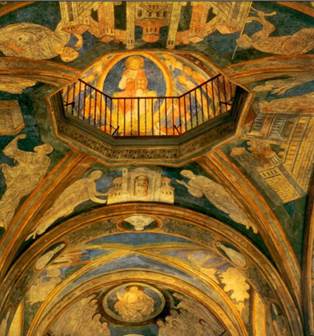
Fig. 3. Bottom view of the apse of the upper church of St. Mary and St. St. Clement's in Schwarzreindorf. Photo of the author.
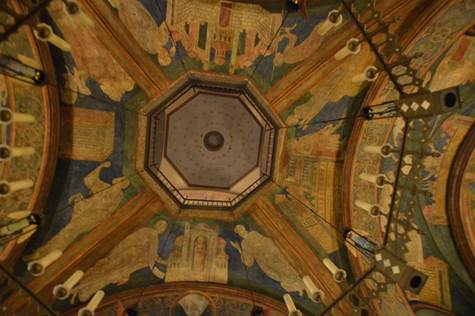
4. View through the octagonal hole connecting the upper and lower churches of Schwarzreindorf.Photo of the author.
A similar situation in the formation of the building decoration system, when the program demonstrates a vortex-like movement directed towards the vault representing a cross in the sky with shining stars, can be seen in the mausoleum of Galla Placidia in Ravenna, as noted earlier [14] (Fig.5).
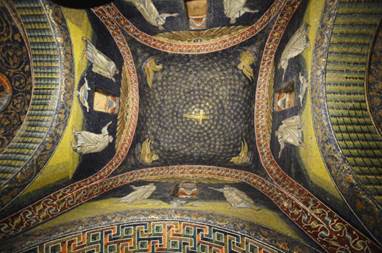
Fig. 5. Decoration of the mausoleum of Galla Placidia in Ravenna, 5th century. Photo by the author.
The program of painting the walls of the lower church in the vertical plane represents scenes of the New Testament history of Christ: "Transfiguration", "Crucifixion" and "Expulsion of merchants from the temple." In the apse of the lower church, the reconstructed composition represents the Lord sitting on a heavenly throne in a mandorla, St. Clement, the apostles and symbolic animals accompanying the Glory of the Lord. The niches of the lower church contain images of rulers, the issue of interpretation of which was considered in detail by the author in [15]. Murals on the walls of the choir and apse of the upper church of Schwarzreindorf: issues of interpretation, influences and patterns The wall painting of the upper church has been preserved only in the eastern part: in the arch, on the walls and vault of the choir, as well as in the apse. The painting on the south wall of the choir illustrates the New Testament story, which, as K. Koenigs points out [3, p. 96], is most often interpreted as a scene from the life of the Mother of God ("The Virgin Mary is led to the altar"). It shows striking similarities to the composition that can be seen in the church of San Apollinare in Classe near Ravenna, which illustrates a fragment of the text of the Eucharistic canon of the Roman liturgy, combining three Old Testament sacrifices into one composition [21, p. 30]. Two figures at the altar demonstrate a special similarity: in St. Appolinare in Class, it is Abraham leading Isaac to the altar, whereas in Schwarzreindorf, young Mary is led to the altar (Fig. 6). In Schwarzreindorf's composition, the same theme of the gift intended for God remains relevant, since, like Abraham, giving his Son to God Mary's parents dedicate her to the Lord. This topic is especially relevant after the death of Arnold von Wied in the context of the transformation of the Schwarzreindorf church into a convent. Opposite the scene with the Virgin Mary, on the north wall of the choir in the upper church of Schwarzreindorf, there is a scene that is interpreted as "The Appearance of the Lord St. John" (Fig. 7). This composition was created with a clear allusion to the Burning Bush, when the Lord spoke to Moses from a burning bush [3, p. 96], which, as is known, is a typological reference to the image of the Mother of God. Both scenes on the walls of the choir of the upper church of Schwarzreindorf, in this case, are connected with the representation of the Virgin Mary, to whom the upper chapel was dedicated.
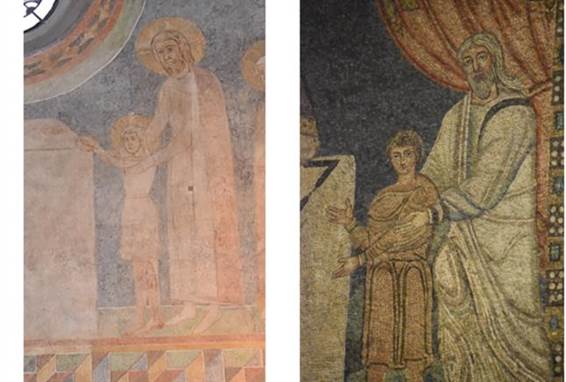
6. Schwarzreindorf and Ravenna. Fragments of compositions (from left to right): "The Virgin Mary is led to the altar" ‒ fresco on the south wall in the upper church of St. Mary and St. Clement in Schwarzreindorf and the scene of the Old Testament sacrifice in the mosaic of the apse of San Apollinare in Classe, Ravenna, VI century. Photo of the author.
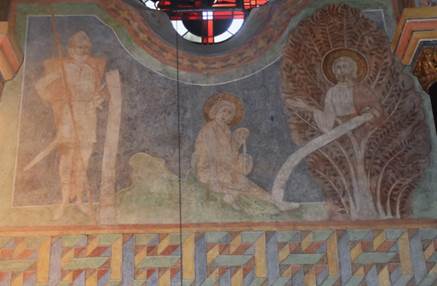
7. Fresco on the north wall of the choir in the upper church of St. Mary and St. St. Clement's in Schwarzreindorf. Photo of the author.
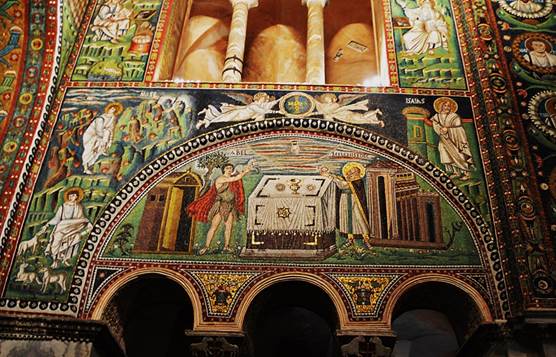
8 Fragment of the decoration of the left wall. Church of San Vitale, Ravenna, VI century. Photo of the author.
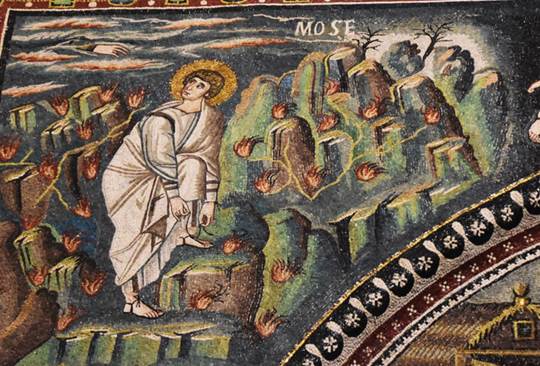 Fig. 9. Moses at the Burning Bush. Mosaic of the presbytery of the Church of San Vitale in Ravenna, VI century. Photo of the author.
In the iconographic program of the presbytery of the Church of San Vitale in Ravenna, on the wall, where, as in the San Apollinare in Class, the Old Testament sacrifice is presented (Fig. 8), we also find an image of Moses in front of a Burning Bush (Fig. 9). Thus, it is obvious that thematically the program of the upper church of Schwarzreindorf reproduces Ravenna Old Testament Eucharistic motifs on the walls of the choir, translating them into New Testament typological parallels. It should be noted that the ornamental decoration of the arches of the lower and upper churches of Schwarzreindorf also has certain parallels with the decoration of the arches and vaults of the Ravenna temples. It can be stated that the picturesque ensemble of the upper church of Schwarzreindorf reveals very significant stylistic and iconographic links with the programs of the temples of Ravenna. This issue has been discussed in detail in an article that is currently being prepared for publication (Schwarzreindorf and Ravenna: on the question of the influence of Ravenna monuments on the frescoes of St. Peter's Church). St. Clement and St. Mary in Schwarzreindorf // Eastern Christian Art. Iconography, connection with the liturgical tradition of the Church: a collection of articles in honor of N.V. Kvlividze).
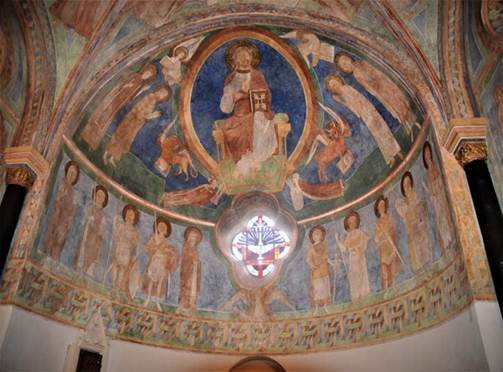
10. Painting of the apse of the upper church of St. Mary and St. By Kliment Schwarzreindorf. Photo of the author.
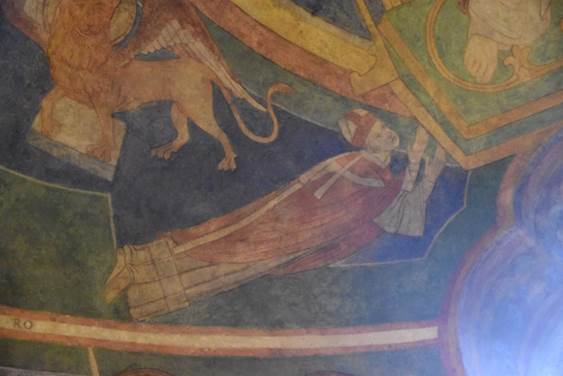
11. Arnold Von View at the feet of Christ. A fragment of the decoration of the apse of the upper church of St. Mary and St. St. Clement's in Schwarzreindorf. Photo of the author.
The painting on the top of the apse of the upper church of Schwarzreindorf (fig. 10) represents two figures flanking the seated Christ. However, the interpretation of these figures remains debatable. In the center of the concha we see the traditional composition "Majestas Domini" (fig.10), under which two figures hover at the feet of Christ ‒ the founder of the temple Arnold von Wied and his sister Hedwig (Fig.11, 12). At the top of the bright band along the entire conch stretches complemented by Wirth text "[filium] V [nigenitum, ignomi] NI [a] OPERTVM٠ Y٠ IN٠ MVNDVM٠ MISIT ٠ QVEM٠ VICTA٠ MORTE٠ REVISIT" which, according to P. Clement, inspired by the gospel of St. John 3:17: "Non enim misit Dens Filium suum in mundum, ut judicet mundum, sed ut salvetur mundus per ipsum" ("For God did not send his Son into the world to judge the world, but that the world might be saved through him") [4, p. 345]. A text close to this can be found in the First Epistle of St. Peter. John 4:9: "In hoc apparuit charitas Dei in nobis, quoniam Filium suum unigenitum misit Dens in mundum, ut vivamus per eum" ("God's love for us was revealed in this, that God sent His only begotten Son into the world so that we might live through Him"). An angel is depicted below the mandorla of Christ, and under it is the inscription "Sanctus" (Fig. 13), referring to the text of the beginning of the angelic hymn of the canon of the Eucharist.
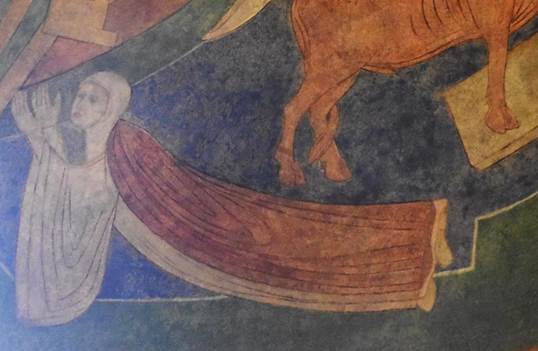
12. Arnold's sister Hedwig at the feet of Christ. A fragment of the decoration of the apse of the upper church of Schwarzreindorf. Photo of the author.
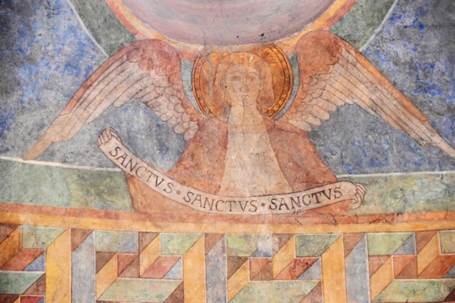
Fig. 13. A fragment of the decoration of the apse of the upper church of St. Mary and St. St. Clement's in Schwarzreindorf. Photo of the author.
The saints around the Throne have not been precisely identified and different variants are possible. P. Clement believes that at the right hand of Christ is represented by St. The First Martyr Stephen, beardless, with a palm branch and in spiritual vestments, followed by St. John the Baptist with his arms raised, with St. John the Baptist on the south side. Peter with a cross and St. Lawrence, beardless, in spiritual vestments and with a book in his hand [4, pp. 344-345]. K. Koenigs offers several possible interpretations of this composition [3, p. 94]. He believes that the two figures around Christ can also be considered as a variant of Deisis. The Mother of God is then to the right of Christ with her arms raised, and her face should have been veiled, which the restorers turned into the beard of the saint [3, p. 94]. He also considers the extreme figures of the composition as images of St. Lawrence and St. Stephen. However, K. Koenigs suggests that another interpretation of the figures of this composition is possible, assuming that the two figures surrounding Christ may represent the apostles St. Peter and St. Paul [3, p. 94]. One of the important arguments in favor of this assumption is the text of the dedication inscription of the church in 1151, which states that "the lower church was consecrated in honor of St. Nicholas. St. Clement, Martyr and Pope, successor of St. Peter the Apostle: the left altar in honor of St. Lawrence the Martyr and all the confessors, the right altar in honor of St. Stephen the Metropolitan and all the martyrs, the middle altar in honor of the Apostles Peter and Paul; the altar of the upper chapel, finally, in honor of the Blessed Virgin Mary and the Virgin Mary, as well as the Evangelist John (he was consecrated) by the Venerable Bishop Otto von Freising" [4, p.271]. It follows from this text that the upper chapel is dedicated to the Virgin and St. John (the evangelist), and although there was no place for them in the apse, the scenes of their lives occupy the entire space on the walls of the choir. In addition, the dedication inscription says nothing about St. Nicholas. St. John the Baptist, but St. John the Baptist is mentioned there. St. Lawrence, St. Stephen, St. Peter and St. Paul, who could well have taken the place of St. St. John the Baptist, as K. Koenigs points out [3, p. 94]. This version looks the most plausible. Although only the number of saints and the overall structure of the composition can be determined unambiguously, the interpretation of the apse composition with the participation of the Holy Apostles Peter and Paul seems most likely, not only due to the mention of all the listed saints in the dedication inscription in the lower church, but also due to a number of other factors.
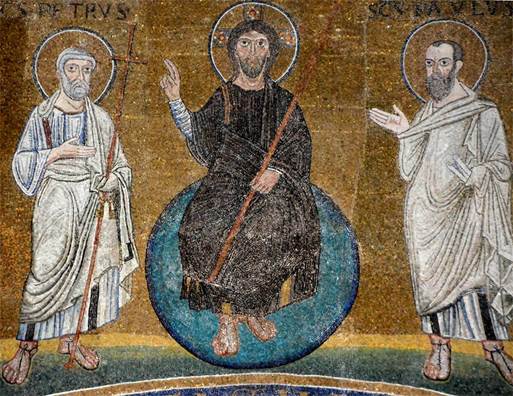
14. Christ, St. Peter and St. Pavel. Mosaic fragment of the triumphal arch of the Basilica of San Lorenzo Fuori le Mura, Rome, VI century. Photo of the author.
Firstly, there has been an iconographic tradition of depicting not only John the Baptist and Christ with a cross since early Christian times, but also the Apostle Peter, which is confirmed by a number of monuments of the IV‒VII centuries, among which the monuments of Rome are the leaders. The image of St. Peter with a cross in his hands can be seen on the fresco of the turn of the IV - V centuries in the arcosolia of Biator in the catacombs "Ad decimum" on Via Latina (6 km of modern Via Anagnina), in the scene "Traditio legis"; in the decoration of the vault of the Naples baptistery in the same scene; on the mosaic of the VI century. the Arc de Triomphe in the Church of San Lorenzo Fuori le Mura in Rome (fig.14); on the sarcophagus of the Twelve Apostles from the Church of San Apollinare in Classe in Ravenna; in the mosaic of the 7th century in the apse of the chapel of St. Venanzio and Domnio of the Lateran Baptistery in Rome. In all of these monuments, except the last one, the Apostles Peter and Paul flank the image of Christ. Secondly, examples of such iconography of the Apostle Peter are also known in the German territory of the Empire era. K. Koenigs, arguing for the possibility of such an interpretation, points to the presence of a similar image in the church of St. Peter. Patroclus in Zoste [3, p. 94], however, the existence of the Roman iconographic tradition seems to us to be an equally important factor. Thirdly, it should be noted that there is a similar example in the decoration of the apse of the church of the Premonstratensian monastery, located just 50 km from the church of Schwarzreindorf, where the abbey church was also built and decorated in the middle of the 12th century. This is the church of St. Andrew and St. Mary of the abbey in Knechtsteden (fig. 15). The church of Knechtsteden was one of the first buildings of the Premonstratensian order in the Rhineland [22, p.179]. The founder of the church was Hugo von Sponheim [22, p.179]. P. Klemen describes this in detail: "On the territory of the Knechtsteden estate inherited by Dean of Cologne Cathedral Hugo von Sponheim, which he transferred to the church in 1130, a small church (angusta et modica) was built in 1132 and the monastery. The first probst was Heribert, a scholastic from the collegiate Church of the Holy Apostles in Cologne, who joined the Premonstratensian order. After Archbishop Bruno II of Cologne approved the foundation of the monastery in 1134, the monastery grew rapidly, and construction of the existing large abbey church began in 1138. The author of the plan and the builder of the western part is Christian, the former treasurer of St. Andrew's Abbey in Cologne, who was elected Abbot of Knechtsteden in the last year of his life" [4, p. 247]. According to the Brussels manuscript referred to by P. Clement (Brussels, Bibl. du roi, Cod. lat. 8564. Series praepositorum et abbatum Knechtstedensium, Abschrift vom J. 1665 von P. Herrn. Greven), "the western part, including the western choir, was dedicated to St. Andrew the Apostle: the new church was specifically conceived as a daughter church of St. Andrew in Cologne. After Christian's death (1151), the construction of the church was completed under the direction of Probst Hermann (1151-1181) by Albert, Probst of Aachen and dean of Cologne Cathedral, which required 1,500 marks. He built the eastern part with three towers, ordered the casting of three bells and supervised the decoration" [4, p. 247]. O. Demus suggests that Albert of Aachen was the founder's nephew and donor, who "in the donation of 1162 ... indicated that the sums he donated, which would no longer be needed for construction, should be used for interior decoration. This means that work on the construction of the church and the abbey continued during the 1160s" [22, p.180]. Objecting to P. Klemen, O. Demus argues that "the murals in the western apse were part of the final stage of the work" and "were completed after 1162," namely in the period 1170-1180 [22, p.180]. P. Klemen, however, considered them earlier than the murals of Schwarzreindorf and assumed that They were created after 1140 [22, p.180]. Comparing them with the murals of Schwarzreindorf and their "mature and balanced style" [4, p.256], P. Klemen suggests that the western apse of the Knechtsteden church was built immediately after 1140, and that "while work continued in the eastern part of the church, perhaps the temporarily completed western part was already in use" [4, S. 256]. Arnold von Wied had good relations with this abbey, located in the diocese of Cologne: "He maintained good relations with the Premonstratensian churches in Steinfeld and Knechtsteden" [3, p. 15]. Considering that Albert of Aachen, who is depicted in the apse of the Church of St. St. Andrew and St. Mary at the feet of Christ as a donor, he was also the dean of the main church of Cologne, he undoubtedly must have known the Archbishop of Cologne well. Arnold's inner circle also had a special attitude towards demonstrators. Otto of Freising was himself the founder of the Premonstratensian abbeys, and Anselm of Havelberg was a devoted follower of Norbert of Xanten [23, pp. 11-39].
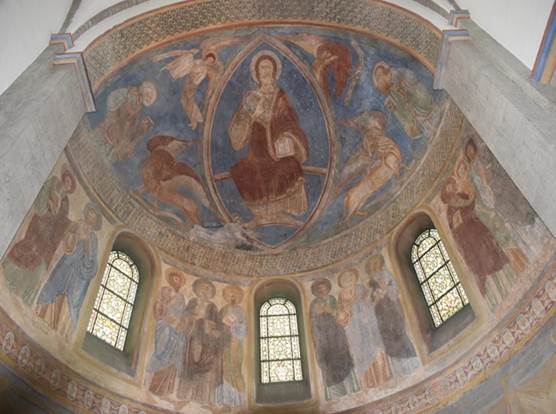
Fig. 15. Painting of the apse of the Church of St. St. Andrew and St. Mary of Knechtsteden Abbey. Photo of the author.
Painting of the western apse of the Church of St. St. Andrew and St. Mary in Knechtsteden represents the Lord in Glory, surrounded by symbolic animals of the evangelists and the Apostles Peter and Paul (Fig. 15). Such apsidial programs, in addition to the texts of the Holy Scriptures and the liturgical symbols associated with them, refer to the main themes of early Christian temple programs in Rome, the themes of the establishment of the church and the glorification of martyrdom. But, what is especially important for the Holy Roman Empire of the 12th century, this composition has a political emphasis and recalls the continuity of imperial power emanating from the first Roman Empire, the one that was again revived by the Ottonian dynasty, and from which power passed first to the rulers of the Salic dynasty, and from them to the reigning Staufen dynasty. This circumstance actualizes this kind of composition, especially for the programs of the founders close to the court.
Just as in the apse of the upper chapel of Schwarzreindorf, we see the prostrate figures of Arnold and Hedwig von Wied at the feet of Christ, in Knechtsteden, Albert of Aachen hovers in the lower part of the conch under the mandorla of the Savior in white Premonstratensian robes. The general structure of the painting of the apse of the Knechtsteden Abbey church, where the frieze of the apostles standing in full height is located under the composition "Majestas Domini" (Fig.15), correlates with the structure of the painting of the apse of the upper church of Schwarzreindorf.
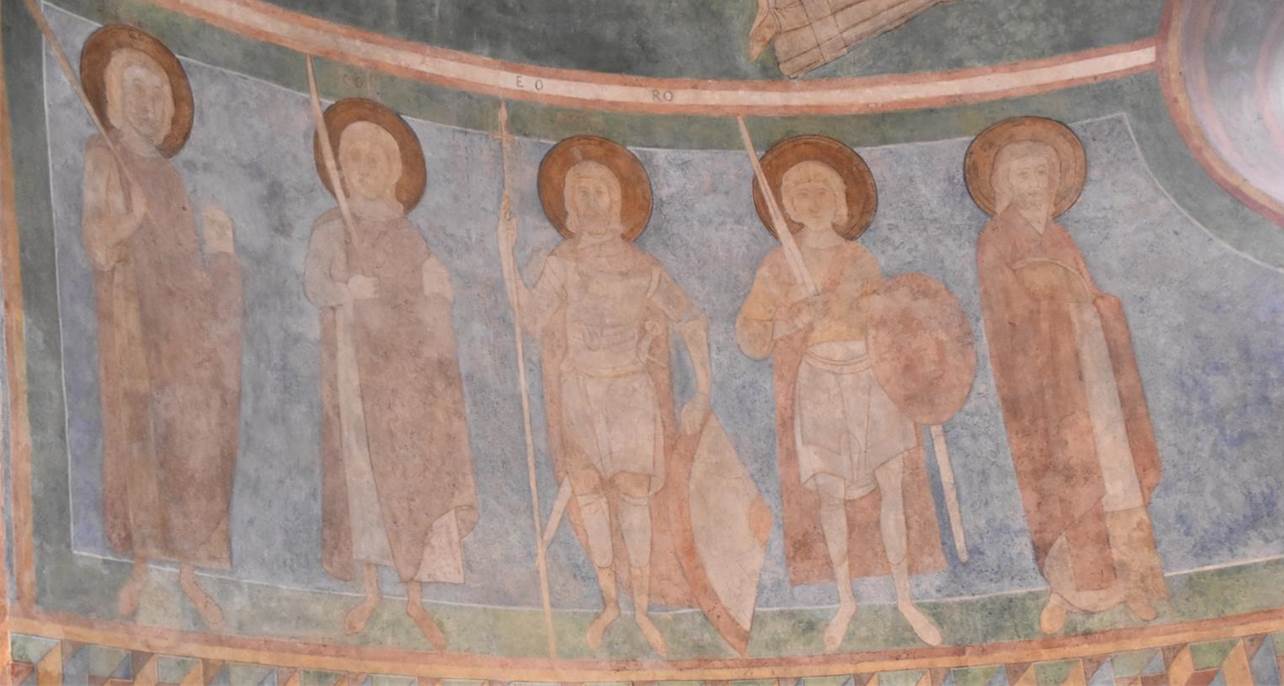
16. Fragment of the painting of the apse of the upper church of Schwarzreindorf. St. Martyrs to the left of the window. Photo of the author.
In Schwarzreindorf, in their place, we see a frieze of holy warriors and martyrs (Fig. 11, 16), which is understandable, given the fact that the customer himself and many of his entourage were crusaders. Five figures representing the holy martyrs are depicted to the left and right of the window. There are inscriptions of abbreviated names on the green stripe above the martyrs. The first two on the left are St. Damian and St. Cosmas were patrons of the Essen Monastery, whose abbess was Arnold's sister Hedwig. Behind them is a bearded warrior named Eustace, the next two characters are not signed. K. Koenigs suggests [3, p. 94] that these may be locally revered Rhenish martyrs, for example, St. Gereon of Cologne. The right row is headed by St. Maurice, the leader of the Theban Legion, and the Bonn martyrs St. Cassius and St. Florentius, followed by St. Malusius and St. Hippolytus, the patron saint of the Herresheim Monastery, whose abbess was Hedwig [4, p. 346; 3, p. 94]. Stylistic comparison of the images of the apse of the upper church of Schwarzreindorf with the painting of the apse of the church of St. Andrew and St. Mary of Knechtsteden Abbey reveals significant similarities in the representation of the image of Christ (Fig. 17) and the symbolic animals of the Evangelists (Fig. 18, 19, 20).
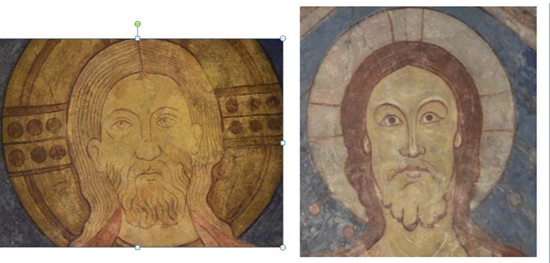
17. The image of Christ. From left to right: the apse of the upper church of Schwarzreindorf; the apse of the Church of St. St. Andrew and St. Mary of Knechtsteden Abbey. Photo of the author.
Despite the fact that the image of Christ in Schwarzreindorf is worse preserved than in Knechtsteden, the contours of the Savior's face, however, seem to be variations of the same pattern.
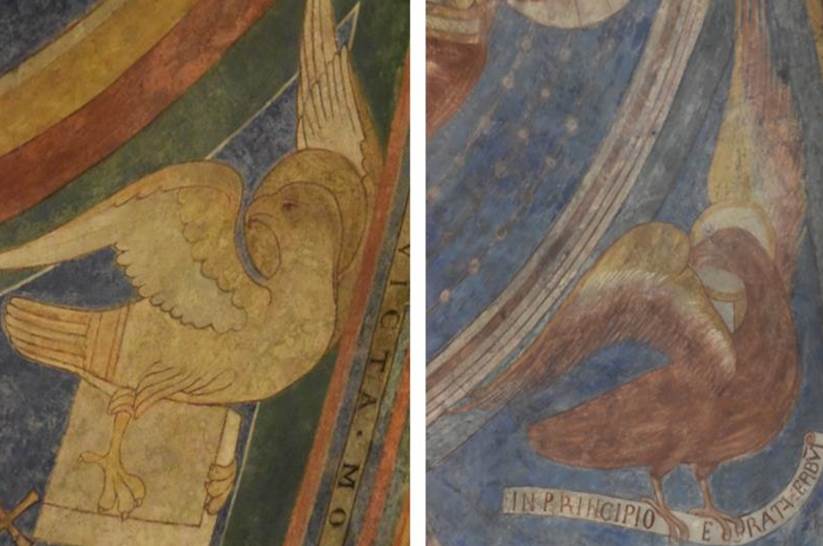
Fig. 18. The Eagle of St. St. John's. From left to right: the apse of the upper church of St. Mary and St. St. Clement's Church in Schwarzreindorf; the apse of St. Clement's Church. St. Andrew and St. Mary of Knechtsteden Abbey. Photo of the author.
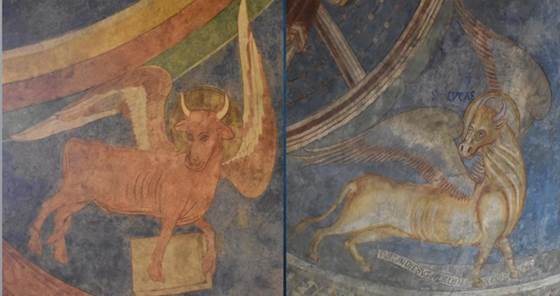
Fig. 19. Taurus of St. Luke. From left to right: the apse of the upper church of St. Mary and St. St. Clement's Church in Schwarzreindorf; the apse of St. Clement's Church. St. Andrew and St. Mary of Knechtsteden Abbey. Photo of the author.
Considering the state of preservation of the frescoes of Schwarzreindorf, the contours of the eagle figure of St. St. John in the apse of the upper church of Schwarzreindorf practically repeats the contours of his image in the church of Knechtsteden Abbey. The shape of the head, the beak, the rounded lines of the body, the position of the wings, the halo around the head, all seem to be copied from the Knechtsteden model (Fig.18).
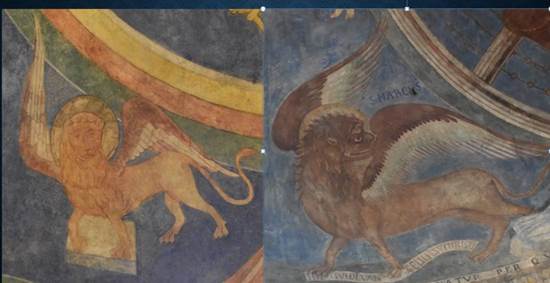
Fig. 20. St. Mark's Lion. From left to right: the apse of the upper church of Schwarzreindorf; the apse of the Church of St. St. Andrew and St. Mary of Knechtsteden Abbey. Photo of the author.
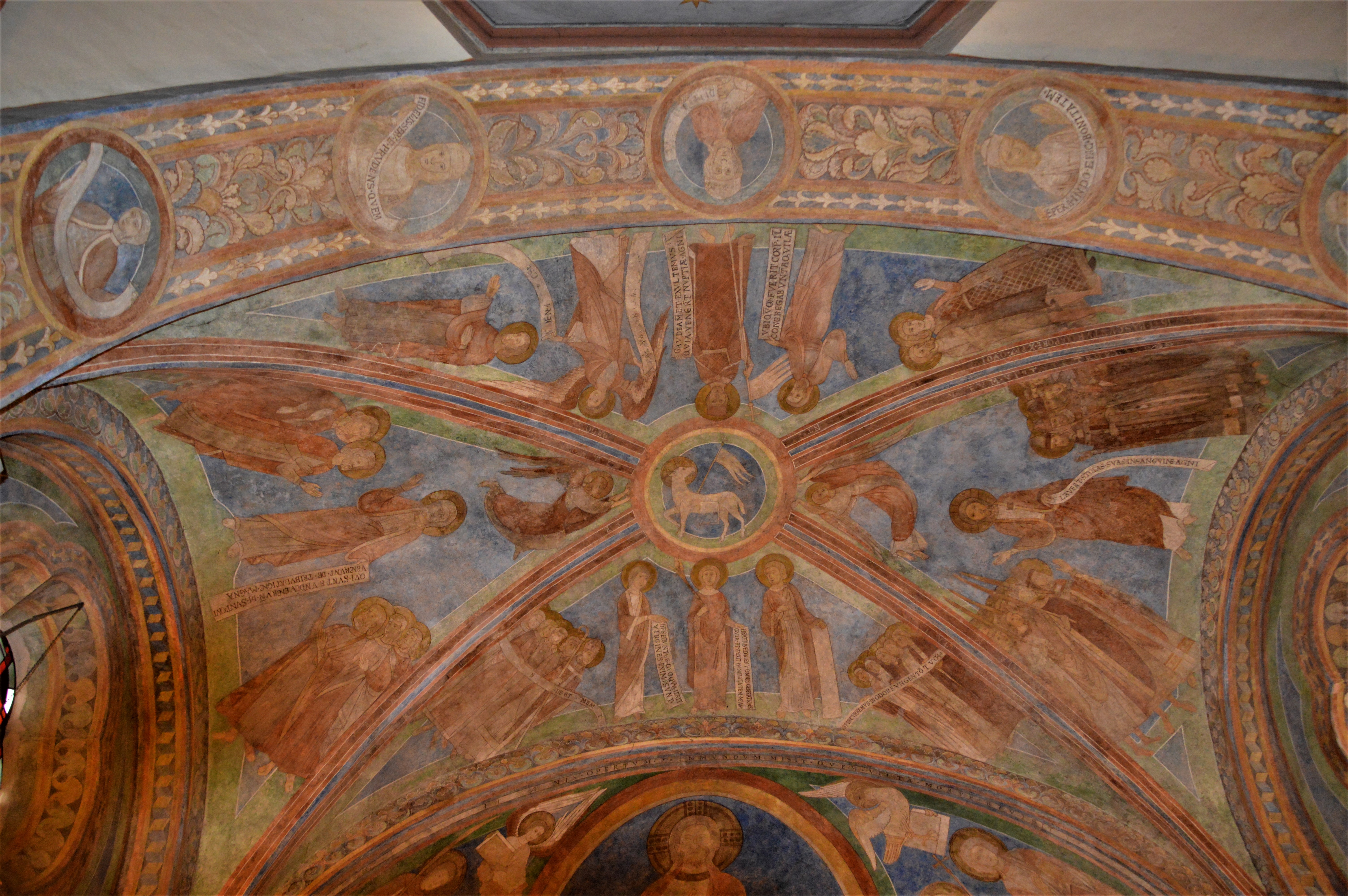
Fig. 21. Painting of the vault of the upper church of St. Mary and St. St. Clement's in Schwarzreindorf. Photo of the author. The poses of the figures, the elaboration of the wings, the position of the paws, and the folds of skin on the body of the taurus of St. Luke and the lion of St. Mark (Fig. 19, 20) in the apse of the upper church of Schwarzreindorf also show clear parallels with the images of the apse of the church of Knechtsteden Abbey. Iconographic program of frescoes of the vault of the upper church of Schwarzreindorf The composition with the Lamb in the choir vault of the upper church of Schwarzreindorf (Fig. 21) is divided diagonally into four compartments, where Christ, the Virgin, the Virgin Church, the righteous, saints, virgins, etc. are represented. The texts that accompany this composition are based primarily on the Revelation of John. In the center of the vault in the mandorla there is a Lamb, which was restored by restorers [4, p. 349, fig. 253].
In the northern and southern compartments, Christ stands in the center of the composition with a cross-shaped halo. In his hands he holds a parcel with inscriptions that have been read and restored from the text of the Vulgate (Biblia Sacra Vulgata: URL: https://drbo.org/lvb/index.htm ). They represent fragments of the text of John's Revelation (Revelation 7:13-14). In the northern Communist Party, the inscription on the parcel (Apocalypse 7:13-14) reads: "quisunte unde venerunhisuntqui veneruntdetribulationemagna" ("who are they [and] where did they come from [and]are they who camefrom the great tribulation"). In the southern Communist Party, the inscription on a scroll in the hands of Christ reads: "et laveruntstolassuas insanguineAgni" ("and they washed their garments and made them white with the Blood of the Lamb"). In the northern Communist Party, Christ is surrounded by figures of saints, including four martyrs with palm branches to the left of Christ, and a group of six members of the clergy, whom P. Klemen identifies as bishops and deacons [4, p. 350]. In the southern Communist Party, five holy men can be seen around Christ. The Eastern Communist Party features a red-robed Virgin with a green branch in one hand and a scroll in the other. The scroll currently has an inscription:"beatamedicentomnesgenerationesqviarespexithvmilitatemmeam" (Luke 1:48: "Quia respexit humiliitatem ancillae suae: ecce enim ex hoc beatam me dicent omnes generations") is a fragment of the lyrics of the song of the Blessed Virgin Mary "My soul magnifies the Lord" ("Magnificat anima mea Dominum"), read and supplemented by Wirth ("He has considered the humility of His Handmaid, for from now on all generations will please Me"). On the left side, on the right hand of the Virgin, a figure with a halo holds a scroll with the inscription "hiseqvntagv qvocvqi ieritvirginsenimsunt" – a fragment from the verse (Rev. 14.4): ("These people follow the Lamb wherever he goes because they are virgins.") To the right of the Virgin, the inscription on the scroll in the figure's hand is lost. Two groups are depicted in the corners of this compartment: on the left, holy men led by a pastor in a mitre and with a bishop's staff, on the right, a group of nuns holding a scroll with an inscription, the text of which is almost lost, but a fragment of "odore vngent vor" has been preserved, supplemented by Wirth ([post te curremus in] odore VNGENT[orum] [t]voR[um]), which refers to the text of the Song of Songs of King Solomon (1:3): "The aromas of your incense are beautiful" ("Trahe me, post te curremus in odorem unguentorum tuorum"). Perhaps, as P. Clement points out [4, p. 350], this text is a fragment of another passage from the Song of Songs (4:10): "your breasts are more beautiful than wine, and the fragrance of your perfume is better than all spices" ("pulchriora sunt ubera tua vino et odor unguentorum tuorum super omnia aromata"). The inscription on the scroll held by the left group is almost erased, but you can read: "n de at . . . mem . . .t». All the texts of the inscriptions on the scrolls held by the figures depicted in the compartments of the choir vault of the upper chapel of Schwarzreindorf were read and supplemented by Wirth [4, p. 350]. The virgin in the center of this composition obviously represents the Mother of God. The branch in her hand, as P. Clement points out [4, p. 350], was interpreted as a branch of the "paradise tree of life, which people have lost since the fall of Adam" and which, with its fruits, will revive the blessed who have returned to paradise (Revelation John 2:7): "to him who overcomes, I will give to eat of the tree of life, which in the midst of God's paradise." However, it seems to us that the branch in the hands of a Virgin rather refers to a play on the words "virgo" ("virgin") and "virga" ("branch") associated with the text of the prophet Isaiah (Isaiah 11:1): "And there shall come forth a branch from the root of Jesse, and a branch shall sprout from his root." This symbolism was well known and very widespread in Christian programs of the 12th century, especially after the development of the iconography of the plot of the "Tree of Jesse" in the Abbey of Saint Denis by Abbot Suger [24, p. 78]. In the western compartment of the vault, a female figure with a halo is depicted in the center of the composition, wearing a red headdress with loose long hair, wearing a cloak over a plaid dress. In her right hand she holds a long staff with a cross at the top and a standard, in her left hand she holds a scroll with an inscription from the text of Revelation John 19:7: "gaudeam et exvl temvs quia venert nvptiae agni" ("Gaudeamus, et exsultemus: et demus gloriam ei: quia venerunt nuptiae Agni, et uxor ejus praeparavit se" ‒ "Let us rejoice and be glad, and give glory to Him, for the marriage of the Lamb has come, and his wife is made ready"). This figure is seen as an image of the Church, the Bride of the Lamb, in the context of the Crusades, it can be interpreted as a militant and triumphant Church. On the right hand of Ecclesia stands a holy man with a scroll in his hand, on which is written a fragment of the text of the Gospel of Matthew (Matthew 24:28): "Ubicumque fuerit corpus, illic congreguntur et aquilae" ("Wherever there is a body, eagles will gather there"). On the left hand of Ecclesia stands an angel with outstretched wings and a scroll in his hand, the inscription on which has almost disappeared. In this Communist Party, according to P. Clement, only the figure of the Church can be reliably interpreted [4, p. 351]. Thus, it can be seen that the program of the upper church's code was compiled by a very outstanding theologian, who not only uses various quotations from the Holy Scriptures, but composes his compositions from individual fragments of the text, which he needs to explain the program. The influence of the customer's environment on the creation and realization of the idea of the decoration of the Schwarzreindorf church
All these circumstances lead to the next important question that has long been preoccupying researchers ‒ who from the entourage of Archbishop Arnold II of Cologne participated in the development of the painting program of the upper and lower churches on his ancestral land? There are serious reasons to believe that this program was greatly influenced not only by Rupert Deitzky, as shown by V. Noys [10], but also by Otto of Freisen, in particular, by his work (Chronica or Historia de duabus civitatibus), which actualizes the theme of the "two Cities". This assumption has been made repeatedly. K. Koenigs believes, for example, that "Otto von Freising performed a complex work called the Arnold Church" [3, p. 88]. However, the hypothesis of the influence of Otto of Freising and his work (Chronica or Historia de duabus civitatibus) on the complex "multi-layered" iconographic program of the Schwarzreindorf Church requires a deeper study through a detailed comparison and analysis of the visual images of the program and the texts of Otto of Freising. Recognizing his possible influence on the lower church's program and the overall design of the temple's program as a whole, it should be assumed that Otto of Freising was not the only one who contributed to this process. Both the founder's sister Hedwig and his childhood friends Vibald of Stablau and Anselm of Havelberg, with whom Arnold von Wied had a much closer relationship, could have participated in this [19, p. 5]. Vibald, Abbot of Stablot and Malmedy, Corvey and Monte Cassino, who carried out diplomatic assignments for Conrad III and Frederick Barbarossa, was not only an influential political figure, but also a famous theologian, an inventive iconographer and patron of ecclesiastical art, no less significant than Abbot Sugerius of Saint-Denis [25]. 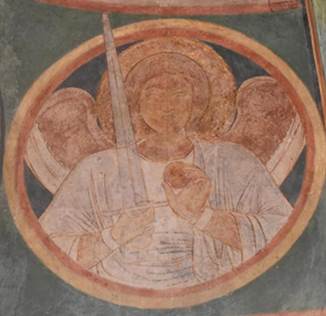
22. Medallion with the image of Archangel Michael. The painting of the lower church of St. Mary and St. St. Clement's in Schwarzreindorf. Photo of the author.
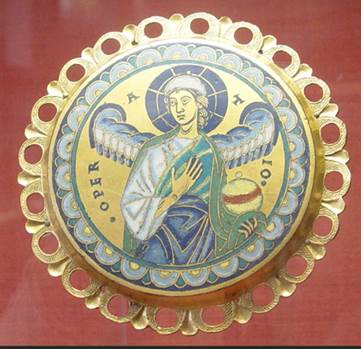
23. The medallion of the altar of St. Remaclus from the Abbey of Stablo, representing the personification of "Operatio", circa 1150, Museum of Decorative Arts, Berlin. Photo of the author.
A comparison of the representation of the archangel Michael in a medallion above the door of the staircase to the upper church in the northern wall of the lower church of Schwarzreindorf (Fig. 22) with the image of the "operacio" from the altar of St. Remaclus of the Abbey of Stablot (Fig. 23) makes it possible to clearly demonstrate that the samples from the abbey Vibalda could serve as a direct source of inspiration for the Schwarzreindorf masters who painted the lower temple. Similar images of angelic images are found quite often in temple programs, as P. Klemen points out, but he finds the greatest similarity of the image from Schwarzreindorf with Byzantine examples ‒ an angel from the Kahrie Jami Church (Chora Monastery) in Constantinople and with the ivory image of the Byzantine work from the Ravenna Museum (fig. 24) [4, s. 311, fig. 227, 228]. A comparison of the images of angels from Kahrie Djami and the Ravenna Museum with the image of Archangel Michael in Schwarzreindorf shows that Byzantine angels have a different wing shape, pointed at the top, in contrast to the smooth, rounded shapes from which the wings of Archangel Michael from Schwarzreindorf are assembled (Fig. 22) and the "operatio" image from the Abbey of Stablot (Fig. 23).
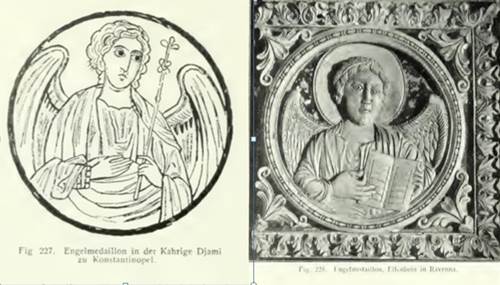
24. Medallions with an angel from the Kahrie Jami Church in Constantinople (left) and from the Ravenna Museum. Image source: [4, p.311, fig.227].
The angel wings in the medallion from Stablot and from Schwarzreindorf have a similar silhouette and well-visible edging. In addition, the wings of the Byzantine models are very large and rest against the borders of the medallions on the sides and below, whereas the angelic images from Schwarzreindorf and Stablot have small wings, leaving a free space at the bottom of the medallions. The folds on the draperies of the right bent arm of the Schwarzreindorf and Stablot angels are also more correlated with each other than with the specified Byzantine patterns. Thus, the medallion of the altar of St. Remaclus from the Abbey of Stablot (fig. 23), representing the personification of the "Operatio" and located in the collection of the Museum of Decorative Arts in Berlin (Identifier:W-1978.56, c. 1150), demonstrates the fact that the source of inspiration Schwarzreindofsky masters could not find in Byzantine models, and much closer with the help of the abbot of the monastery of Stablot, who at that time, along with numerous other issues, was paying attention to the creation of the St. Remaclus altar program for his abbey. Another person from Arnold von Wied's inner circle who could have significantly influenced the creation of the design of the Schwarzreindorf church is his childhood friend Anselm of Havelberg (1129-1155). Anselm is an excellent speaker and theologian who became a famous church writer. He was one of the first disciples and followers of St. Norbert of Xanthen, the founder of the Premonstratensian Order, and deeply devoted to his teacher. He was also an excellent diplomat who carried out assignments for both the pope and the emperor, for which he eventually received the bishopric of Ravenna [23, p. 15-20].
A dedicatory inscription preserved in the choir of the lower church of Schwarzreindorf names a number of very high-ranking people who attended the consecration of the temple. Otto of Freising, King Conrad III, Bishops Albert of Meissen and Henry of Liege were named in it, the founder and members of his family were present, as well as Vibald, Abbot of Corvey and Stablot [4, p. 271]. However, Anselm of Havelberg is not named in this text. In the last years of the reign of Conrad III, he was sent away from the court and was able to return only after the accession of Frederick Barbarossa. Since 1152, Anselm began to take an active part in public affairs again. Together with Arnold and Wibald, he was part of Frederick Barbarossa's inner circle and, upon returning from Greece, as Otto of Freising testifies, "received the archbishopric of Ravenna, as well as the exarchate of the same province, a magnificent reward for his labors"[23, p. 110]. If we proceed from the generally accepted version that the lower church was painted before its consecration in 1151, then analyzing the program of the temple as a whole, we can understand that its main idea as an image of "two cities" was conceived initially during the life of the founder. The influence of Rupert Deutsky's "De sancta trinitate et operibus eius" on the program of the lower Church of labor is generally recognized. This allows us to draw some conclusions. It is known that Arnold von Wied admired Rupert, and Anselm Havelberg strongly "disliked" him [26, p. 67]. There were reasons for this, one of which was the negative relationship between Rupert and Anselm's teacher, St. Norbert of Xanthen. Anselm, in his letter to Ecbert, Abbot of Huysburg (Epistola venerabilis Anselmi Havelbergensis episcopi ad Ecbertum abbatem Huysborgensem contra eos qui opportune contendunt, monasticum ordinem digniorem esse in Ecclesia quam canonicum, PL 188, Col. 1120C), speaks of Rupert as follows: "... it is possible, however, that He is considered great by you not because he wrote something great, but because he was an abbot of monks; I did read some of his writings, I admit, with curious novelty, I also knew him and saw him, but I found that the beautifully said Greek proverb is true about him: a fat belly does not give birth to a thin one. the mind." The serious influence of Rupert's texts on the program of the lower church suggests that this project took into account the wishes of the founder of the temple and ignored the attitude of Anselm to Rupert of Deutz, who was not present at the consecration of the temple in 1151. Thus, it is quite obvious that the main ideas of the church's program in Schwarzreindorf, related to the influence of Rupert's texts, matured during Arnold's lifetime with the participation of his inner circle, even before the consecration of the temple, and in this he could have been supported by Vibald of Stablot and Otto of Freising, but not by Anselm of Havelberg, who despised Rupert and was removed in that time is from the royal court. As for the detailed development of the upper church program, the conducted research allows us to present the following picture. The murals on the walls of the upper church choir, which demonstrate iconographic typological connections and stylistic parallels with the monuments of Ravenna, most likely indicate the influence of Anselm of Havelberg, who became Archbishop of Ravenna in 1155. He was able to discuss the ideas of this program with Arnold during their stay together in Italy even before the latter's sudden death in 1156. The iconographic program of the vault of the upper chapel is more complex and indicates the clear participation of a virtuoso master theologian. This is also evidenced by the general iconographic idea of the Schwarzreindorf double church program, connecting both chapels, which presents us with a complex "multi-layered" theological project. This project, which demonstrates the free variation of various fragments of the texts of the Holy Scriptures, a sophisticated selection of typologically related texts and plots, could only have been created by an experienced and highly educated theologian. In Arnold von Wied's inner circle, at least three people could handle this task: Anselm of Havelberg, Wibald of Stablot, and Otto of Freising. It can be assumed that the final revision of the upper church program and especially its implementation most likely took place after Arnold's sudden death, which additionally motivated his entourage to complete this project with dignity. After Arnold's death, his closest friends Wibald and Anselm, as well as Otto of Freising, briefly outlived him. All three died in 1158. It is very likely that the theological program they developed for painting the vault of the upper church was carried out without them, under the supervision of the Arnold sisters. It is also possible that some fragments of this program, such as the inclusion in the program of painting the vault of a female monastic group, are related to the establishment of a convent here and the wishes of the founder's sisters Hedwig, Sofia and Siburgis.
As for the painting of the apse of the upper church of St. Mary and St. Clement in Schwarzreindorf, its iconographic program, unlike the vault and walls of the choir, is not so complicated at all. It is quite traditional. The emphasis on tradition in this program is especially important. It is this connection with the heritage of Rome, with the veneration of local and Roman saints, with the themes of the glorification of the Church of Christ and the martyrdom, which form the basis of most early Christian temple paintings, complemented by the perpetuation of the memory of the founders of the temple, depicted at the feet of Christ, forms the basis of this program. This iconographic decision can be called quite ordinary and predictable. The same type of painting program can be found in the apse of the church of Knechtsteden Abbey, where Albert of Aachen, who was dean of Cologne Cathedral during the administration of Arnold von Wied, was engaged in the construction and decoration of the temple until the end of his days. Albert oversaw the construction campaign in Knechtsteden until his death in 1164, as indicated by his tombstone inscription in St. Peter's Church. St. Andrew and St. Mary in Knechtsteden, therefore, the issues related to the practical implementation of the temple painting project were close to him. The revealed stylistic parallels in the murals of the apse of the Knechtsteden church and the upper church of Schwarzreindorf suggest the appearance of masters from Knechtsteden in Schwarzreindorf, or at least the acquaintance of the artist Schwarzreindorf with the Knechtsteden painting. Considering also the special relationship of the Archbishop of Cologne with Knechtsteden Abbey, it is highly likely that Albert of Aachen could have provided significant support to the sisters of Arnold von Wied in completing the decoration of the double church of Schwarzreindorf, which became the tomb for his high-ranking and untimely deceased patron, primarily in matters of painting the apse of the upper church. This version of events suggests that the painting of the upper church of Schwarzreindorf was most likely completed during the lifetime of Albert of Aachen, that is, before 1164.
The article is published in the version approved by the reviewers (after receiving a positive review recommending the manuscript for publication) with corrections made by the author (after receiving the editor’s comments, if any).
Read all reviews on this article
References
1. Friese, M. (2006). Die Doppelkapelle von Schwarzrheindorf. Köln: Kunsthistorisches Inst. der Univ., Abt. Architekturgeschichte.
2. Verbeek, A. (1953). Schwarzrheindorf. Die Doppelkapelle und ihre Wandmalereien. Düsseldorf: L. Schwan.
3. Königs, K. (2001). St. Maria und St. Clemens Schwarzrheindorf. Bonn: Druckerei Gerhards.
4. Clemen, P. (1916). Die Romanische monumentalmalerei. Düsseldorf: L. Schwann.
5. Gierschner, S. (1991). Zur Authentizität der romanischen Wandmalereien von Schwarzrheindorf. Versuch einer immanenten Quellenkritik. In U. Mainzer (Ed.), Paul Clemen zur 125. Wiederkehr seines Geburtstages (pp. 115-148). Köln: Rheinland-Verlag GmbH.
6. Simons, A. (1846). Die Doppelkirche zu Schwarzrheindorf. Bonn: Buddeus.
7. Aus'm Weerth, E. (1880). Wandmalereien des christlichen Mittelalters in den Rheinlanden. Leipzig: T.O. Weigel.
8. Kern, P. (2003). Das Bildprogramm der Doppelkirche von Schwarzrheindorf, die Lehre vom vierfachen Schriftsinn und die Memoria des Stifters Arnold von Wied. Deutsche Vierteljahrsschr für Literaturwiss und Geistesgesch, 77(3), 353-379.
9. Hansmann, W., & Hohmann, J. (2002). Die Gewölbe und Wandmalereien in der Kirche zu Schwarzrheindorf. Konservierung-Restaurierung-neue Erkenntnisse. Arbeitsheft der rheinischen Denkmalpflege, 55. Worms: Wernersche Verlagsgesellschaft.
10. Neuß, W. (1912). Das Buch Ezechiel in Theologie und Kunst bis zum Ende des XII Jahrhunderts. Mit besonderer Berücksichtigung der Gemälde in der Kirche zu Schwarzrheindorf. Münster.
11. Derbes, A. (1992). The Frescoes of Schwarzrheindorf, Arnold of Wied and the Second Crusade. In M. Gervers (Ed.), The Second Crusade and the Cistercians (pp. 141-154). New York: Palgrave Macmillan.
12. Odell, M. S. (2011). Reading Ezekiel, Seeing Christ: The Ezekiel Cycle in the Church of St. Maria and St. Clemens, Schwarzrheindorf. In After Ezekiel: Essays on the Reception of a Difficult Prophet (pp. 115-136). New York: T & T Clark.
13. Khrypkova, E. A. (2018). The cult of the "empty throne" and the idea of unity of secular and ecclesiastical power in the program of the Church of St. Maria and St. Clemens in Schwarzrheindorf. Artikult, 32(4), 43-55. https://doi.org/10.28995/2227-6165-2018-4-43-55 EDN: YUDQDB
14. Khrypkova, E. A. (2019). The Book of the Prophet Ezekiel in the iconographic program of the frescoes of the Church of St. Maria and St. Clemens in Schwarzrheindorf. Artikult, 35(3), 12-47. https://doi.org/10.28995/2227-6165-2019-3-10.28995/2227-6165-2019-3-12-47 EDN: QWNELQ
15. Khrypkova, E. A. (2025). The iconographic program of the Church of St. Maria and St. Clemens in Schwarzrheindorf: On the issue of the role and interpretation of the images of rulers. Vestnik RGGU. Series: Philosophy. Sociology. Art Studies, 3, 84-100. https://doi.org/10.28995/2073-6401-2025-3-84-100 EDN: MILQVJ
16. Herwegen, I. (1908). Die Darstellung Jesu im Tempel in der Pfarrkirche zu Schwarzrheindorf. Annalen des Historischen Vereins für den Niederrhein, 86, 161-164.
17. Herwegen, I. (1910). Zu der Schwarzrheindorfer Darstellung Jesu im Tempel. Annalen des Historischen Vereins für den Niederrhein, 89, 116-117.
18. Kunisch, J. (1966). Konrad III, Arnold von Wied und der Kapellenbau von Schwarzrheindorf. Düsseldorf: L. Schwann.
19. Wolter, H. (1973). Arnold von Wied, Kanzler Konrads III. und Erzbischof von Köln. Köln: Verlag der Buchhandlung Dr. H. Wamper GmbH.
20. Lacomble, T. J. (1981). Urkundenbuch für die Geschichte des Niederrheins Bd. 1: 779‒1200. Edited by W. Rüdiger Schleidgen. Veröffentlichungen der Staatlichen Archive des Landes Nordrhein-Westfalen: Reihe C, Quellen und Forschungen, 10. Düsseldorf: 1840, ND Siegburg.
21. Bovini, G. (1991). Ravenna Art and History. Ravenna: Longo.
22. Demus, O. (1970). La peinture murale romane. Paris: Flammarion.
23. Lees, J. T. (1998). Anselm of Havelberg: Deeds Into Words in the Twelfth Century. Leiden-New-York-Köln: Brill.
24. Khrypkova, E. A. (2013). The Basilica of Saint-Denis of Abbot Suger. Moscow: DPK Press.
25. Wittekind, S. (2004). Altar-Reliquiar-Retabel: Kunst und Liturgie bei Wibald von Stablo. Cologne, Weimar, and Vienna: Bohlau.
26. Petit, F., & Praem, O. (2011). Spirituality of the Premonstratensians: The Twelfth and Thirteenth Centuries. Collegeville, Minnesota: Liturgical Press.
Peer Review
Peer reviewers' evaluations remain confidential and are not disclosed to the public. Only external reviews, authorized for publication by the article's author(s), are made public. Typically, these final reviews are conducted after the manuscript's revision. Adhering to our double-blind review policy, the reviewer's identity is kept confidential.
The list of publisher reviewers can be found here.
The work is devoted to the historical and art criticism analysis of the painting of the double church of St. Mary and St. St. Clement's in Schwarzreindorf. The work is carried out at a high research level and includes consideration of such topics as the history of the creation of the object of research, the history of research on paintings discovered in the 19th century, the analysis of the content, themes, narratives of murals using comparative research. The subject of the study is the picturesque decoration of the Schwarzreindorf church, which has been preserved in the lower and upper churches. As a result, the author makes valuable assumptions based on the analysis of various historical and art history materials, about the dating of the construction of the object (the double church) and the dating of the creation of the object (the painting). The relevance of the issue is related not to the subject of study, but rather to the application of research approaches. The author demonstrates a meticulous approach to documentary and visual materials. In fact, the article is a theoretical example of art history research, based not on ephemeral guesses and assumptions, but on documented research protocols. The novelty of the work is expressed in the author's conclusions regarding the dating of the images and the identification of stylistic parallels with the paintings of the apse of the church of San Apollinare in Classe near Ravenna and the mosaic of the presbytery of the church of San Vitale in Ravenna. In addition to the indicated historical and art criticism approach, the methodology of the article includes comparative, iconographic and socio-cultural analyses. Such a methodological combination allows the author to draw conclusions that are important for art studies. The work is very clearly structured, the text of the article is divided not according to formal, but according to substantive criteria and reflects the sequence of empirical analysis of the painting. The article includes five sections in total. In the first, the author presents the history of the construction of the facility, makes some conclusions on the chronology and personalities involved in the implementation of the church construction project; then the author proceeds to tell about the murals, the history of their discovery and offers a historiographical analysis of the sources. The second, third and fourth sections of the article are devoted to the iconographic and comparative analysis of the murals of the lower and upper churches of Schwarzreindorf. These sections are the most informative, and the text contains high-quality, representative illustrative material. It is also necessary to note separately that the author has conducted a partially narrative study. Based on the inscriptions preserved fragmentally in the paintings, the author reproduces the ideological context that the entire church building carries. In the fourth section, the author, using a socio-cultural approach in art studies, reconstructs the social environment of the customer and his closest associates and relatives. The analysis of the historical canvas, visual sources and socio-cultural factors leads the author to non-trivial conclusions about the content of the ideological program implemented in the construction of the upper and lower churches of Schwarzreindorf. The style of presentation is characterized by objectivity and reliability, which indicates a high level of scientific and research competence of the author. The conclusions of the article are of interest to Russian art criticism and related historical, philosophical, and theological disciplines. The bibliography corresponds to the content of the work. The only technical note is that some section headings are punctuated with a dot, and some are not. It is necessary to unify this point. The article is written at a high theoretical level and is recommended for publication.
|





 © 1998 – 2026 Nota Bene. Publishing Technologies. NB-Media Ltd.


