|
Culture and Art
Reference:
Varakina, G.V., Dobrovol'skaya, V.E. (2026). The Fairy-Tale Character as an Archetype of 'Russianness': In Search of a Cultural Code (Based on the Murals of the Industrial Park 'Yesipovo-4', Moscow Region). Culture and Art, 2, 1–16. https://doi.org/10.7256/2454-0625.2026.2.77776
The Fairy-Tale Character as an Archetype of 'Russianness': In Search of a Cultural Code (Based on the Murals of the Industrial Park 'Yesipovo-4', Moscow Region)
Varakina Galina Vladislavovna
ORCID: 0000-0002-0004-3989
Doctor of Cultural Studies
Head of the Department; Department of General and Slavic Art Studies; A.N. Kosygin Russian State University (Technology. Design. Art)
129337, Russia, Moscow, Yaroslavsky district, Khibinsky passage, 6

|
galina_varakina@mail.ru
|
|
 |
|
Dobrovol'skaya Varvara Evgen'evna
ORCID: 0000-0002-2346-7493
PhD in Philology
Associate Professor; Department of General and Slavic Art Studies; A.N. Kosygin Russian State University (Technology. Design. Art)
129337, Russia, Moscow, Yaroslavsky district, Khibinsky passage, 6
|
|
dobrovolska@inbox.ru
|
|
 |
|
DOI: 10.7256/2454-0625.2026.2.77776
EDN:
BZEPMK
Received:
01/18/2026
Read all reviews on this article
Published:
02/02/2026
Abstract: This study explores the themes and imagery of murals in the industrial park of the Holding «Stroitelny Alliance» in the Moscow Region. The murals prominently feature Russian folk and authorial fairy tales, as well as literary works whose heroes are widely recognized as fairy-tale characters. The main goal was to understand these characters as carriers of the Russian cultural code, which forms the conceptual program of the murals. Key figures include Vasilisa the Wise, Marya Tsarevna, the Swan Princess, Chernomor, the Thirty-Three Bogatyrs, Ivan Tsarevich, Danilo the Craftsman, and Lefty. The murals function as allegories rather than literal illustrations of texts. The research object is the fairy-tale murals of the «Stroitelny Alliance» Holding in the Moscow Region, with the subject being the fairy-tale characters depicted. An interdisciplinary approach was employed, combining art history methods (iconographic, formal-stylistic) with comparative, intertextual, and intermedial analyses. This revealed connections within the artistic space (monumental painting, applied arts) and external interactions (architecture, design, business, ethnocultural heritage). Significant results include analysis of ISP «Koledino» murals as an ethnocultural prototype for the «Yesipovo-4» murals; identification of the process of codifying national values in fairy-tale characters and their transmission through «Yesipovo-4» murals; and interpretation of the cultural code in contemporary contexts. The study introduces new empirical material and proposes methodologies for analyzing objects in the art buffer zone, such as autonomous industrial murals. Terminological solutions for analyzing these objects (replication, intermedial remake and remix, compositional collage) are offered. This research contributes both theoretically and practically to art studies and cultural understanding in industry.
Keywords:
industrial park, cultural code, muralism, public art, Russianness, street art, ethnocultural identity, intermediality, intertextuality, comparative studies
This article is automatically translated.
Introduction Our research is devoted to the murals of the Esipovo-4 industrial park, located in the Solnechnogorsk district of the Moscow region. The interest in the murals of this park is due to several reasons. Firstly, muralism as a variant of street art has attracted, especially in the last decade, the close attention of domestic researchers from various scientific fields: anthropologists, cultural scientists, philosophers, sociologists. To a much lesser extent, art historians are professionally interested in murals, which is largely due to the borderline nature of this phenomenon. Since the late 2010s, the scientific discourse has been actively discussing the conceptual framework associated with various manifestations of street art, as well as the boundaries of artistic and socio-communicative in such phenomena [1-3]. The second reason was the theme of the murals of the specified location — these are fairy-tale characters and plots. Moreover, both the selection of images and their interpretation are interesting: Vasilisa the Wise, Mary the Princess, Princess Swan, Uncle Chernomor and thirty-three heroes, Ivan Tsarevich and others. The very fact of referring to samples of Russia's intangible ethno-cultural heritage is very symptomatic. There is a lot of talk about national identity today, both at the legislative, scientific, and even everyday levels. It has become one of our tasks to understand the reason for the appeal to the national theme of a large construction holding company. And finally, the very placement of murals also raises questions, since we have an atypical situation of legitimately painting murals on the facades of existing industrial facilities remote from urban space. This violates the existing cliches of murals focused on social activity and communicative meaning. The conceptual design of these objects, the features of the artistic language and the specifics of the placement were also in the field of our scientific interest. All these circumstances not only confirm the relevance of the study, but also are proof of its scientific novelty, which consists in identifying the need for modern business and related social groups to form their cultural code based on continuity and ethno-cultural identity. The object of the study is the fabulous murals of the Construction Alliance Holding, located in the Moscow region. The subject of the research is the fairy—tale characters featured in the murals of the Construction Alliance Holding. The purpose of the study was to identify the principle of iconographic selection of archetypal characters by the Holding. The main aspects of the research are: to trace the experience and internal motivation of the Holding's appeal to fairy-tale images (Koledino, the Firebird mural); to formulate the program of the triptych of murals "Russian Fairy Tales"; to interpret the fairy-tale characters of the murals in the context of the corporate policy of the Construction Alliance Holding. In the course of our research, we have developed an interdisciplinary methodological approach at the intersection of art history, cultural studies and cultural anthropology. Among the main methods, the iconological method, the method of comparative comparison, intertextual and intermediate analysis were of great importance. The iconological method was used to comprehend the modern interpretation of traditional forms of culture in order to identify the mechanism of their recoding. His result focuses on understanding the process of creating a modern cultural code based on cultural continuity. The comparative comparison method was applied to analyze the murals' programs and the Holding's policy. As a result, we were able to identify the reason for the appeal to Russian folk and author's tales, certain plots and characters, interpret them in the context of modern realities and within the framework of the corporate concept, striving for progress. The intertextual analysis allowed us to consider the mural as a text, identify borrowings in the murals of fragments of other texts and reveal the mechanism of compositional collage, as well as the principle of free replication. The intermediate analysis was very useful when comparing literary texts and murals of the Construction Alliance Holding. The basis is the folklore image as a carrier of cultural meanings, which is translated from a verbal form into a pictorial one. The use of the comparative method allowed us to provide a justification for the relationship between the policies of industrial companies and traditional values. Our research was based on a body of scientific texts that address various aspects of the problem: muralism and street art [1-15], murals of industrial zones [3, 9-11, 13-15] and, especially, industrial parks [9, 14], fairy-tale characters and plots appearing in the murals under consideration, and their semantics [16, 17], the modern cultural code [18, 19]. The understanding of murals in modern scientific discourse is conducted mainly in the field of cultural anthropology [20-22], to a much lesser extent in the field of art criticism. The most significant art studies were the publications of M. E. Mayevskaya [5, 9], M. E. Vilchinskaya-Butenko [1], as well as a collective study of the St. Petersburg State University of Industrial Technology and Design, the Institute of Street Art Research and a number of other higher educational institutions [3]. The interdisciplinary nature of the research required referring to methodological works to determine a research strategy [23, 24]. We used the existing experience of this kind of research [8, 11, 12]. Research in the field of folklore studies was of great importance, which was necessary when working with folk images and texts [25, 26]. All this allowed us not only to describe the murals of the Esipovo-4 industrial park, but also to comprehend them in the context of the artistic practice of street art, as well as within the framework of the Holding's policy, identifying and proving the conceptual basis for appealing to fairy-tale images, their conscious selection and modern interpretation.
Murals of industrial parks as a phenomenon Muralism is a phenomenon associated with both the history of art and modern artistic practices, in particular street art. In its classical form, muralism is a phenomenon of Mexican art of the 1920s and 1930s. The preservation of this term requires its transformation: neo-muralism [3]. However, modern muralism is not only an artistic phenomenon, but also a socio–cultural, and sometimes political one, coupled with the visual embodiment of the author's position. The mural is a kind of artist's message to the mass audience, and art acts as a form of communication. Murals in scientific discourse appear in the context of research on street art, standing out among its other forms by the fact that they "exist on an inhuman, monumental scale, very far from the viewer" [1, p. 27]. But there are terminological variants here, first of all, the distinction between street art and public art: "Unlike street art, public art is most often represented by monumental painting and sculpture in public space (muralism, neo-muralism, monumental advertising, propaganda) and sanctioned by the authorities" [1, p. 20]. The term "industrial/urban art" is used much less frequently in the Russian scientific community, which usually appears as a synonym for street art [1].
Regardless of the terminological nuances, all researchers agree on one thing: murals are one of the modern artistic practices that exist in an urban environment and are characterized by monumentality, legality, interactivity, and temporary permanence. In addition, most researchers emphasize the importance of murals in urban space: "<...> the image of the urban space of the digital era is formed by the synthesis of fine art, media technologies and elements of traditional architecture, where muralism plays a key role as the most ambitious artistic strategy in urban space" ("the image of the urban space of the digital era is formed through the synthesis of fine art, media technologies and elements of traditional architecture, while muralism plays a key role as the most ambitious artistic strategy in urban space", — our translation) [5, p. 10]. However, in the case of the murals of the Construction Alliance Holding, everything is completely different. The murals are not located in the urban area, but in remote industrial parks in the Moscow region. And this fundamentally changes the situation related to both the perception and the communication role of wall painting. At the same time, significant changes are being observed in contemporary art, which also violate interspecific boundaries. The appearance of action art, installations and street art in the second half of the twentieth century allowed us to speak about the advent of the era of media. It is no coincidence that murals are often referred to not as murals, not paintings, but as art objects, including the murals of the Holding. A similar mobility is observed within street art, moreover, within muralism itself: "<...> the new practice of creating large-scale murals is clearly traced, not only in the structure of mass residential development, but also in individual modernized industrial zones, former factory territories transformed into business clusters, food courts, etc." ("the new practice of creating large-scale murals can be traced not only in the structure of mass residential buildings, but also in separate modernized industrial zones, former factory territories transformed into business clusters, food courts, etc.", - our translation) [5, p. 9]. But even in this case, we are talking about a communicative space in which the mural acts to a certain extent as the epicenter of this communication. In the industrial parks of the Construction Alliance Holding, murals are not just a decoration, an addition to the architectural environment; they are really art objects marking it. Moreover, the murals carry great meaning, revealing the concept of the Holding Company regarding industrial parks and industrial progress in general. And in this, the Holding clearly follows the traditions of muralism [11]. One of the goals of creating murals in industrial parks is place identification and branding, which fully corresponds to this kind of visual art. This kind of marking is not only able to distinguish an urban (or other) landscape from its surroundings, not only to give it a new meaning, but also to improve the aesthetic qualities of the territory.: "In addition to residential buildings with an increased need for landscaping and improved visual navigation among typical buildings, where the appearance of bright murals clearly allows for a more attractive environment, the practice of revitalizing and reviving industrial areas has also become a prominent line in the development of domestic muralism and the introduction of street art" [9, p. 124]. The Construction Alliance Holding company offers its own concept of integrating murals into the landscape of industrial parks: "An industrial city turns industrial parks into an open-air gallery" (Industrial City [website]. URL: https://icpark.ru /) (fig. 1)
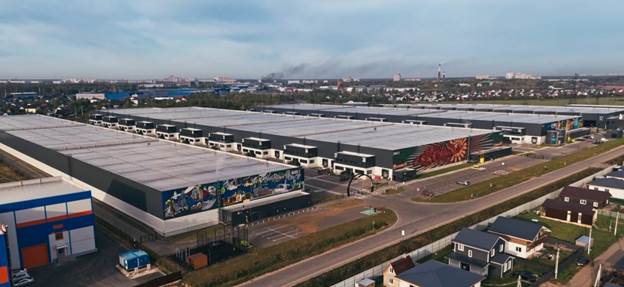
Fig. 1. ICPark "Koledino", triptych "Flight of Progress", 2024-2025, murals, total area 2,540 m2, Moscow region, Podolsk, micr. Klimovsk, Kommunalnaya St., 44. The developer of the Holding "Construction Alliance", the author of the idea of MAKE SENSE Group. Photo of the copyright holder, Construction Alliance Holding, 2025
Thus, an industrial park is a new form of organization of production and business, but it is also an innovative socio—cultural solution for industrial clusters, where art objects perform a semantic function.
Triptych "Russian Fairy Tales" of the Esipovo-4 Industrial Park The largest and most conceptually mature project of the Construction Alliance Holding together with the MAKE SENSE Group communication agency was the triptych of murals "Russian Fairy Tales" of the Esipovo-4 industrial Park located in the Solnechnogorsk district of the Moscow region. The program of the triptych is already embedded in its name, as if illustrating the famous expression of A.S. Pushkin: "A fairy tale is a lie, but there is a hint in it, a lesson for good fellows" ("The Tale of the Golden Cockerel"). The concept of the program is a person, his work, which is capable of transforming the world. It is through the prism of handicraft work and traditional cultural values that the fairy-tale characters of the triptych are comprehended, among whom the literary hero Lefty finds his place. Murals do not illustrate fairy-tale texts, which is quite common. They interpret fairy-tale and literary heroes as bearers of traditional values that have not lost their relevance today. Moreover, fairy-tale images are interpreted quite freely, based on folklore, author's and literary interpretations, replicas of popular culture, and cinema. In murals, they are carefully selected and recoded, as traditional images receive a new meaning, while retaining their value base. Thus, the authors manage to show the connection of times and, ultimately, to comprehend industrial progress in a single timeline. The first appeal to the fairy-tale character is associated with the mural of 2025. "Firebird" ICP "Koledino" (Podolsk). This mural by artist S. G. Perevozchikova is central to the triptych "Flight of Progress". At the same time, he differs from the other two in his compositional closeness (in terms of the number of characters) and symbolism. It is these two qualities — clarity of form and depth of content — that have revealed the enormous potential of the fairy tale, its ability to speak about complex things simply and fascinatingly. The firebird turns from a mythical character into a complex symbol that combines traditional meanings - another world, magic, curiosity, miracle — and modern values that are far from fairy tales — technological progress, creativity, national identity, and a dialogue of cultures. Visually, we recognize the Russian foundations of this mural through the image of a fiery bird, the intricate pattern of the ornament, and the activity of the golden-red palette (Fig. 2).
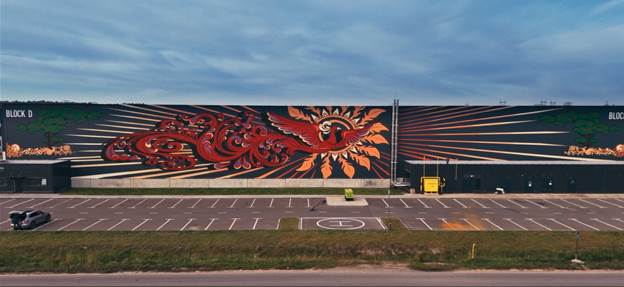
Fig. 2. Perevozchikova S. G. "Firebird", part of the triptych "Flight of Progress", 2025, mural, aerosol paints, rubber paint, ICPark "Koledino", Moscow region, Podolsk, micr. Klimovsk, Kommunalnaya St., 44. The developer of the Holding "Construction Alliance", the author of the idea of MAKE SENSE Group. Photo of the copyright holder, Construction Alliance Holding, 2025
It is this recognizability, the "Russianness" of the fairy-tale character that makes him attractive to the mass audience. One may not know the Old Slavonic fonts, have no idea about the world tree, and not recognize the magical meanings of color; however, everyone knows the attractive power of the Firebird, which everyone wanted to possess. The Firebird is an image of a cherished, often unattainable dream. Depending on the context, this image is concretized, acquiring certain functions: a guiding star, miraculous help, spiritual power, a guide in space and time. This image combines visual beauty, a sign of national identity, magical power and self-belief. Thus, the image, abandoning traditional meanings, acquires new meanings in the context of modernity. The triptych "Russian Fairy Tales" includes the following compositions: "Threads of Time", "The Mystery of Buyan Island" and "The Wisdom of craft" (Fig. 3).
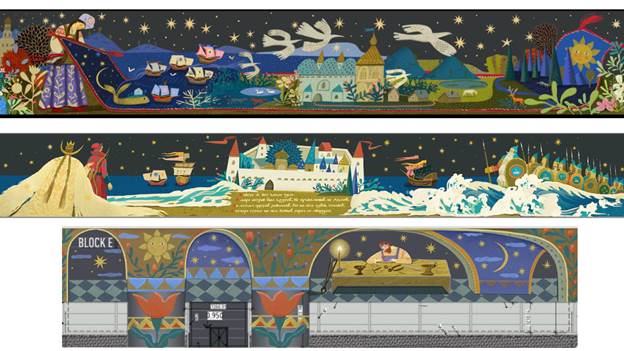
3. "Russian fairy tales", sketches of a triptych of murals for ICPark "Esipovo-4", 2025. The author of the idea of MAKE SENSE Group, artist N. V. Ignatova. Photo of the copyright holder, Construction Alliance Holding, 2025
The first two murals are fabulous, because their imagery is based on folk and author's fairy tales: "The Frog Princess" (SUS 402), "The Beautiful Wife (Go I don't know where)" (SUS 465A), "Wonderful Children" (SUS 707) in Pushkin's poetic interpretation of "The Tale of the Tsar Saltan, about his son, the glorious and mighty hero Prince Guidon Saltanovich, and about the beautiful princess Swan." It should be noted that fairy tales are not illustrated, the eventfulness in murals is minimized. In addition, the authors of the idea and artists of the MAKE SENSE Group communication agency rely not on authentic folklore images, but on the author's interpretation: a literary fairy tale, film adaptations, modern stereotypes. Thus, in addition to folklore meanings, there are others peculiar to the time of different authors, including the authors of murals. This is clearly visible in the third mural, "The Wisdom of Craft." It is based on the image of a Lefty from the novel by N. S. Leskov "The Tale of the Tula Oblique Lefty and the Steel Flea". However, both the image itself, which is generalized and abstract, and its fixation in the national memory through specific qualities - hard work, ingenuity, humor, love for the Fatherland — turn the plot and Lefty himself into a symbol where the visual image and meanings merge together. Moreover, the image of Lefty is completely replaced by the image of another legendary character — Danila, the master from P. Bazhov's fairy tales "The Stone Flower", "The Mountain Master" and "The Fragile Twig". But if Lefty is a generalized hero, then Danila the master had a real prototype — Danila Kondratievich Zverev. And then the legend takes on very specific, vital forms. The image of the hero serves as "the embodiment of the subtlety of work, ingenuity and immense respect for the cause, which is done not for the sake of fame, but at the behest of the heart and conscience" (based on the internal documents of the Holding). In all three murals, the idea of the greatness of a man of work and his skill is revealed. Each character reveals this conceptual core of the triptych in his own way. In "Threads of Time," a girl skillfully weaves a carpet that comes to life in her hands. In "The Mystery of Buyan Island," the characters — Prince Guidon and Princess Swan — admire the wonderful city that appeared on the island, like a dream come true. Finally, the mural "The Wisdom of Craft" shows a hero who works miracles with his work, confirming us in the idea that the miracle of transformation depends on the person himself, his skill and diligence. Central to the triptych is the mural "The Secret of Buyan Island", based on Pushkin's "The Tale of Tsar Saltan" (Fig. 4).
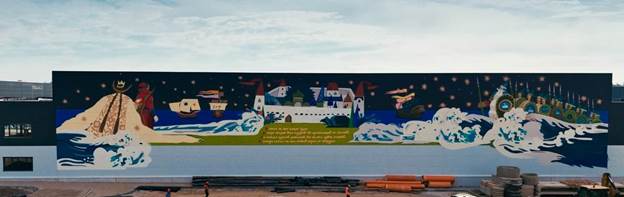
4. Ignatova N. V. "The Secret of Buyan Island", triptych "Russian fairy tales", 2025, mural, aerosol paints, rubber paint, 6040 x 1168 cm (705 m2), ICPark "Esipovo-4", Moscow region, Solnechnogorsk, village of Lozhki, Esipovo Industrial Park, d 17a/1. The developer is the Construction Alliance Holding, the author of the idea of MAKE SENSE Group. Photo of the copyright holder, Construction Alliance Holding, 2025
The literary work is based on the folklore text "Wonderful Children", however, the author took only one plot move: the queen and her youngest son were thrown into the sea by slander, the wonderful child grows by leaps and bounds, at his request the sea throws a barrel on the island of Buyan, where the tsarevich saves the Swan princess from the magician, after which Virgo creates a city in gratitude. Then she presents him with wonderful curiosities: a squirrel nibbling golden nuts with emerald kernels and singing songs, a wonderful patrol of sea knights. The fact that virgo is a representative of another world is indisputable, but the prince is not an ordinary person either: he is a warrior capable of killing a sorcerer, he is able to take power in the city, he rules wisely and honestly, punishes opponents not very seriously, but significantly. But most importantly, he is a collector: he collects curiosities (a squirrel, sea knights and the Swan princess herself), he gathers a family - he calls his father to him. He is a fighter for the truth – the story of forever must be known. And the island of Buyan itself is also a kind of other space — an ideal country where "Everyone on that island is rich, / There is plenty, everywhere there are chambers." The developer was attracted by the idea, first of all, of Buyan Island as a special place — a place of power, and the city that appeared on it out of nowhere, which became a symbol of justice and prosperity. Conceptually, a Brawler is not only a bearer of certain values, or values related to him, but it is the personification of the very idea of an Industrial City. In this regard, a fragment of the text by A. S. Pushkin is integrated into the mural "The island was steep in the sea, / Not a halt, not a dwelling ...". The idea of transforming life and the world is transmitted through the mural. However, in addition to the wonderful city, some fairy-tale characters appear in the composition: Swan Princess, Prince Guidon, Chernomor and 33 heroes. Moreover, there are no negative characters, as well as Tsar Saltan. The selection of fairy-tale characters is clearly dictated not only by the text, but, above all, by the concept of the Holding. It's about a city, a dream city. The rest of the characters only explain and complement this story.
The mural "Threads of Time" is filled with complex associative connections. The title immediately takes the viewer away from the fabulous prototypes into the realm of meanings and symbols. The composition presents a panorama of a wonderful city surrounded by forests, lakes, meadows and mountains, reminding everyone of the well-known saying: "Beyond the mountains, beyond the forests, Beyond the wide seas..." (the beginning of the fairy tale "The Hunchback Horse" by P. P. Yershov). It is only after examining the panorama that we notice that we are actually looking at a carpet, the pattern of which has become voluminous and come to life. On the left side, the girl holds a carpet. The prototype can be either a Frog Princess or a Mary Princess [25, 16] (Fig. 5).
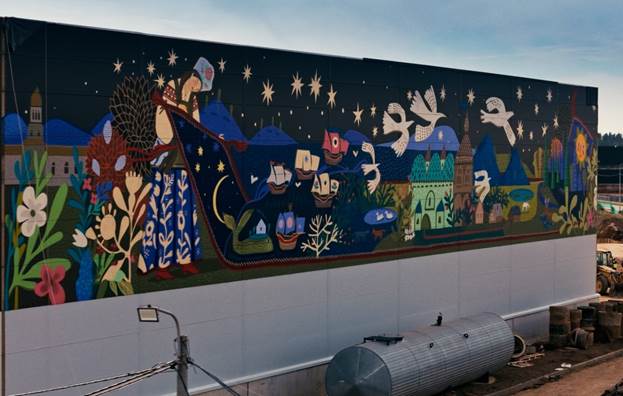
5. Ignatova N. V. "Threads of time", triptych "Russian fairy tales", 2025, mural, aerosol paints, rubber paint, 4840 x 1168 cm (565 m2), ICPark "Esipovo-4", Moscow region, Solnechnogorsk, village of Lozhki, Esipovo Industrial Park, 17a/1. The developer is the Construction Alliance Holding, the author of the idea of MAKE SENSE Group. Photo of the copyright holder, Construction Alliance Holding, 2025
It should be noted that, as in the case of the "Mystery of Buyan Island", this mural is not illustrative and refers to the authentic material not directly, but through later replicas. However, this is not a whim of the authors of the mural, but an established tradition. Thus, the index of fairy tales records more than 30 variants of "The Frog Princess" (SUS 402). However, for non-specialists, the main version of this tale is texts from the collection of A. N. Afanasyev that have been revised for children's reading (Afanasyev A. N. Folk Russian Tales: in 3 volumes, vol. 2. Moscow, 1985, No. 267-269). The formation of the canon of this type of story was influenced by the fabulous illustration of the late 19th and early 20th centuries. First of all, it is the design of a book of fairy tales for an Expedition to procure government papers. The first sketches for this fairy tale were created by I. Ya. Bilibin in 1898, and the entire series of fairy tales was published in 1901. In addition to book illustrations, the visual canon of the image of the Frog Princess was influenced by Russian cinema. In 1939, the film directed by A. Rowe "Vasilisa the Beautiful" was released, where Valentina Sorogorskaya played the role of the Frog Princess. In 1954, Mikhail Tsekhanovsky shot the cartoon "The Frog Princess". It was the making of the carpet in the animated film that influenced the fairy-tale canon in the second half of the twentieth century. Since a folklore tale does not describe the objective world [26, 35], we can only guess which carpet the frog princess created. In this case, the author's works form more vivid images. However, in any case, the wonderfulness of the carpet is important. It is made by a virgo from the "other" world, who possesses extraordinary abilities. The carpet is also wonderful because it was made overnight. For a fairy tale, this is one of the forms of realization of the motive of the wonderful, fabulous. However, in modern society, fairy-tale images are not realized directly, but with additional associations associated with rethinking specific motives. In the case of the mural, the heroine's work skills can be considered as a kind of form of technological progress, allowing her to create a special thing that differs from others in beauty and quality. The fairy tale "The Beautiful Wife (Go I don't know where)" (SUS 465A) has more than 70 variants of this plot type. The tale is mostly known for its arrangement by A. N. Tolstoy. In 1966, the cartoon I. P. Ivanov-Vano was released, made in a puppet and swing technique. The script was written by N. R. Erdman in the style of raeshny verse. The cartoon is a comedic adaptation of a folk tale. In 1987 The magazine Yunost published a play in poetry by L. Filatov "About Fedot the Sagittarius, a Dashing Fellow," which became extremely popular. It was she who formed the canon of this tale for popular culture (note that the plot scheme in most cases coincides with folklore, although the plot itself is filled with many details and images peculiar to the author's literature). Many performances were staged based on this work, and in 2001 S. Ovcharov's full-length film "The Tale of Fedot the Sagittarius" was released, which deviated greatly from the original source. It did not become popular, as did the 2008 cartoon directed by Lyudmila Steblyanko at the Mill Studio. Despite these failures, the plot of the fairy tale, even in the author's version, is well known to Russian society, and wonderful curiosities are easily identified. First of all, we are talking about a wonderful carpet, the manufacture of which is one of the difficult tasks assigned to Fedot the Sagittarius by the tsar. There is a stereotype of this wonderful carpet: it depicts the whole country, it is a kind of map of the state. Of course, for cinematographers, the carpet turns into a living map, and it is this image that is fixed in popular culture. Thus, the carpet from the fairy tale "The Frog Princess" is an example of the magical art of the heroine, and the carpet from the fairy tale "Go there, I don't know where" is also recognized as a wonderful curiosity, since in some versions of the fairy tale the heroine does not create it, but obtains it with the help of wonderful servants. In addition, under the influence of the author's texts, the carpet in both story types acquires additional features (carpet map): and if in M. Tsekhanovsky's cartoon the carpet depicts a river, a ship sailing along it and several buildings, then L. Filatov's carpet is described as a map of "The whole Race in full / It's reflected on the carpet." This kind of mobility in understanding fairy-tale characters and attributes gives freedom to their modern interpretations. In particular, the mural "Threads of Time" has the following metaphorical meaning: "Russian craftsmen weave "threads of fate", turning them into patterns of life and legends" (based on internal documents of the Construction Alliance Holding). That is, the carpet is understood not as space, but as space-time, as life in its dynamics, as the connection of generations. The triptych reveals the idea of progress, which should result in the emergence of a wonderful city where everyone will find happiness. It somewhat resembles a utopia close to the idea of Belovodye [19], with the difference that the city that Stroy Alliance creates is not a place of prosperity and absolute justice. It is a space for a person's self-realization and creative potential. The appeal to fairy-tale characters and plots makes it possible to pave the way from the past to the future, to justify one's position on the basis of common cultural traditions and historical continuity.
Conclusion
The main results of the study are related to the identification of the relationship between artistic images (fairy-tale characters), their initial semantic load and modern interpretation. We have proved that the use of the murals language is largely dictated by the developer's desire to "find his own code for industrial and cultural territories" (from an interview with the authors of Artyom Petrukhin, partner of the Construction Alliance Holding). On the one hand, we are talking about corporate policy, but at the same time this fact can be interpreted as an attempt to form a new culture — a culture of Industrial parks, understood "as hyperlocal spaces for life and work" (from an interview with Artem Petrukhin, partner of the Construction Alliance Holding). In this case, we are talking about creating a cultural code. The translator of this cultural code is the murals, which, on the one hand, brand the territory, and with it the Construction Alliance Holding; on the other, visualize the values of the created culture of industrial parks through recognizable characters. We have established the principle of choosing plots and characters: the personification of values that are close to the concept of an industrial park, the possibility of expanding the semantic field of figurative plot motifs and their free arrangement. This explains the appeal to the Russian folk tale, as well as the author's fairy tale, in some cases to literary plots and characters. In all these cases, regardless of the folk or author's origin of the material, the popularity of selected characters is observed, their entry into the popular consciousness as "their own". An important result of the research was the identification of the features of the artistic language of working with authentic material. We have identified several techniques that are more typical of design, which is due to the borderline nature of the analyzed objects. First of all, it is a compositional collage, i.e. the combination of heterogeneous replicated objects in one composition, united conceptually and forming new meanings. We also identified an appeal to the technique of replica — the repetition of objects, stylistically close, but with elements of the author's interpretation. When transferring an image with a change of medium (art form, way of living in space and / or material), we can talk about an intermediate remake, and in some cases, a remix. Examples are literary and ethnographic images (literary text), illustrations (artistic text), and monumental replicas of fragments of illustrations (murals of the Stroy Alliance Holding). Thus, we can talk about the birth of a new phenomenon — the industrial park mural, which connects the past, present and future, translates life—creating meanings, and symbolizes modern values.
The article is published in the version approved by the reviewers (after receiving a positive review recommending the manuscript for publication) with corrections made by the author (after receiving the editor’s comments, if any).
Read all reviews on this article
References
1. Vilchinskaya-Butenko, M. E. (2022). Visualization modes of urban art: street art vs public art. Bulletin of Tomsk State University. Cultural Studies and Art History, 47, 18-34. https://doi.org/10.17223/22220836/47/2 EDN: IXMKNU
2. Kuzovenkova, Y. A. (2024). Discursive formation of "street wave" art in Russia. Yaroslavl Pedagogical Bulletin, 3, 192-200. https://doi.org/10.20323/1813-145X-2024-3-138-192 EDN: QPYGNT
3. Aesthetics of street art. (2018). St. Petersburg: St. Petersburg State University of Technology and Design.
4. Goncharova, N. G. (2021). Street art in the contemporary urban environment: a new form of monumental painting. Academic Bulletin of UralNIIPROJECT RAASN, 1, 64-69. https://doi.org/10.25628/UNIIP.2021.48.1.011 EDN: SIRXXY
5. Maevskaya, M. (2022). Murals as a key form of street art in the architecture of the city of the 21st century. In Proceedings of the 8th International Conference on Arts, Design and Contemporary Education (ICADCE 2022) (pp. 5-11). Amsterdam: Athena Publishing.
6. Evans, G. L. (2025). Graffiti, street art and ambivalence. Humanities, 14, 90-114.
7. Tremblin, M. (2024). Affect and effect of overpainting at the age of neo-muralism. SAUC-Street Art and Urban Creativity (repository), 10(1), 98-123.
8. Mendelson-Shwartz, E., & Mualam, N. (2024). Murals and the city: A comparative perspective on practices, policies, and regulations (1st ed.). New York: Routledge.
9. Maevskaya, M. E. (2023). Strategies for the legalization of street art in the space of Russian cities in the context of international experience: Positive and negative practices. Modern Architecture of the World, 2(21), 111-132. https://doi.org/10.25995/NIITIAG.2023.21.2.005 EDN: DPJVHA
10. Musabekova, L., & Espenova, A. (2023). Contemporary art in the meta-space. Central Asian Journal of Art Studies, 8(4), 163-178.
11. Abram, S. (2024). Graffiti, street art and murals in the age of the neoliberal city: The muralization of capital. Street Art & Urban Creativity, 10(2), 40-53. https://doi.org/10.25765/sauc.v10i1.918 EDN: EDAARS
12. Forte, F., & De Paola, P. (2019). How can street art have economic value? Sustainability, 11, 580-591.
13. Wang, Y., & Wu, X. (2023). Current progress on murals: distribution, conservation and utilization. Heritage Science, 11, 61-75. https://doi.org/10.1186/s40494-023-00904-9 EDN: PUQCMH
14. Yibin, H. (2024). Conflict and fusion between graffiti mural and public space. Humanities and Social Science Research, 7(3), 86-98. https://doi.org/10.30560/hssr.v7n3p86 EDN: QQASVD
15. Rahman, F., Rahman, N., Shafique, A., Ahad, A., & Shukla, A. (2025). Urban regeneration and heritage tourism: A bibliometric analysis over three decades. International Journal of Research and Innovation in Social Science, IX, 4239-4262.
16. Korepova, K. E. (1980). The plot of "Tsarevna-Lyagushka" in the East Slavic fairy tale tradition. In Questions of plot and composition (pp. 97-112). Gorky: Gorky State University.
17. Comparative index of plots: East Slavic fairy tale (SUS). (1979). Leningrad: Nauka.
18. Afanasyeva, N. V. (2024). Visual culture as a space for the formation and representation of ethnocultural identity. Yaroslavl Pedagogical Bulletin, 3, 208-213. https://doi.org/10.20323/1813-145X-2024-3-138-208 EDN: TGCLBY
19. Chistov, K. V. (2003). Russian folk utopia: (genesis and functions of socio-utopian legends). St. Petersburg: Dmitry Bulanin.
20. Petrov, N. V. (2019). Local text, folklore and public art in an oil mono-city: Almetyevsk. In Folklore and anthropology of the city (Vol. II, No. 3-4, pp. 74-105). EDN: CTYOZC
21. Fialkova, L. (2010). Applied use of folklore. Anthropological Forum, 13, 147-176. EDN: NLQNZV
22. Tuchina, O. R. (2025). Contemporary urban space: sociocultural analysis. Yaroslavl Pedagogical Bulletin, 2, 224-231. https://doi.org/10.20323/1813-145X-2025-2-143-224 EDN: EEFOJF
23. Varakina, G. V. (2025). Intermedial discourse in architecture: the phenomenon of self-replication (based on the material of urban development of small towns in Central Russia in the second half of the 19th-early 20th centuries). In Interdisciplinary research in the humanities: mediality, intermediality and postmediality in culture and art (pp. 9-14). Moscow: FGBOU VO "Russian State University named after A. N. Kosygin (Technologies. Design. Art)".
24. Varakina, G. V., Perevolochanskaya, S. N., Azarova, V. V., & Dobrovolskaya, V. E. (2022). Iconology and comparativism: interdisciplinary discourse. Herald of Slavic Cultures, 4(66), 320-332. https://doi.org/10.37816/2073-9567-2022-66-320-332 EDN: DOXCAU
25. Dobrovolskaya, V. E. (2001). The heroine of the Russian fairy tale (issues of mythological genesis and character evolution). In Folklore of the peoples of Russia: Folklore. Myth. Literature (pp. 53-65). Ufa: Bashkir University.
26. Dobrovolskaya, V. E. (2009). Material realities of the Russian fairy tale. Moscow: GRTsRF.
|





 © 1998 – 2026 Nota Bene. Publishing Technologies. NB-Media Ltd.


