Culture and Art
Reference:
Sadovina, V.P. (2026). The Theater of Moving Sculpture in the Era of Historical Avant-Garde. Culture and Art, 2, 230–252. https://doi.org/10.7256/2454-0625.2026.2.76992


|
Library
|
Your profile |
 This work is licensed under a Creative Commons Attribution-NonCommercial 4.0 International License.
|
Culture and Art
Reference:
Sadovina, V.P. (2026). The Theater of Moving Sculpture in the Era of Historical Avant-Garde. Culture and Art, 2, 230–252. https://doi.org/10.7256/2454-0625.2026.2.76992
The Theater of Moving Sculpture in the Era of Historical Avant-Garde
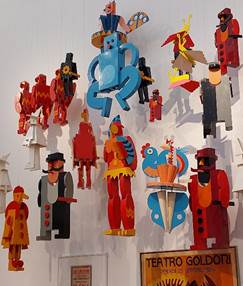
DOI: 10.7256/2454-0625.2026.2.76992EDN: NLLHKQReceived: 11/28/2025Published: 03/03/2026Abstract: The article explores the phenomenon of marionettes and the practice of their use in realizing the avant-garde ideas of the early 20th century aimed at creating an all-encomassing work of art that would blur the boundaries between art and life. The research focuses on the creative practices of Italian Futurists, Swiss Dadaists, the Bauhaus School, and artists of the Russian diaspora and the young Soviet Union, all of whom shared an interest in the marionette as a self-contained piece of art with a different potential for constructing a new art. This interest resonated with the ideas of innovative theatre directors who advocated replacing live actors with puppet performers, as well as with the evolving societal attitude toward the world of childhood, since children viewed life's events from a different perspective and perceived in them the possibility for social change. The selected corpus of works is analysed with respect to the quality of execution and preservation, development and transformation of the avant-garde aesthetics of the first third of the 20th century. The article further examines the influence of Soviet Russia's ideological program on shaping a new "standard" for a marionette. The findings suggest that the Futurists and Dadaists almost simultaneously took a step toward constructing an abstract marionette form grounded in geometry, elements of Cubism and the "mechanical" movement of the puppet. The Bauhaus School introduced additional constructivist elements into its models drawing on the school's experiments in "mechanical" and spatial ballets. However, most marionettes created by various artistic associations were not devoid of figuration; the artists did not seek to replace imagery with symbolism. In post-revolutionary Russia the images of marionettes in puppet theatres had to be readily understood by audiences, prompting artists to emphasize expressiveness, sculptural qualities, and realism while allowing certain elements of the grotesque to convey the content of the play clearly. Therefore, it is only natural that the innovative ideas of individual masters did not receive a proper response and remained largely unappreciated. Keywords: avant-garde, futurism, sculpture of the twentieth century, marionettes, Puppet theater, visual arts, avant-garde scultpure, avant-garde marionettes, Dadaism, ConstructivismThis article is automatically translated. Introduction The search for a new artistic language by the masters of the first "wave" of the European avant–garde, which was based on the rejection of traditions and positioned itself as a breakthrough into the future, covered creative platforms - from painting to cinema. On all the meridians of Europe, art groups plunged into theoretical searches for new visual systems, dressed in the forms of manifestos, "evenings" imbued with the idea of performance, and public performances. This movement leads to the emergence of a solid idea of a total work of art that can unite various artistic forms, fully involve the viewer in the presented action, thus achieving the blurring of the boundaries between art and life. The theater has become the most suitable platform for the realization of the idea, where elements of various types of creativity harmoniously combine. Avant-garde experimental projects (for example, the opera "Victory over the Sun" by M. Matyushin, K. Malevich and A. Kruchenykh (1913) and the ballet "Parade" by E. Satie and J. Cocteau (1917)) anticipated the development of theatrical performances, where the stage itself would "play", being a "plastic complex" controlled from the outside. The characters will be "plastic automatons" that move and "talk" at the expense of the actors inside or the puppets themselves. The phenomenon of the marionette did not arouse the attention of the avant-gardists by chance. Since the era of Romanticism, the doll has been interpreted as an object that stood on the border of two worlds, and combined dual categories as alive/ dead, animate/inanimate (for example, in the short stories "The Sandman", "The Automaton", in the fairy tale "The Nutcracker and the Mouse King" by E. T. Hoffman; in "The Tale of the priest and his stupid employee" by A. S. Pushkin). As Yu.M. Lotman wrote, in people's minds "two doll faces have formed: one beckons to the cozy world of childhood, the other is associated with pseudo-life, dead movement, death, pretending to be life. The first looks into the world of folklore, fairy tales, and the primitive, the second recalls machine civilization, alienation, and duality" [17, p. 379]. The innovators saw in the puppet a different potential, consonant with the aesthetics of the early avant–garde: its capabilities exceed human ones, moving, it easily overcomes the physical limitations of the laws of nature, making the impossible possible. The reason for such abilities of the puppet lies, according to G. von Kleist, in its "anti-gravity" [11, p. 515]. V. Benjamin also mentioned this in 1923, emphasizing that in puppet shows we "watch little men who, as if on tiptoe, tickle the earth, because they descend ... like angels, and are not bound by gravity like real actors" [31, p. 541]. The "mechanics" of the puppet became one of the dominant creative practices of the avant-gardists, which was consonant with the theoretical constructions of the theater director E. G. Craig. Inspired by the idea of a reform that denied naturalism in stage productions, in his essay "The Actor and the Supermarionet" (1908), Craig outlined the "model" of an actor divorced from the traditional role of "interpreter." But since the actor is "a living figure in which ... the weakness and tremor of human flesh are noticeable" [14, p. 227], the author develops a theory about a "super puppet" in which "something of genius is guessed, ... their movements–signals do not become hasty and confused", but "the body is in a state of trance ... will become clothed in the beauty of death, preserving a living spirit" [Ibid., p. 228], without trying to compete with real life in such moments. Italian futurists, "armed" with the cult of the machine, supported the idea of dehumanizing the stage and the actor. For example, in the drama Sexual Electricity (1909), F. T. Marinetti introduces two puppet characters, Professor Marriage and Mrs. Family, about whom the main character declares: "Here are the people! ...These are the symbols of everything that exists outside our world..." [41, p. 34]. The Futurists insisted on replacing the "unbearable human actors" in the theater of the future with real "gas actors" made of luminous forms that could "perfectly convey the unusual meanings of theatrical performance" [21, p. 382]. The increased interest of avant-gardists in puppet theater is also due to changes in society at the beginning of the 20th century in relation to the world of childhood. The idea of children as different from adults is reflected in the texts of Z. Freud ("Three Essays on the theory of sexuality", 1905/1911, "Analysis of the phobia of a five-year-old boy", 1908-1909), in the concept of J. Freud. Piaget on the development of a child's thinking (1921-1930s), V. Stern ("The Language of Children", 1907), in the strategy of M. Montessori ("The method of scientific pedagogy applied to the upbringing of children in orphanages", 1909). Society focused its attention on children, because they looked at life events in a different way and saw in them the potential to create a "new" world. On the other hand, the puppet theater, which was often associated with the world of children, harmoniously fit into the search for new ways of visual expression. The history of art studies is rich in works that comprehensively explore the avant-garde theatrical practices of the first third of the 20th century. Among the domestic publications, the articles of the KukArt magazine (1992-2006) stand out, where a comprehensive "revision of the doll" was carried out [20, p.15], and the doll phenomenon within the boundaries of the Russian avant-garde was also studied. Among recent foreign publications, we note the texts of the catalog of the exhibition in Reggio Emilia "Marionettes and the avant-garde. Picasso. Depero. Glue. Sarzi" (2023), whose curators conceived the idea of presenting the puppet as an emotional driving force capable of breaking the boundary between the stage and the world, art and life. However, with all the abundance of research material, no attempt was made to comprehend the puppet as a full–fledged work of art, in other words, as a "moving sculpture" [8, p. 75], born at the junction of two types of art - theater and sculpture. The author of the article seeks to fill this gap by setting out to trace the ways of preserving, evolving and transforming the aesthetics of the avant-garde in the image of a puppet through an analysis of the creative practices of masters of the Russian diaspora, the young country of the Soviets, Italian Futurists, Swiss Dadaists and the Bauhaus art school. The Puppets of Italian Futurism In 1915, F. Depero and J. Balla published the manifesto "Futurist Reconstruction of the Universe", which emphasized the intention to create it anew by finding "abstract equivalents of all forms and elements of the Universe" [1, p. 371]. Metal animals and mechanical creatures should become inhabitants of the renewed world, and futuristic toys will be designed for entertainment and development of the "creative impulse" of children and adults. Balla directed his interest towards the construction of the environment, and Depero turned to the topic of anthropomorphic innovative puppet figures. He started with a series of wooden toys (1917), constructed from cones, cylinders, cubes, in 1918. Depero created a group of marionettes for the musical performance "Plastic Dances" at the Teatro dei Piccoli ("Theater of the Little Ones") named after the actors of the puppet theater and the children's audience for which the theater was originally designed (Rome) by V. Podrecchi. In the doll models ("Clowns", "Man with a Mustache", "Savages", "Shadows", etc.) (Fig. 1), the previously used construction techniques are repeated, but without the attraction to asymmetry. The characters of the extremely simplified forms varied in height (85 or 30 cm), but the effect on the viewer was not their height, but the control mechanics, i.e. movement.
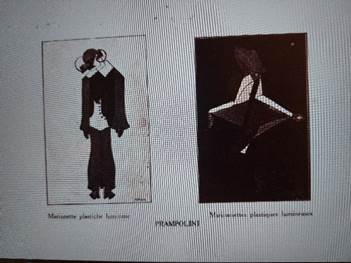
1. The puppets of the play "I Balli Plastici" (reconstruction). 1918. Wood, paint. Different sizes. Museum of Modern Art of Trento and Rovereto. Source: Photo of the author In five episodes of the show, obeying the rhythm of the moderately innovative music of J. F. Malipiero, A. Casella, B. Bartok, J. Tiritt, colorful characters performed repetitive mechanical movements like robots, sometimes clumsy and grotesque. The following fragment vividly describes the mechanics of the movements in the "Savages" dance: "... a wild dance began between groups of red and black savages above and below on the stage.... They wanted to fight for possession of the Great Savage, so they lined up against each other and staged a ballet duel.... The great Savage bared her belly, and in it a silvery savage baby performed a complex minuet..." [32, p. 3]. The perception of marionettes by art critics and theater figures is of interest. For example, E. Craig criticized Depero's work in "The Marionette to-night", comparing his dolls "to crude "toys"" [44, p. 33]. V. Cardarelli's essay is filled with negativity towards puppets: "stylized ... dolls with creaking joints and stiff limbs" [35, n. p.]. An objective comment by J.L. Piccardi on the style of the dolls was made on the pages of L'IDEA Nazionale (April 17, 1918), where it was noted that they were "made according to the canons of Cubism - based on the articulation of geometric bodies and lines." E. Prampolini responded to the proposal of the French poet P. Albert-Biro to make dolls for the drama "Matum and Tevibar" (1919). Combining and reworking, but not repeating the techniques of his colleagues, the master created "luminous plastic puppets" [47, p. 30]. The surviving sketches [39, p. 348] and photographs (Fig. 2) indicate that, working with the doll, mechanics and color, the futurist shifted the focus of attention to constructing the abstract form of the actor-puppet.
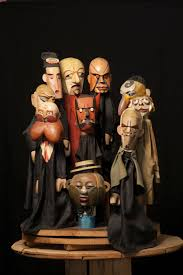
2. Enrico Prampolini. Sketches of "glowing plastic puppets". 1918. Source: Prampolini E. Scenodinamica futurista. Noi, Anno I–II Serie, Numero speciale "Teatro e la Scena Futurista", 1924. P. 30. J. Liszt, describing the innovative features of the characters [40, p. 88], noted that the "Doctor" had binoculars instead of eyes, the head of the "Matum" was represented as a transparent skull with an incandescent light bulb, and the wings, hidden in a membrane shell, opened when the hands moved upward. An umbrella served as part of the "Lady's" torso, covering the figure as a protective shield. In the early 1920s, the master once again turned to creating dolls for performances, now at Cabaret del Diavolo. However, if the W. Podrecki theater encouraged the audience to watch the moving geometric shapes, then the owner of the cabaret, J. Gori trusted more the "grotesque expressionism" of the dolls, who were able to "imitate real, living people" with their figures [36, p. 195]. Following the wishes of the customer, Prampolini slightly departs from the ideals of futurist aesthetics and carves twelve "fantocci" (according to the traditional Italian terminology "fantoccio" – the so-called petrushka doll, i.e. a doll worn on the actor's arm, which lacks additional controls) in height from 20 to 50 cm for short satirical performances. "for the spite of the day." The dolls depicting political figures of that time are made in a grotesquely realistic manner with sufficient portrait similarity. In addition to the political characters (B. Mussolini, King Vittorio Emanuele III, etc.), the group of petrushkas contains allegorical images - "The Red Devil", "Fascism" and "Peace" (Fig. 3).
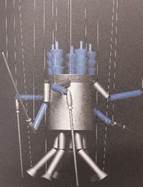
3. Enrico Prampolini. Twelve fantocci. Ca.1922. Wood, paint. Different sizes. Collection of Elisabetta Bagliani, Italy. Source: Il tempo del Futurismo / A cura di Gabriela Simongini. Roma: Treccani, 2024. P. 319 The first character, according to R. Orizio, embodies communism [46, n. p.] – a symbol of the bloody political clashes of the "right" and "left" in Italy (1919-1920), accompanied by strikes and rallies. The master conveyed the idea in the image of a sly, grinning type with horns and empty eye sockets. The allegory of the "World" is also recognizable, for the sake of clarity, the futurist depicted it as round as the globe of a bourgeois in a boater hat and bow tie. At the same time, the character serves as a caricature of the liberal newspaper Il Mondo [34, p. 54], one of the last independent political publications liquidated by the Mussolini regime in 1926. The Dada Puppets E. Craig's innovative idea of a "super-puppet" aroused keen interest among Dadaists. In the presence of manifestos, but in the absence of a clear artistic program, the participants relied on active communication with the audience, which was easily achievable in the theater. In the mid-1910s, the director of the Zurich Museum of Arts and Crafts, A. Alterr, conceived the idea of creating a puppet theater "free from traditional theatrical conventions, where abstraction would be the only acceptable form for expressing ideas" [42, p. 44]. During the preparation of the Werkbund exhibition, he selected two teachers from the School of Arts and Crafts, O. Morakh and S. Teiber, to perform two puppet shows. In this article, we will focus in detail on the artistic solution of S. Toiber for the play by C. Gozzi "The Stag King" (1918). The story of King Deramo, desperate to find a bride, is presented through the prism of Z.'s theory of psychoanalysis. Freud in the form of a comic musical parody featuring seventeen puppets. And here the ambivalence of the puppet came into play as well as possible and gave the plot a special appeal. The master herself was well acquainted with Freudian theory, and her experience of participating [45, n. p.] in Rudolf von Laban's innovative "expressive" dances at the Voltaire cabaret was useful in developing an approach to the movement of dolls capable of expressing the full range of emotions. S. Toiber's puppets are stylized figurines detached from figurativeness, combining geometry, collage and color. Each doll consists of compositionally matched and vertically articulated spheres, cones and cylinders. They exchange energy with decorative materials (feathers, brass details, lace), emphasizing the individual characteristics of the characters (gender, character or status). Delicately using patterns, the master worked out the faces of the characters, emphasizing the nature of the emotions experienced. For example, the Freud Analyst puppet resembles a pyramid toy, it is assembled from repeating multi-colored cylinders and washers, not located close together, but connected on hinges according to the "garland" principle. The doll's arms are disproportionately long and her legs are short. Her only decoration is a kind of crown, which, perhaps, the master wanted to mark the "stardom" of the founder of psychoanalysis. The image of the companion of "Freud the Analyst" - "Dr. Oedipus Complex" – echoes the image of the first one: a similar pyramid, but truncated, consists of red-yellow cones strung on top of each other, instead of hands – details shaped like pencils. The most effective character is "The Guardian", he is saturated with excessive generalization and mechanistic (Fig. 4).
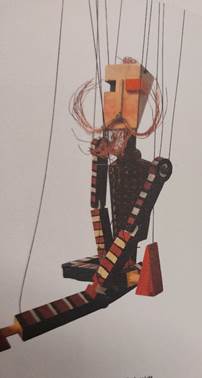
Fig.4. The Guardian (reconstruction). 2015-2016. Wood, paint. Height 180 cm. The Fendi Archive, Rome. Source: Marionette e Avanguardia / A cura di James M. Bradburne. Reggio Emilia: Corraini, 2023. P. 236. The image resembles a rotating "mindless robot automaton" [38, p. 59], consisting of a cylindrical torso, five legs and arms with sharp swords. The head is replaced by a group of inverted and towering cones. According to the idea of the play, the puppet embodies the image of censorship [28, p. 140] in psychoanalysis, in other words, the force separating the conscious and the unconscious. The idea of the coming kingdom of machines is enhanced by the use of silver paint, which is covered with a puppet. Objectively speaking, The Guardian is one of the first abstract puppets in the history of the creative practices of the European avant–garde. After the premiere in September 1918, the theater was closed due to the Spanish flu pandemic in Europe. However, S. Teiber's puppets were not forgotten. For example, in some Dadaist performances, "several puppets and curious painted cardboard masks recited Arp's poems" [33, pp. 39-44]. On October 08, 1919, the Dadaist magazine Der Zeltweg published a group photograph of all the puppets and an enthusiastic review of the created images and the quality of their performance. The Puppets of the Bauhaus School The German Bauhaus art school, as A. Tarkhanov wrote, was "a great nomadic theater" [19, p. 48], which endowed the world with a galaxy of talented masters. Adopting V. Kandinsky's idea of "a scenic composition that will be the first work of monumental art" [10, p. 131], the Bauhaus theater workshop most vividly manifested itself in creating a total theater during the years of O. Schlemmer's leadership. V. Gropius noted that the main task was to interpret the space that Schlemmer "perceived not only by sight, but also by the whole body, the sense of touch of the actor and the dancer" [37, p. 8]. However, an actor/dancer dressed in a costume was not ready to overcome the law of gravity, and the idea of an artificial human figure ready to "perform any movement and stand in any position" became relevant again [48, p. 29]. In addition, the idea fit into the agenda of creating a New person – a prototype of a new industrial, technological and urban culture. O. Schlemmer saw the development of the relationship between the actor and the stage in three directions: "man + machine", "man-machine" and "man at the control panel". The set topics for the search led to the creation in 1923 of the theater of "mechanical eccentricity", where "the concentration of scenic action in its purest form" takes place [43, p. 52]. However, the experiments of the "mechanical" theater were mostly related to set design and dance ("Mechanical Ballet" by K. Schmidt, F. V. Bogler and G. Telscher (1923), "Circus", "Behemoth" by A. Shavinsky (1924)). Although plays featuring marionettes were not widely distributed in the Bauhaus, K. Schmidt's production "The Adventures of the Little Hunchback" (1923) firmly occupied a place in the history of avant-garde art. The puppet play is based on a fairy tale from the collection "One Thousand and One Nights" about the clash of cowardice and fear of the heroes responsible for the murder of the hunchback buffoon, with the miracle of his fabulous revival. K. Schmidt's puppets, made by T. Hergt, are stylistically divided into two categories: the Hunchback, the Tailor, the Tailor's Wife, and the Merchant are made in the "naive" style, and the Doctor, his Servant, the Executioner, and the Crier are made in the constructivist style. The first group of more anthropomorphic dolls is assembled from rounded multicolored details, which makes it easy for the eye to glide over them. The characters' psychology is evident in their facial expressions. For example, the characteristics of the "Tailor's Wife" emphasize her grumpy nature: an evil grin, disheveled hair, long nails replace pupils. In addition, compared to her husband, a tailor, she has impressive volumes. The Hunchback is perhaps the most technically complex doll: there is a hidden mechanism in the head that allows the puppet to open and close its mouth and move its eyes. The "Tailor" (fig. 5) is more capable of imitating human movements than others. Thanks to the numerous hinges, the doll is able to sit with one leg bent and placed on the other.
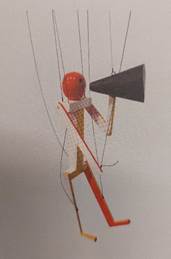
Fig. 5. Kurt Schmidt. The tailor. 1923. Wood, paint, various materials. 40x11x5 cm. Private collection Source: Marionette e Avanguardia / A cura di James M. Bradburne. Reggio Emilia: Corraini, 2023. P. 250. In the "Doctor" and the rest of the dolls of the second group, the intonations of constructivism are felt, the figures consist of squares, rectangles, rulers, rings of red, black, white and silver colors connected by hinges, fragmentary there is a "trace" of industry – spiral and wire elements. All puppets are designed for frontal perception, and when viewed from the side, they are of no visual interest, as they appear colorless, narrow and devoid of volume. The design of the "Doctor's Servant" echoes the costumes for the "Mechanical Ballet", it is based on geometry and design, thanks to them it is clear that the viewer is a servant: the doll is able to bow to the floor, and its disproportionately long arms will reliably take care of you. The simplest structures are the "Herald" (Fig. 6) and the "Executioner" – an example of basic human anatomy in the spirit of constructivism: a rectangular frame imitating a human torso with a spiral spine in the "Executioner", and a torso in the form of the letter "T" in the "Herald" holding a megaphone in his hand. When rotated, the doll changed color like the costumes of dancers from O. Schlemmer's ballet of spatial dance "Triad".
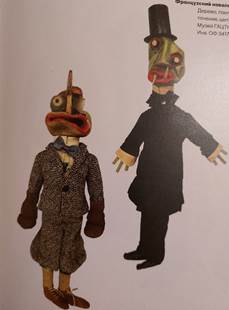
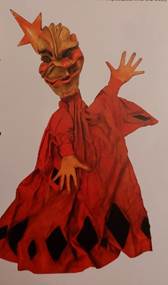
6. Kurt Schmidt. The herald. 1923. Wood, paint, various materials. 40x12x12cm. Private collection Source: Marionette e Avanguardia / A cura di James M. Bradburne. Reggio Emilia: Corraini, 2023. P. 251. Russian puppets after the October Revolution The evolution of the creation of "moving sculptures" within the boundaries of the Russian avant-garde did not occur as rapidly as the development of other types of art. The opera "Victory over the Sun", which became a kind of revolution in art, offered the audience a different image of the character in K. Malevich's costumes. As Kruchenykh recalled, "the costumes... were built cubistically.... This changed the human anatomy: the artists moved, held together and guided by the rhythm of the artist and the director" [13, p. 71]. According to E. Bobrinskaya, Malevich's characters anticipated "grotesque machine-ness ... on the theme of various automata and mechanisms" [3, p. 98], which echoed the myth of the machine cultivated by Italian futurists. Yu. Slonimskaya and N. Simonovich-Efimova, who revived "dollmaking" [5, p. 154] in Russia, remained faithful to the artistic principles when creating dolls: realism, sculpturality and expressiveness. For example, the marionettes for the famous play by Yu. Slonimsky's "The Power of Love and Magic" (1916) were designed by artists from the "World of Art" and became a kind of hymn to the passing of the modern era. The 1917 Revolution became a symbolic watershed in art. As E. Lisitsky recalled, "1918 flashed before... my eyes like a lightning bolt that split the world in two."… It was necessary to choose: here or there – there was no middle ground" (RUSAL. F. 2361. Op. 1. D. 58. L. 2). The Soviet government opened up a new perspective for culture and much had to be created anew. Regarding puppet shows, there were disagreements regarding the systems of dolls ("parsley" or marionettes), their use and repertoire. As a result, in 1919 THEO of the People's Commissariat of Education formulated the main task for the puppet theater of the Soviet country: "... educating the masses ... to implement healthy ideas" [22, p. 50], which implied the preparation of productions that would have "cultural and educational value" [Ibid., p. 50]. This formulation has decisively drawn a line towards the search for a future "standard" for the puppet. The propaganda theater, as a platform for the implementation of the ideological program, attracted craftsmen who moved with the troops and were engaged in painting propaganda trains, creating posters and mobile stands, and preparing productions. Within the framework of the article, we will focus on two members of the All–Russian Central Executive Committee's Krasny Vostok campaign train team - artist V. V. Khvostenko and sculptor N. G. Shalimov (Articles by I. V. Smekalov about the work of V. V. Khvostenko and N. G. Shalimov in the Krasny Vostok campaign train team were published in the magazine Dom Burganova. Cultural Space", 2016, No. 1 and in the catalog of the exhibition "The Way to the East. Russian Artists in Central Asia in the 1920s and 1940s" (GTG, 2025)). During the years of service in the propaganda train (1919-1921), craftsmen in the commonwealth made 70 dolls [23, p. 88], while Shalimov carved models, Khvostenko painted them, and his wife (E. A. Shpilko) helped with decorating dolls and making costumes for them. Due to straitened circumstances, the same puppets were used in several performances, given the diverse repertoire of the propaganda train.: fairy tales and fables, farce plays ("The Jealousy of Barboulier" by J. B. Moliere, "Two Chatterboxes" by I. Cervantes), satirical plays by A. P. Chekhov ("Surgery" and "Fuss") and the futurist poet V. Kamensky ("Stepan Razin"). A significant part of the repertoire consisted of didactic propaganda activities ridiculing the old regime, "praising communist clean-up days" [6], and short sketch reports on current events. The preserved visual evidence allows us to form an idea of the artistic language of the dolls that participated in the "Crown and Star" performance, which illustrated the victories of the "Petrushka the Revolutionary" over the "Hydra of Counterrevolution." The sculptural forms of the characters can be divided into two groups. In the first– there is a simplified modeling, but the faces show physiognomic features without any personification, fragments of the surface are cut at different angles, which gives geometry to the image, but without traces of cubism. This group includes "The Capitalist", "The English Diplomat" and two "Characters" who participated in several productions. The forms of the second group are filled with grotesque features and are subject to the laws of modernist plasticity. For example, "The Englishman" and "General Nikita" (Fig. 7) resemble monstrous creatures with bulging eyes and distorted mouths, the faceted surfaces of asymmetrical faces are emphasized.
Fig.7. N. G. Shalimov, V. V. Khvostenko. General Nikita. 56x49x8.5 cm. The Englishman. 60x90x8 cm. Wood, various materials. S. V. Obraztsov GATSTK Museum, Moscow Source: Catalog of the exhibition "The Way to the East. Russian artists in Central Asia in the 1920s and 1940s. Moscow, GTG, 2025. p. 93 Cubist generalizations can be traced in the "French Chevalier Pas de Troyes", whose head is made in the form of a silver ball. The most unusual way is "Parsley": "there is a red star on the head, the mouth is ugly... the doll has a small recess for a battery, and instead of pupils there are small red light bulbs" [12, p. 34] (Fig. 8).
8. N. G. Shalimov, V. V. Khvostenko. Punch. The 1920s. Wood, various materials. 70x54x11 cm. S. V. Obraztsov GATSTK Museum, Moscow Source: Catalog of the exhibition "The Way to the East. Russian artists in Central Asia in the 1920s and 1940s. Moscow, GTG, 2025. p. 91 He was probably not the only "mechanized" doll, because at the Orenburg exhibition (1920) another sculpture was also exhibited – "... a faint resemblance of a human head, instead of the right ear there is a button from an electric bell with a wire to the place where the mouth is supposed to be..." (From the newspaper "Kommunar" (Orenburg), 06/08/1920 G.). One can't help but draw a parallel with the above-mentioned puppets of E. Prampolini for the play "Matum and Tevibar". The program for the formation of a "new" person in the post-revolutionary era influenced the creative process of creating puppets. An unprofessional viewer, as noted by E. Steiner, "who did not have the culture of vision and the ability to speculatively dress the constructivist backbone in decoratively insignificant flesh and skin" [30, p. 66], preferred the objective, that is, more understandable. The materials of the exhibition of puppet theaters in Moscow (1927) at the N. Bertram Toy Museum, where 603 objects were exhibited, are interesting [9, p. 29]. During the event, "photographs were taken of all those present ... with their dolls in their arms in order to capture the main moments from the life of Moscow's puppet theaters" [Ibid., p. 26]. Traces of the film have been lost, but based on archival evidence, it is possible to outline in general terms the picture of artistic trends in the creation of dolls of the 1920s. The masters who collaborated with such metropolitan theaters as the Efimov Theater (Moscow), the Puppet Theater Workshop at the Chamber Theater (Moscow), the Shaporina-Yakovleva Marionette Theater (Leningrad), the Smena Marionette Theater in Tver (Leningrad), and others left a mark in the history of marionette art.- Yakovleva, a pioneer of the revival of the puppet theater in Soviet Russia– recalled that by the autumn of 1918 there were no more "... and carvers, ... we had to find and improve the technique of ... making them ourselves" [29, p. 1]. Artists E. A. Kruglikova and E. A. Yanson carved dolls, and, as noted by Shaporina-Yakovleva, the latter "was a first-class carver" [Ibid., p. 1]. While working on "Circus Performance" (1919), E. A. Kruglikova carved puppets for circus acts ("Harlequin") (Fig. 9) and satirical sketches (figurines of politicians A. Briand and N. Chamberlain) (Fig. 10-11).
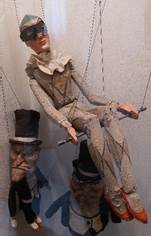
Fig. 9. E. A. Kruglikova. Harlequin. 1919. Tree. E. S. Demmeni Puppet Theater, St. Petersburg Source: Photo of the author
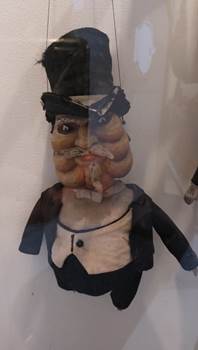
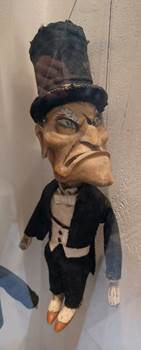
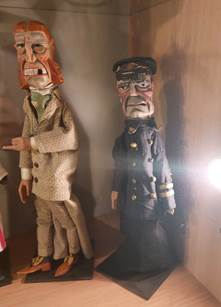
10-11. E. A. Kruglikova, A. Briand, N. Chamberlain. 1919. Tree. E. S. Demmeni Puppet Theater, St. Petersburg Source: Photo of the author The dolls are made in a realistic manner with elements of the grotesque, which is more relevant to the characters-politicians. Later, the artist came up with marionettes for the plays "Little Red Riding Hood" (1920) and "The Tale of Emelya the Fool" (1920), where "the dolls seemed to imitate a live actor, but this imitation ... made the viewer believe that they were small living creatures" [7, p. 2]. V. Solovyov, having given He gave the master's puppets a general assessment and compared them to overly refined puppets. Slonimsky, and noted significant progress, but "Russian lubok is not yet the style that should reign supreme..." [25, p. 1]. The dolls "Don Quixote", "Sancho Panza" and "Maritonna" performed by sculptor K.P. Konovalov for "Don Quixote" (1926) are realistic and expressive and resemble "foreign puppets of the modernist style of the last century" [9, p. 35]. The stylistics of the puppets for the performances "Little Black Tom" (1926) and "Squad" (1930), executed by the sculptor N. S. Rybolovlev and N. V. Tsivchinsky, respectively, attracts attention. The images of "Tom's English Master", "Captain" (Fig. 12), and "Pioneer from the Squad" (Fig.13) demonstrate the movement from carefully calibrated facial modeling to expressive dynamics, displacement, and asymmetry characteristic of Cubism. Objectively speaking, such examples of dolls are the exception rather than the rule against the general background of socialist realism that was advancing in culture by the end of the 1920s.
Fig.12. N. S. Rybolovlev. Tom's master, the Captain. 1926. Tree. E. S. Demmeni Puppet Theater, St. Petersburg Source: Photo of the author
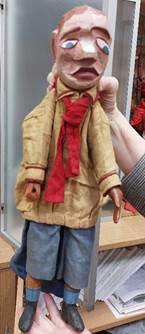
Fig.13. N. V. Tsivchinsky. A pioneer from the squad. 1930. Tree. E. S. Demmeni Puppet Theater, St. Petersburg Source: Photo of the author In 1920, within the walls of the Chamber Theater named after A. Ya. Tairov, as part of the implementation of the resolution of the Board of the Feasibility Study of the People's Commissariat of Education, a workshop was organized on the basis of a Puppet Theater Studio. Ten puppet systems were developed here, and performances with their participation were "relied on", because according to the creative team, the puppet theater was considered as "... one of the most acute types of ... art, as a spectacle of pure movement..." [26, p. 4]. Sketches and dolls were made by V. A. Favorsky, P. Ya. Pavlinov, V. A. Sokolov. Favorsky became the "father" of the puppets for the productions of "David and Goliath", "1001 nights", "Lipanyushka". The expressive "Goliath" (Fig. 14), "Baba Yaga" (Fig. 15), "The Old Man", "The Old Woman" indicate that the master did not use avant-garde techniques in his work, was not fond of "playing the engineer" [27, p.10], but remained within the boundaries of traditional sculpture. Pavel Pavlinov became the author of the models "Columbine" and "Harlequin" for the play "Harlequinade" and seven marionettes for the production based on the fairy tale by V. F. Odoevsky, made, like Favorsky's dolls, in a realistic manner.
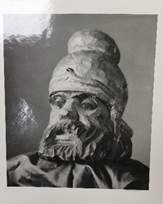
Fig.14. V. A. Favorsky. Goliath. The 1920s. Tree. GATSTK named after S. V. Obraztsov, Moscow Source: Photo of the author
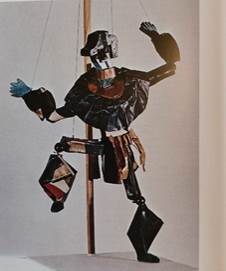
Fig.15. V. A. Favorsky. Baba Yaga. The 1920s. Tree. GATSTK named after S. V. Obraztsov, Moscow Source: Photo of the author V. A. Sokolov's name stands out because of his innovative approach, because he saw the development of the art of puppets in two directions.: the first is where she is "a character who literally loses... her head, acting without her or vice versa with two heads, a character consisting of only arms and legs, without a torso..."; the second way involved the participation of specially designed dolls "in the movement of some shapes, planes, lines, light and sound." in the complex of these movements" [24, pp. 631-632], which echoes the goals of Tairov's "new" theater. Whether Sokolov was able to fully implement his achievements in Soviet Russia is a question that has no definite answer, because in 1923, during a tour, Sokolov stayed in Germany and subsequently performed in Europe and the United States. Provincial theaters, which borrowed techniques and repertoire from the capital, employed their own talented craftsmen. For example, in the theater of the Socialist Village of V. A. Schwemberger (Chernigov), the sculptor G. V. Neroda and the artist A. Reznikov performed "with undoubted taste" [18, p. 1.] dolls for the performances "Petrushka", "Little Red Riding Hood" and "Jealousy of Barboulier". The master carved "Petrushka", "Gypsy", "Doctor", etc., having managed to convey the "best" and "worst" characteristics of the characters. Often, due to a shortage of materials, the craftsmen used papier-mache, but in such cases the dolls were somewhat sluggish in shape and "approximate, but sometimes it is not harmful, and sometimes even desirable" [9, p. 22], as noted by the staff of the Main Department of Social Education. The use of alternative materials was practiced by the sculptor V. A. Sergeev (the play "Red Petrushka" for the Baku Puppet Theater), the puppeteer M. Ya. Artyukhova and the masters of the Voronezh Theater N. V. Bezzubtseva (1925), who, noting that not everyone sees the head and facial features of the doll, showed more attention to the costume, since "dolls ... must express with the utmost clarity what they are supposed to in the play, they must not get confused for a single second in the eyes of the viewer" [2, p. 8]. Considering that in the early 1920s avant-garde art more or less fit into the ideological agenda, members of the art association "Unovis" resumed showing "Victory over the Sun", now in Vitebsk (1920). Following them, E. Lisitsky in 1923 proposed his own version of the set design, which echoed the ideas of the Bauhaus, where marionettes would "play" - "figurines" (figurines – comes from the German word "figuinen" – "figures"), controlled by the director in an electromechanical installation located on the stage. The artist has prepared an album of sketches of the opera's characters ("Athletes", "Undertakers", etc.) and introduced new characters – "Traveler through all ages", "Watchman", "Sentry", "New Man". Moreover, according to J. E. Boult, Lisitsky wanted to give the opera a political connotation, since the "New man" is created by "the communist system ..., from a small insignificant wheel of a machine, he turns into its captain, helmsman" [15, p. 11]. "Figurines" are independent structures made of flat and three–dimensional elements assembled by analogy with Lissitzky's columns, with anthropomorphic inclusions. The color of the parts was considered equivalent to a specific material, and the figures should be made of metals having a similar color (for example, "shiny copper, wrought iron" [16, p. 79]). The "figurin" design uses an "engineering" algorithm conceived by the author: displacement of the central axis, asymmetry, discontinuity and airiness, so characteristic of puppets that are not subject to gravity. The interpretation of the puppets created by A. Exter in 1926 as part of a film project by Danish director Peter Urban Gad is very interesting. Having years of communication with avant-garde artists from Europe and Russia, who enriched her with ideas from cubism to constructivism, and experience in theatrical and cinematographic projects, Exter "always remained "above the isms", freely handled them" [4, p. 47]. According to the script, the action took place in Venice and further in New York, where the characters of the Italian Commedia dell'arte moved, came into contact with the local "fantasy inhabitants" of the "Big Apple" - "Sandwich Man", "Robot", "Advertising Man", police officers and divas ("The Lady in Black red"), dressed in the fashion of the 1920s. The puppets contain stylistic references to Cubism, but through the prism of the twenties: the master avoids the deformation of matter, preferring to design from wood, metals, and industrial objects (beads, buttons, bottle caps). At the same time, the characters of Commedia dell'arte have not lost their visual similarity to the traditional image, and the New Yorker characters are an artistic product reflecting to one degree or another the time when they were created. The "Black" (Fig. 16) and the "White Harlequin" are opposites in character (the sly one is a simpleton) and in design. The "black" consists of arms and legs, without a torso, the parts are made in the form of bars and diamonds connected on hinges, which emphasizes that the puppet is not familiar with gravity. The "White Harlequin" is more stable despite the prefabricated structure, and the colors used to paint the sculpture add a special mischief to the doll.
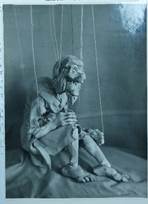
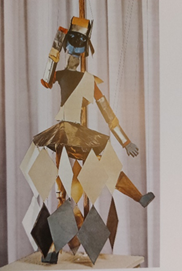
Fig. 16. A. Exter. The Black Harlequin. 1926. Wood, various materials. Source: J. Chauvelin, Nadia Filatoff, J E. Bowlt. Les Marionettes d’Alexandra Exter. Paris: Max Milo Editions, 2003. P. 288 The puppets "Longy I" and "Longy II" (Fig. 17) resemble phantoms, because there is almost nothing human in them (except for the eyes, one foot and one hand), and the costume of gray, gold, and black diamonds connected by wire gives the character an additional ephemerality. One can imagine that even with a slight breeze, the suit began to move, resembling mobile structures.
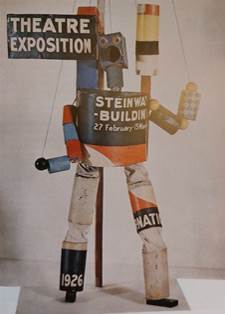
Fig. 17. A. Exter. Longi II. 1926. Wood, various materials. Source: J. Chauvelin, Nadia Filatoff, J E. Bowlt. Les Marionettes d’Alexandra Exter. Paris: Max Milo Editions, 2003. P. 291 The most radical of all Exter's puppets are the "Robot", the "Sandwich Man" (Fig. 18) and the "Advertising Man", assembled as a constructor of objects and geometric shapes. The robot puppets are covered from head to toe with numbers, advertisements and advertisements, thus symbolizing a person who is at the mercy of a new force – the force of consumption.
Fig. 18. A. Exter. The sandwich man. 1926. Assemblage, various materials. Source: J. Chauvelin, Nadia Filatoff, J E. Bowlt. Les Marionettes d’Alexandra Exter. Paris: Max Milo Editions, 2003. P. 289 Conclusion A brief overview of the evolution and place of "moving sculptures"-puppets within the boundaries of the European historical avant-garde allows us to draw certain conclusions. The revived interest in the marionette at the beginning of the 20th century was picked up by modernists and representatives of more radical avant-garde movements. The creative practices of the puppet masters were episodic and mostly related to theatrical projects. The Italian futurists were the pioneers, offering the public characters of simplified, geometrized shapes, the feature of which was a "mechanized" coordinated movement. The futurists and the participants of "Dada" took the next step towards constructing an abstract actor-puppet almost simultaneously. The Bauhaus school has advanced even further in the art of "moving sculptures", having invented, guided by constructivist aesthetics, a new type of puppet – a prototype of a person of a new industrial and technological culture. However, each group of characters created by the avant-gardists was always dominated by dolls that were not devoid of figurativeness, the masters did not seek to replace the image with a symbol, and Cubist associations were traced in the modeling. It seems that the masters, in alliance with theater directors, wanted to "wake up" the audience by releasing an avant-garde puppet onto the stage, but without frightening or pushing them away from the theater. Therefore, for short interludes "on the malice of the day," the masters, slightly departing from the ideals of the avant-garde, carved petrushki in a grotesquely realistic manner, trying to achieve a portrait resemblance to the political figures of the era. In Russia in the first post-revolutionary decade, the marionette and the petrushka doll were more in demand, their engagement was explained by solving the primary tasks of the ideological program. When carving dolls, the masters remembered that their creations should be understandable to an inexperienced viewer. Therefore, when creating artistic images, attention was focused on expressiveness, sculpture, realism, with the assumption of elements of the grotesque in order to clearly express the content of the play. It is quite natural that, having such strong arguments, the innovative models of puppets proposed by E. Lisitsky and V. A. Sokolov remained unclaimed.
The article is published in the version approved by the reviewers (after receiving a positive review recommending the manuscript for publication) with corrections made by the author (after receiving the editor’s comments, if any). References
1. Balla, G., & Depero, F. (2020). Futurist reconstruction of the universe. In Italian Futurism: Manifestos and programs 1909–1941 (Vol. 1). Gileya.
2. Bezzubtsev, N.M. (n.d.). Puppet theater in Voronezh. Archive of the GACCTK Museum named after S.V. Obraztsov. R-21. KP-5493. 3. Bobrinskaya, E.A. (2018). The soul of the crowd: Art and social mythology. Kuchkovo Pole. 4. Boult, J.E. (1990). "Dynamic use of static form": The art of Alexandra Ekster. In Russian theatrical and decorative art 1880–1930. Art. 5. Butkova, O.V. (2012). Magic and mechanics: Fairy tale heroes and themes among puppets and marionettes of the Silver Age. Questions of Theatre, 3-4, 154-165. 6. Voitinskaya-Khvostenko, A.Ya. (n.d.). Artist and researcher. 1965: Manuscript about V.V. Khvostenko (Collection of the artist's family). 7. Danko, E.Ya. (n.d.). Marionettes in Leningrad. Archive of the GACCTK Museum named after S.V. Obraztsov. R-26/3. 8. Efimov, A.I. (1990). Moving sculpture. In What is puppet theater? (Collection of articles). Union of Theatre Workers of the RSFSR. 9. Information letter on the puppet theater exhibition in Moscow, March 28, 1927. Archive of the GACCTK Museum named after S.V. Obraztsov. R-3. КП-5348. 10. Kandinsky, V.V. (1967). On the spiritual in art (A. Lisovsky, Trans.). International Literary Association. 11. Kleist, G. von. (1977). On the puppet theater. In Selected works: Dramas, stories, articles (Trans. from German). Fiction. 12. Kochetkova, N. (2008). Petrushka with light bulb eyes. Izvestia, (41m), 34. Retrieved from https://eivis.ru/browse/doc/13572566 13. Kruchenykh, A.E. (1996). Our exit: To the history of Russian futurism. Lit.-Artistic Agency "RA". 14. Craig, E.G. (1988). The actor and the supermarionette. In Memories, articles, letters (Trans. from English). Искусство. 15. Lisitsky, L.M. (1919). New culture. School and revolution: News of the Vitebsk provincial executive committee of councils of student deputies, 23, 11. 16. Lisitsky, L.M. (1991). Plastic image of the electromechanical performance "Victory over the Sun": Preface to the album of sketches. In Collection of theoretical prose by L. Lisitsky. GTT. 17. Lotman, Y.M. (1992). Dolls in the cultural system. In Selected articles (Vol. 1). Aleksandra. 18. Petrushka. (1922). Article from the local newspaper of Chernihiv, January 30. Archive of the GACCTK Museum named after S.V. Obraztsov. R-2380. 19. Pogodaeva, S.I. (1992). Mechanical eccentricity of the Bauhaus. KukArt, 1, 48-51. 20. Pogodina, S.I. (2012). Moscow magazine "KukArt" (1990–2000): An attempt to revise the puppet. Labyrinth: Journal of Social and Humanitarian Studies, 2, 14-27. 21. Prampolini, E. (2020). Futurist scenography and choreography of the universe. In Italian Futurism: Manifestos and programs 1909–1941 (Vol. 1). Gileya. 22. RSFSR. People's Commissariat for Education. Theater Department. Puppet theater: Puppet theater studio. Bulletin of the Theater Department of the People's Commissariat for Education, 2. 23. Smirnova, N.I. (1963). Soviet puppet theater, 1918–1932. Academy of Sciences of the USSR. 24. Sokolov, V.A. (1923). Marionette. Theater and Music, 6, 631-632. 25. Solovyov, V. (1920). Instead of a review. Life of Art, 425-427, 1. 26. Tairov, A.Ya. (1920). The tasks of the Chamber Theater, July 17. Archive of the GACCTK Museum named after S.V. Obraztsov. R-2102/1. КП-5500/1. 27. Favorovsky, V.A. (1932). Forget playing the engineer. Brigade of Artists, 4-5, 10-11. 28. Freud, S. (2003). The interpretation of dreams (Trans. from German). Azbuka-Classics. 29. Shaporina-Yakovleva, L.V. (n.d.). Information about puppet theater: Private letter to N.D. Bertram. Archive of the GACCTK Museum named after S.V. Obraztsov. R-92. КП-5438. 30. Steiner, E.S. (2002). Avant-garde and the construction of the new man: The art of the Soviet children's book of the 1920s. New Literary Review. 31. Benjamin, W. (1993). Berlin puppet theater. In Ombre corte: Writings 1928–1929. Einaudi. 32. Berghaus, G. (1998). Italian Futurist Theatre, 1909–1944. Clarendon Press. 33. Berghaus, G. (2005). The Dada soirées in Zurich. In Avant-garde performance: Live events and electronic technologies. Palgrave Macmillan. 34. Boschiero, N. (2023). Enrico Prampolini's plastic-caricature burlesque puppets. In Marionette e Avanguardia (J.M. Bradburne, Ed.). Corraini Edizione. 35. Cardarelli, V. (1918). The plastic dances at the Teatro dei Piccoli. Il Tempo, April 17. 36. Giavanelli, P.D. (1978). Gino Gori: The grotesque and other theatrical studies. Bulzoni. 37. Gropius, W., & Wensinger, A.S. (1971). The Theater of the Bauhaus. Westleyan University Press. 38. Hemus, R. (2009). Dada's Women. Yale University Press. 39. Lista, G. (1989). The futurist scene. Editions du Centre national de la recherche scientifique. 40. Lista, G. (2013). Enrico Prampolini: European futurist. Carocci editore. 41. Marinetti, F.T. (1920). Sexual electricity. Facci Editore. Retrieved from https://archive.org/details/marinetti-elettricita-sessuale-1920/page/n1/mode/2up 42. Mikol, B. (1988). Art figures: The puppets of Sophie Taeuber and Otto Morach. Puck, 1, 44-51. 43. Moholy-Nagy, L. (1971). Theater, circus, variety. In The Theater of the Bauhaus. Westleyan University Press. 44. Nigro, A. (2017). The plastic dances tested by criticism: Known, lesser-known, and unpublished judgments. In DEPERO il Mago (N. Boschiero & S. Roffi, Eds.). Milano: Silvana Editoriale. 45. Notes: L'éCOLE DE DANSE LABAN. (1917). Dada, 1, July. Retrieved from https://monoskop.org/images/5/52/Dada_1_Jul_1917.pdf 46. Orizio, R. (1982). Down with the bourgeoisie in slippers, The great Milan. Il Giornale, September 24. 47. Prampolini, E. (1924). Futurist scenodynamics. Noi, Anno I-II Serie, Special issue "Theater and the Futurist Scene". 48. Schlemmer, O. (1971). Man and art figure. In The Theater of the Bauhaus. Westleyan University Press.
Peer Review
Peer reviewers' evaluations remain confidential and are not disclosed to the public. Only external reviews, authorized for publication by the article's author(s), are made public. Typically, these final reviews are conducted after the manuscript's revision. Adhering to our double-blind review policy, the reviewer's identity is kept confidential.
|
| We use cookies to make your experience of our websites better. By using and further navigating this website you accept this. | Accept and Close |

 © 1998 – 2026 Nota Bene. Publishing Technologies. NB-Media Ltd.