Police activity
Reference:
Arkhipov, S.N. (2025). Schematization of a unified algorithm for the charging and discharging of weapons as a tool for minimizing incidents when handling weapons in the duty units of the Ministry of Internal Affairs of Russia. Police activity, 6, 67–78. https://doi.org/10.7256/2454-0692.2025.6.76940
Schematization of a unified algorithm for the charging and discharging of weapons as a tool for minimizing incidents when handling weapons in the duty units of the Ministry of Internal Affairs of Russia
Arkhipov Sergei Nikolaevich
Master of Sports of Russia in shooting from combat hand-held small arms, Associate Professor, Department of Fire Training, Tyumen Institute for Advanced Training of Employees of the Ministry of Internal Affairs of the Russian Federation
625049, Russia, Tyumen region, Tyumen, Amurskaya str., 75

|
as.master13@mail.ru
|
|
 |
Other publications by this author
|
|
|
DOI: 10.7256/2454-0692.2025.6.76940
EDN:
SNNWCQ
Received:
11/25/2025
Published:
01/05/2026
Abstract: In this study, the author analyzes the causes and factors of incidents involving firearms in the duty units of internal affairs bodies. The main reasons for violations have been identified: the lack of a unified action algorithm, insufficient practical training, and a low level of weapon handling skills. The subject of the research is the scheme of a unified algorithm for loading and unloading firearms, with a description of the actions of employees when handling firearms during receipt and surrender. A unified algorithm for loading and unloading firearms is presented and justified, and a scheme for its implementation is described with the aim of reducing the number of incidents. The results of a pedagogical experiment confirming the effectiveness of the application of the unified algorithm scheme are provided. A comprehensive set of practical recommendations for the application of the unified algorithm schemes in the official activity during loading and unloading firearms is given. The object of the author's research is the professional training of employees of territorial internal affairs bodies. Research methods include systematic analysis of service instructions and departmental orders on the studied problem; pedagogical experiment; expert evaluation of the correctness of actions; timing of operations; mathematical and statistical data processing; and surveying employees on their knowledge and understanding of the sequence of actions. The main conclusions of the research are: 1. The causes of emergencies involving firearms are often due to non-compliance with safety measures when handling weapons; 2. The lack of a precise sequence of actions with firearms when loading firearms before going on duty and unloading them upon surrender manifests itself in the chaotic execution of these actions, which becomes the cause of serious incidents; 3. The absence of a unified algorithm for loading and unloading firearms; 4. The application of an employee's action algorithm for loading firearms before going on duty and unloading them upon surrender, along with a scheme placed in duty units at the loading and unloading location, will minimize the likelihood of accidental discharge. A significant contribution of the author is the development of a unified algorithm and its accompanying scheme, which are being integrated into the educational process and professional activities of internal affairs employees during classes in the system of professional service and physical training. The novelty of the research lies in the development of a unified algorithm (the scheme of the unified algorithm) for the actions of employees with firearms during their receipt and surrender in the duty unit.
Keywords:
safety, combat handguns, the Ministry, employee, duty station, unified algorithm, scheme, loading, unloading, pedagogical experiment
This article is automatically translated.
Introduction
Fire training of law enforcement officers is an important aspect of their professional activities, and ensuring the safe handling of firearms is one of the primary tasks in observing the personal safety measures of law enforcement officers of the Russian Federation [1].
Of particular importance is the fulfillment of this task in duty stations, where weapons and ammunition are regularly stored and distributed for official tasks. But despite regular classes and briefings, cases of unintentional use of weapons are recorded annually, leading to injuries and, in some cases, death of employees.
In modern conditions, the complications of the operational situation, the increased number of tasks performed on the employee, the level of stress and psychophysiological stress, safety issues and compliance with the sequence of loading and unloading weapons are becoming particularly relevant. However, an analysis of orders, instructions, and official documents shows that a variety of approaches, inconsistencies in instructions, and a formal attitude to practical training make it difficult for employees to develop sustainable and safe skills.
This work is devoted to the theoretical substantiation, empirical confirmation and practical implementation of the scheme of a unified algorithm for loading and unloading weapons in duty stations of law enforcement agencies as the main tool for reducing the likelihood of accidents leading to conditions associated with the probability of an accidental shot when loading or unloading weapons.
The analysis of reviews on the facts of emergencies related to the unregulated use of firearms in duty stations by employees of territorial internal affairs bodies, due to careless (inept) handling of weapons, demonstrate a steady trend towards an increase due to a violation of the sequence of necessary actions with weapons. The most pressing problem is in the duty stations of the internal affairs bodies, where, according to departmental reports, 73% of all incidents are related to non-compliance with the sequence and rules when loading and unloading weapons. Such violations often have serious consequences not only for the violators, but also for the surrounding employees [2].
The issue of the low effectiveness of existing training methods remains acute, as well as the lack of a single and clear algorithm of actions that would be understandable and applicable to all employees, regardless of their region of service, their position, practical experience and length of service.
Statistical data on the use of firearms by law enforcement officers that are not regulated by Federal Law No. 3-FZ of February 7, 2011 "On the Police" indicate that only in the period from 2020 to the first half of 2021, 34 cases of careless (inept) handling of weapons were recorded, and in In 2022 - 96 cases, in 2023 – 118 cases; in 2024 – 141 cases (Figure 1).

Figure 1. Dynamics of cases of careless (inept) handling of weapons.
The statistics in Figure 1 indicate a steady negative trend in cases of careless (inept) handling of weapons. The number of cases of careless (inept) handling of weapons has been growing over the past three years. So in the period from 2022 to 2023, the increase was +22 cases, and from 2023 to 2024, the increase was +23 cases.;
The total number of cases in three years was 355 cases.
In their writings, Podlipnyak Yu.F., Gedugoshev R. R. note that "... among the main causes of the misuse of weapons and injury, occurs as a result of:
- lack of solid skills with weapons and, first of all, when discharging them;
- non-compliance with safety requirements;
- inept and careless handling of weapons..." [3];
So, based on the results of a pedagogical experiment conducted in the period from 2020-2023 on the basis of the Tyumen Institute for Advanced Training of Employees of the Ministry of Internal Affairs of Russia, in which 296 subjects participated, as well as based on the analysis of materials from official inspections on the use of firearms by law enforcement officers (2020-2024), we identified three main groups of causes emergencies in duty stations during loading and unloading of weapons:
- the lack of a repeatable unified algorithm of actions: in practice, this leads to employees resorting to different sequences of actions when loading and unloading weapons, which leads to errors even among employees and trainees with excellent theoretical training;
- there is no logical sequence of steps and actions performed, as a result of which violations of basic safety rules are allowed, and in most cases (90%) actions are performed in the absence of automatism of actions, with the addition or omission of necessary steps.;
- insufficient integration of theoretical knowledge into practice: (despite the mandatory study of security measures and the order of handling weapons), as a result of which (84%) of employees make mistakes when transferring knowledge to real situations of official activity, especially under stressful conditions. This may be due to the fact that an employee is able to list all the stages of discharging a pistol, but in practice forgets to remove the magazine before checking the chamber, which is dangerous and violates existing instructions.
According to the results of the pedagogical experiment, it should be noted that newly recruited employees (64% of cases, people who started serving with weapons for the first time) more often than others have difficulty performing consistent actions, get confused, and are influenced by fear of mistakes or a stressful situation.
Research in the field of human activity safety shows that the standardization of professional action algorithms is a key principle in ensuring industrial and service safety in various fields of activity. And if we consider the field of security in relation to the activities of a law enforcement officer, then the use of a single algorithm for performing sequential actions when loading and unloading weapons in the duty station will allow:
- minimize the likelihood of variability where only one correct sequence is allowed.;
- develop sustainable skills that approach the level of automatism;
- minimize the human factor and create a predictable and controlled working environment during the loading or unloading of weapons in the duty station;
- increase the level of responsibility: all participants in the process (the employee and the person in charge of the unit who controls the process of loading or unloading weapons in the duty station) understand at what stage and who should perform this or that control.
International experience and analysis of domestic practice prove: that in conditions of strictly regulated activities and (in special services, law enforcement agencies, medicine) the introduction of uniform algorithms (protocols and checklists) leads to a significant reduction in errors related to the "human factor".
Therefore, the development of unified algorithms for the sequence of actions and implementation in official activities will help eliminate the key cause of all emergencies involving weapons.
If we consider the psychological and pedagogical aspects of this study, it should be noted that the educational process on the safe handling of weapons requires consistency between theoretical and practical training.
Effective formation of skills in safe handling of weapons is achieved through constant repetition, modeling of typical and abnormal situations, immediate correction of errors and the use of visual schemes (algorithms, flowcharts).
To consolidate the studied algorithm, it is necessary:
1. Clear visual reference signals and a diagram representing the entire sequence of the operation (Figure 2).
2. At least 35-40 repetitions before the transition of the performed action to the level of the skill brought to automatism (according to pedagogical psychology) [4].
The algorithm is based on the following principles:
- minimization of the number of stages without loss of control over safety;
- Repeatability and versatility for most combat handguns (pistols, submachine guns, submachine guns);
- activation of control points (checking the magazine, checking the ammunition in the shoe, inspection, checking for the presence of a cartridge, control trigger);
- the logical connection of each step with the previous and subsequent one.

Figure 2. Graphical diagram of the employee's algorithm of actions when loading and unloading a pistol with a brief description of the actions performed.
The steps of the algorithm for loading service firearms before joining the service.
The employee, having received weapons and ammunition from the operational duty officer in a specially equipped place at the bullet trap of the duty station, performs the following actions in accordance with the algorithm:
1. Inspect two stores, compare the numbers on the store case, if any, with the number on the frame and make sure that they are in good working order (no cracks, dents on the case).
2. Check the availability of all received ammunition (by quantity), their identity, series, manufacturer, year of manufacture (Figure 3).

Figure 3. Marking of the cartridge on the bottom of the sleeve
3. Check if there is a cartridge in the chamber.
In order to make sure that there is no cartridge in the chamber, it is necessary:
- take the pistol in your hand, point the weapon at the bullet trap, make sure there is no magazine at the base of the handle;
- turn off the fuse (lower the flag down), move the shutter to the rear position with your left hand, set it to the shutter delay;
- visually inspect the chamber and make sure there is no cartridge;
- remove the bolt from the bolt delay and turn on the safety (raise the flag up), while the trigger will be cocked (Makarov pistol (PM), PMM).
(pull the trigger (in pistols, in the design features of which this is provided) to remove the trigger from the combat cocking after checking the weapon (Yarygin pistol (PY)) or deactivate the firing pin (Lebedev pistol (PLC), Glock pistol).
- inspect the assembled pistol, check the number on the frame and bolt, make sure there is no rust, cracks, or nicks on the sights.
4. Fasten the carbine of the pistol strap to the bracket, and put the pistol in the holster [5].
5. Equip the magazines with cartridges and load the weapon:
- equip one magazine with cartridges and put the holsters in your pocket for a spare magazine;
- equip the second magazine with cartridges and place it in the base of the pistol grip.
The steps of the discharge algorithm.
Upon completion of service, performance of operational tasks and occupations, weapons and ammunition are provided to the operational duty officer of the duty units of the territorial internal affairs bodies, institutions, and divisions.
An employee hands over his service firearms and ammunition only in the room for loading (cleaning) weapons in the presence of a responsible person from the leadership (commander) of the unit, who monitors the correctness of the actions of the staff to unload firearms.
The algorithm of an employee's actions when discharging a service firearm after service [6, 10].
1. Place two magazines on the table (Figure 4):
- removing the spare magazine from the holster pocket;
- remove the pistol from the holster;
- remove the second magazine from the base of the pistol grip and place it on the table. Holster the pistol.
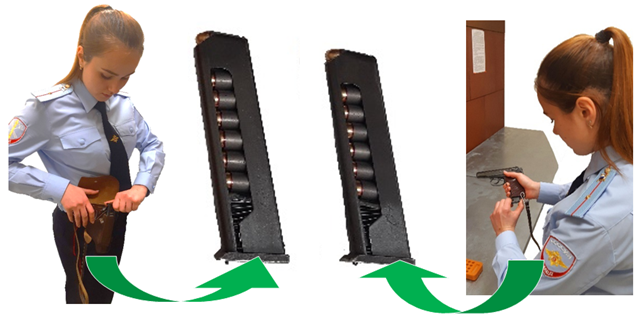
Figure 4. Execution of the first point of the algorithm of actions of an employee when discharging a service firearm after service
2. Empty the magazines, i.e. place the cartridges from the magazine in the pads cells – all cells (by number) must be filled (example: Makarov pistol – 16 cells for cartridges).
Place the empty magazines and the cartridge case on the table in front of you (Figure 5).
3. Check if there is a cartridge in the chamber (Figure 6). To do this, it is necessary:
- take the pistol in your hand, point the weapon at the bullet trap, make sure there is no magazine at the base of the handle;
- turn off the fuse (lower the flag down), move the shutter to the rear position with your left hand, set it to the shutter delay;
- visually inspect the chamber and make sure there is no cartridge;
- remove the bolt from the bolt delay and turn on the safety (raise the flag up), while the trigger will be removed from the combat cocking (Makarov pistol (PM), PMM).
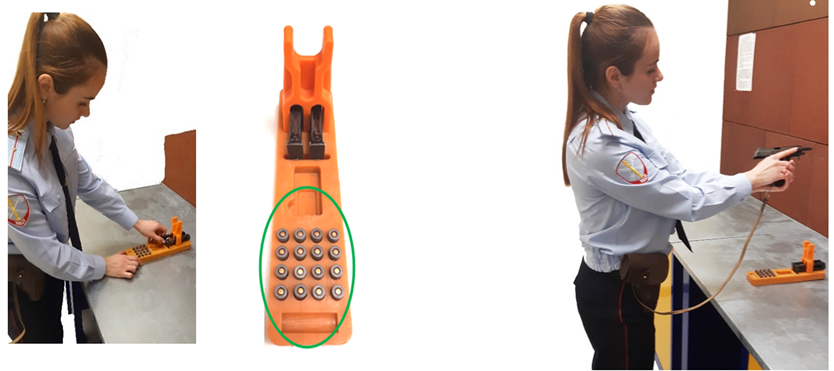
Figure 5. Figure 6.
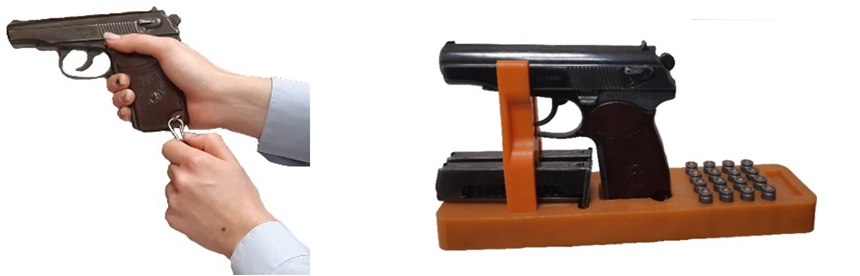
Figure 7. Figure 8.
4. Unfasten the carbine of the pistol strap from the bracket (Figure 7)[6].
5. Inspect the pistol, clean and lubricate the weapon if contamination is detected.
6. Put the gun on the pad (Figure 8).
7. Hand over the weapon to the operational officer on duty.
The practical significance of the algorithm lies in its versatility. The visualization (schematization) on the information poster conveniently reflects the main stages for both processes (Figure 1).
During the practical implementation, the scheme and algorithm were placed in each duty station in the field of view of the staff. After the introduction of the new scheme and algorithm, significant positive changes were recorded.:
- the accuracy of the sequence has increased to 100% in all stages;
- The time required to perform charging and discharging operations has been reduced by an average of 25%.%;
- the number of mistakes made when handling weapons has decreased by half;
- there has not been a single episode of a sequence violation that could lead to an accidental shot.
The key advantage of the proposed unified algorithm is the repeatability of steps and the absence of unnecessary operations. The first four stages are identical for both procedures, which reduces the likelihood of erroneous actions and, as a result, eliminates an error that can lead to an accidental shot.
An assessment of employees' perception and readiness showed (a survey) that employees trained according to a single algorithm had virtually no difficulty remembering the order of operations. The majority of respondents noted an increase in confidence when working with weapons and a decrease in stress.
The analysis of typical errors before and after the implementation of the algorithm showed the following results:
- Without a scheme, from 4 to 12 errors per 100 performed actions were recorded.;
- When using the algorithm – no more than 1-2, and this is only at the first stage of implementation.
The introduction of a single algorithm for loading and unloading weapons helps eliminate the key cause of errors - the variability of actions. It helps to acquire knowledge, form stable skills, and reduce the burden on an employee's attention under stress.
Schematization of the algorithm of the sequence of loading and unloading of weapons contributes to better memorization and reproduction in a real situation. Mandatory repetition and control by a teacher or a senior duty officer according to a given algorithm scheme allows you to rank and correct errors before they manifest themselves in dangerous situations [8,9].
Thus, the comprehensive unification (standardization) of procedures for loading and unloading weapons, implemented through the introduction of a single algorithm and scheme understandable to all employees, significantly increases the safety of official activities, reduces the number of incidents related to the "human factor", promotes the development of sustainable professional skills and serves as a guarantee for the preservation of life and health of employees of the Ministry of Internal Affairs of Russia. Continued research and methodological refinement of schemes for combat handguns will reduce the risk level to the lowest values [10].
The article is published in the version approved by the reviewers (after receiving a positive review recommending the manuscript for publication) with corrections made by the author (after receiving the editor’s comments, if any).
Read all reviews on this article
References
1. Arkhipov, S.N. (2024). An approach to the implementation of measures to reduce incidents when receiving and handing over weapons and ammunition. Police activity, 5, 27–39. https://doi.org/10.7256/2454-0692.2024.5.69132
2. Sinitsyn, E.I. (2022). Analysis of possible physical conditions of using firearms by the employees of temporary holding facilities and guarding units of the police service. Police activity, 1, 29–39. https://doi.org/10.7256/2454-0692.2022.1.37165
3. Gedugoshev, R.R. (2018). Fire training as an integral part of the professional training of employees of the internal affairs bodies of the Russian Federation. Eurasian Legal Journal, 9, 379-380.
4. Panov, V.I. (2021). Automation of professional actions as a way to prevent service errors. Psychology and Security, 2, 27-35.
5. Instructions for the procedure for issuing standard combat handguns, ammunition, and special means to employees of the internal affairs bodies of the Russian Federation for permanent storage and carrying, approved by the order of the Ministry of Internal Affairs of Russia dated November 17, 1999, No. 938. Clause 23. Access from STRAS "Lawyer".
6. Arkhipov, S.N. (2021). Fire training of employees of the internal affairs bodies: A textbook. Tyumen: Tyumen Institute for Advanced Training of Ministry of Internal Affairs Employees.
7. Baranov, A.M., & Sergeev, M.V. (2018). On safety measures during the receipt (surrender) of standard firearms by an internal affairs employee in the duty unit. In Problems of Professional Training of Law Enforcement Employees: Collection of Materials from the All-Russian Round Table (pp. 42-48). Orel: Orel Legal Institute of the Ministry of Internal Affairs of the Russian Federation named after V.V. Lukyanov.
8. Sinitsyn, E.I., & Ivanov, D.I. (2025). Application of a complex of special shooting exercises without ammunition by employees of police escort units before starting duty. Bulletin of the Tyumen Institute for Advanced Training of Ministry of Internal Affairs Employees, 1, 98-103.
9. Sinitsyn, E.I. (2025). Organizational and methodological aspects of fire training of employees of police escort units. In Optimization of Educational and Training Processes in Higher Education Institutions: A Healthy Lifestyle as a Factor in Drug Prevention: Materials of the All-Russian Scientific and Practical Conference Dedicated to the Memory of the USSR Master of Sports in Sambo and Judo, Honored Coach of the RSFSR Colonel of Police E.V. Agafonov (pp. 101-104). Krasnoyarsk: Siberian Legal Institute of the Ministry of Internal Affairs of the Russian Federation.
10. Arkhipov, S.N. (2023). Ensuring safety during the receipt and surrender of weapons through the use of schemes and algorithms: A practical guide. Tyumen: Tyumen Institute for Advanced Training of Ministry of Internal Affairs Employees.
Peer Review
Peer reviewers' evaluations remain confidential and are not disclosed to the public. Only external reviews, authorized for publication by the article's author(s), are made public. Typically, these final reviews are conducted after the manuscript's revision. Adhering to our double-blind review policy, the reviewer's identity is kept confidential.
The list of publisher reviewers can be found here.
The reviewed article is devoted to an extremely relevant and practically significant issue related to the need to ensure the most standardized, logical and safe process of loading and unloading service firearms in duty stations of the internal affairs bodies, which results from a steady increase in the number of emergencies caused by non-compliance with the established sequence of actions when handling weapons, and also indicates that The authors reasonably chose the subject of the study, which consists in theoretical and methodological analysis, and then in designing a single algorithm for these procedures, which minimizes the risk of errors caused by the human factor and the variable degree of preparedness of employees to perform specific and regulated operations. The research methodology presented by the authors is based on a combination of statistical analysis of incidents, pedagogical experiment, study of psychological and pedagogical patterns of formation of stable professional skills and analysis of normative prescriptions, which allows creating a methodologically holistic framework within which conclusions about the need to introduce a unified scheme are not declarative, but are confirmed by data obtained from a representative sample of students and employees included in the experiment, and reasonable comparisons with the results of official inspections concerning violations that led to or could lead to abnormal shots. The relevance of the research disclosed in the article is beyond doubt, as the authors demonstrate a steady negative trend in the number of incidents, supported by statistical indicators over a long period of time, and logically associate the increase in risks with increased psychophysiological stress on employees, an increase in the number of tasks, as well as insufficient unification and inconsistency of existing regulatory documents, which leads to Different duty stations may use different approaches to the same procedure, which, in turn, generates errors even among experienced employees. The scientific novelty of the work is manifested in the fact that the authors not only systematize existing approaches and identify key groups of causes of unsafe situations, but also propose an integrated, graphically designed and proven algorithm focused on versatility, repeatability and compliance with the basic principles of automated action formation, which makes it possible to classify the study as one of the works contributing to the development of fire training and security techniques. The style of the article differs in such a way that the reader is step-by-step immersed in the logic of research: from analyzing the problem and its statistical confirmation to a detailed description of the algorithm and substantiating its pedagogical, service and organizational effectiveness, which together forms a complete compositional structure complemented by clear and visual diagrams and graphic materials that significantly increase the accessibility of complex technical descriptions. The content of the article is characterized by a high level of detail, a fixed description of all stages of loading and unloading weapons, including control operations, mechanical actions, the procedure for examining weapons and checking ammunition, which gives the impression of a completed methodological development suitable for use in official practice without the need for further adaptation, and this is an important advantage. The bibliography demonstrates the correct and logical reference to normative documents, scientific publications and textbooks, which creates a solid theoretical basis for research, and also allows us to trace the continuity of ideas in the context of the development of the domestic fire training system. The appeal to the opponents is expressed not in the form of a direct polemic, but in the form of contrasting existing, fragmentary and insufficiently effective approaches to the proposed unified algorithm, which allows the authors to convincingly show the advantages of standardization over variable models of professional behavior. The conclusions of the article appear to be logical, reasoned and confirmed by empirical data, while the authors demonstrate an attentive attitude to the practical side of the issue, emphasizing that the implementation of the algorithm has already led to a reduction in the execution time of operations, a reduction in the number of errors and the complete absence of cases that could lead to an accidental shot. The interest for the readership, which includes specialists in the field of fire training, heads of departments, teachers of educational institutions of the Ministry of Internal Affairs and researchers in the field of professional security, is undoubtedly high, since the proposed methodology can be directly integrated into professional activities and significantly improve the safety of routine operations. The advantages of the article are the elaboration of the material, the logic of the research, the practical orientation, the justified novelty and high visibility achieved through the use of graphic materials that greatly facilitate the perception of complex procedures. The comments come down to the fact that in further research it is possible to expand the analysis to other types of small arms and additional categories of employees in order to build an even more universal model, and it is also advisable to strengthen the section devoted to the analysis of security protocols, which would further enrich the comparative base of the study.
| 




 © 1998 – 2026 Nota Bene. Publishing Technologies. NB-Media Ltd.


