Genesis: Historical research
Reference:
Kang, S. (2025). Leisure Practices in the Urban Life of Port Arthur (1898–1904). Genesis: Historical research, 7, 80–91. https://doi.org/10.25136/2409-868X.2025.7.75151


|
Library
|
Your profile |
 This work is licensed under a Creative Commons Attribution-NonCommercial 4.0 International License.
|
Genesis: Historical research
Reference:
Kang, S. (2025). Leisure Practices in the Urban Life of Port Arthur (1898–1904). Genesis: Historical research, 7, 80–91. https://doi.org/10.25136/2409-868X.2025.7.75151
Leisure Practices in the Urban Life of Port Arthur (1898–1904)
DOI: 10.25136/2409-868X.2025.7.75151EDN: KOMKTRReceived: 07/14/2025Published: 08/03/2025Abstract: This article explores the socio-cultural transformation of the city of Port Arthur (Lüshun) during the period of Russian lease from 1898 to 1904. The analysis is conducted through the lens of leisure practices of the urban population. The central subject of the study focuses on key aspects of urban everyday life and entertainment, including the following phenomena: alcohol consumption; the development of the restaurant business, particularly key establishments, their clientele, and their role in public life; the functioning of military clubs and the organization of social events; the development of theatrical life; as well as the active development and characteristics of the sex industry. The author examines how boredom, nostalgia for homeland, and the spiritual vacuum of garrison life in the context of an isolated colonial enclave stimulated the formation of the entertainment industry and specific consumption models, acting as a catalyst for urbanization processes and the transformation of urban space. The study is based on an analysis of the AVP RI archive, periodicals ("Novy Krai" as the key chronicle), and memoirs of contemporaries. To interpret the data and identify trends, a comparative-historical method and historical-scientific analysis were employed. The author also conducted fieldwork in Lüshun to gather local information. The introduction of new materials about Russian leisure in Port Arthur (1898-1904) enriches the content in the history of "Russian" Kwantung. This research comprehensively investigates the role of leisure as a factor in the urbanization of a colonial city for the first time. The main conclusions are that, firstly, the synthesis of Russian consumer culture with local elements created a unique urban environment. Secondly, leisure (particularly mass alcohol consumption), stimulated by the nostalgia and boredom of the garrison, became a catalyst for the development of the entertainment industry and the transformation of space. Thirdly, the development reflected the contradictions of colonial urbanization: social segregation determined the segmentation of leisure; attempts to replicate metropolitan models (theater) encountered isolation; the regulation of the sex industry exposed socio-economic contradictions. Port Arthur is a characteristic example of the complex trajectory of development of Far Eastern cities within the framework of Russian imperial policy. Keywords: Port Arthur, Lvshun, Far East, Kvantunskaya Oblast, urban life, restaurant life, theater life, sexual services, leisure practices, alcohol consumptionThis article is automatically translated. During the period of the Russian lease, Port Arthur rapidly urbanized: a European New City was being formed, urban infrastructure was developing, and cultural processes were taking place at the same time. These processes were similar to what took place in the Russian province at the turn of the 19th and 20th centuries, but of course, life in Port Arthur was distinguished by the specifics of the colonial city. In the pre-revolutionary and Soviet periods, Russian historiography focused on the study of the military history of Port Arthur, while the analysis and interpretation of the events of the Russo-Japanese War of 1904-1905 was a key topic of these studies. A qualitative breakthrough in the study of the history of Port Arthur proper occurred in the post-Soviet period. Since the 1990s, V.G. Datsyshen began to form a new direction in the social history of the "Russian" Kwantung [5]. Among the researchers in this field, it is also necessary to mention D.B. Pavlov and I.V. Lukoyanov. They achieved significant results in the colonial studies of Port Arthur: they not only published many scientific articles on the subject, but also jointly compiled a collection of sources on the history of the city [23]. Pay special attention to the monograph by A.V. Lysev [12], which focuses on the living conditions, food, uniforms, and leisure activities of participants in the defense of Port Arthur in 1904, as well as the life of the city itself. In addition, historians are currently paying great attention to urban daily life and, in particular, leisure activities in provincial cities. [4]; [10]; [14]. This article is devoted to the daily life of the population of Port Arthur in the period 1898-1904, especially its entertainment and leisure. At the moment, none of the above researchers have addressed the history of Port Arthur's urbanization and, in particular, the role of leisure practices in this process. Meanwhile, they have become a catalyst for the transformation of urban space through the formation of modern forms of consumption. The sources of studying the everyday life of the residents of Port Arthur were memoirs, journalism and information from the newspaper Novy Krai.
Homesickness "Homesickness is a poison that poisons the entire existence of newcomers here on the outskirts. Homesickness is a continuous, all—consuming suffering that overshadows all desires, thoughts, and feelings in those possessed by it" [31. P. 221], wrote David Ilyich Schrader, traveling through the Far East at the end of the 19th century. The Port Arthur garrison, which became a Russian naval base in China in 1898, turned out to be the third city in the empire in terms of geographical distance from the capital, second only to Petropavlovsk and Vladivostok in this regard. The monotonous routine of military service, isolation from the outside world, difficulties adapting to local conditions and homesickness undermined the morale of the military. Recalling his life in Port Arthur, Lieutenant Colonel V.A. Mustafin noted that "the life of the first colonists was both boring and difficult" [17. L. 87]. Similar accounts reveal parallels in the narratives of other authors. One of the servicemen of that time also described this situation: "Boredom, boredom and boredom again, which the officers diligently diluted with vodka, beer and cheap wine, and the lower ranks replaced the wine with kvass; moreover, the officers preferably fought boredom in the Officers' Meeting, only as an exception in a local European restaurant, and the lower ranks they mostly got drunk in dirty, backwater pubs and only in exceptional cases — in a soldier's buffet or in a tea shop" [9. P. 25]. Despite the strict regulations and punishments applied in the detention houses in Port Arthur for the abuse of alcoholic beverages, the level of drunkenness among the army ranks reached significant proportions [18. p. 16]. Port Arthur did not suffer from a lack of alcohol. You can easily find his advertisement in the newspaper Novy Kray. In April 1900, a wholesale warehouse of wine and alcohol by V.K. Yakobson was opened in Port Arthur, and 6 months later the second warehouse of the I.I. Kharlamov Partnership was opened [22. P. 13]. The shortage of clean drinking water also led the residents of Port Arthur to excessive consumption of beverages such as beer and kvass (1). It is noteworthy that there was no shortage of alcoholic beverages even during the siege [18, p. 107]. Schlitz beer, Moum and Roederer champagne [32. P. 1], and P.A. Smirnov's vodkas, liqueurs and liqueurs were sold in Port Arthur [24. P. 1]. The servicemen called them "mumchik", "redererchik" and "Smirnovka" [13. P. 3]. Thanks to Porto Franco, wines were very cheap here: the best champagne was sold for 3 rubles per bottle, and if you take a box, the bottle cost 2 rubles. 90 kopecks, Jamaican rum — 1 ruble. 25 kopecks per bottle, and beer from 40 to 50 kopecks per bottle [7. Pp. 194-195]. In the second half of 1901, the price of local wine (vodka) was 4 rubles and 50 kopecks per bucket, and alcohol was 6 rubles per bucket (2). Smirnovka was sold at the same price as in Russia, with the difference that monopolka (state–owned vodka) was sold everywhere in Russia and the Smirnovka was not available in many places, but in Port Arthur, on the contrary [7. P. 194]. Port Arthurians recalled "a mountain of boxes of Peter Smirnov products, which majestically flaunted at the station [...] and served as a triumphal arch at the entrance to the Old City" [18. P. 108]. As for the Chinese vodka shaoju (3) or suli, Russian memoirists recalled that its smell was disgusting and pungent. Chinese small shops sold alcohol in bottles [22. P. 13]. Officer A.V. Vereshchagin recalled that Russian officers "do not drink it, but Cossacks and soldiers do not disdain it. Some people loved it so much that they even preferred it to Russian vodka [...]" [3. P. 92]. Compared to Russians, the natives did not particularly like alcohol, and it was very rare to meet a drunken Chinese on Kwantung Street [29. p. 230]. In addition, lunch and dinner could be obtained at the garrison assembly for 18 rubles per month, and in regimental restaurants, dinners cost from 25 to 30 rubles per month [7. P. 196]. In Port Arthur, the oldest restaurant was Saratov, located on the embankment in the Old Town, directly opposite the entrance to the raid. It was the busiest place in the city. For a short time, this restaurant actually replaced the officers' club. Journalist Nikolai Ivanovich Kravchenko, who visited Port Arthur in 1904, noted that the good quality of food in this restaurant was not characterized by a high price, which allowed most residents of Port Arthur to consider the Saratov restaurant an analogue of Palkin [8. Pp. 100-101, 156]. Another restaurant, Kronshtadt, accepted orders for dinners at weddings, balls, evenings, consecrations of buildings, celebrations of military units, etc. Lunch could be arranged in a restaurant, or food could be ordered with delivery [28. P. 3]. Entrepreneur Isidor Nikobadze maintained the popular Zvezdochka hotel and restaurant in Artur (5).
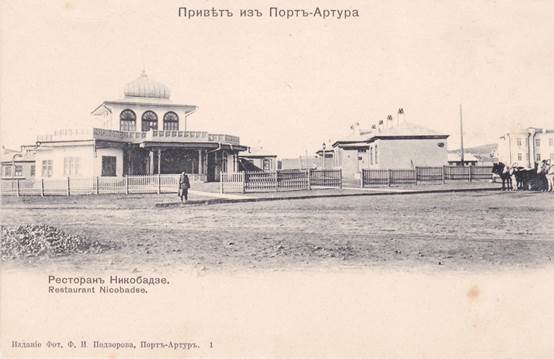
Fig.1. Nikobadze's restaurant in Port Arthur. Source: From his own collection. URL: https:// m.vk.com/wall-210777285_3078 (date of request: 04/01/2025) In addition, during the period of Russian rule in Port Arthur, Chinese Yu Deji and his partners created a restaurant in the center of the New City, "Taifenglou", which was housed in a two-story brick building. Visitors were served on the ground floor, and separate offices were located on the second floor. The restaurant was richly decorated, the furniture was made of luxurious rosewood, it was the largest Chinese restaurant in Port Arthur (6). These restaurants were undoubtedly convenient places for officers to spend their leisure time in Port Arthur. In the evening, lively companies gathered in them, champagne flowed here and diamonds sparkled. The correspondent of the London Daily Mail newspaper, Benjamin Wegner Norregaard, wrote: "The Russian officer, without a doubt, is not stingy. Once he has money, he spends it generously. Tired of the boring and annoying life on the forts and outposts, when he receives his salary, he strives to the city and throws money for several crazy hours until the last ruble is thrown out of his wallet; with a light heart and a heavy head, he returns to his boring duties after a carouse" [19. P. 14] (7).
Cultural leisure The development of the entertainment industry has become a direct reflection of the economic and cultural transformations in the city. For the higher ranks, the entertainment life was richer than for the lower ranks. Balls were held for senior officers. D.G. Yanchevetsky described a ball at the house of Vice Admiral E.I. Alekseev in Port Arthur in 1900: "The chief Commander of the region invited to the ball all the mess companies and officers of all units with their spouses, representatives of civil, urban and commercial institutions, etc. The hall, the living room, and the buffet shone with electricity. [...] The young people danced with enthusiasm. The non-dancers [...] settled into the living room and buffet, where cool drinks, wine and champagne poured in a tropical downpour [...]. A quiet night, a garden studded with stars of electric lights, elegant couples walking, the sound of music, a diverse society, general animation and fun" [33. Pp. 4-5]. According to G. Kozmin, the latest Paris fashions were shown at such balls, "for which all the shops of Port Arthur were emptied" [7. P. 200]. Grand military parades were also held in Port Arthur in honor of important holidays (the day of the emperor's coronation and the day of the occupation of the city). On May 14 (26), 1899, on the anniversary of the coronation of Emperor Nicholas II, a divine service was held in the new church of the city, after which a parade was held on the square. After greeting and walking around the ranks, the head of the peninsula, Subbotich, proclaimed the cry "Hurrah!" in honor of the Emperor and Empress Alexandra Feodorovna, which was bravely picked up by the parading units to the sounds of the national anthem. Then the troops marched in a ceremonial march [15]. Literary and artistic figures from Russia also traveled to the Liaodong Peninsula to hold concerts in support of the troops. In 1901, the Slavyanskaya Capella mixed choir visited Vladivostok, Dalny, and Port Arthur [6. P. 32]. The third concert, held on October 14 (27) under the baton of M.D. Agreneva-Slavyanskaya in Port Arthur, received a favorable review [30. p. 685]. In the summer, the military music choir performed three times a week on Nikolaevsky Boulevard. In winter, there were dancing evenings in the military and naval assemblies [1. l. 99 vol.]. The theater played an important role in the life of Port Arthur, and, according to contemporaries, Vladivostok and Port Arthur were the theatrical strongholds of the entire Far Eastern region [27. P. 171]. The construction of the Sino-Eastern Railway contributed to the development of Port Arthur and the growth of its population, which created favorable conditions for business [25. p. 137]. Educated segments of the population and astute entrepreneurs immediately responded to the emerging commercial opportunities. Under these conditions, Port Arthur was a very favorable environment for entrepreneurs, and when performing four times a week, it was possible to earn an average of 500 to 600 rubles [27. P. 310]. K.P. Miroslavsky was the first who decided to conduct theatrical business in the Far East [25. P. 137]. In 1902, he opened the theater season with "a pretty good operetta for Port Arthur with a relatively modest budget, something like seven thousand." Then he also expanded his influence to other cities such as Harbin, Khabarovsk and Blagoveshchensk [27. P. 310], and also managed theaters in Dalny, Liaoyang and Mukden [26. P. 171]. Although the entrepreneurs tried to reproduce the cultural model of the capital in the border military fortress of Port Arthur, they were limited by material resources: Port Arthur was so far from the densely populated European part of Russia, living conditions were so difficult, and the population was so small that it was difficult to create a professional theater troupe there, and the entrepreneur had to travel to Moscow or St. Petersburg. to recruit artists [25. p. 138]. The actors, who were chosen after a long ordeal, despite the promise of a large salary, had to endure long journeys to Kwantung and rumors that the way across the border of "Manchuria" was unsafe [2. P. 432]. During the 1902-1903 theatrical season, entrepreneur K.P. Miroslavsky attempted to reorganize the operetta troupe, instructing director A.N. Solin to carry out a new set of artists. However, the cast was significantly inferior in professional level to the previous season. The personnel imbalance caused by the absence of leading soloists led to the artistic degradation of the repertoire. Despite the fact that the attendance was high at first, then the fees dropped to a minimum. An unexpected fire finally ended the unsuccessful business of the theater. Adjutant General E.I. Alekseev assisted Miroslavsky and authorized the allocation of an emergency subsidy in the amount of 7 thousand rubles from the funds of the Kwantung regional government. In addition, to cover the losses incurred during the fire of the theater, personal financial assistance in the amount of 16 thousand rubles from Emperor Nicholas II was provided, donated to the entrepreneur and the troupe [27. P. 310]. This was considered a "royal favor," but in fact reflected a strategy of symbolic support for the "cultural mission" on the outskirts of the empire. The funds received were used to reconstruct the Tifontai Chinese Theater, which previously belonged to a noble Chinese, but his business did not improve. The theater was located far from the city center, which created additional inconveniences. The season ended in a complete collapse, and Miroslavsky, having paid off the troupe, stopped further productions of operetta performances [27. P. 310; 20. P. 122]. In early 1904, rumors of a possible war increasingly kept the residents of Port Arthur in suspense, which is why people finally lost interest in visiting theaters and entertainment venues. A correspondent of the Russian Invalid newspaper wrote from Port Arthur: "The interests of domestic and foreign policy so fill the minds of the local population that there is no time or desire to attend a theater or circus" [20. P. 122]. This to some extent foreshadowed the decline of the theater industry in Port Arthur. According to the memoirs of actress F. Baskakova, who lived in Port Arthur, the play "Dead Souls", scheduled to be shown on the evening of January 27 (February 9), 1904, did not take place: on the same night, Japanese troops bombed Port Arthur [2. P. 432]. The evacuation of the actors after the outbreak of war marked the end of theatrical life in Port Arthur. In addition to the theater, several clubs and societies were organized for entertainment, such as a tennis club and a racing society. The tennis club was small. There were two tennis courts, and both were comfortable. There was a card room in the clubhouse itself [16]. Persons who had the right to enter military and naval meetings were accepted as members of the tennis club without running for office. The membership fee was 4 rubles for half a year. And the membership fee of the racing society is 12 rubles per year [21. P. 74]. In early 1901, enthusiasts proposed the creation of a museum in Port Arthur. According to the petitioners, the museum was supposed to promote a deeper understanding and knowledge of China among the Russian population, as well as exhibit and showcase the trophies accumulated during the 1901-1902 campaign in China as evidence of the country's history. On the basis of this initiative, on March 3 (16), 1901, a committee on the establishment of the museum was established. The main responsibility of the committee was to plan the location, finance and collect collections for the future museum. Following the discussion, the committee decided to locate the museum in the New City. In 1901, the committee managed to collect voluntary donations in the amount of 8,122 rubles and 47 kopecks [1. l. 98 vol.-99], which provided the necessary financial support for the initial construction of the museum. However, the museum was also not completed due to the Russian-Japanese War.
Sexual services If theaters, clubs, restaurants and other places served as "legal" venues for residents of Port Arthur, then at the same time, shadowy side lives and directly related to the physiological needs of the male population of the city were rapidly developing in the city. During the Qing Dynasty, there were brothels in Liushong, which was used exclusively as a military base, not only near the barracks, but also in the city itself. During the period of the Russian lease of Port Arthur, the number of women engaged in prostitution has only increased. One of the reasons for the existence of brothels was the need to regulate prostitution in the city. For example, to keep Chinese laborers away, the Russians set up theaters and brothels on Kwantung, where Japanese girls worked. Brothels were a lucrative place. In the second half of the 19th century — the first half of the 20th century. The Japanese government used the prostitution trade abroad as a means of obtaining foreign currency [36] (8). At the turn of the century, there were many Japanese brothels in the Russian Far East. So, in 1903 there were 18 brothels in Vladivostok and 8 in Khabarovsk. Before the outbreak of the war, there were a lot of brothels in Port Arthur, mostly Japanese [18. P. 81] (9). Japanese brothel workers abroad received a special name — "Karayuki-san" (10). In Port Arthur, Japanese prostitutes were more popular than Chinese women [7. P. 191]. As for the source of these Yamato prostitutes, it was not uncommon for young Japanese women to be deceived by members of organized criminal groups offering completely different jobs abroad. In 1901, the chief chief of the Kwantung region, E.I. Alekseev, wrote in a report that "the Japanese government is taking strict measures to stop Japanese women from traveling to countries neighboring their homeland for prostitution, and recently it has begun to issue passports to women under the age of thirty-five to leave Japan only if they receive certain occupations outside their homeland and representations from employers of their certificates about that" [1. l. 63 vol.]. But trafficking of Japanese women abroad was difficult to eradicate, as the economic benefits of this criminal activity were extremely high. Regardless of where the women were exported — to Hong Kong, Singapore, Shanghai, Vladivostok, etc. — the price for one Japanese woman could reach 500 yen, and such a high profit served as a powerful driving force for the continuation of criminal activity. The "Law on the Protection of Immigrants", adopted by the Japanese government in 1896 for Japanese working abroad, stipulated that the work of Japanese women abroad was limited to cooking, servants, etc. Thus, if a Japanese woman engaged in prostitution abroad, she was not protected by law. However, this law did not apply to China and Korea at that time, so brothel owners could transport Japanese women there with impunity or use these countries as transit points for transporting women to other places. However, the city authorities could not treat the work of tolerance houses in the city indifferently and allow them to expand uncontrollably. In the 19th century, the needs of public health became "an excuse for restricting and controlling the activities of prostitutes" [34, p. 140]. The urban regulation of prostitution in the Russian Empire was entrusted to the Ministry of Internal Affairs, but the structure of the regulation itself remained at the discretion of local authorities [34, p. 145]. There was a certain classification among the prostitutes of Port Arthur based on the social status of the clients who used their services. B.M. Lobach-Zhuchenko acknowledged on this issue that the "contingent of prostitutes" for the common people "is replenished exclusively by women of the yellow race, since "whites" can afford only "gentlemen" [11. C. 18]. It is obvious that the claims of the West of the 19th and early 20th centuries to "regulate prostitution acquired a racist character when they were transferred to the colonies" [35, p. 6].
Conclusion During the Russian lease period, Port Arthur developed rapidly and became a vibrant, dynamic city. In the course of urbanization, leisure practices have become a catalyst for the transformation of urban space through the formation of various forms of consumption. Homesickness and boredom of garrison life have become one of the reasons for the increase in alcohol consumption. Over time, this general psychological mechanism turned into a factor that contributed to the development of the entertainment industry and consumer culture. All this gradually influenced the appearance of the city, both spatially and culturally. At the same time, it cannot be denied that the urban development of Port Arthur during the period of Russian rule also reflects the complex process of urbanization in a colonial context. At the city government level, the authorities tried to maintain social order and economic control by regulating the prostitution industry, but the scale of the prostitution industry reflected the contradictions of the socio-economic structure typical of a colonial city. As a result, the urban spatial culture in Port Arthur gradually became more complex and diverse. The forms of leisure in the studied context generally replicated the models typical of the urban centers of the Russian Empire. However, their specificity was determined by two key factors: the dominance of the military contingent and the presence of a significant proportion of the indigenous population. In this regard, the following characteristic features of Port Arthur should be highlighted. Firstly, with a population exceeding 40,000 people, Port Arthur was a large urban center in the Far East, while simultaneously belonging to the category of medium-sized cities on an imperial scale. Secondly, the urban population was subjected to strict social segregation along the lines of: officers / lower ranks; Russian subjects / indigenous population; partly military / civilians. This structuring of the social space inevitably determined the segregation of leisure practices. Thirdly, geographical isolation contributed to the spread of homesickness and compensatory alcohol consumption in all social strata, while the quality of alcoholic beverages was hierarchized according to the status of the consumer. The last factor is that the distance from the center of the empire created significant difficulties in maintaining the level of development and comfort typical even for an ordinary provincial city.
notes (1) Similar phenomena were observed, for example, in Germany in the 1870s, where urban water was polluted, tasteless and unsafe, and tea and coffee were luxuries, poor local workers preferred beer, which was, among other things, a nutritious drink. See: Abrams L. Workers’ Culture in Imperial Germany: Leisure and Recreation in the Rhineland and Westphalia. NY., 1992. P. 64. (2) It should be noted that local alcohol in bottling and wholesale (in barrels) was not bottled or sold below 95 ° c. See: Pozdneev D.M. Trade in Port Arthur. St. Petersburg, 1902. p. 13. (3) Shaoju: the whale. 烧酒, these are Gaolian alcoholic beverages with a strength of 50°, they were made in distilleries. See: [Description of the localities of the Liushunkou district] / 大连市区区志志志公公 [ed. The Office of Local History of Liushunkou District of Dalian City]. 大连 [Dalian] / Dalian. 1999. P. 310. (4) "Palkin" is a famous restaurant in St. Petersburg. (5) E.V. Vladi, the granddaughter of Isidor Nikobadze, stated that her grandfather arrived in China in 1900, and he was the owner of the Zvezdochka restaurant. See: Elena Vladi // Prayers of Russian Poets. XX–XXI. An anthology. URL: https://azbyka.ru/otechnik/molitva/molitvy-russkih-poetov-20-21-antologija/158#source (Date of request: 03/01/2025). Local historians from Liushun confirmed that this restaurant was located in a New city. (6) This information was collected from 2021 to 2024 during the author's fieldwork in Liushun, where he communicated with many researchers of the local history of Liushun. (7) Benjamin Wegner Nørregaard (1861-1935) was a Norwegian military officer, railway engineer, journalist, diplomat and famous war correspondent. (8) Prostitution was of great importance to the Japanese economy during the Meiji period. The state depended on income from brothels to finance infrastructure and achieve political goals. Although the growth of prostitution was not officially declared a government goal, the interests of government circles objectively contributed to the expansion of the sex industry. This is a policy of continuity: the Meiji government, like the previous shogunate, publicly declared the restriction of prostitution, while deliberately creating conditions for its prosperity. See: Amy Stanley. Selling Women Prostitution, Markets, and the Household in Early Modern Japan. 2012. University of California Press. P. 193. (9) The abundance of Japanese prostitutes in the Far East is explained by the system of registered prostitution and the boom of outbound work abroad in 1887-1896 in Japan. Prostitution in Japan has been a legal trade since the Edo period, but in 1872 the government issued a "Decree on the liberation of all geisha and prostitutes," and legally declared prostitution illegal in the country. This measure has only led to the displacement of prostitution into the shadow economy. Having studied the system of registered prostitution in Europe, the Japanese government in 1900 re-legalized this craft, including the export of Japanese women to brothels. See: [Kiyotaka Inoue, Atsuko Yasutake].「近世~近代における丸山遊郭と柳町遊郭の建築的考察」[Architectural study of the Maruyama and Yanagimachi Yukaku quarters (red light districts) of the Edo and Meiji periods)] //『長崎大学大学院工学研究科研究報告』[Reports of the Graduate School of Engineering, Nagasaki University] / Reports of Graduate School of Engineering, Nagasaki University. 2022. Vol. 52. No. 99. P. 9.; [Tomijiro Yoneda].『警察三大法令正解』[The correct answer to the three basic police laws]. 明倫館 [Tokyo: Meirinkan] / Tokyo: Merinkan. 1900. P. 141.]; [Morisaki K.]. [trans. from Japanese to Chinese Wu Yihan and Lu Ping]. 唐行小姐: 被卖往异国的少女们[Karayuki-san: The girls sold abroad]. 上海: 格致出版社 [Shanghai: Publishing house "Truth and wisdom"] / Shanghai: Truth & Wisdom Press. 2022. P. 66-67, 91, 94-97.; 日本向海外输出大批妓女的历史(组图)[The history of Japan's export of a large number of prostitutes abroad (pictures)]. URL: http://www.ims.sdu.edu.cn/info/1014/9170.htm (date of request: 5.12.2024). (10) Karayuki-san: Japanese women who went to China and Southeast Asia to work as prostitutes in the second half of the 19th century. They mostly came from Shimabara, Nakasaki Prefecture, and Amakusa, Kumamoto Prefecture. References
1. AVP RI. F. 143. Op. 491. D. 1550.
2. Actors in Port Arthur in the First Days of the War. (1904). Theater and Art, 22, 432-433. 3. Vereshchagin, A.V. (1903). In China: Memories and Stories. V. Berezovsky. 4. Goncharov, Yu.M. (2004). Essays on the History of Urban Life in Pre-Revolutionary Siberia (Mid-19th-Early 20th Century). Sova. 5. Datsyshen, V.G. (1996). Activities in Port Arthur: On the Problem of Russia's Acquisition of a Colony in Southern Liaodong. In Relations of the Peoples of Russia, Siberia, and Eastern Countries: History and Modernity (pp. 105-124). Irkutsk. 6. Ivanov, I. (1907). Impressions from Military Campaign Life during the Occupation of Manchuria in 1900–1903. A.S. Suvorin Printing House. 7. Kozmin, G. (1904). The Far East: Memories and Stories. V. Berezovsky. 8. Kravchenko, N.I. (1906). To War!: Letters, Memories, Essays of a War Correspondent. R. Golike and A. Vilborg. 9. Lipkin, M.K. (1907). Essays and Stories from Military Life. 10. Lityagina, A.V. (2007). Leisure in Russian Cities in the Second Half of the 19th-Early 20th Century. Questions of History, 10, 136-142. 11. Lobach-Zhuchenko, B.M. (1904). Port Arthur. S.A. Chikolini Printing House. 12. Lisev, A.V. (2019). Russian Port Arthur in 1904: The History of Military Everyday Life. 13. A Little Feuilleton. (1904). Novy Kray, 11 (24), 8. 14. Malysheva, S.Yu. (2011). A Leisure Day, A Leisure Evening: The Culture of Leisure in the Provincial Russian City in the Second Half of the 19th-Early 20th Century. Academy. 15. Local News. (1899). Novy Kray, 16(28), 20. 16. Local News. (1899). Novy Kray, 7(19), 45. 17. Mustafin, V.A. (n.d.). Port Arthur 1898–1902. GAF RF. F. R5881. Op. 2. D. 521. 18. Nozhin, E.K. (1906). The Truth about Port Arthur. P.A. Artemyev Publishing. 19. Norregaard, B.V. (1906). The Great Siege: Port Arthur and Its Fall (with illustrations and charts) (B. Serebrennikov, Trans.). V. Berezovsky. 20. Echoes of Military Events. (1904). Theater and Art, 6, 122. 21. Kwangtung Province Memorandum for 1901–1902. (1901). A.Y. Oparin Printing House. 22. Pozdneev, D.M. (1902). Trade in Port Arthur. 23. Port Arthur and the Far East, 1894–1904: The Last Colonial Project of the Russian Empire. (2018). Collection of Documents (I.V. Lukoyanov & D.B. Pavlov, Eds.). TsGI-Print. 24. Board of the Partnership of P.A. Smirnov. (1902). Novy Kray, 4(17), 2. 25. Presnyakova, L.V. (2013). Russian Theater in Port Arthur at the Beginning of the 20th Century. Observatory of Culture, 2, 137-139. 26. Presnyakova, L.V., & Presnyakov, S.V. (2005). Chronicle of Theater Life in the Far Eastern Region Based on Capital Press Materials (End of the 19th–Early 20th Century). VGUES Publishing House. 27. Provincial Chronicle. (1903). Theater and Art, 14, 308-311. 28. Restaurant "Kronstadt" A.K. Vladimirov. (1902). Novy Kray, 4(17), 2. 29. Shooter (Kozmin, G.). (1903). Chinese Life in Kwangtung. Military Collection, 3, 201-234. 30. Khokhlov, A.N. (2015). Tours of M.D. Agreneva-Slavyanskaya's Chapel in China Before and After 1917. Society and State in China, 2, 677-696. 31. Shreider, D.I. (1897). Our Far East: (Three Years in the Ussuri Region). A.F. Devrien. 32. E.L. Mondon. (1902). Novy Kray, 1(14), 1. 33. Yanchevetsky, Y.G. (1903). At the Walls of Immovable China: The Diary of the Correspondent of "Novy Kray" at the Theater of Military Actions in China in 1900. P.A. Artemyev Publishing. 34. Rodríguez García, M., Heerma van Voss, L., & van Nederveen Meerkerk, E. (Eds.). (2017). Selling Sex in the City: A Global History of Prostitution, 1600s–2000s. Brill. 35. He, X. (2003). Dangerous Pleasures: Prostitution and Modernity in 20th Century Shanghai (H. Minzhong & S. Ning, Trans.). Jiangsu People's Publishing House. 36. History of Japan's Large-scale Export of Prostitutes Overseas. (n.d.). Retrieved December 5, 2024, from http://www.ims.sdu.edu.cn/info/1014/9170.htm
Peer Review
Peer reviewers' evaluations remain confidential and are not disclosed to the public. Only external reviews, authorized for publication by the article's author(s), are made public. Typically, these final reviews are conducted after the manuscript's revision. Adhering to our double-blind review policy, the reviewer's identity is kept confidential.
|
| We use cookies to make your experience of our websites better. By using and further navigating this website you accept this. | Accept and Close |

 © 1998 – 2026 Nota Bene. Publishing Technologies. NB-Media Ltd.