|
Culture and Art
Reference:
JING, Y. (2026). The Legend of the Eight Immortals as an example of the continuity in the integration of cultural heritage into food packaging design. Culture and Art, 2, 73–91. https://doi.org/10.7256/2454-0625.2026.2.74039
The Legend of the Eight Immortals as an example of the continuity in the integration of cultural heritage into food packaging design
Tszin YUEHAN
Postgraduate Student; Institute of Design and Arts; St. Petersburg State University of Industrial Technologies and Design
18 Bolshaya Morskaya str., Saint Petersburg, Russia, 191186

|
jingyuehan@mail.ru
|
|
 |
|
DOI: 10.7256/2454-0625.2026.2.74039
EDN:
NAAVAB
Received:
04/09/2025
Published:
03/03/2026
Abstract: The research is dedicated to the analysis of the continuity of China's cultural heritage through the example of the integration of the legend of the Eight Immortals into food packaging design. It focuses on the evolution of visual (color palette, composition) and symbolic elements (character images, mythological plots) during the 20th and 21st centuries, as well as their adaptation to commercial requirements and technological innovations. Specific examples, from the packaging of "Zhonghua Sezi" cookies (1912–1949) with traditional ornaments to the interactive box "Zhiwei Guan" (2021) using shadow theater, demonstrate how design transforms from direct reproduction of myths to their stylization (anime style in the 2019 project). The study shows that the synthesis of traditional narratives with modern technologies (digital graphics, interactivity) preserves cultural identity, enhances emotional connection with consumers, and increases the market value of brands. A comparative analysis of the evolution of packaging (20th-21st centuries), visual (color, composition) and historical-cultural (context of the era) analysis of design elements, case analysis (the "Return of the Eight Immortals" project), and the study of the adaptation of mythological symbols have been employed. Qualitative methods include analysis of sources, visual materials, marketing strategies, and technological innovations. The integration of the legend of the Eight Immortals into packaging design reflects the dynamics of adapting cultural heritage to aesthetic and market challenges. For example, the transition from direct copying of mythological images (1990s "Penglai" wine packaging) to their stylization in anime style ("Return of the Eight Immortals," 2019) has preserved key meanings ("longevity," "luck"), making them relevant for youth. Interactive formats, such as shadow theater in the "Zhiwei Guan" packaging (2021), transform packaging into a tool for conveying historical memory, engaging consumers through playful elements. The novelty of the study lies in the systematic analysis of the transformation of visual elements and the demonstration of the relationship between the commercialization of archetypes and the growth of brand competitiveness. The synthesis of traditions with technologies creates a sustainable dialogue between the past and present, ensuring the practical significance of cultural memory in modern marketing.
Keywords:
packaging design, Yantai city, Eight Immortals, cultural commercialization, cultural marketing, regional culture, brand value, Cultural Heritage, Symbolic elements, Traditional Mythology
This article is automatically translated.
In today's consumer market, food packaging design has evolved from a simple functional medium into an important communication tool between brand and consumer. As noted by S. Watson and E. Waterman, the visual image plays a key role in creating objects that reflect collective identity. Their research highlights that the power of visual elements allows not only to convey information, but also to form an emotional connection with cultural heritage [13, p. 87]. Being a key port city in the northeast of Shandong Province, Yantai has a rich cultural heritage and unique folk art, which provides inexhaustible resources for creative food packaging design. The Legend of the Eight Immortals, included in the List of National Intangible Cultural Heritage of China (State Council of the People's Republic of China, 2008). For a designer, cultural heritage is both a source of inspiration and an existing narrative that has both formal, stylistic, imaginative, and emotional, value–based features. The legend of the Eight Immortals, being part of the Taoist tradition, provides designers with a wide range of resources that adapt to modern visual solutions while maintaining emotional intensity and historical continuity. American economist Edward Denison believes that successful packaging design makes it possible to effectively interact with consumers and effectively meet the requirements of humans and natural development [17, p. 53]. With the development of the consumer market and the improvement of aesthetic standards of consumers, food packaging goes beyond traditional functions – simply to protect products and convey basic information [8, p. 53]. Today, it is an effective marketing tool that conveys product information to the target audience and allows manufacturers to interact directly with consumers. Giles Culver, co-founder, design strategist and managing director of Lippa Pierce Design, noted in his book "What is Packaging Design?" that "compared to other design categories, one of the characteristics of packaging design is that its effectiveness can be quickly assessed" [5, p. 72]. In turn, Walter Gropius, one of the founders of the German Bauhaus, said: "The purpose of design is people, not products" [4, p. 12]. Well-designed food packaging can attract the attention of consumers, stimulate their desire to buy, and then promote the sale of goods. Due to the unique design elements and color combinations, food packaging is aimed at conveying the brand's philosophy and values, as well as increasing consumers' sense of identity and brand loyalty [16, p. 121]. Emotional and associative links with the national cultural heritage evoke a special response among consumers. The legend of the Eight Immortals, as an important component of Chinese Taoist culture, was first recorded in written sources during the reign of the Eastern Han Dynasty (25-220) in Mu Rong's work "A Treatise on Reasoning and Perplexity." In the course of historical development, the images of these eight characters and the plots associated with them were gradually enriched, by the Jiajing period of the Ming Dynasty (1507-1567), a version familiar to modern people was mainly formed. The group of "Eight Immortals" includes: — an elderly man (Zhang Golao); — young men (Lan Caihe and Han Xiangzi); — The warlord (Zhongli Quan); — the scientist (Liu Dongbin); — an aristocrat (Cao Guoju); — the patient (Li Teguai); — a woman (He Xiangu). Each character has unique character traits and special supernatural abilities, reflecting a variety of social types and Taoist ideals [9, p.150]. On June 7, 2008, the State Council of the People's Republic of China approved the inclusion of the Legend of the Eight Immortals in the second part of the list of national Intangible Cultural Heritage, and Penglai became the only region in China to successfully submit an application. Penglai District, part of Yantai City, is located in the northern part of Yantai City. In Penglai, the legend of the Eight Immortals plays a unique and important role [12, p. 1]. When designing product packaging, it is important to have a deep understanding of the cultural context of the Eight Immortals, to determine whether the legend of them corresponds to the product in order to emphasize its features. However, it is also necessary to take into account modern aesthetic preferences of people and market trends in order to create an image that simultaneously attracts the attention of potential consumers, increases brand awareness and reveals a connection with national culture. The first known images of Eight Immortals on product packaging appeared during the period of the Republic of China (1912-1949) on a tin box of cookies from the Zhonghua Xieji Shanghai Company (Fig. 1). During this period, China was characterized by the influx of foreign capital and the expansion of opportunities for market development. Zhonghua Xieji used the image of eight Immortals in the packaging design, which not only emphasized Chinese features, but also corresponded to the aesthetics of that time. This kind of innovation is inseparable from technological progress. In 1912, new printing machines were introduced in Shanghai, which made it possible to apply exquisite color patterns on tin boxes. The packaging design uses an ornament of stylized bats (symbolizing "happiness" thanks to the homophone in Chinese) as an auxiliary element, red is used as the main color, combined with the brand name made in Chinese calligraphy. This packaging design was an innovative idea for commercial packaging in the 1920s. 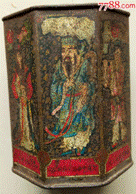 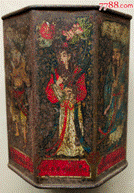 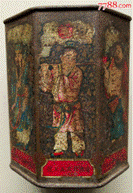
Fig. 1. Cookie packaging. Shanghai Zhonghua Xiji Cookie manufacturing company. The years 1912-1949.
The packaging of malt milk "Eight Immortals are congratulated on longevity", released by the Jiangnan-Wuhan Food Processing Plant in the 1980s, reflects a unique approach to packaging design for the period (Fig. 2). The choice of images of Eight Immortals for the design of a premium nutritional product of that time corresponded to an associative connection: in folk legends, these characters symbolize longevity and supernatural abilities. The designers used their images to hint at the "full-fledged nutritional composition and health benefits" of the product. The cylindrical packaging box implies a favorable meaning of "completeness and durability". As the box rotates, the images of the Eight Immortals change sequentially, like the pages of an illustrated comic book. The designer chose blue as the background, which contrasts sharply with the colors of the costumes of the Eight Immortals. In Chinese culture, the blue color symbolizes purity, wisdom and health, which is closely related to the theme of celebrating longevity. During the period of China's reforms and openness (1978), this design was perceived as very representative, which was also facilitated by the use of bronzing technology. This combination of tradition and modern approach is a typical example of the transformation of commodity packaging in the 1980s. 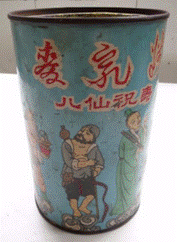
Fig. 2. Packaging of malt milk. Jiangnan-Wuhan Food Processing Plant. The 1980s.
In the 1990s, the Penglai Distillery released an alcoholic drink with the theme "Eight Immortals crossing the Sea" (Fig. 3). They used cultural creativity to create an unusual bottle design. The images of the Eight Immortals recreate a mythological scene, evoking associations with the legend; the shape of the gourd symbolizes the Taoist elixir of immortality, embodying longevity. The blue and white color scheme resembles the view of Penglai Mountain in the fog, creating a mystical atmosphere. The ceramic bottle continues the tradition of storing alcohol in ancient China, and the fragility of ceramics emphasizes the value of the drink. The inscription "Eight immortals cross the sea" is made in Chinese calligraphy — the solemn font contrasts with the playful images of the deities. During the economic transformation of the 1990s, this project was successful both culturally and commercially. The combination of the famous legend with modern design has allowed the brand to stand out among many other alcoholic beverages. 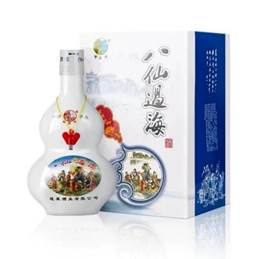
Fig. 3. Wine packaging. Penglai Wine Company Limited Liability Company. The 1990s.
With the advent of the 21st century, the development of technology and the spread of computer graphic design have increased the level of packaging design. Compared to previous designs, the modern packaging with the theme "Eight Immortals cross the Sea" features more careful detailing, clear display of patterns, and compliance with the aesthetic standards of modern food packaging. Early designs dedicated to the Eight Immortals mainly focused on traditional mythological themes, emphasizing the history and cultural value of the images. Modern designs, while retaining traditional elements, pay more attention to the preferences of young people and practical needs. This translates into a more fashionable style, vibrant color combinations, and packaging functionality. Stylization is a technique when a designer, using an existing style, changes iconography, reproduces the image system and formal features of one of the styles of the past, applying them in a new artistic context. This is a creative method based on the relationship between the stylized sample and the stylizing composition. For example, in the Return of the Eight Immortals project, stylization manifested itself in the adaptation of traditional Taoist images through cartoon and anime styles, which allowed preserving cultural identity while making them relevant to young people. The design of the Return of the Eight Immortals series is based on the traditional culture of the eight Taoist Saints, combining innovation with modern aesthetics to create products combining cultural depth and practicality. The project was developed by the team of Xianren Zhilu Cultural Communications Company, which promotes the idea of "heritage and innovation are equally important" by creating two styles — "Tao-Eight Immortals" and "Q-Eight Immortals". "Tao-Eight Immortals" is made in the style of traditional Chinese ink painting, conveying the spirit of self-overcoming, and "Q-Eight Immortals" uses flat illustrations to approach a youth audience. In the visual design, the postcards reinterpret the stories of the eight immortals through an anime style with bright colors, and the packaging for the fragrance bags combines traditional jacquard weaving and embroidery with a soft Chinese color palette, emphasizing cultural sophistication [7] (Fig. 4). Through the series "The Return of the Eight Immortals", the Xianren Zhilu Company cooperates with more more than 30 enterprises, covering the production of seafood, wine, coffee and other industries, realizing the commercialization and popularization of cultural resources. 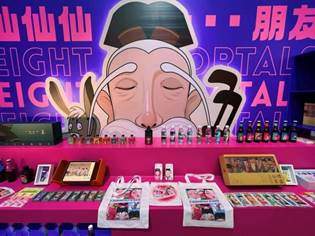
4. The Yantai project "The Return of the Eight Immortals". Xianren Zhilu Cultural Communications Company. 2019
The team skillfully applied knowledge in the field of color psychology in the packaging design, for example, wine produced by the Yantai Wine Company (Fig. 5). For it, orange was used as the main color, which symbolizes enthusiasm, vitality and luck. It is very suitable for packaging alcoholic beverages, which is aimed at creating a festive atmosphere. The golden color of the text embodies nobility and luxury, emphasizing the quality of the product. Each box has different characters printed on it, with different facial expressions and expressive movements, which fully demonstrates the legend and charm of the Eight Immortals. Each small package has blessings written in calligraphy, such as luck, study, happiness, etc., which also supports the overall packaging style. 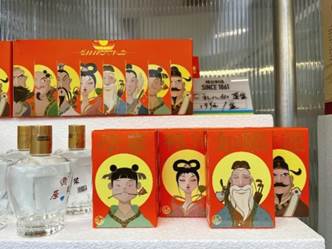
Fig. 5. Wine packaging. Xianren Zhilu Cultural Communications Company. 2019
Continuing the theme of integrating cultural heritage into modern products, the 2021 collaboration is an illustrative example. The century-old Hangzhou brand Zhiwei Guan, together with the Zhejiang company Natural Creation (a cultural and creative limited liability company), created a gift package for Chinese desserts inspired by the legend of the "Eight Immortals Crossing the Sea." Using the idea of the Chinese shadow puppet theater as the main design element has made it possible to integrate Chinese traditions into modern life and combine them with innovative technologies. After opening the lid of the box, the curtain screen unfolds along the edges, instantly turning into a miniature theater stage. The set includes figurines of the characters of Eight immortals from the Shadow Theater, which, combined with the function of a smartphone flashlight, allow consumers to personally experience the joy of directing and theatrical performance [1] (Fig. 6). This type of creativity, which turns packaging into an interactive platform, not only increases the effectiveness of environmental protection and reuse, but also enriches communication experience with traditional culture. Consumers have the opportunity to independently control the characters, recreating the legendary story of "Eight Immortals cross the Sea" or improvising new plots, being creative. It's like embodying the principle of "everyone shows their strengths" from Taoist legends in a game for the whole family. Combined with Chinese Zhiwei Guan desserts, the box recreates the exquisite atmosphere of ancient tea parties with theatrical performances that transform the images of the Eight Immortals from simple images into an interactive experience that promotes the transmission of cultural memory. This packaging has become a real breakthrough in the introduction of intangible cultural heritage into marketing. This method of making national culture interesting continues the brand's philosophy of "Natural Creation" – "exploring traditions – innovative design – giving new life" [3]: first, the essence of traditional culture is extracted, then transformed into new forms adapted for modern use. 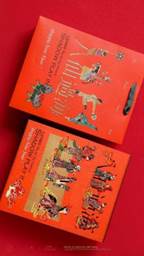 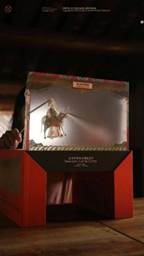
6. Packaging of Chinese desserts. Hangzhou Zhiwei Guan Food Company and Zhejiang Cultural and Creative Company Natural Creation. 2021
Continuing the tradition of integrating the theme of the Eight Immortals into packaging design and building on the success of previous projects, designer Li Shuang turned to marine themes in 2024, enriching it with elements of classical Chinese mythology. After a detailed study of historical and artistic sources, she artistically reinterpreted the characters' images, paying special attention to three key works: the Qing-era work "Portraits of Eight Immortals" by court artist Yu Zhiding (1647-1716) (Fig. 7), the 1907 painted silk "Feast of Eight Immortals at a Peach Banquet" (Fig. 8) and the modern The "Eight Immortals" by Hua Sanchuan (1930-2004) (Fig. 9), created using the Gongbi technique. 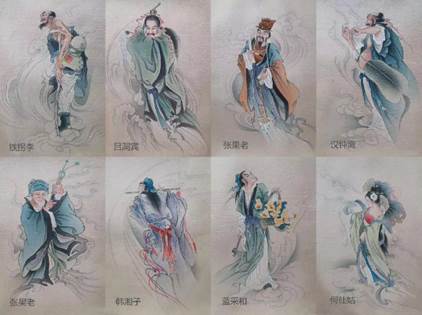
Fig. 7. Yu Zhiding. Portraits of Eight Immortals. From left to right:Li Teguai, Liu Dongbin, Cao Guojiu, Zhongli Quan, Zhang Golao, Han Xiangzi, Lan Caihe, He Xiangu. 1662-1722-ies. Paper.
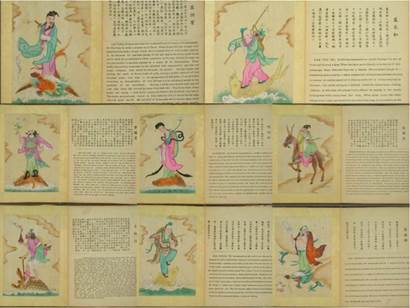
8. The feast of the eight immortals at the peach banquet. From left to right: Liu Dongbin, Lan Caihe, Cao Guojiu, He Xiangu, Zhang Golao, Li Teguai, Han Xiangzi, Zhongli Quan. 1907 Silk. 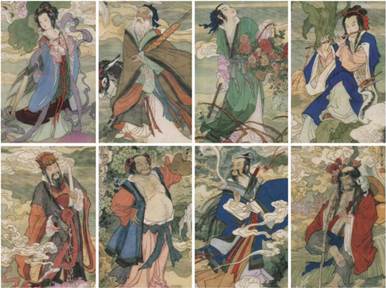
Fig. 9. Hua Sanchuan. Eight immortals. From left to right:He Xiangu, Zhang Golao, Lan Caihe, Han Xiangzi, Cao Guojiu, Zhongli Quan, Lu Dongbin, Li Teguai. 1950s — the beginning of the 21st century. Paper.
These three works represent important stages in the interpretation of the image of the Eight Immortals in Chinese art, demonstrating the evolution of styles and artistic methods from traditional Chinese painting to modern art. These works allowed us to trace the evolution of the artistic image and interpretation of the theme "Eight Immortals crossing the Sea" in various historical periods, which served as a valuable source of materials and inspiration for Li Shuang's design decisions. She combined her own design concept and traditional elements to create a series of images of Eight Immortals that not only retain their traditional charm, but also meet the spirit of the times.: 1) Lee Teguai According to legend, Li Teguai, the first of the Eight Immortals, originally possessed a noble appearance, but after a mystical incident — when his soul left his body during a meeting of immortals, and a disciple prematurely burned his physical shell — he was forced to inhabit the body of a beggar, which determined his new appearance [20, p.92]. When creating the modern image, the designer synthesized historical sources: the green robe dates back to the work of the artist Hua Sanchuan "The Eight Immortals" (Fig. 9), where Li Teguai is depicted in a long robe; the pose with a crutch and disheveled hair are borrowed from the scroll "The Feast of the Eight Immortals at the Peach Banquet" in 1907 (Fig. 8) and stone sculptures of the Penglai tourist area (fig. 10). His dark complexion, curly beard and piercing gaze emphasize his mystical essence and wisdom, and the use of cartoon stylization softens the image, combining historical authenticity with emotional expressiveness. The ferocious expression reflects the character's rejection of his new look, but through playful visual elements such as exaggerated eyes and dynamic posture, the design remains attractive to a young audience, transforming an ancient archetype into a modern symbol where the "formidable" harmoniously coexists with the "cute." (Fig. 11) 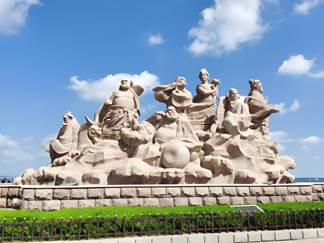
10. Stone sculpture "Eight immortals crossing the sea". China, Shandong Province, Yantai City, Penglaige Tourist Area.
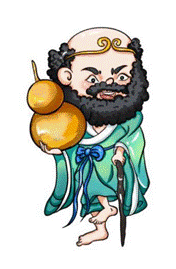
Fig. 11. Li Shuang. The image of Lee Teguai. 2024
2) Zhongli Quan Zhongli Quan occupies a prominent position among the Eight Immortals, second only to Li Teguai, therefore he is deeply respected [19, p.68]. Legend has it that when he was born, his body was the size of a three-year-old child, and he didn't cry or eat all day. It wasn't until the seventh day that he started talking, and it turned out that he was the reincarnation of an immortal. He grew up and became an official, and after losing the war, he decided to settle on Mount Zhongnan. There, he received instruction from Emperor Donghua and the immortal Hua Yang. In the end, he became immortal. In Li Shuang's work, Zhongli Quan strolled leisurely with a group fan in his hand, with a round face like a child's, hair tied in a double bun on his head, and a blue shirt, showing a sweet and kind bearing. (Fig. 12) 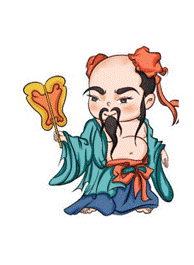
Fig. 12. Li Shuang. The image of Zhongli Quan. 2024
3) Zhang Golao Zhang Golao, the eldest of the Eight Immortals, according to historical records possessed the secret of immortality. Emperors Wu Zetian and Xuanzong repeatedly tried to invite him to court, but he skillfully avoided attention by pretending to be dead. His canonical image, captured in mythology, is a Taoist elder sitting on a donkey backwards, with a Bamboo drum behind his back, a symbol of spiritual guidance. [10, p. 249] The gray-green robe reproduces the style of the scroll "Portraits of Eight Immortals" (Fig. 7) by Yu Zhiding of the Qing era, where The simplicity of the cut emphasizes the ascetic nature of the hermit. A wrinkled face with a soft smile, inspired by Hua Sanchuan's work "The Eight Immortals" (Fig. 9), conveys wise benevolence. The bamboo drum on his shoulder is also highlighted, making Zhang Golao recognizable at a glance. (Fig. 13) 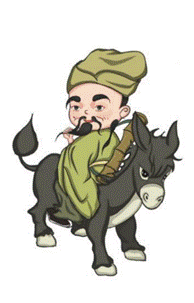
Fig. 13. Li Shuang. The image of Zhang Golao. 2024
4) Lu Dongbin
There are many legends about Lu Dongbin, the most legendary of the Eight Immortals. According to sources, since childhood he was distinguished by an outstanding mind and eloquence, and at the age of 64, having met Zhongli Quan in Chang'an, he devoted himself to Taoist practices and the art of the sword, becoming a defender of the people [11, p.185]. The blue Taoist robe with wide sleeves is reproduced from Yu Zhiding's scroll "Portraits of the Eight Immortals" (Fig. 7), where the color symbolizes purity of spirit; the sword on his back and the broom in his hand, taken from the illustration "The Feast of the Eight Immortals at the Peach Banquet" (Fig. 8), represent justice and detachment from worldly passions. The facial detailing, including wise wrinkles and a penetrating gaze, is inspired by the work of Hua Sanchuan (Fig. 9), emphasizing the transcendence of the character. Softened body proportions and rounded facial features are combined with a determined expression in the eyes, creating a balance between heroic charisma and accessibility for a young audience. Lu Dongbin appears as a bearded sage in a blue robe — a sword on his shoulder and a broom in his hand visualize his role as a spiritual mentor and warrior-protector (Fig. 14). 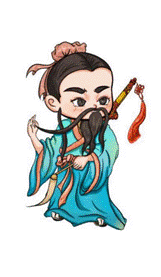
Fig. 14. Li Shuang. The image of Liu Dongbin. 2024
5) He Xiangu He Xiangu is the only woman among the Eight Immortals whose story is full of miraculous transformations. According to legend, an ordinary tofu saleswoman, He Xiugu, received a magical peach from an elder, gained the ability to fly and predict fate, becoming a folk "celestial", bringing hope [18, p.43]. In Li Shuang's illustration, she is depicted in a relaxed pose: with one hand she holds a lotus, a symbol of purity, with the other she gently touches her neck, emphasizing grace. Her image combines traditional and modern elements: a pink hanfu with wing-shaped sleeves, stylized based on the scroll "Feast of the Eight Immortals with Peaches" (Fig. 8), where the folds of fabric resemble petals; a transparent scarf wrapping around the shoulders like a cloud (borrowed from Hua Sanchuan's work "The Eight Immortals") (Fig. 9); golden wavy embroidery on the hem, referring to flights over the Yunmu River. He Xiangu's face combines refinement and gentleness, arched eyebrows and half-closed eyes convey wisdom, rosy cheeks and a slight smile emphasize benevolence. Two neat hairpieces, stylized based on traditional Chinese hairstyles of the Ming era, complete the image of the "beautiful immortal", reflecting her connection with Taoist spiritual practice (Fig. 8). 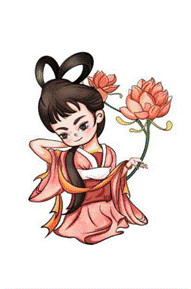
Fig. 15. Li Shuang. The image of He Xiangu. 2024
6) Lan Caihe According to legend, Lan Caihe became a magician in adulthood under the guidance of Zhongli Quan. He lost his parents in childhood, had no permanent home, wandered and behaved strangely. Although Lan Caihe is a man, he often wears women's clothes and holds a basket of flowers in his hand. In Li Shuang's design, the blue color of the clothes refers to the traditional image from the scroll "Portraits of the Eight Immortals" (Fig. 7), where the blue robe symbolizes spiritual harmony and connection with nature. The female silhouette of a dress with wide sleeves, copied from the illustration "The Feast of the Eight Immortals with peaches" (Fig. 8), embodies the Taoist concept of the unity of yin and yang, and the flower basket represents prosperity and immortality. Children's facial features with large eyes and arched eyebrows, inspired by the work of Hua Sanchuan (Fig. 9), emphasize the image of an "eternal child", free from social conventions, and rosy cheeks and a smile adapted to youth aesthetics. Dynamic pose with a raised basket, reminiscent of a stone sculpture in Penglai [2, p.187] (Fig. 10). (fig. 16) 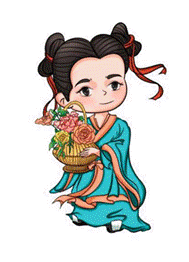
Fig. 16. Li Shuang. The image of Lan Caihe. 2024
7) Han Xiangzi Legend has it that Han Xiangzi was a handsome young man with a flute in his hands. He originally had a marriage contract with the daughter of the prime minister of the Han Dynasty. This girl was both smart and beautiful. The emperor of the Han Dynasty wanted to betroth her to his nephew, but she strongly opposed it. The emperor of the Han Dynasty was very angry, so he stripped Han Xiangzi of his position and sent him to work in a remote place. In the end, the young girl died from excessive grief, and Han Xiangzi was reincarnated into a white crane. This white crane later met Zhongli Quan and Lu Dongbin, who magically turned him into a hero. After growing up, Han Xiangzi decided to live in seclusion and practice Buddhism on Mount Zhongnan, and eventually became one of the Eight Immortals [15, p.31]. The designer portrayed Han Xiangzi as a handsome young man in an orange short blouse and blue trousers, playing the flute. The orange shirt and blue trousers refer to classic illustrations such as "The Feast of the Eight Immortals at the Peach Banquet" (Fig. 8), where bright colors emphasize youth and connection with nature. Flute pose, borrowed from the works of Yu Zhiding (Fig. 7) and Hua Sanchuan (Fig. 9). The color scheme reflects the connection with the marine theme of Peng Lai, where orange is associated with the sun, and blue with the ocean. (Fig. 17) 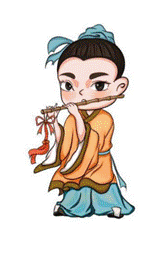
Fig. 17. Li Shuang. The image of Han Xiangzi. 2024
8) Cao Guoju Cao Guojiu, the younger brother of Empress Cao, holds a unique place among the Eight Immortals due to his aristocratic status. His visual image, based on historical sources, includes red official clothes and a cap-ushamao, a traditional headdress of Chinese officials, symbolizing power and social status. He holds jade tablets in his hands, reflecting his connection with the imperial court, as indicated in classical texts. Legend has it that when he was living in seclusion in the mountains, he met two immortals, Zhongli Quan and Lu Dongbin. They taught him the secret way to become immortal and made him immortal. Another legend says that the emperor awarded him a gold medal. One day, when he was crossing the Yellow River, he didn't have the money to buy a ferry ticket, so he used the gold medal as collateral. As a result, he met Lu Dongbin by chance. After they went on a journey together, Cao Guojiu gained immortality and became one of the Eight Immortals [14, p.21]. The character's design emphasizes rounded body shapes, which corresponds to the traditional idea of an influential dignitary. The pose — one hand with a jade plaque, the other on his belt — emphasizes the combination of authority and light irony. The red color of formal wear, symbolizing well-being and connection with the Taoist tradition, harmoniously combines with modern requirements for visual communication in packaging, providing an emotional connection with the consumer. (Fig. 18) 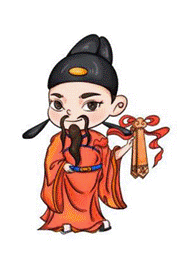
Fig. 18. Li Shuang. The image of Cao Guoju. 2024
Li Shuang's Zui Basian gift package design, inspired by the myth of the "Eight Immortals Crossing the Sea," combines traditional culture and modern aesthetics through stylized caricature images of characters and visual elements of artifacts. The design combines the hyperbolic expressions of Li Teguai and the graceful poses of He Xiangu, while retaining recognizable attributes — a gourd, a fan of banana leaves, etc. The architectural elements of the Peng Lai Pavilion and the waves of the East Sea enhance the cultural identity. Bright colors and dynamic illustrations attract attention, the corrugated material carrier combines protection and convenience, and the scene of the immortals fighting the dragon visually conveys the idea of unity, awakening a cultural connection with the region. The brand's logo, combining calligraphy and prints, highlights the traditional flavor. Related products with the theme of "Eight Immortals" expand the cultural context, creating a unique brand image. The design successfully brings Peng Lai seafood packaging to life through caricature, functional innovation, and a modern interpretation of visual elements. [6, p. 48] (Fig. 19) 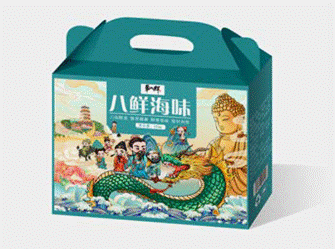
Fig. 19. Li Shuang. Seafood packaging. 2024.
The interpretation of cultural heritage continues to be important not only as the inclusion of memory in current culture, but also as a way to change the perspective of cultural heritage perception, as a form of presentation of a new context of an artifact or idea for their emotional living, research, understanding. Today, citation has become one of the most common forms of including cultural heritage objects in a modern context. The example of the legend of the Eight Immortals shows that packaging design may vary at different stages from the twentieth to the twenty-first century, but relying on the non-material cultural heritage allows us to emphasize the value assessment of its objects. A comparative analysis of the packaging of products from different periods revealed that the images of the Eight Immortals and packaging design techniques were constantly changing in accordance with the demands of the era, but they always retained key cultural meanings: "luck", "happiness" and "longevity". At the beginning of the twentieth century, red and blue colors were more often used in packaging design, patterns symbolized good luck and conveyed cultural characteristics, and the focus was on consumers focused on traditional values and cultural heritage. In the 21st century, the image of the Eight Immortals became more in tune with the cartoon aesthetic, which shifted the focus to younger buyers. Modern technologies also make it possible to increase the interactivity of packaging, for example, through augmented reality or game elements. Despite the variety of design approaches, all packaging design styles retain key elements of the mythological archetypes of the "Eight Immortals" — from the symbolism of longevity to mythological plots. At the same time, the use of modern materials not only enhances the visual expressiveness, but also increases the practicality of the product. The study showed that the evolution of the commercialization of the legend of the Eight Immortals has gone from simple copying of characters to innovative reconstruction of plots, which is vividly demonstrated by the 2019 project "The Return of the Eight Immortals". Thanks to the artistic reinterpretation of images and the synthesis of traditional narratives with modern aesthetics and interactive formats, the project organically integrated cultural heritage into a modern context. Successful business cases, including the use of ceramic bottles with mythological motifs by the Penglai Brewing Company and the interactive packaging of Zhiwei Guan from Hangzhou, illustrate the practical application of this strategy. In product design, the modernization of stylistic, material and technological innovations can significantly strengthen the cultural identity of brands. At the same time, modern interpretation and presentation of traditional elements contribute to increasing the market competitiveness of brands.
The article is published in the version approved by the reviewers (after receiving a positive review recommending the manuscript for publication) with corrections made by the author (after receiving the editor’s comments, if any).
Read all reviews on this article
References
1. Sohu. (2024). Are you afraid of getting bored at home during the Chinese New Year? Shadow theater gift set "Eight Immortals Crossing the Sea": it's delicious and fun! Retrieved from https://www.sohu.com/a/447341612_166982
2. Wang, Y. (2007). Analysis of the cultural heritage of the Legend of the Eight Immortals. Zhongzhou Journal, 5, 186-191.
3. WeChat. (2024). Recreation · Reinterpretation · Revival | On the twelfth anniversary of the "Natural Creativity" project. Retrieved from https://mp.weixin.qq.com
4. Wei, J. (2006). Basics of packaging design. Shanghai People's Fine Arts Publishing House.
5. Calver, J. (2003). What is packaging design? RotoVision.
6. Li, X. (2024). Application of the mythological story "Eight Immortals Crossing the Sea" in the packaging design of Penglai seafood. Qilu University of Technology.
7. Baijiahao. (2024). The dream of a girl from Yantai about the "Eight Immortals": using the light of design to illuminate the culture of the city. Retrieved from https://baijiahao.baidu.com/s?id=1776833724008196479&wfr=spider&for=pc
8. Nichiporchuk, A. V. (2018). Product packaging as a channel of marketing communication. Humanitarian Accent, 3, 47-54.
9. Reshetneva, U. N. (2013). Precedent names of Daoist deities in the folk sayings of China. Omsk Scientific Herald, 2, 149-152.
10. Riftin, B. L. (1991). Eight Immortals. In S. A. Tokarev (Ed.), Myths of the Peoples of the World: Encyclopedia (Vol. 1, p. 673). Soviet Encyclopedia.
11. Xi, F. (2017). Analysis of the iconography of the folk art drawing "Eight Immortals Crossing the Sea." Study of Ethnic Art, 30, 180-188.
12. Tang, M. (2020). Study of the inheritance of the legend of the Eight Immortals in Penglai. Huazhong Normal University.
13. Watson, S., & Waterton, E. (2010). Visual perception: representation and narrative in the construction of heritage. Material Culture Review, 71, 84-96.
14. Zou, Y. (2011). Cultural subtext and decorative function of the traditional pattern "Dark Eight Immortals." Modern Decor (Theory), 4, 21.
15. Zhou, Y. (2021). Design of the animation prototype character "Eight Immortals Crossing the Sea". Anhui Engineering University.
16. Shtepa, Y. I. (2020). The role of packaging and product design in brand formation. Symbol of Science: International Scientific Journal, 5, 120-122.
17. Denison, E. (2004). Prototypes of packaging: Ecological thinking (J. Xiaohun, Trans.). Shanghai People's Fine Arts Publishing House.
18. Yang, W. (2014). Aesthetic interpretation of the female immortal symbol He Xiangu. Sichuan Normal University.
19. Yang, H. (2009). The historical reality of the "Eight Immortals." Lunar Monthly Selected Readings, 22, 68-69.
20. Yang, Y. (2013). The gilded bronze statue of the Eight Immortals from the Ming Dynasty. World of Collections, 6, 91-94.
Peer Review
Peer reviewers' evaluations remain confidential and are not disclosed to the public. Only external reviews, authorized for publication by the article's author(s), are made public. Typically, these final reviews are conducted after the manuscript's revision. Adhering to our double-blind review policy, the reviewer's identity is kept confidential.
The list of publisher reviewers can be found here.
The subject of the research in the article submitted for publication in the journal Culture and Art, as the author reflected in the title ("The Legend of the Eight Immortals as an example of continuity in the introduction of cultural heritage into the design of food packaging"), is an example of the continuity of the use of the figurative and symbolic content of the legend of the Eight Immortals (in the object of research) in design food packaging in China. In the title of the article, the author used a common but controversial metaphor, "the introduction of cultural heritage into design." On the one hand, the metaphor reflects the process of promoting cultural heritage through its use in the design of consumer goods of wide demand. On the other hand, according to the reviewer, cultural heritage is not some kind of invention that needs to be implemented. Rather, we should talk about the introduction of socio-humanitarian technology for rebranding deep concepts of traditional culture, which are reflected in the cultural heritage, but certainly need to be widely promoted in order to maintain the cultural continuity of generations in the formation of a common cultural identity. However, the above remark concerns exclusively the need for further research of the designated subject for a deeper systematization of the conceptual and terminological apparatus, i.e. it is not critical for evaluating the presented work. The author consistently reveals the figurative and symbolic content of the legend of the Eight Immortals and examples of its use in the design of food packaging by Chinese manufacturers according to the established traditional set of images: an elderly man (Zhang Golao); two young men (Lan Caihe and Han Xiangzi); a military commander (Zhongli Quan); a scientist (Liu Dongbin); an aristocrat (Cao Guojiu); a sick man (Li Teguai); a woman (He Xiangu). Each character, as the author noted, based on existing research, has unique character traits and special supernatural abilities, reflecting a variety of social types and Taoist ideals. Based on the established traditional typology, food manufacturers, as the author noted, initially used the images of the Eight Immortals on packaging at the beginning of the 20th century to promote their products, to achieve competitive advantages based on a nationwide semantic field. Over time, in the context of radical socio-cultural changes and transformations, the question arose of preserving this common semantic field for further use of the potential of a common cultural identity. As a result, the author comes to quite reasonable conclusions that at the beginning of the twentieth century, red and blue colors were more often used in packaging design, patterns symbolized good luck and conveyed cultural characteristics, and the orientation was aimed at consumers focused on traditional values and cultural heritage. In the 21st century, the style is changing significantly and the images of the Eight Immortals acquire cartoon features, which is associated with a shift in the focus of marketing communication to young customers and the use of modern technology. The author emphasizes that the evolution of the commercialization of the legend of the Eight Immortals has gone from simple copying of characters to innovative reconstruction of plots, which is vividly demonstrated by the 2019 project "The Return of the Eight Immortals". Thus, the subject of the research is disclosed by the author at a good theoretical level, which makes it possible to recommend the article for publication in a reputable scientific journal. The research methodology is based on the principles of an integrated approach, taking into account advanced theories of modern design (E. Denison, J. Culver, V. Gropius, A.V. Nichiporchuk, Wei Jie, etc.). The author's methodological complex is relevant to the scientific and cognitive tasks being solved. The results of the study are trustworthy. The author argues the relevance of the chosen topic by the fact that in the modern consumer market, the design of food packaging has evolved from a simple functional medium into an important communication tool between the brand and the consumer, forming visual images of the common semiosphere, which play a key role in creating objects reflecting collective identity. The scientific novelty of the study, which consists in a comprehensive analysis of the example of the continuity (evolution) of the use of the figurative and symbolic content of the legend of the Eight Immortals in food packaging design in China in the XX-XXI centuries, deserves theoretical attention. The author has maintained a scientific style of the text. The structure of the article follows the logic of presenting the results of scientific research. The bibliography, taking into account the author's reliance on the analysis of empirical material, sufficiently fully reveals the problematic field of research, but needs to be finalized in accordance with the requirements of the editorial board and GOST. The appeal to the opponents in the article is correct and sufficient. Although the author does not focus on the theoretical criticism of colleagues' work. The article is certainly of interest to the readership of the Culture and Art magazine and may be recommended for publication after the bibliography has been finalized.
|





 © 1998 – 2026 Nota Bene. Publishing Technologies. NB-Media Ltd.


