Culture and Art
Reference:
Filonenko, N.S., Tipikin, V.V., Kazakova, N.Y. (2026). “Kansei design”: in search of a “poetic sense”. Culture and Art, 2, 218–229. https://doi.org/10.7256/2454-0625.2026.2.73671


|
Library
|
Your profile |
 This work is licensed under a Creative Commons Attribution-NonCommercial 4.0 International License.
|
Culture and Art
Reference:
Filonenko, N.S., Tipikin, V.V., Kazakova, N.Y. (2026). “Kansei design”: in search of a “poetic sense”. Culture and Art, 2, 218–229. https://doi.org/10.7256/2454-0625.2026.2.73671
“Kansei design”: in search of a “poetic sense”
DOI: 10.7256/2454-0625.2026.2.73671EDN: NNAOUVReceived: 03/12/2025Published: 03/03/2026Abstract: The article is devoted to understanding the design approach, invented in the early 2010s by the French designer-researcher P. Levy – “kansei design”. Following the researcher, the authors of the article consider “kansei design” as a direction focused on the development of a designer's special sensitivity (Japanese “kansei”). Since the design of kansei was formed in Japan, it turned out to be associated with the Japanese aesthetic tradition. However, due to the fact that this approach increases the designer's demands on product quality, suggesting more subtle work with meanings, the authors of the article see the relevance of this approach for the development of Russian design. The purpose of the research is to reveal the potential of the concept of “kansei design” in domestic design practice. The methodological basis of the research consists of: the method of problem statement, definition of the concept, formulation of the concept, design experiment, interpretation of experimental results. Summarizing the ideas of P. Levy, who is inspired by the design approach of the Japanese company Muji, and Kenya Hara, the art director of the Muji company itself, the authors of the article consider kansei design as a direction that involves “nurturing the sensitivity” of both the designer and the consumer. This “nurturing of sensitivity” increases the designer's attention to the experience of interacting with a thing and, through this, opens up new opportunities for creating hidden meanings of a product that are revealed to the consumer at some point in time, like a poetic work. According to the authors of the study, this approach opposes the desire for short-term benefits of market pragmatism and is therefore able to fit into the Russian tradition of socially oriented design, which, in addition to commercial tasks, has always had a super-task of human development. Keywords: sensibility, kansei, kansei engineering, emotional engineering, kansei design, potential of sensibility, potential of kansei, Pierre Levy, Murata Chiaki, Kenya HaraThis article is automatically translated.
Today, the ability to create something new in a world where almost everything has already been invented largely depends on the designer's insight, his ability to foresee the future, correctly grasp market requirements, etc. Therefore, despite the fact that initially "kansei design" (Japanese "kansei" - "sensitivity") is a trend developing in Japan, its relevance for modern design as a whole is associated with a focus on sensory experience, high demands on the quality of goods not only at the level of material production, but also at the level of generated meanings. The experience of Japanese designers is being actively explored in the West today. In particular, French design researcher P. Levy is conceptualizing a design approach that unites Japanese designers, but at the same time is applied in practice by Western designers. In his program article “Beyond Kansei Engineering: The emancipation of Kansei design” (2013), he proposed to consider “kansei design" as an actual design paradigm based on the development of the designer's senses [1]. In our opinion, applying the Japanese experience of developing designer sensitivity in our country can allow us to balance the formal analytical approach developed at the time by VNIITE, or the formal artistic approach of the Senezh Studio. Accordingly, the purpose of this study is to reveal the potential of P. Levy's "kansei design" concept in domestic design practice. It can be assumed that due to the fact that kansei design is broader than a purely commercial approach to design, it can later be integrated into the tradition of Russian socially oriented design, the main task of which has always been the development of a person, both a designer and a user. At the beginning of the study, we will focus on the very concept of "kansei", which P. Levy rightly suggests leaving untranslated; then we will turn to the substantive side of the concept of "kansei design"; and finally, we will summarize the results of our experiments in developing projects that give rise to a poetic feeling in the viewer (which in Japanese can also be called "kansei"). As for the degree of development of the topic, we note that since "kansei design" grew out of the ergonomic approach of the 1980s. "kansei engineering", in the framework of the study we will rely on the collections of the conference "International Conference on Kansei Engineering and Emotional Research" (published since 2007). We add that in 2017 The book "father" "Kansei Engineering" has been published in English Nagamachi Mitsuo (he is also the founder of the International Institute of Kansei Design - International Kansei Design Institute – in Hiroshima in 2005). His book "Kansei Innovation: Practical Design Applications for Product and Service Development" is a guide for industrial designers on the application of Kansei engineering design methods in design practice [2]. In the same year, the Japanese industrial designer Murat Chiaki's monograph "'Potential of Sensitivity' Thinking" was published in Japanese, in which the author offers a diagram of the consumer's "kansei" objectification [3]. Murat Chiaki's position is interesting for us because, like P. Levy, the designer offers an understanding of "kansei" as a sensitivity rooted in the Japanese cultural tradition. Before starting the study, we note that the Japanese usually understand by "kansei" in the broadest sense the "sensitivity" of a person that he develops throughout his life. Thus, the famous Japanese calligrapher Ootani Senji, arguing about the need for a master to "sharpen" his sensitivity, emphasized that this cannot be achieved simply by practicing calligraphy. According to him, a person's sensitivity increases when he reads a lot, travels, and acquires life experience. [4, p. 55] In the late 1980s, the word "kansei" began to be actively used in social research, where it qualitatively characterized consumer behavior in the context of the rapid growth of the Japanese economy. Gradually, this concept turned into research on industrial design, in which the designer's task began to be understood as the transformation of a potential consumer's "kansei" into a new design product. And in the early 2010s, French researcher P. Levy began to consider Kansei design as a design paradigm in which "Japanese philosophy is being rethought as an inspiring way to solve urgent problems related to research in the field of design" [1, p. 83]. It should be noted that there is no single definition of "kansei" in different fields of kansei research today, since these fields are developing in different epistemological paradigms. However, according to P. Levy, this does not mean that each individual field of research should not develop its own definition of the concept of "kansei". According to him, the discussion of the different meanings of "kansei" by representatives of different disciplines can contribute to a productive exchange between them. [5] 1) The polysemanticism of the concept of "kansei" According to Nagamachi Mitsuo, "kansei" is a general feeling contained in the atmosphere of a situation. It is formed in the consumer not only at the level of the five senses, but also at the level of proprioception (feeling the position of the body in space), while its depth is determined by a person's past experience and information from his memory. [2]. Similarly, P. Levy defines "kansei" himself: for him, "kansei" is "how a person qualitatively perceives his environment" [6, p. 10]. However, for the French researcher, "kansei" is precisely the "Japanese sensitivity" caused by the Japanese mentality, values, etc. On the official website of the Japan Society of Kansei Engineering, "kansei" is also associated with the traditional Japanese sensitivity, expressed in the compassion of "aware", which provided the basis for the aesthetics of the Heian era. According to the Russian Japanist M. P. Gerasimova, this was a period when "the Japanese turned to their cultural heritage and opposed the emotional beginning of their traditions to academic Chinese scholarship" [7, p. 149]. At the same time, "emotion was perceived as a link between different elements of the universe" [8, p. 295]. As a result, Japanese art not only created an emotional experience for the viewer, but also provided an opportunity for an expanded understanding of the works in their relationship with the world. It is no coincidence that Japanese design theorist and practitioner Morita Yoshitsugu emphasizes that "kansei design" is aimed at revealing the "heart" of a thing with the help of "kansei" [3]. We are talking about the most important category of Japanese philosophy – Japanese "kokoro". According to the remark of the Russian Japanese T. P. Grigorieva, "kokoro" is a vital principle that is a property of matter itself (in it, will, reason and feeling are inseparable from each other) [9, p. 71]. At the same time, "kokoro" is what connects everything with everything in this world, so a thing with a "kokoro" cannot be designed; from the point of view of Japanese tradition, it can only "be born" in the hands of a master at a certain point in time (also in interaction with a person – a "meeting" must occur" a man with a thing"). We can say that when a thing has a "kokoro", "kansei" acquires real depth. This is the beauty that the founder of the Japanese arts and crafts movement, Yanagi Muneyoshi (1889-1961), spoke about. He understood beauty as an essence deeply hidden in a thing, the manifestation of which generates a subtly tart, calm and discreet aesthetic [10, p. 270]. Murata Chiaki also connects "kansei" with the traditional Japanese worldview. He understands by "kansei" the very ability of a person to communicate, that is, to be able to "hear" the feelings of the interlocutor, which is possible, from the point of view of the Far Eastern tradition, only if a person renounces his "I" [3]. In other words, Murata Chiaki's "kansei" receptivity becomes possible only with a person's inner detachment during interaction with an interlocutor (or a design product). 2) Japanese version of “Kansei design”: the poetic sound of emptiness In one of his studies, P. Levy proposes the concept of "artefactual emptiness" design, which, in his words, allows for the possibility of "beautiful appropriation" of a design product through its "wrongness" (he understands "wrongness" as "something that cannot be planned"). As an example, the French researcher cites the products of the Japanese company Muji, which, in his words, enable consumers to "develop their own way of interacting with them." [11] Muji is one of the largest international companies supplying household goods, clothing and food. The company's branding is based on the idea of opposing consumer culture, therefore, unlike most other brands, Muij almost does not use advertising, does not put company logos on its products, preferring to create an atmosphere of peace and purity using simple shapes and natural materials. According to P. Levy, unlike earlier design concepts of an "open" form, the concept of an "artifact void" involves not just accepting the hidden capabilities of a product, but seeing the core value of the product in them. Revealing the meaning of emptiness in traditional Japanese culture (it is indicated, among other things, by the first hieroglyph in the word "muji"), P. Levy emphasizes: the value of emptiness "implies that no phenomenon can be independent and is determined only by its relation to other phenomena" [11]. It is no coincidence that the business card of Muji is still a hanging CD player, which looks like a sign of the primordial emptiness of the world in Zen Buddhism - the enso circle. However, the true value of this product is revealed at the level of intuition of practical action, since the player resembles a wall fan in the way it is turned on and looks (the consumer intuitively brings his face to the player), which can cause an association of music with the wind (more broadly, cause an unexpected feeling of a person's connection with the outside world). It should be noted that P. Levy's understanding of emptiness is consonant with the understanding of Ken Hara, the art director of Muji. Kenya Hara compares emptiness to a question that contains many answers. He writes that when a person contemplates an empty space in Japanese painting, his feelings are involuntarily "sucked in" by this filled emptiness. He adds, "When I meditate on an object [starting to feel its primordial emptiness], it becomes [for me] completely different, as if I had just encountered it for the first time."[12] In accordance with the understanding of emptiness as inviting reflection, Kenya Hara formulates the concept of designing an "Ex-formation" or "un-formation" environment. The designer points out the need for design communication, in which familiar things become unknown. According to him, an excess of information makes knowledge "dead" and uninteresting to humans, so the task of communication design today is to promote a person's "non-cognition" of the world, that is, his comprehension-the experience that he still "knows nothing" [13, p. 16]. It should be noted that the creation of products with a "poetic feeling" requires from the designer (and then from the consumer) a state of communicative openness and, at the same time, some emotional detachment from his project (or the finished design product), since it is based on a kind of "peripheral" vision of the semantic field of a thing. That is why there is no specific message in the Muij advertising posters designed by Kenya Hara: only the view of the sky, the plain or the sea. It is expected that the meaning will arise naturally when the viewer interacts with the poster. However, we emphasize that preparing for a consumer's "meeting" with a product requires a certain skill from the designer: the Russian Japanese writer V. Pronnikov wrote about the deep tradition of preparing for a "meeting" with a thing in Japan, noting that "Japanese instantaneity, seemingly accidental, is deliberate, the means of its expression are strictly calculated" – like the deliberate scattering of dry leaves in the Japanese garden after its cleaning [14, p. 155]. 3) Experiments on using the experience of Kansei in domestic design practice As an experiment on the creation of "kansei", we will analyze the thesis of a graduate student of the USU named after N. S. Alferov – I. Bobina ("Non-standard forms of advertising communication using the example of environmental advertising", led by E. E. Pavlovskaya and V. V. Tipikin) (Fig. 1). During the project, the graduate student created various variants of non-replicated advertising, based on weather events (snowfall, heavy rain, flowering plants) and materials from nature (ice, mud, fallen leaves, etc.). As a result of her artistic experiments, objects appeared whose shape could not be fully designed (for example, when sprouting moss and lichen or when exposed to rust). Therefore, advertising, which is usually perceived as aggressive and soulless, suddenly began to feel fragile and alive.
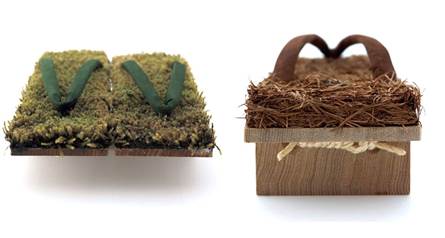
It should be noted that Western designers have been experimenting with the natural properties of materials for a long time, so the novelty of this project lies only in the fact that these experiments are transferred to the field of advertising communications. However, in our opinion, the real value of the project could be the development of the idea of the relevance of these communications. Let's give a similar example from the Japanese author – plasterer Shuhei Hasado “Geta”, presented at the exhibition “HAPTIC – Awakening the Senses” (lit. "Awakening of the Senses") in Tokyo (2004) (Fig. 2). This exhibition, planned and organized by Kenya Hara, was dedicated to "making designers think less about the appearance of their objects, such as color, shape and size, and more about how objects will be perceived". According to Shuhei Hasado, he presented an object in the form of traditional geta sandals at the exhibition because "he felt that shoes understood the earth better than anyone else" [15]. It is important for us that this art object not only awakens tactile sensitivity, but through tactile experience shows a person's connection with the world, that is, it contains conceptual depth.
In traditional Japanese art, the metaphor of correlative connections between phenomena is the subtle lines of force connecting hieroglyphs in calligraphy, depicted objects in painting, groups of stones in the art of dry gardens, etc. According to P. Levy's subtle remark, in the Japanese tradition, emptiness binds everything together: thanks to it, everything arises in the interdependent premise of "engi" (jap. bud. "interdependent origin"). [11] However, when we turn to the Western tradition, we do not need to articulate these connections at the level of object-spatial or graphic compositions. It is significant that the Japanese themselves in the 1950s were forced to draw a demarcation line between the void of "yehaku" in classical calligraphy and "modern", inspired by the Western avant-garde. If the traditional emptiness of "yehaku" is considered to be appreciated only by "the inner eye searching for the Buddha nature", then the avant-garde emptiness began to be understood as a color spot in P. Mondrian's compositions, providing an almost mathematical balance of black and white [16, p. 69]. As far as we can tell, the connections between the elements of avant-garde calligraphic compositions have become more abstract.
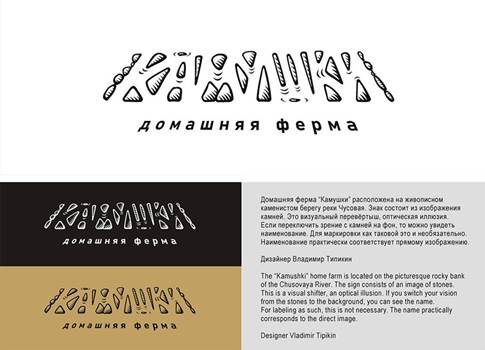
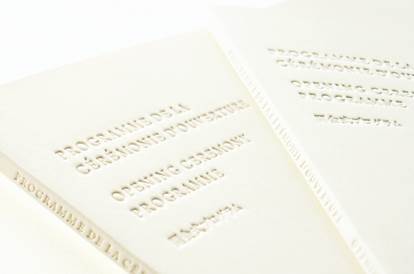
When the Russian graphic designer V. V. Tipikin transforms an empty background into a graphic form of a word in the logo for the Kamushki home farm, using an optical illusion, he gives a semantically boundless empty space a specific meaning (Fig. 3). In other words, he uses the opposite approach to the Japanese tradition, nevertheless However, it evokes no less an emotional response from the viewer – the feeling that the Word stands above everything (for comparison, we can cite the booklet for the Winter Olympic Games in Nagano by Kenya Hara, in which the snow-covered plain is perceived by the viewer almost as an initial Void (Fig. 4)).
Conclusion We see the potential of applying the kansei design concept in domestic design practice in creating hidden product meanings that are revealed to the consumer at some point, allowing him to suddenly realize and feel the consistency of material and spiritual in everyday life. According to Murat Chiaki, not everyone can feel the "poetic" depth of a thing, but if it has a low potential for a response in the soul and body of the consumer, then in principle it cannot affect anyone [3, p. 160]. In our opinion, without attention to the sensory perception of a thing, which allows a designer to work with meanings on a deeper level, it is impossible today to form a competitive image of domestic design in the international arena. On the other hand, the application of the kansei design project approach opens up an opportunity for the creative development of the designer himself, which means that it allows solving the problem of professional "burnout".
The article is published in its final version as approved following the last positive peer review recommending acceptance for publication. It incorporates revisions made by the author in response to prior negative peer review reports that did not recommend publication. All peer review reports, including initial negative reviews, are published in open access alongside the article. All versions of the author’s revisions are archived in the publisher’s repository and may be made available upon reasonable request in accordance with Elsevier’s editorial policies and applicable data availability requirements. References
1. Levy, P. (2013). Beyond Kansei Engineering: The emancipation of Kansei design. International Journal of Design, 7(2), 83-94.
2. Nagamachi, M., & Lokman, A. M. (2017). Kansei Innovation: Practical design applications for product and service development. CRC Press. 3. Murata, C. (2017). “Potential of Sensibility” Thinking. Japan Productivity Center. 4. Ootani, S. (2001). Kansei o migake! [Оттачивайте чувствительность!]. Sumi, 1-2(148), 54-55. 5. Levy, P. (2022). Complex thinking for Kansei studies: For an epistemological shift of the field. In KEER2022: 9th International Conference on Kansei Engineering and Emotional Research (pp. 163-170). Japan Society of Kansei Engineering. 6. Levy, P., Yamanaka, T., & Lee, S. (2007). On Kansei and Kansei design: A description of a Japanese design approach. In IASDR2007. Hong Kong Polytechnic University. 7. Gerasimova, M. P. (2021). Ёдзё-критерий художественности в японской эстетике. Вестник института востоковедения РАН, 2(16), 144-156. https://doi.org/10.31696/2618-7302-2021-2-144-156 8. Gerasimova, M. P. (2018). Самоценность эмоции в японском культурном пространстве. Ежегодник Япония, 47, 295-313. https://doi.org/10.24411/0235-8182-2018-10014 9. Grigorieva, T. (1979). Japanese Artistic Tradition. Science. 10. Gerasimova, M. P. (2016). Yanagi Muneyoshi's Theory of Crafts. Japan Yearbook, 45, 260-272. 11. Levy, P. (2020). Artefactual emptiness-on appropriation in Kansei design. In KEER2020: 8th International Conference on Kansei Engineering and Emotional Research. Japan Society of Kansei Engineering. 12. Hara, K. (2015). Ex-formation. Lars Müller Publishers. 13. Hara, K. (2018). Dezain-no dezain [Дизайндизайна]. Iwanami-shoten. 14. Pronnikov, V. (1985). Ikebana, or the Universe Captured in a Flower. Science. 15. How, C. (2015). Reconnecting with our senses. Poetic Design magazine. Retrieved March 8, 2025, from https://poeticdesignstudio.wordpress.com/2015/04/24/reconnecting-with-our-senses/ 16. Bogdanova-Kummer, E. (2020). Bokujinkai: Japanese Calligraphy and the Postwar Avant-garde. Brill.
First Peer Review
Peer reviewers' evaluations remain confidential and are not disclosed to the public. Only external reviews, authorized for publication by the article's author(s), are made public. Typically, these final reviews are conducted after the manuscript's revision. Adhering to our double-blind review policy, the reviewer's identity is kept confidential.
Second Peer Review
Peer reviewers' evaluations remain confidential and are not disclosed to the public. Only external reviews, authorized for publication by the article's author(s), are made public. Typically, these final reviews are conducted after the manuscript's revision. Adhering to our double-blind review policy, the reviewer's identity is kept confidential.
|
| We use cookies to make your experience of our websites better. By using and further navigating this website you accept this. | Accept and Close |

 © 1998 – 2026 Nota Bene. Publishing Technologies. NB-Media Ltd.