Man and Culture
Reference:
Shramova, M.S. (2026). Postcolonial discourse in the aesthetics of "New Brutalism". Man and Culture, 2, 167–183. https://doi.org/10.25136/2409-8744.2026.2.72970


|
Library
|
Your profile |
 This work is licensed under a Creative Commons Attribution-NonCommercial 4.0 International License.
|
Man and Culture
Reference:
Shramova, M.S. (2026). Postcolonial discourse in the aesthetics of "New Brutalism". Man and Culture, 2, 167–183. https://doi.org/10.25136/2409-8744.2026.2.72970
Postcolonial discourse in the aesthetics of "New Brutalism"
DOI: 10.25136/2409-8744.2026.2.72970EDN: YPPUYZReceived: 01/08/2025First review received: 04/23/2026 15:02 — manuscript returned for revisionRevised manuscript submitted: 04/23/2026 19:16Second review received: 04/26/2026 07:48 — manuscript returned for revisionRevised manuscript submitted: 04/23/2026 19:16Final review received: 04/29/2026 17:23 — recommendation for publication.The article is published in its final version as approved following the last positive peer review recommending acceptance for publication. It incorporates revisions made by the author in response to prior negative peer review reports that did not recommend publication. All peer review reports, including initial negative reviews, are published in open access alongside the article. All versions of the author’s revisions are archived in the publisher’s repository and may be made available upon reasonable request in accordance with Elsevier’s editorial policies and applicable data availability requirements. Read all reviews on this article Published: 04/30/2026Abstract: The article examines how postcolonial discourse shapes the aesthetic strategies of "New Brutalism" – an artistic and architectural movement that emerged in the UK in the 1950s within the "Independent Group." The focus of the research is the interaction between the visual practices of the "new brutalists" and the socio-political transformations of post-war Britain, including the transition to a "welfare state" policy and the beginning of the decolonization of the British Empire. Attention is drawn to the creative method As Found, as well as the concepts of Jean Dubuffet (art brut) and Le Corbusier (beton brut), which are regarded as sources for rethinking modernist oppositions such as "intellectual/brutal," "civilization/barbarism," and "center/periphery." Analyzing the "Pavilion and Patio" at the "This is Tomorrow" exhibition (1956) illustrates how the aesthetics of "New Brutalism" hybridizes technological progress, primitive art, and the everyday life of London's inner periphery, forming an early visual model of a postcolonial perspective. The methodology of the research consists of an interdisciplinary analysis that combines postcolonial theory with visual studies, an iconological approach to interpreting the "This is Tomorrow" exhibition and the "Pavilion and Patio," as well as comparing the As Found method with the concepts of art brut and beton brut. The scientific novelty of the work lies in the fact that the aesthetics of "New Brutalism" is systematically examined within the framework of postcolonial discourse for the first time, rather than merely in the context of pop art or modernist architecture. It is shown that the As Found method, based on photographs of Bethnal Green and the practice of "engaged observation," creates a unique space of inner periphery within the metropolis, where working-class neighborhoods and post-war ruins begin to function as a "tribal" landscape. Comparing As Found with Dubuffet's art brut and Le Corbusier's beton brut allows for the interpretation of the turn towards everyday life and marginal practices as an early visual articulation of postcolonial hybridity, blurring the oppositions of "civilization/barbarism," "center/periphery," and "technology/primitive." As a result, it is concluded that "New Brutalism" not only transforms modernist schemes of cultural appropriation but also anticipates postcolonial critique, asserting visual culture as a significant agent of decolonization in the metropolis. Keywords: New brutalism, art brut, Independent group, postcolonialism, decolonisation, Reyner Banham, Dubuffet, pop-art, as found, SpivakThis article is automatically translated.
Postcolonial theory emerged as a critical paradigm for analyzing the effects of colonial rule, focusing on issues of power, representation, and cultural identity. However, already in the classical works of E. Said, G. C. Spivak and H. Bhabhi is noticeably dependent on Western academic institutions and the conceptual apparatus that they declare the object of criticism: the "deconstruction" of orientalism is carried out in a language inherited from European theory (M. Foucault, A. Gramsci, French structuralism), while the figure of the "colonial Other" remains constructed within the framework of the university discourse of the metropolis [21; 22; 11]. In the fundamental work of E. Said "Orientalism" (1978) systematically deconstructs this discourse as a mechanism for creating a Eurocentric image of the East, where anthropology and ethnography serve as instruments of symbolic dominance, reinforcing the binary opposition "I am the Other" [21]. At the same time, Said himself, relying on the corpus of Western humanitarian thought and mainly literary sources, actually reproduces another form of hierarchy: the voice of the "East" is again represented on behalf of the intellectual, and not through diverse local practices and subjectivity, which draws the attention of A. Ahmad, emphasizing the elitism of his optics [8]. Said emphasizes that colonial power extends not only economically, but also through representation, where Orient is constructed as exotic, static, and subordinate, but its model of representation ultimately anchors the very framework of the Orient./The West" as epistemologically central, leaving in the shadow other axes of inequality (class, gender, internal urban differences within the metropolis) [24]. This problem becomes one of the objects of criticism by G. C. Spivak in the essay "Can the oppressed speak?" (1988), where she shows not only the impossibility of the "voice" of marginalized subjects within the framework of Western knowledge, but also the vulnerability of the postcolonial theorist himself, who arrogates to himself the right to speak on behalf of the "subaltern" [22]. Spivak introduces the concept of epistemological violence, demonstrating that even critical discourse inevitably filters out and normalizes someone else's experience, translating it into academically recognized forms of expression; thus, postcolonial theory risks turning into another humanitarian "metropolis", processing someone else's trauma into symbolic capital — this is pointed out, in particular, by B. Parry and other critics of academization postcolonialism [19]. In his essay "The Location of Culture" (1994), H. Bhabha introduces the concept of hybridity as a space of resistance, where the colonizer and the colonized merge in an ambivalent identity, blurring the pure boundaries of cultures [11], and this motif directly resonates with the practices of "New Brutalism", referring to slums, ruins and "grassroots" culture as a resource for authenticity. In this perspective, the aesthetics of "New Brutalism" appears not just as a modernist experiment, but as one of the early, albeit unarticulated spaces of postcolonial discourse. To identify postcolonial strategies in the work of the "new Brutalists", the work will go through a number of stages: identifying the socio-political context that shaped the emergence of the concept of "New Brutalism"; analyzing the sources of the formation of the aesthetic system of "New Brutalism"; defining aesthetic strategies and methods of "New Brutalism" and comparing them with postcolonial ones; the purpose of this study will be determining the influence of postcolonial discourse on the aesthetics of the "New Brutalism". The methodological basis of the research is a cultural-historical approach combined with an iconological analysis of the exhibition projects and photographic materials of the "Independent Group"; postcolonial criticism (E. Said, G. C. Spivak, H. Bhabha) and the concept of the "third space" of hybridity are used to interpret visual strategies. The socio-political context is reconstructed on the basis of the historiography of post-war Britain and the processes of decolonization. To analyze the visual method As Found, a hermeneutic approach is used, which makes it possible to read material objects and exhibition environments as cultural texts. The emergence of postcolonialism is directly related to the decolonization processes of the 1950s and 1960s, but its chronological framework has expanded in recent decades, including an analysis of early manifestations in the metropolises of the colonial powers [5; 12; 24]. In the context of Great Britain, this is especially noticeable: the Labour Party, which came to power in the 1945 elections, led by K. Attlee embarked on a "welfare state" that purported to erase existing hierarchies between classes – social reforms that would provide equal access to education and healthcare to all segments of society. The Labour Party had to solve not only the economic and social problems of post-war Britain, but also the aggravated problem of national liberation movements in the colonies. The decolonization of Great Britain, which took place under the flags of the "welfare state", contrary to the general decolonization rhetoric of the British government, was aimed at retaining influence through "protecting and promoting the interests of the inhabitants of the colonies" [6, pp. 153-154], which included the free entry of residents from the Commonwealth countries to the territory of the United Kingdom, large financial investments aimed at for the development of colonies, as well as conducting anthropological research. Thus, the new course of colonial policy laid the foundations for new approaches in British anthropology and sociology towards colonial societies, marking the beginning of the departure of their consideration as primitive peoples [6, pp. 153-154], that is, postcolonial studies that flourished in the 1980s and 1990s. However, decolonization in this form was not a rejection of imperial thinking, but its transformation: through controlled migration, investment, and anthropological research, the metropolis retained the right to describe, classify, and institutionalize "former" colonies as objects of care and management. These practices formed a new configuration of power, where the language of humanism and "development" concealed neocolonial dependencies, and scientific disciplines — from social anthropology to urban studies — secured the status of a laboratory of modernization experiments for "colonial" and working-class areas [3; 9].It is in this ambiguous situation of formal renunciation of empire while maintaining epistemological control that postcolonial readings of British art become possible, which make it possible to see in architectural and artistic gestures not only an aesthetic experiment, but also a reworking of the imperial heritage. That is why further analysis focuses on the specific visual and spatial strategies of the "Independent Group" - the sources, methods, and exhibition practices of the "New Brutalism" — in which the political context described above receives its own artistic expression. "New Brutalism": Polemics and politics
"New Brutalism" is a term proposed by the art and architectural critic R. Banem to describe the work of the "Independent Group" in 1966. The "Independent Group" was formed in 1952, during a series of informal meetings of artists and critics (L. Alloway, E. and P. Smithson, N. Henderson, E. Paolozzi, R. Hamilton, M. Cordell) at the Institute of Contemporary Art (ICA — Institute of Contemporary Arts) in London, established by G. Reed and R. Penrose for free discussion of new ideas and art forms outside the Royal Academy of Arts. In the research literature, the legacy of the "Independent Group" is traditionally described in terms proposed by L. Alloway, who fixed the concept of "pop art" for her work [18, p. 114], which contributed to the formation of the main paradigm of studying the legacy of the "Independent Group": in Russian and foreign historiography, the participants of the "Independent Group" are often called "fathers pop art" [1, pp. 285-286; 18; 2]. The present study is based on an earlier description of the creativity of R. Banham's group, formulated by him in 1955 in the program article "New Brutalism" [10, p. 356]. The difference between L. Alloway's and R. Banham's definitions is not limited to terminology: it reflects two different political frameworks for reading the group. If it was fundamental for L. Alloway to fit the "Independent Group" into the context of transatlantic pop culture and society, R. Banham, on the contrary, saw in their work a class challenge to bourgeois culture, which, in particular, is reflected in critical form in Soviet historiography through criticism of the "illusory challenge to pop culture" [4]. Nevertheless, this article suggests returning to the analysis of the class bias of R. Banham's positions in the perspective of the socio-political situation specific to Britain. The choice of this optics is relevant because modern historiography is making a noticeable turn: the group's "brutal" legacy is being rehabilitated [20, p. 241; 23], and its creative method is being reinterpreted As Found, which, on the one hand, is inscribed in art history through the inheritance of a surrealist strategy."found object" (especially in photographic practices), and on the other hand, it is directly related to a new milestone in the social and political development of Great Britain. R. Banham connects the practice of the "Independent Group" with the working class and with popular culture, reflected in British literature and cinema of the "new wave" [18, p. 115]. He expanded on this position in the article "The Atavism of the short-distance cyclist" (1964), the very title of which plays off the cult novel by A. Sillitou from the generation of "young angry" "The Loneliness of the Long-distance Runner" (1959). Maintaining interest in low-class culture was ensured by the social policy of the Labor Party, which proclaimed a course towards a "classless society." The social marker "classless" was spreading among the youth of this time, which was an analogue of "progressive views" – representatives of the middle class appropriated models of the working class, which became imaginary concentrates of "vitality" and "vitality" [15, p. 52]. It is characteristic that in the works of the 1950s, R. Banham does not directly name the "Independent Group", but writes about a small circle of young avant-garde architects and artists, whom he designates as "new brutalists." For R. Banham, the attempt to invent a new terminology is fundamental: in his works, he mentions that the "new brutalists", having become acquainted with modernism, tried to abandon it, and, consequently, to be "two steps ahead" of the elders [10, p. 356]. It is this ideological paradigm of the "new brutalism", dating back to the mid-1950s, that opens up the possibility for a postcolonial interpretation undertaken in this study. Sources of the "New Brutalism" R. Benham calls the works of the French artist about art brut J. as sources of "new brutalism". Dubuffet and the concept of the Franco-Swiss architect béton brut Le Corbusier. The members of the "Independent Group" E. Paolozzi and N. Henderson got acquainted with art brut during their visit to Paris in 1948, when they visited many famous European artists (K. Brancusi, F. Leger, A. Giacometti) and galleries, including the Art Brut Lobby, which made a strong impression on both. Zh. Dubuffet is looking for "authentic" art beyond the boundaries of "institutions" and "classes." In 1945, J. Dubuffet, together with A. Breton, created a collection of objects created by residents of psychiatric hospitals, prisoners, originals, singles and children. In this marginal work, he saw "an artistic operation, completely pure, unprocessed, reinvented by the author in all its phases, starting only with his own impulses" [11]. The concept of art brut, therefore, is based not only on aesthetic features, but also on its social characteristics. For "brutal art", as J. understood it. Dubuffet, the art of "primitives", "naive art" and "folk art" were also examples of "authentic artistic creation". In the essay "Brutal art is preferable to cultural art" (1949), J. Dubuffet works with the concepts of "intellectual" and "brutal" (using the dictionary of postcolonialism – "barbarism" and civilization" [21], and "barbaric" turns out to be for J. Dubuffet. Dubuffet is synonymous with authentic art).
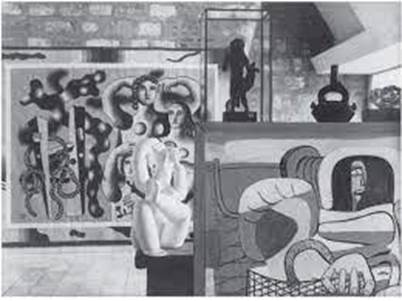
1. Exhibition "Primitive Art and Modern House", 1935. Photo by edition: Immeuble 24 N.C. et Appartement Le Corbusier. Apartment Block 24 N.C. and Le Corbusier's Home (accessed 04/11/2022). This corresponded to the interest in "primitive" art among architects such as Le Corbusier. An exhibition in Le Corbusier's Paris apartment in 1935 entitled "The so-called "primitive art" in a modern house" ("Les Arts Dits primitifs dans la maison d'aujourd'hui") featured works by contemporary artists such as J. Braque, F. Leger and P. Picasso along with ancient and historical artifacts. Such forms of "inclusion" of primitive Oceanian and African art in modernist art are associated with "cultural appropriation", appropriation of elements of someone else's culture and its exploitation [9]. At the same time, in the art of "primitives" modernism found the elements necessary for the re-organization of its own artistic language, the life impulse of art, as did Le Corbusier, whose concept of béton brut became an expression of this search for healing power for modernism. The concept of béton brut (lit. "untreated concrete") It was introduced by Le Corbusier during his work on the "Residential unit" in Marseille (Unité d'Habitation, 1947-1952), where the texture of wooden formwork, handprints of workers and the rejection of plaster turned the technological necessity of the post-war shortage into an ethical position –"honesty of the material." R. Banham, in his program article "The New Brutalism" (1955), builds his concept of "new brutalism" in direct dependence on the definition of architecture given by Le Corbusier: the article opens and ends with the same formula – "L'architecture, c'est, avec des matières brutes, établir des rapports émouvants" ("architecture is the creation of exciting connections from rough materials"), which Benham translates into the language of his own program.: "rough materials" become "materials" in a ready–made form"" (As found), "connections" become "a clear detection of structure", and "excitement", with which Le Corbusier describes the effect produced by architecture, R. Banem translates into the register of "memorable Image" [10, p. 358]. However, Le Corbusier is present in Banham not only as a theoretical basis, but also as a cultural signal: describing the formation of a circle around E. And P. Smithson in the early 1950s, R. Banham captures their common "tendency to look towards Le Corbusier and be aware of what is called brut brut." R. Banham connects béton brut Le Corbusier with l'art brut J. Dubuffet as two lines of the same Parisian intellectual context, to which the British group appeals. At the same time, Benham's attitude of brutalism to Le Corbusier is ambivalent: on the one hand, he recognizes the Marseilles Unit as the only work by Le Corbusier in which there is a key quality for brutalism.je-m'en-foutisme — rudeness, "disregard", refusal to polish. On the other hand, the author insists that "the new Brutalism, if it is architecture in the grandiose sense of Le Corbusier's definition, is at the same time the architecture of our time, and not his, and not Lyubetkin's, and not the time of the masters of the past" [10, p. 360]. Thus, béton brut becomes an aesthetic category within which the post-war modernist movement develops, providing fruitful ground for interpretation within the framework of the "high/low" dichotomy.
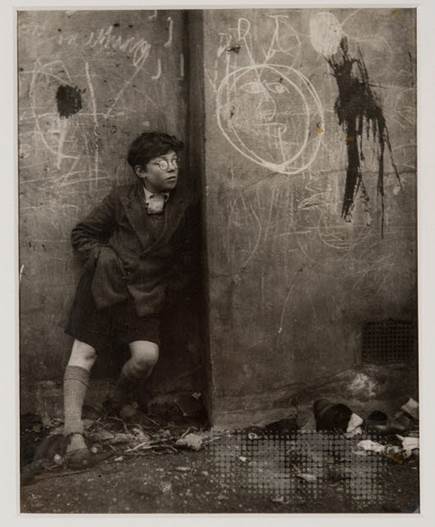
Fig. 2. Nigel Henderson. Peter Samuels. 1951. Tate Archive. A typical example of the search for the "vitality" of the low class, just as Le Corbusier described béton brut with the help of "rough" handprints of workers or the roughness of plaster, is walking in the framework of the practice of "New Brutalism" by N. Henderson and E. Paolozzi through Bethnal Green, a slum in the East end of London (East End), where is his wife, J. Henderson conducted included sociological studies of the working class. Henderson's photographs from this period capture "street life": children's games and the daily lives of Bethnal Green residents. In a similar way, back in the late 1930s, the sociological campaign Mass Observation conducted its research, studying the daily lives of modern Britons. Mass Observation researchers treated their task as a simultaneous sociological and surrealist practice (object trouve) [20, p. 240]. The practice of "inclusive observation" of Bethnal Green, subsequently, developed into a key concept for the "New Brutalism" - As Found. T. Schregenberger notes that As Found is associated with the discovery of everyday and the study of relationships with everyday objects [17, p. 8-10], and in this sense, the Smithsonian description of the concept of As Found brings it closer with field research and an ethnographic approach [3, pp. 36-56]. For H. Foster [14, p. 302-303], the "ethnographic approach" is associated with the "primitivist fantasy" of a European that primary social or mental processes are accessible to the "Other", which are closed to the European/bourgeoisie. This "primitivist fantasy," according to Foster, is rooted in surrealism with its interest in subversive practices, an anthropological approach where the "Other" is "subconscious," in brutal art where the "Other" is "anti–civilization," marginal art, abstract expressionism where the "Other" is a "primitive artist." which is assigned a visceral impulse. "A primitivist fantasy," concludes H. Foster, it has to do with the postcolonial situation, where the relationship between the center and the periphery is erased. Consequently, the "New Brutalism" may be a version of the "primitivist fantasy" about the "noble savage", which has earned strong criticism from researchers of postcolonialism. The method of the "New Brutalists" shifts the focus to the inner "peripheries" of the metropolis – the working-class neighborhoods of the East End, post-war ruins, abandoned industrial areas, which are viewed almost ethnographically, as if they were remote "tribal" landscapes. This inner exotisation of urban space demonstrates how the postcolonial logic of the redistribution of center and periphery begins to work within British everyday life itself: what was previously labeled as the external "primitive" world is now found in the heart of an industrial metropolis, and the artist and architect occupy the position of an observer-researcher, whose optics are shaped simultaneously by avant-garde aesthetics and colonial regimes of visibility..
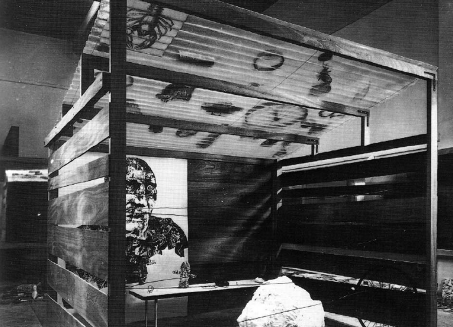
Fig. 3. Photo of the installation of Group 6 (Eduardo Paolozzi, Alison and Peter Smithson, Nigel Henderson) demonstrates "Patio and Pavilion" at the "This is Tomorrow" exhibition at the Art Gallery Whitechapel, London, 1956 Tate Archive. Just as Dubuffet eliminated the hierarchies between the "intellectual" and the "brutal," the "new brutalists" deconstructed the oppositions between technology and primitives. At the exhibition "This is Tomorrow", which was held at the Whitechapel Gallery in 1956, Group 6, which included E. and P. Smithson, E. Paolozzi and N. Henderson, staged their famous "Pavilion and Patio" (1956) (Fig. 3), offering a different view of technological progress. The Pavilion and Patio was inspired by trips to Sheffield, where the Smithsons got to know the architecture of the British countryside. The pavilion is free of walls, resembling a wooden "barn", it is nevertheless solved in high-tech materials (aluminum, corrugated plastic). The catalog describes "Pavilion and patio" as "necessary elements of a human home... the first thing you need is a piece of the world, a patio. The second is an enclosed space, a pavilion" [Cit. according to: 16, p. 87]. These two spaces were provided with "symbols for human life": 1. The head of the person himself – his mind and his environment; 2. The image of a tree – as a symbol of nature; 3. Stones and natural objects for stability and decoration; 4. A light box – as a symbol of home and family; 5. Artifacts and pin-ups – as a symbol of his irrational motives; 6. Frog and dog – as a symbol of animals; 7. Wheel and airplane – as a symbol of movement. In addition, Paolozzi placed a number of his brutal sculptures on the floor – a large amorphous white object received a place of honor in the center of the pavilion. At the edges, he laid out a series of bas-reliefs resembling archaeological remains. On the table located in the center of the pavilion was one of his small sculptures of a man, as well as a real pistol and a dial. N. Henderson hung a large photo collage "Human Heads" (1956, Tate Modern) on the back wall of the pavilion, consisting of pieces of various textures, and a photo collage "The Cycle of life and death in a pond" (1956, Tate Modern) resembling archaeological fragments of the Paleolithic underwater world [16, p. 87]. "The pavilion and Patio" as a postcolonial space In the Pavilion and Patio, high technology is organically combined with primitive, archaeological sites, the "brutal" with the "intellectual", barbarism with civilization. Art historian D. Mellor explained this phenomenon in his essay "Magnificent Technique in Britain in the 1950s" by the fact that the "Independent group" shared a "fragile way of thinking": on the one hand, there is a festive fascination with American pop culture and industry, and on the other, fantasies of ruin, horror, enormity and apocalypse, expressed in the bloody cyborgs of the artist M. Cordell or sculptures by E. Paolozzi [Cit. according to: 20, p. 241]. R. Koolhaas and O. Enveizor see the postcolonial metropolis in a similar way, where technological progress is combined with primitiveness and waste [9, p. 983], organizing a common hybridized space called junkspace. In the conditions of postcolonialism, primitivism is no longer hidden in exotic cultures, it exists equally in the "urban jungle". The postcolonial hybridization of culture may be associated with a rethinking of the category of time, moving away from the concept of "linearity" in favor of "multidimensionality", which is characteristically expressed in postcolonial literature [5]. "Multidimensionality", the simultaneous presence of different eras actualizes the categories of cultural memory, avoiding expansionist thinking. Conclusion Thus, the analysis allows us to conclude that the aesthetic principles of the "Independent Group" demonstrate a connection with postcolonial concepts: the principle of As Found rejects the hierarchy of "high" and "low", rejects the idea of artistic form as a result of purification of the material and accepts the texture of the ordinary in an uneducated form. In the postcolonial perspective, As Found turns out to be not just an aesthetic gesture, but an epistemological position: a rejection of "civilized" processing, recognition of the aesthetic self-sufficiency of what Imperial optics classified as "unprocessed", "primitive" or "marginal". The "image" in R. Banham's definition erases the boundaries between "high" and "low" and acquires the meaning of a memorable visual integrity over a classical composition. Aesthetic value ceases to be a function of normative beauty and becomes a function of the affective power of the image. "Images" equalize the rights of artifacts that previously belonged to different hierarchical registers — they all become visual events, going beyond the Eurocentric hierarchy of high art. The exhibitions of the Independent Group transform the exhibition environment from a neutral container into an active hybrid structure, where technological and "primitive", industrial and organic, European and non-European coexist on equal terms. While traditionally postcolonial theory (E. Said, G.C. Spivak, H. Bhabha) focused on textual representations and epistemological violence, leaving the visual and spatial practices of the metropolis on the periphery of analysis, and the aesthetics of "New Brutalism" was considered primarily as a pop art or modernist experiment without connection with decolonization, as a result of the analysis of socio-political in the context of the "welfare state" and decolonization, the sources of the "New Brutalism", as well as comparing strategies As Found with postcolonial concepts of hybridity, this incompleteness is eliminated: the binary oppositions "civilization/barbarism", "center/periphery", "technology/primitive" are deconstructed at the material level of the "Pavilion and patio", where the technological The pavilion and the ethnographic patio coexist in an ambivalent space, anticipating the "third space" of H. Bhabha. What was described as abstract hybridity in the postcolonial theory of the 1980s and 1990s was visualized in the aesthetics of "New Brutalism" in the 1950s, where the inner periphery of London (Bethnal Green) became a laboratory for the conversion of imperial hierarchies into postcolonial ones. Thus, the "New Brutalism" not only reflects, but anticipates postcolonial criticism, turning modernist appropriation into a hybrid gesture that erases the Eurocentric framework and presents visual culture as a full-fledged agent of the decolonization of the metropolis. Just as the "welfare state" erased old social structures and carried out decolonization through the inclusion of colonial cultures in its orbit, the "new brutalists" carried out the operation of transforming the established modernist schemes of cultural appropriation of colonial discourse into a postcolonial one. The identification of elements of postcolonial optics in the aesthetics of the "New Brutalism" makes it possible to expand the context of interpretation of the work of the "Independent Group": having made a radical revolution in visual culture and received the status of "fathers of pop art", the "new Brutalists" simultaneously translated into the language of architecture and visual art those epistemological shifts that had already been worked out in literature and philosophy. Dubuffet and Le Corbusier were surrealists in the 1930s and 1940s, and were systematized in academic postcolonial discourse only in the 1980s and 1990s (E. Said, G. C. Spivak, H. Bhabha). Postcolonialism acquires its own visual and spatial dimension in the aesthetics of the "Independent Group": it is here, at the level of material objects and exhibition environments, that the "third" hybrid register is first visualized in British art of the 1950s, which academic postcolonial theory captures only three decades later.
The article is published in its final version as approved following the last positive peer review recommending acceptance for publication. It incorporates revisions made by the author in response to prior negative peer review reports that did not recommend publication. All peer review reports, including initial negative reviews, are published in open access alongside the article. All versions of the author’s revisions are archived in the publisher’s repository and may be made available upon reasonable request in accordance with Elsevier’s editorial policies and applicable data availability requirements. References
1. Andreeva, E. Yu. (2011). Everything and nothing: Symbolic figures in the art of the second half of the 20th century (2nd ed.). Ivan Limbakh Publishing House.
2. Andreeva, E. Yu. (2007). Postmodernism: Art of the second half of the 20th-early 21st century. Azbuka-Classics. 3. Baranov, D. A. (2018). On the ethnographic dimension of materiality. Petersburg Slavic and Balkan Studies, 2(24), 36-56. https://doi.org/10.21638/spbu19.2018.203 4. Kukarkin, A. V. (1985). Bourgeois mass culture: Theories, ideas, varieties, samples (2nd ed., rev.). Politizdat. 5. Ponomarev, E. (2020). Postcolonial theory and travel literature. New Literary Review, 160. https://www.nlobooks.ru/magazines/novoe_literaturnoe_obozrenie/161_nlo_1_2020/article/21988/ (accessed March 12, 2022). 6. Khakhalkina, E. V. (2016). Great Britain, decolonization processes in Asia, and the Colombo Plan (1945–1951). Bulletin of Tomsk State University, 409, 152-156. https://doi.org/10.17223/15617793/409/25 7. Shramova, M. S. (2021). "Parallels of life and art": The influence of photography on the aesthetics of "New Brutalism." Art Innovation, 1, 41-57. 8. Amselle, J.-L., Mellott, N., & Van Dam, J. (2003). Primitivism and postcolonialism in the arts. MLN, 118(4), 983-988. 9. Banham, R. (1955). New Brutalists. Architectural Review, December, 356-360. 10. Dubuffet, J. (n.d.). L'Art Brut préféré aux arts culturels. https://www.artbrut.ch/fr_CH/art-brut/qu-est-ce-que-l-art-brut (accessed March 9, 2020). 11. Foster, H. (1996). Return of the real: The avant-guard at the end of the century. MIT Press. 12. Goldie, C. T. (2005). Modernisation and the New Left in sixties Britain: Thesis submitted in partial fulfilment of the requirements for the degree of Doctor of Philosophy. Sheffield Hallam University. 13. Kitnick, A. (2010). Eduardo Paolozzi and others, 1947–1958: A dissertation in candidacy for the degree of Doctor of Philosophy (Art and Archeology). Princeton University. 14. Lichtenstein, C., & Schregenberger, T. (2015). As found: The discovery of the ordinary. British Architecture and Art of the 1950s. 15. Massey, A. (1995). The Independent Group: Modernism and mass culture in Britain, 1945-59. Manchester University Press. 16. Robbins, D. (1990). Independent Group: Forerunners of postmodernism? In D. Robbins (Ed.), Independent Group and aesthetic of the plenty (pp. 1-249). 17. Walsh, V. (2001). Nigel Henderson: Parallel of life and art. 18. Ahmad, A. (1992). In theory: Classes, nations, literatures. Verso. 19. Bhabha, H. K. (1994). The location of culture. Routledge. 20. Dirlik, A. (1994). The postcolonial aura: Third World criticism in the age of global capitalism. Critical Inquiry, 20(2), 328-356. 21. Parry, B. (1987). Problems in current theories of colonial discourse. Oxford Literary Review, 9(1), 27-58. 22. Said, E. W. (1978). Orientalism. Pantheon Books. 23. Spivak, G. C. (1988). Can the subaltern speak? In C. Nelson & L. Grossberg (Eds.), Marxism and the interpretation of culture (pp. 271-313). University of Illinois Press. 24. Young, R. J. C. (2001). Postcolonialism: An historical introduction. Blackwell.
First Peer Review
Peer reviewers' evaluations remain confidential and are not disclosed to the public. Only external reviews, authorized for publication by the article's author(s), are made public. Typically, these final reviews are conducted after the manuscript's revision. Adhering to our double-blind review policy, the reviewer's identity is kept confidential.
Second Peer Review
Peer reviewers' evaluations remain confidential and are not disclosed to the public. Only external reviews, authorized for publication by the article's author(s), are made public. Typically, these final reviews are conducted after the manuscript's revision. Adhering to our double-blind review policy, the reviewer's identity is kept confidential.
Third Peer Review
Peer reviewers' evaluations remain confidential and are not disclosed to the public. Only external reviews, authorized for publication by the article's author(s), are made public. Typically, these final reviews are conducted after the manuscript's revision. Adhering to our double-blind review policy, the reviewer's identity is kept confidential.
|
| We use cookies to make your experience of our websites better. By using and further navigating this website you accept this. | Accept and Close |

 © 1998 – 2026 Nota Bene. Publishing Technologies. NB-Media Ltd.